CPT Code 25210: Excision of a single carpal bone
CPT Code 25210: Official descriptor and quick-reference data CPT Code 25210 is a...

Last Updated: Nov 26, 2026
V2512 is the HCPCS Level II code for contact lens, gas permeable, bifocal, per lens.
It covers one rigid gas permeable lens with separate distance and near zones, billed per lens with an RT or LT modifier. A GP lens that corrects astigmatism with no near zone is V2511, the toric code. A translating bifocal stays V2512 when prism ballast holds its near segment in place, and a soft bifocal is V2522.
Let Pabau's smart automation suggest the right codes, reduce claim denials, and keep your practice compliant—effortlessly.
Automate repetitive tasks and focus on what matters most—your patients.
Reduce coding errors and ensure compliance with the latest regulations.
Clean claims, fewer denials, and faster reimbursements.
Powerful insights and reporting to help your practice thrive.
HIPAA compliant SOC 2 certified GDPR-compliant Trusted by 4,000+ clinics worldwide

V2512 bills one gas permeable (rigid) contact lens with a bifocal design, so each eye goes on its own claim line.
Design picks the code: a GP toric or prism-ballast lens is V2511, a spherical GP lens is V2510, and a soft bifocal is V2522.
A translating GP bifocal still bills as V2512 when prism ballast or truncation keeps its near segment in place.
Medicare never covers a bifocal contact lens for presbyopia alone, and its aphakia rules don’t name bifocal contact lenses, so confirm coverage first.
Append RT or LT to every V2512 line, and bill the fitting separately under its CPT fitting code.
HCPCS Code V2512 is the supply code for one rigid gas permeable (GP) bifocal contact lens, billed per lens. It sits in the V2500-V2599 contact lens series of the HCPCS Level II code set. The CMS quarterly HCPCS update lists its official descriptor as Contact lens, gas permeable, bifocal, per lens. The Refractive Lenses policy article (A52499) sets the coverage and modifier rules for Medicare contact lens claims.
Two parts of that descriptor decide the code. “Gas permeable” means a rigid lens material. “Bifocal” means the lens carries two powers, one zone for distance vision and one for near vision.
The descriptor names no diagnosis. Presbyopia and aphakia decide whether a payer covers the lens, but neither one moves the claim to a different lens code.
Medicare treats contact lenses after cataract surgery as prosthetic devices, so they bill through the DMEPOS system. A practice that dispenses V2512 to Medicare patients needs a valid DMEPOS supplier enrollment.
A gas permeable bifocal contact lens is a rigid lens with one optical zone for distance and a second zone for near work. It replaces the reading glasses that a patient without full focusing ability would otherwise need. GP bifocals come in two broad designs.
Prism ballast in a translating bifocal is there to keep the near segment low. It does not correct astigmatism, so it never turns a bifocal lens into a toric one.
V2512 covers the lens itself when two conditions hold. The lens is made of a rigid gas permeable (GP or RGP) material, and its design is bifocal.
Included under V2512:
Not covered by V2512:
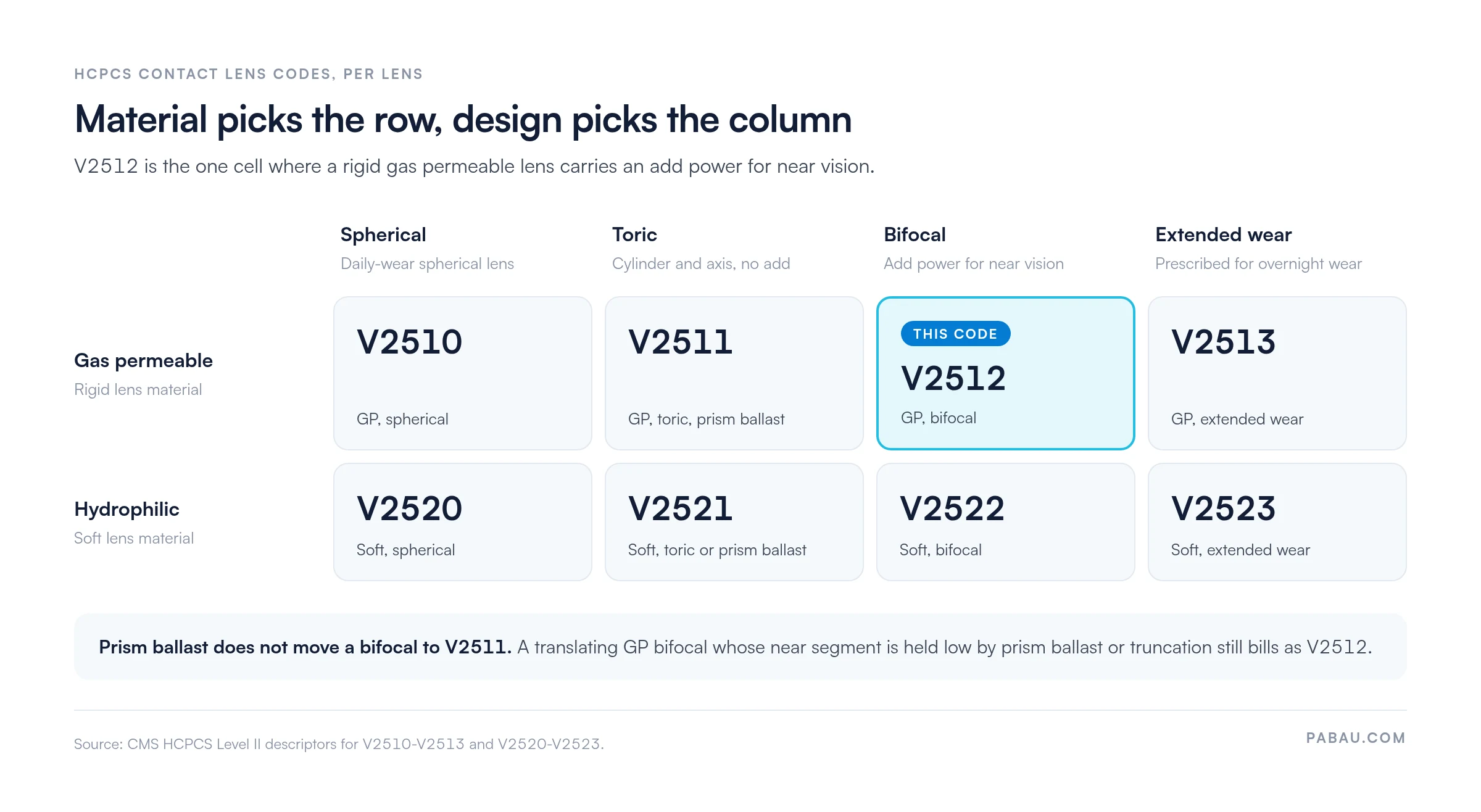
The prescription drives the choice, and the grid below maps each design to its code for both lens materials. An add power for near vision on a GP prescription points to V2512. A GP prescription with a cylinder power and axis but no add points to V2511, the toric code.
HCPCS has no separate code for a GP multifocal lens. Most payers accept V2512 for a simultaneous-vision GP multifocal, but some route unlisted designs to V2599 (contact lens, other type). Check the payer’s policy before the first claim.
The V2510-V2513 group covers gas permeable lenses, and V2520-V2523 covers hydrophilic (soft) lenses. Each group splits by design in the same order: spherical, toric, bifocal, then extended wear. V2512 and V2522 are the two bifocal codes, separated only by material.
Two slips cause most wrong-code denials here. A GP toric lens billed as V2512 fails the design test, because it has no near zone. A soft bifocal billed as V2512 fails the material test and belongs under V2522.
The reverse mistake happens too. A translating GP bifocal held in place by prism ballast is still V2512, not V2511. The near segment is what the descriptor describes, and the ballast only stabilizes it.
V2512 is medically necessary when the patient needs both distance and near correction from a rigid lens, and the payer covers the condition behind it. Most GP bifocals are fitted for presbyopia, which payers treat as routine vision care.
The chart should state why the patient needs a rigid bifocal rather than spectacles, readers or a soft lens. A reviewer reads that note to decide whether V2512 is medically necessary or an elective upgrade.
Every V2512 line needs a linked ICD-10-CM diagnosis code that supports medical necessity. The code tells the payer which benefit the claim falls under, so it matters as much as the lens code.
Laterality has to line up across the diagnosis code, the V2512 line and the modifier. A right-eye lens for an aphakic patient needs H27.01, the RT modifier and one unit of V2512 on that line.
Before submitting, read the prescription for two values: the add power and the cylinder. An add with no cylinder supports V2512. A cylinder with no add supports V2511. If the chart shows both, confirm with the fitter which design was dispensed, because the lens code follows the dispensed design.
Medicare Part B does not cover contact lenses for routine vision correction, and presbyopia counts as routine. It covers contact lenses only as prosthetic devices for aphakia, and once after each cataract surgery with an IOL.
Because the LCD does not name a bifocal contact lens, confirm coverage with your DME MAC before you dispense V2512 to an aphakic Medicare patient. If coverage is in doubt, issue an Advance Beneficiary Notice (ABN) before dispensing.
Medicare Advantage plans set their own rules, and many add a routine vision benefit that Original Medicare lacks. That benefit may cover a GP bifocal for presbyopia, usually with an allowance cap.
Traditional Medicare does not generally require prior authorization for contact lens supplies. Medicare Advantage, Medicaid and commercial plans set their own rules, so check each plan before the lens is ordered.
When a plan requires prior authorization (PA), it usually asks for the diagnosis and the GP bifocal prescription with its add power. For aphakia, some plans also want the operative report.
The Medicare Refractive Lenses policy requires the RT or LT modifier on every contact lens code, and most other payers follow the same rule. A claim line without one is rejected as incorrect coding.
For a pair, bill two lines: V2512-RT with 1 unit, then V2512-LT with 1 unit. Medicare rejects a single line billed with RTLT and 2 units. For a clean claim submission, check both lines before the claim leaves the practice.
Complete records support medical necessity and hold up in a post-payment audit. The chart should contain these items before the claim is submitted.
V2512 billing comes down to clean line items on the CMS-1500 or 837P. Follow these steps for each dispensing encounter.
Aphakia shapes the fitting code, even though it never shapes the lens code. A non-aphakic patient fitted with V2512 lenses takes CPT code 92310, or 92314 when an independent technician directs the fitting. An aphakic patient takes 92311 or 92312, or 92315 or 92316 with a technician.
Most V2512 denials can be prevented. The table maps frequent denial scenarios to a typical claim adjustment reason code (CARC) and the fix for each. Effective denial management in healthcare starts with spotting these before the claim leaves the practice.
When a denial posts on the electronic remittance advice, match the code to the table before you correct the claim. Tracking denials by reason code also shows which V2512 errors keep coming back.
Medicare sets allowed amounts for V2512 through the DMEPOS fee schedule. The schedule is state-specific and updated every year, so the rate depends on where the patient lives.
Quote the patient’s share before the GP bifocal is ordered. Presbyopia claims usually fall under a capped vision allowance, so the patient often pays part of the lens cost. A written estimate at the fitting visit prevents billing disputes after dispensing.
Most V2512 errors start before the claim is built. The add power sits in the prescription, the diagnosis sits in the exam note, and the ABN sits in a paper file. Billing staff then rebuild the claim by hand and pick V2511 for a prism-ballasted bifocal, or drop a modifier.
Pabau, a practice management platform with built-in claims management software, routes US claims through Claim.MD. It tracks the authorization code, dates and sessions on the case, with a warning when one is missing.

The prescription, surgical history, ABN and delivery receipt stay in one patient record. Staff stop hunting for documents before each claim, and the file is ready when an auditor asks for it.

Pabau tracks the authorization code on each case and keeps the prescription, ABN and delivery receipt in one patient record. V2512 claims go out with their paperwork in place.

Two facts on the prescription decide V2512: a gas permeable material and a bifocal design with an add power. Read both before the claim is built, and the choice between V2512, V2511 and V2522 is already made. Prism ballast on a translating bifocal does not change that answer.
The harder question is who pays. Presbyopia belongs to the vision plan, and Medicare coverage for aphakia is worth confirming before the lens is ordered. Book a demo to see how Pabau keeps the prescription, authorization and ABN in one patient record, so each V2512 line matches the chart.

Billing a toric GP lens instead? HCPCS Code V2511 covers the gas permeable toric, prism-ballast lens that sits one row above V2512.
New to Medicare claims for vision supplies? Medicare billing walks through enrollment, claim forms and the coverage rules that decide whether a lens is paid.
Seeing claim rejections you can’t diagnose? Denial codes in medical billing breaks down the common CARC and RARC codes and what each one means for your next step.
HCPCS code V2512 covers one gas permeable (rigid) contact lens with a bifocal design. The lens has one zone for distance and one for near vision. Each unit is one lens, so each eye goes on its own claim line with an RT or LT modifier.
Both are gas permeable lenses, and the design is the difference. V2512 is a bifocal lens with distance and near zones. V2511 is a toric, prism-ballast lens that corrects astigmatism. A translating bifocal held in place by prism ballast is still V2512.
Usually, yes. HCPCS has no separate code for a gas permeable multifocal lens, and most payers accept V2512 for it. Some payers route unlisted designs to V2599, so check the payer’s policy before the first claim.
Not for presbyopia, which Medicare treats as routine vision care. Medicare covers contact lenses for aphakia and once after each cataract surgery with an IOL. Its aphakia rules name a distance contact lens with near spectacles, so confirm V2512 coverage with the DME MAC first.
H52.4 (presbyopia) is the most common, and it falls under routine vision benefits. For medical claims, use H27.01, H27.02 or H27.03 for aphakia, Q12.3 for congenital aphakia and Z96.1 for pseudophakia. The diagnosis laterality must match the RT or LT modifier on each line.
V2512 is billed per lens. Bill V2512-RT with 1 unit for the right eye and V2512-LT with 1 unit for the left eye. Medicare rejects a single line billed with RTLT and 2 units.
Traditional Medicare does not generally require prior authorization for V2512. Many Medicare Advantage and commercial plans do. Check the plan’s rules before the lens is ordered, and enter the PA number on the claim.