CPT Code 25210: Excision of a single carpal bone
CPT Code 25210: Official descriptor and quick-reference data CPT Code 25210 is a...

Last Updated: Nov 26, 2026
V2627 is the HCPCS Level II code for a scleral cover shell. The shell is a custom acrylic device worn over a shrunken or disfigured eye that stays in the orbit.
Most V2627 billing errors come from two sources. One is pairing it with a diagnosis for an absent eye. The other is confusing it with neighboring V-codes for prosthetic eyes and their maintenance.
Let Pabau's smart automation suggest the right codes, reduce claim denials, and keep your practice compliant—effortlessly.
Automate repetitive tasks and focus on what matters most—your patients.
Reduce coding errors and ensure compliance with the latest regulations.
Clean claims, fewer denials, and faster reimbursements.
Powerful insights and reporting to help your practice thrive.
HIPAA compliant SOC 2 certified GDPR-compliant Trusted by 4,000+ clinics worldwide

HCPCS code V2627 describes a scleral cover shell, a custom shell worn over a disfigured or shrunken eye that is still in the orbit.
Medicare covers V2627 when the patient has absence or shrinkage of an eye, under LCD L33737 and Policy Article A52462.
Most denials trace to a mismatched ICD-10 code, a missing written order, or a replacement or modification billed without supporting documentation.
Pabau’s claims management software tracks DME claim status and surfaces denial reasons, so billing teams can correct and resubmit faster.
HCPCS code V2627 is the Level II code for a scleral cover shell, maintained by the Centers for Medicare & Medicaid Services (CMS). The official descriptor reads Scleral cover shell. CMS’s Eye Prostheses policy article (A52462) names V2627 as the code for scleral cover shells and folds trial shells into its allowance.
A scleral cover shell differs from a full ocular prosthesis. It does not replace a surgically removed eye. It is a custom acrylic shell placed over a phthisical (shrunken), disfigured, or non-functional eye that remains in the orbit. Billing the wrong code in the V2623-V2629 range is a common audit trigger for DME contractors.
To check a neighboring device, browse the full HCPCS Level II library. V2627 sits there among the V-codes for vision and hearing services.
V2627 covers a thin, custom-fabricated acrylic shell that fits over an existing, non-functioning eye. Ocularists typically fit and supply the device.
Clinical indications for V2627 include conditions where the globe is intact but aesthetically compromised. The device restores a cosmetically acceptable appearance without surgical enucleation.
V2627 does not cover a custom prosthetic eye for an empty socket, which is billed as V2623. A PROSE (Prosthetic Replacement of the Ocular Surface Ecosystem) device takes V2627 only for two specific indications, covered later in this article.
The V2623-V2629 range covers ocular prosthetics and the services that maintain them. Selecting the wrong code from this family is a common root cause of a V2627 denial. The panel below sorts the family by the first question a coder should ask: is the eye still in the orbit?
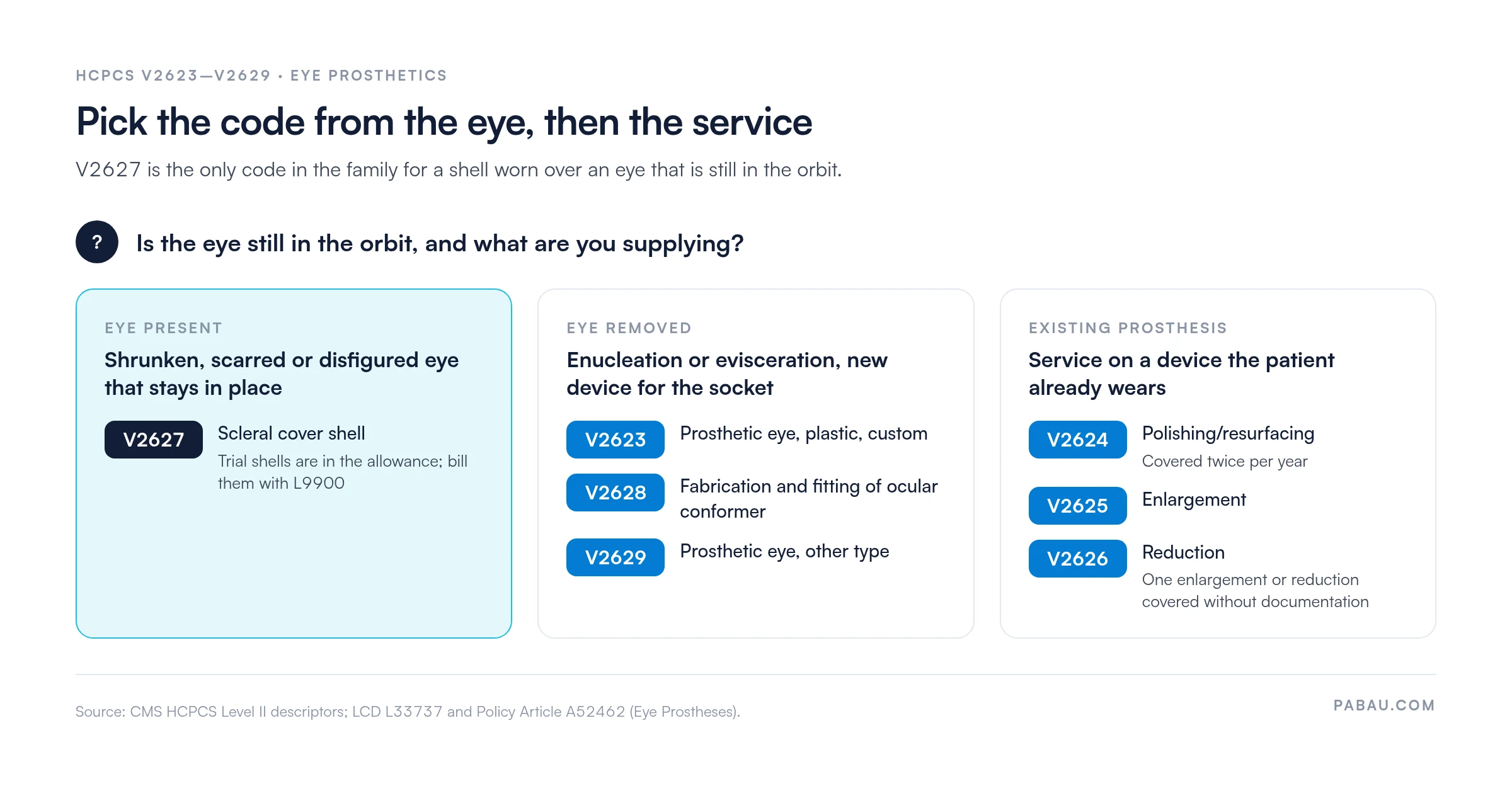
Use this table to confirm each descriptor before submitting.
Medicare Part B covers scleral cover shells under the prosthetic eye benefit. The claims go to the Durable Medical Equipment Medicare Administrative Contractors (DME MACs). Two DME MACs cover Jurisdictions A-D: CGS Administrators (B and C) and Noridian Healthcare Solutions (A and D). Coverage is set by LCD L33737 (Eye Prostheses) and its companion Policy Article A52462.
LCD L33737 and its policy article require the following for a V2627 claim:
Separately, the claim must come from a supplier enrolled with Medicare to bill DMEPOS items. That is a general supplier-enrollment rule, not one of the LCD’s coverage criteria.
Modifications and repairs within 90 days of delivery are included in the original V2627 allowance. After 90 days, a modification is separately payable only when a change in the patient’s condition requires it. Replacement for loss or irreparable damage is documented per the policy, and those records must be available on request. Keeping medical billing compliance records for each replacement makes that review straightforward.
The LCD also sets limits on the neighboring services. Polishing and resurfacing (V2624) is covered twice per year, and one enlargement (V2625) or reduction (V2626) is covered without documentation.
Always verify DME MAC jurisdiction before submitting a V2627 claim. Noridian covers Jurisdictions A and D, and CGS covers Jurisdictions B and C. Submitting to the wrong MAC gets the claim rejected.
CMS publishes no supporting ICD-10-CM code list for V2627. Both LCD L33737 and Policy Article A52462 list no ICD-10 codes at all. The pairings below are illustrative codes commonly used to document the condition. Confirm them with your DME MAC.
Z90.01 (acquired absence of eye) is frequently misused on V2627 claims. It applies when the globe has been surgically removed and a custom plastic prosthetic eye (V2623) is fitted. For a scleral cover shell, the globe must still be present but disfigured. An acquired absence code on a V2627 claim signals a device-diagnosis mismatch and will typically lead to a denial.
Post-payment audits of V2627 claims turn on documentation. The treating practitioner’s records must support the medical necessity of the shell, and supplier records must be available on request. Submitting a clean claim starts with these records in the patient file before billing.
Trial scleral shells are included in the V2627 allowance and are not separately payable. A52462 directs suppliers to report them with L9900 rather than as a second V2627.
Ocularist notes must be detailed enough to establish that the device is custom-fabricated, not stock. Generic fitting records that skip measurements or custom fabrication steps are insufficient and will not survive a DME MAC audit.
V2627 is reimbursed under the Medicare DMEPOS fee schedule, not the Medicare Physician Fee Schedule. Rates vary by state and are updated annually. Always verify the current allowable amount in the CMS DMEPOS fee schedule before quoting reimbursement figures to patients or referring providers.
Key reimbursement mechanics to understand:
Before publishing an internal fee schedule, check the 2026 allowable with the DMEPOS file, the CMS HCPCS coding and billing page, or your DME MAC.
Medicare does not currently require prior authorization for V2627 as a standard condition of coverage, though CMS program integrity initiatives can change that. Prior authorization (PA) requirements vary widely across commercial payers and Medicare Advantage plans.
When PA is required, the request should reference the diagnosis code, the treating physician’s order, and the ocularist’s clinical rationale. A PA that does not name the exact device type (scleral cover shell, not generic ocular prosthesis) may be granted for the wrong code. That claim then fails at adjudication.
Understanding denial management workflows for DME claims is essential for ocularist practices and billing teams. The table below maps the most frequent V2627 denial reasons to their root cause and correction action.
A PROSE device is billed as V2627 only for two indications named in Policy Article A52462. PROSE devices rest on the sclera and treat ocular surface disease, including some types of dry eye. The policy codes them as V2627 when the device treats one of these:
For any other condition, the device must be coded V2531 and is subject to Medicare’s refractive lens statutory coverage exclusion. Billing V2627 for a PROSE device outside those two indications risks a denial and an overpayment demand. Don’t confuse either code with HCPCS S0515, the S-code for a scleral lens used as a liquid bandage device, which Medicare doesn’t pay.
The clinical differences explain why the code turns on the indication:
Unsure whether a scleral device qualifies as V2627? Ask the Pricing, Data Analysis and Coding (PDAC) contractor, Palmetto GBA, for coding guidance before billing. Keep its response in the patient file.
A V2627 claim depends on paperwork from three places: the treating practitioner, the ocularist, and the billing team. The written order often sits in one system, the fitting notes in another, and the signed delivery form on paper.
Pabau, a practice management platform with built-in medical claims management software, keeps the order, fitting notes, and signed delivery form on one patient record. Its claims dashboard then tracks each claim through to payment.

For practices billing several DME codes, Pabau’s medical billing workflows collect the same documents every time. Errors then surface before adjudication rather than after.

Pabau’s claims management tools help ocularists and DME suppliers track claim status, flag denials with reason codes, and resubmit corrected claims without switching systems. See how it works for your practice.

The safest V2627 claim starts with one question: is the eye still in the orbit? If a shell is going over a disfigured or shrunken globe, V2627 fits. If the socket is empty, the claim belongs to V2623, and Z90.01 belongs with it.
After that, the claim stands or falls on its records. Keep the written order, the fitting notes, and the signed proof of delivery together before the claim goes out. Code PROSE devices by indication rather than by shape. Book a demo to see how Pabau keeps that paperwork on one record for your ocular prosthetics claims.

Need a broader overview of how DME billing works? Medical billing fundamentals explains the end-to-end claims process from charge capture through payment posting.
Dealing with repeated denials across your DME claims? Denial codes in medical billing breaks down the most common CARC and RARC codes and what each one requires for a successful appeal.
Billing a prosthetic eye for an empty socket? HCPCS code V2623 covers the custom plastic prosthetic eye and the diagnosis that supports it.
Fitting a conformer after surgery? HCPCS code V2628 covers the fabrication and fitting of an ocular conformer.
Want to reduce claim errors before they reach the payer? Pabau’s claims management software tracks claim status, surfaces denial reasons, and supports corrected claim resubmission in one workflow.
HCPCS code V2627 covers a scleral cover shell, a custom acrylic device fitted over a disfigured, phthisical, or non-functional eye that remains in the orbit. It is usually a cosmetic device and does not restore vision. It is not the same as a custom prosthetic eye for an empty socket, which is V2623.
Yes. Under LCD L33737, Medicare covers scleral cover shells when the patient has absence or shrinkage of an eye from birth defect, trauma, or surgery. The supplier needs a standard written order, records that support medical necessity, and proof of delivery.
CMS publishes no supporting ICD-10 list for V2627, so the diagnosis comes from the documented condition. Commonly used codes include phthisis bulbi (H44.511-H44.519), corneal scars and opacities (H17.00-H17.9), and keratoconus with documented disfigurement (H18.60-H18.629). Avoid Z90.01 (acquired absence of eye), which fits V2623 rather than a shell over an existing globe.
Medicare fee-for-service does not currently require prior authorization for V2627. Medicare Advantage plans and commercial payers commonly do require PA for custom prosthetic devices. Always verify with the specific plan before supplying the device. A PA granted for a generic “ocular prosthesis” may not cover a scleral cover shell.
Only for two indications. Policy Article A52462 codes a PROSE device as V2627 when it treats an eye rendered sightless and shrunken by inflammatory disease. It also applies to dry eye where the device substitutes for the diseased lacrimal gland. For any other condition the device is coded V2531 and falls under Medicare’s refractive lens exclusion.
V2623 is a custom plastic prosthetic eye, fitted after surgical removal (enucleation or evisceration) of the eye. V2627 is a scleral cover shell fitted over a disfigured eye that is still in the orbit. The key billing signal is the diagnosis. Z90.01 (acquired absence of eye) supports V2623, while phthisis bulbi or corneal disfigurement codes support V2627.