CPT code 34812: Open femoral artery exposure for endovascular repair
CPT code 34812: Official descriptor and procedure overview CPT code 34812 is off...

Last Updated: Nov 19, 2026
V2510 is the HCPCS Level II code for contact lens, gas permeable, spherical, per lens. It covers one rigid gas permeable corneal lens with a single spherical power, so toric designs go to V2511 and bifocal designs to V2512.
Because the billing unit is one lens, each eye goes on its own claim line with the RT or LT modifier. A bilateral fitting needs two lines, and most payers deny a line that carries no laterality modifier.
Let Pabau's smart automation suggest the right codes, reduce claim denials, and keep your practice compliant—effortlessly.
Automate repetitive tasks and focus on what matters most—your patients.
Reduce coding errors and ensure compliance with the latest regulations.
Clean claims, fewer denials, and faster reimbursements.
Powerful insights and reporting to help your practice thrive.
HIPAA compliant SOC 2 certified GDPR-compliant Trusted by 4,000+ clinics worldwide

HCPCS Code V2510 covers one gas permeable, spherical corneal contact lens, billed per lens.
Toric or prism ballast GP lenses go to V2511, bifocal GP lenses to V2512, and extended-wear GP lenses to V2513.
Every V2510 line needs RT or LT, and RA is added when the lens replaces a lost or damaged one.
Medicare Part B pays for V2510 only under the post-cataract provision in section 1861(s)(8), not for keratoconus or other corneal conditions.
Claims software such as Pabau checks modifiers and diagnosis pairings before submission, so preventable V2510 denials are caught early.
HCPCS Code V2510 is the Level II supply code for one gas permeable, spherical contact lens. Its official descriptor reads “Contact lens, gas permeable, spherical, per lens.” CMS maintains HCPCS Level II and decides every addition, revision and deletion to codes like this one. V2510 sits in the V2500 to V2599 contact lens range, one of the vision ranges in the HCPCS Level II code set.
Three terms in the descriptor decide whether V2510 is the right code. “Gas permeable” means a rigid lens material that lets oxygen pass through to the cornea, unlike soft hydrogel or silicone hydrogel lenses. “Spherical” means the lens corrects with a single base power, with no toric or prism ballast element. “Per lens” means each eye is billed separately, so the laterality modifier is required.
V2510 covers single-vision, spherical gas permeable corneal contact lenses dispensed for medically necessary purposes. The lens must rest on the cornea and correct with a single power curve.
Covered under V2510:
Not covered under V2510 (use a different code):
The most common miscoding scenario starts when a coder sees “gas permeable” in the chart and defaults to V2510 without confirming the design is spherical. If the prescription includes a cylinder correction and the optometrist fitted a toric GP lens, V2510 is wrong. The chart must name the lens design explicitly.
A gas permeable spherical contact lens is medically necessary when a corneal condition cannot be adequately corrected with spectacles or soft lenses. Payer coverage policies, especially the local coverage determinations (LCDs) of Medicare Administrative Contractors, typically accept the following indications.
The chart must carry a supporting ICD-10-CM diagnosis code that establishes why a GP lens is medically necessary. Most of these conditions are coded by eye, so the code’s sixth character must match the RT or LT line. Cosmetic intent codes trigger automatic denial, so verify each code against the current-year CMS ICD-10-CM tabular before billing.
Verify codes against the applicable MAC’s LCD for ophthalmic prosthetics before submitting. LCD requirements vary by jurisdiction and are updated periodically.
HCPCS Code V2510 is a per-lens code, so every claim line requires a modifier identifying which eye the lens is for. A missing laterality modifier is the most preventable cause of V2510 denials.
For a bilateral fitting, bill two lines: V2510-RT and V2510-LT. Never combine both eyes on a single claim line. If a patient loses one lens within the coverage period, bill the replacement as V2510-RT-RA (or LT-RA). Document the loss with a patient statement or incident report in the chart.
Some Medicare Advantage and Medicaid plans also recognize the KX modifier to indicate that documentation supporting medical necessity is on file. Check the applicable payer policy before adding KX. Applying it without adequate chart documentation increases audit risk rather than reducing it.
All three codes cover gas permeable corneal contact lenses, and the only variable is lens design. Mixing them up is a frequent optometry billing error. It is preventable when the dispense record names the lens type.
The most common error: Billing V2510 when the dispensed lens is a toric GP. The prescription will show a cylinder power, and the dispense record will name a toric lens brand. Bill V2511 instead. A V2510 claim with a toric lens in the chart can pass initial processing, but it creates significant audit exposure. The decision path below runs from the lens design to the finished claim lines.
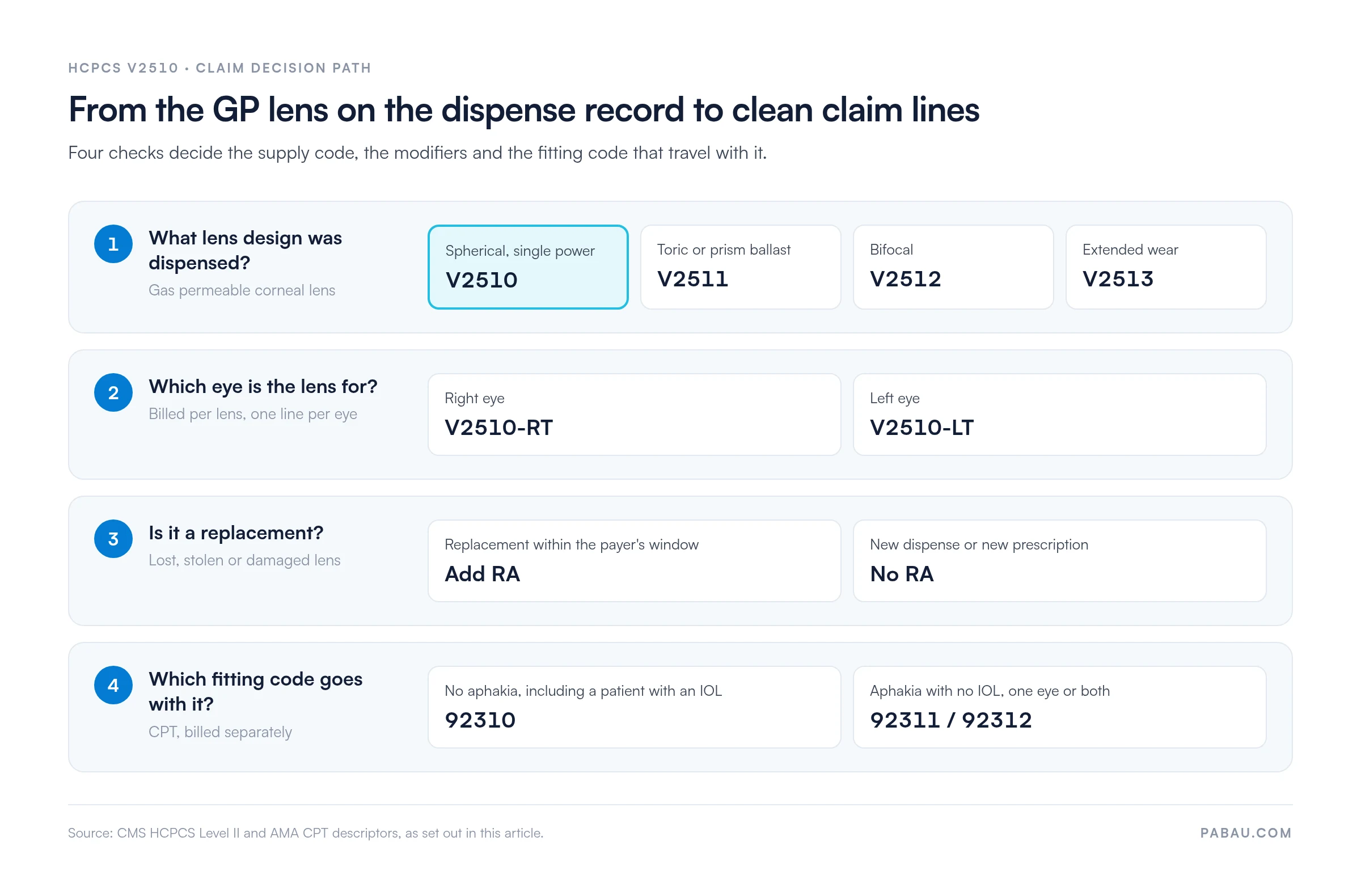
HCPCS Code V2510 is a supply code, so it covers the lens itself and not the clinical work of fitting it. The professional service is billed separately with a CPT fitting code from the 92310 family. Before billing both for one visit, confirm the payer does not bundle the fitting fee into the exam.
Reserve 92311 and 92312 for true aphakia, where the eye has no natural lens and no implant. The AMA updates CPT descriptors annually, so confirm them before billing each year.
Medicare Part B coverage for HCPCS Code V2510 is narrow and frequently misunderstood. Medicare treats routine vision care, including contact lenses for myopia, hyperopia or astigmatism, as non-covered under section 1862(a)(7) of the Social Security Act. That exclusion applies to most conditions for which GP lenses are fitted.
The one coverage exception that matters for V2510 is the post-cataract provision under section 1861(s)(8). Medicare Part B covers one pair of conventional contact lenses or eyeglasses after cataract surgery with an intraocular lens (IOL) implant. So V2510 can be billed to Medicare for a patient who had an IOL placed and chooses contacts over glasses. That patient is pseudophakic, not aphakic, so the fitting is billed with 92310.
For keratoconus, irregular astigmatism or corneal ectasia, the most common indications for GP lenses, Medicare Part B generally does not cover V2510. These patients may have coverage through Medicare Advantage plans or supplemental commercial insurance. Vision benefit rules vary widely between plans, so verify each one before the visit.
Traditional Medicare Part B does not require prior authorization for V2510 under the post-cataract exception. Prior authorization requirements vary by plan type and are common in the following scenarios.
A V2510 claim gets paid on first submission only when the chart supports every line of it. Each item in this list must be in the chart before the claim goes out. The same clean claim submission rules apply here, with every field checked before the claim date.
Run a modifier audit on V2510 claims quarterly. Pull every V2510 claim from the previous 90 days and verify that each line carries RT or LT. Check for the RA replacement modifier where it applies. Claims billed without RT or LT are systematically auto-denied by most payers. Catching the pattern at audit rather than at denial saves the rework of corrected claims and the risk of late filing limits on appeals.
V2510 denials follow predictable patterns. Most trace back to modifier errors, diagnosis mismatches or missing documentation, and all of them are preventable before submission. Denial management strategies work best when they start with pre-submission edits rather than post-denial appeals.
Reimbursement for HCPCS Code V2510 is set through the CMS DMEPOS fee schedule, administered by the Medicare Administrative Contractor for the billing provider’s jurisdiction. Fee schedule amounts are updated annually on January 1 and vary by geographic region based on DMEPOS pricing adjustments.
For the current allowable amount in your jurisdiction, download the fee schedule files from the CMS DMEPOS fee schedule page or your MAC’s provider portal. Specific dollar figures are not cited here because they change annually and vary by region.
Four factors decide what a V2510 claim pays:
Knowing how payers expect medical billing workflows to sequence DMEPOS supply claims helps practices structure V2510 billing. That matters most when a fitting service and a supply item go out on the same date.
Without a check at the point of billing, two errors surface only as denials. One is a V2510 line with no RT or LT, and the other is a toric lens billed as spherical. The corrected claim then eats into the payer’s filing window.
Pabau, the practice management platform we build, tracks required modifiers, diagnosis pairings and documentation fields by payer in its claims management software. It flags a missing element before the claim is submitted, rather than after a denial comes back.
The dispense record, the ICD-10 code and the RT or LT line then agree before the claim leaves the practice. Your billing team spends less time on corrected claims and appeals.

Pabau’s claims management tools flag missing modifiers, mismatched diagnosis codes and absent prior authorizations before claims are submitted, not after they come back denied.

Treat the dispense record as the source of every V2510 claim. When it names a spherical GP design, the eye, and a diagnosis the payer’s LCD accepts, the code, modifier and ICD-10 pairing follow from it.
For Medicare patients, settle coverage before the lens is ordered. A post-cataract patient with an IOL is billable under section 1861(s)(8), while a keratoconus patient needs an ABN and a self-pay conversation first.
Book a demo to see how Pabau checks modifiers and diagnosis pairings on your contact lens claims before they reach the payer.

Need a deeper look at DMEPOS denial patterns? Denial codes in medical billing explains the most common CARC codes and how to build a systematic response workflow.
Billing an extended-wear GP lens instead? HCPCS code V2513 covers the extended-wear gas permeable lens code and how it differs from V2510.
Fitting soft lenses rather than GP? HCPCS code V2520 covers the hydrophilic spherical lens code and its modifier rules.
Want to see how claims are checked before they reach the payer? Claim.MD clearinghouse overview covers how electronic claims are validated and routed before reaching payers.
Looking to strengthen your overall revenue cycle? What is revenue cycle management walks through the end-to-end process from eligibility verification to payment posting.
HCPCS Code V2510 is the supply code for a contact lens that is gas permeable, spherical in design, and corneal in fit, billed per lens. It covers single-vision rigid GP lenses for medically necessary corneal conditions. Toric or prism ballast GP lenses use V2511, and bifocal GP lenses use V2512.
RT (right eye) or LT (left eye) is required on every V2510 claim line, since the code is billed per lens. Add RA alongside RT or LT when the lens is a replacement for a lost, stolen, or damaged lens within the payer’s coverage period.
Medicare Part B covers V2510 only under the post-cataract exception in section 1861(s)(8). It allows one pair of contact lenses or eyeglasses after cataract surgery with an IOL implant. For other conditions such as keratoconus or irregular astigmatism, Medicare Part B generally does not cover contact lenses.
All three cover gas permeable corneal lenses. V2510 is spherical (single power), V2511 is toric or prism ballast (corrects cylinder or uses prism), and V2512 is bifocal (two focal zones). The lens design documented in the dispense record determines the correct code.
The most common cause is a missing RT or LT laterality modifier. Others are a diagnosis that fails the payer’s medical necessity criteria and a missing prior authorization. Billing V2510 for a toric lens that belongs under V2511 is another.
Prior authorization requirements depend on the payer. Traditional Medicare does not require PA for the post-cataract exception. Many Medicare Advantage plans and commercial insurers that cover medically necessary contact lenses do require authorization before dispensing. Verify with each plan at the eligibility verification stage.