

CCSD code XR940: Foreign body retrieval billing guide
CCSD code XR940 is the UK private healthcare code for retrieval of a foreign bod...

Last Updated: Nov 26, 2026
S0515 is the HCPCS Level II code for a scleral lens, liquid bandage device, per lens. It describes a scleral lens used as a therapeutic device, which vaults the cornea and holds a reservoir of fluid against a damaged surface.
Practices use it for conditions such as persistent epithelial defects, neurotrophic keratopathy and severe dry eye. Medicare does not pay for S0515. A scleral lens fitted to correct vision is billed with V2531 instead.
Let Pabau's smart automation suggest the right codes, reduce claim denials, and keep your practice compliant—effortlessly.
Automate repetitive tasks and focus on what matters most—your patients.
Reduce coding errors and ensure compliance with the latest regulations.
Clean claims, fewer denials, and faster reimbursements.
Powerful insights and reporting to help your practice thrive.
HIPAA compliant SOC 2 certified GDPR-compliant Trusted by 4,000+ clinics worldwide

HCPCS Code S0515 bills one scleral lens used as a liquid bandage device — a lens that protects a damaged corneal surface under a fluid reservoir.
A gas-permeable scleral lens fitted to correct vision is billed with V2531, and the two codes are not interchangeable.
Medicare does not pay for S0515, so coverage depends on each commercial plan or Medicaid program, and most require prior authorization.
Pabau, a practice management platform with built-in claims tools, helps eye care practices track S0515 authorizations, attach clinical records and monitor remittances in one workflow.
HCPCS Code S0515 is a temporary national S-code for a scleral lens used as a liquid bandage device. The official descriptor, shown in the AAPC code listing for S0515, reads: Scleral lens, liquid bandage device, per lens. It took effect on October 1, 2004, and sits in the Vision Supplies range (S0500-S0596) of HCPCS Level II.
Each part of that descriptor shapes the claim. “Liquid bandage device” makes the lens a therapeutic device: it vaults the cornea and holds a reservoir of fluid against a damaged surface. “Per lens” means one unit equals one lens, so a pair is two units with RT and LT modifiers. Optical correction appears nowhere in the descriptor. That job belongs to V2531, covered further down.
S-codes are temporary national codes for commercial insurers and state Medicaid programs, not Medicare. The Centers for Medicare & Medicaid Services lists S0515 with Medicare status I, meaning the code is not valid for Medicare purposes. Checking the payer at scheduling catches that rule before the lens is ordered.
S0515 covers the lens itself — the physical device — when it is dispensed to protect or heal the ocular surface. It does not cover the fitting service, follow-up visits, solutions or replacement lenses beyond what the plan allows. Soft bandage lenses and disposable lenses take other codes, such as S0500. The table below separates covered items from excluded ones.
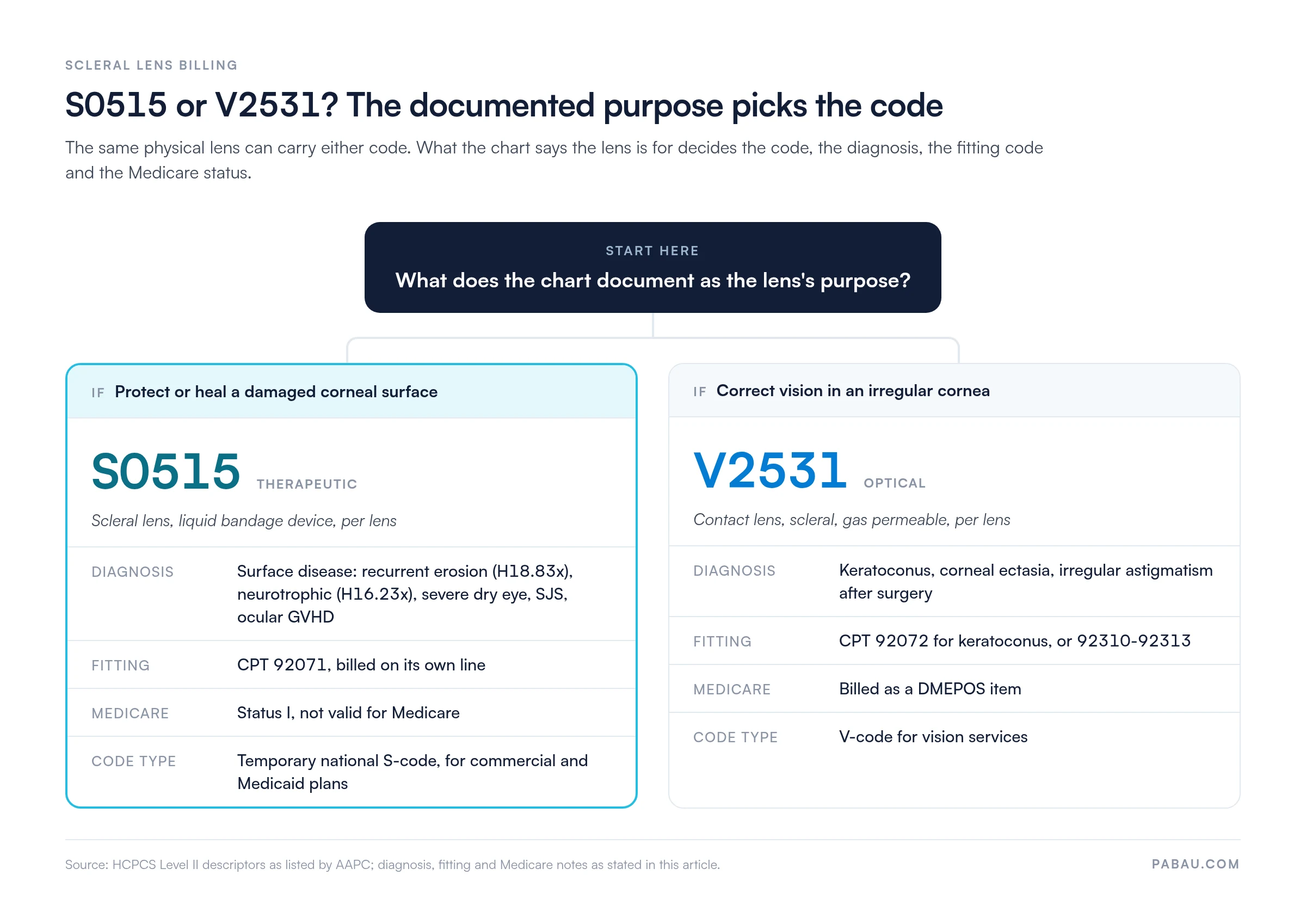
The most common coding mistake with this code is billing S0515 for an optical scleral fit. When the documented purpose is sharper vision in an irregular cornea, the lens is V2531, whatever its design. When the purpose is protecting a diseased surface, S0515 is the code, and the chart has to say so. The diagram below traces both paths, from documented purpose to fitting code.
Payers treat S0515 as a therapeutic device, so medical necessity rests on ocular surface disease that standard treatment has not controlled. A scleral lens earns its place when the fluid reservoir protects or heals the cornea in ways drops, plugs and soft bandage lenses could not. Commonly accepted indications include the following conditions.
The chart should record slit-lamp findings with staining and best corrected visual acuity. It should also list every treatment tried, why it failed and the goal of the lens. Photographs of the epithelial defect strengthen a request. Keeping that record complete is part of a wider medical billing compliance program, and it lowers audit risk on high-cost devices.
Every S0515 claim needs an ICD-10-CM code that describes the ocular surface disease the lens treats. Keratoconus and other corneal shape codes point to optical correction, so on their own they invite a diagnosis-inconsistent denial. Use the lateral code that matches the eye being treated.
Where the systemic code carries no laterality, list it with a lateral ocular code that matches the RT or LT modifier. A mismatch between diagnosis laterality and the line modifier is an easy denial to avoid.
S0515 and V2531 can describe the same physical lens, but they bill different jobs. V2531 is Contact lens, scleral, gas permeable, per lens, used for optical correction, such as keratoconus or post-surgical ectasia. S0515 is the same kind of lens used as a liquid bandage to treat surface disease. The documented purpose decides the code, not the lens design.
Switching codes to chase payment is a compliance risk in both directions. Billing V2531 for a bandage lens misstates the service, and billing S0515 for an optical fit does the same. A related device, the scleral cover shell, has its own code, V2627, and is not a lens worn for vision or surface healing. A scleral lens made of gas-impermeable material also has its own code, V2530.
Coverage for HCPCS Code S0515 varies widely, and checking it before dispensing prevents the most expensive denial. The categories below give a starting framework. Always read the individual plan’s policy or fee schedule before submitting.
Running insurance eligibility verification at scheduling, not on the day of service, leaves time to secure authorization before the lab makes the lens.
Most plans that cover S0515 want prior authorization before they pay for it. The request usually follows these steps.
Some plans limit replacement — for example, one lens per eye every 12 months. Record each dispensing date and confirm the new lens falls outside that window before you submit.
Order the scleral lens from the lab only after prior authorization is approved and the approval number is in the patient chart. A lens ordered earlier leaves the practice carrying its cost if the plan then denies the request.
A clean S0515 claim brings the payer, the diagnosis, the authorization and the lens line together. The steps below apply to a commercial or Medicaid plan that lists S0515.
Submitting a clean claim means the payer gets every required element on the first pass. For S0515, the high-risk fields are Box 21 (ICD-10 with laterality), Box 23 (authorization number), Box 24D (HCPCS code and modifier) and Box 24G (units).
Modifiers on S0515 claims mostly carry laterality. The table below covers the ones that come up on therapeutic scleral lens claims.
Most plans expect RT and LT on separate lines, which also lets you track payment by eye. GA, GY and KX are Medicare liability and coverage modifiers, so they have no role on a commercial S0515 claim.
S0515 denials cluster around a few fixable causes. The table maps each one to its usual claim adjustment reason code (CARC) and the fix.
A CO-97 means the payer treated the lens as included in payment for another service, often the fitting. Appeal with the separate supply line and the lab invoice. The denial codes reference covers the wider CARC list.
S0515 has no Medicare allowable, so payment comes from each commercial contract or state Medicaid fee schedule. Rates for the same lens can differ sharply between plans in one market.
With no Medicare rate to fall back on, collection depends on the front end of the claim. Verifying benefits at scheduling, documenting fully and working denials within the plan’s appeal window decide how much of each S0515 charge is paid.
Many eye care practices track scleral lens authorizations in a spreadsheet, keep photos in one system and post remittances in another. A missing authorization number or the wrong diagnosis then surfaces only when the denial arrives.
Pabau keeps the clinical record, the authorization and the claim in one place. Staining photos and treatment history sit on the patient’s file, ready to attach to a request. Pabau’s claims management software tracks each claim through to the ERA, so a denied S0515 line is flagged for follow-up before it ages out.

Pabau’s claims management tools help optometry and ophthalmology practices track prior authorizations, attach ocular surface documentation and monitor ERA remittances. S0515 claims then reach the right payer with the right records.

HCPCS Code S0515 is a therapeutic code, and getting that right is where clean claims start. A scleral lens that protects a diseased cornea under a fluid reservoir is S0515, while one fitted to correct vision is V2531. Code the purpose the chart documents, pair it with a surface-disease diagnosis and route it away from Medicare.
From there, payment depends on an authorization in hand before the lens is ordered and a separate line for the fitting. To see how Pabau keeps those records and claims in one workflow, book a demo.

Billing an optical scleral lens instead? HCPCS code V2530 covers the code for a gas-impermeable scleral lens.
Fitting a cover shell over a blind or disfigured eye? HCPCS code V2627 explains the scleral cover shell code and its documentation.
Dispensing soft or disposable lenses? HCPCS code S0500 covers the code for disposable contact lenses.
Need a denial management reference? Denial management in healthcare covers how to triage and appeal common claim rejections across specialty billing workflows.
Looking for a clean-claim submission checklist? What makes a clean claim explains the data elements payers check on first-pass adjudication.
HCPCS Code S0515 covers one scleral lens used as a liquid bandage device. The lens vaults the cornea and holds a reservoir of fluid against a damaged surface. It is used in conditions such as persistent epithelial defects, neurotrophic keratopathy or severe dry eye. One unit equals one lens, and the fitting is billed separately.
No. Medicare lists S0515 with status I, meaning the code is not valid for Medicare purposes, so a Medicare claim for it will be denied. Medicare Advantage plans set their own policies, so check the plan’s scleral lens policy before dispensing.
S0515 is a scleral lens used therapeutically as a liquid bandage for ocular surface disease. V2531 is a gas-permeable scleral lens used for optical correction, such as keratoconus. The documented purpose decides the code, and the two are not interchangeable.
Not on its own. Keratoconus is an optical indication, so a scleral lens fitted to correct vision is V2531. S0515 applies when the documented purpose is protecting or healing the corneal surface.
CPT 92071 covers fitting a contact lens for the treatment of ocular surface disease, and the lens supply is reported separately. CPT 92072 and 92310-92313 describe optical fittings, so they usually go with V2531 instead.
Usually, yes. Most plans that cover S0515 want prior authorization with slit-lamp findings, photographs, a record of failed treatments and a letter of medical necessity. Record the authorization number before you order the lens.
Common causes are a Medicare or non-covering payer (CO-96), a missing authorization (CO-197) and a diagnosis that does not fit the code (CO-11). A missing RT or LT modifier (CO-4) and weak medical necessity records (CO-50) are also common. Read the CARC on the remittance before you correct or appeal.



