HCPCS code V2599: Other type contact lens billing guide
What is HCPCS code V2599? HCPCS code V2599 is the Level II supply code for a con...

Last Updated: Oct 20, 2026
92313 is the CPT code for prescription of optical and physical characteristics of and fitting of contact lens, with medical supervision of adaptation; corneoscleral lens.
It covers scleral and corneoscleral designs that vault the cornea and land on the sclera. Medicare pays it once per encounter, whether one or both eyes are fitted. Corneal lenses, including GP and ortho-K, belong under 92310, 92311, or 92312. A keratoconus patient’s initial fitting may fall under 92072 instead.
Let Pabau's smart automation suggest the right codes, reduce claim denials, and keep your practice compliant—effortlessly.
Automate repetitive tasks and focus on what matters most—your patients.
Reduce coding errors and ensure compliance with the latest regulations.
Clean claims, fewer denials, and faster reimbursements.
Powerful insights and reporting to help your practice thrive.
HIPAA compliant SOC 2 certified GDPR-compliant Trusted by 4,000+ clinics worldwide

CPT Code 92313 covers prescribing, fitting, and supervising adaptation to a corneoscleral (scleral) contact lens.
Instead, corneal lenses, including soft, corneal GP, and ortho-K designs, belong under 92310, or 92311 and 92312 for aphakia.
Medicare assigns 92313 a bilateral indicator of 0, so bill one line and one unit whether you fit one eye or both.
Therefore, for a keratoconus patient’s initial fitting, check whether the payer expects CPT 92072 before you report 92313.
CPT Code 92313 is the code for prescribing and fitting a corneoscleral, or scleral, contact lens. Specifically, its official wording comes from the American Medical Association’s CPT code set. It reads: “Prescription of optical and physical characteristics of and fitting of contact lens, with medical supervision of adaptation; corneoscleral lens.”
A corneoscleral lens vaults over the cornea and lands on the sclera, the white of the eye. That scleral landing zone separates 92313 from the corneal lens codes beside it. In addition, three service components are bundled into the code.
The descriptor names no eye count. Medicare assigns 92313 a bilateral surgery indicator of 0, so you bill it once, as one unit, whether you fit one eye or both. Overall, the modifier section below covers the details.
Knowing the boundaries prevents the most common code-family errors. Specifically, the table below maps them.
Lens materials are billed with HCPCS V-codes. A gas permeable scleral lens is V2531, reported per lens, so a bilateral fit carries two units or RT and LT lines. CPT also lets you report the supply as part of the fitting, so follow each payer’s preference.
The 92310-92313 family splits on two variables: where the lens rests, and whether the eye is aphakic. Notably, lens material and fitting difficulty play no part in the descriptors.
The 92313 vs. 92310 test is the lens design recorded in the chart. A corneal GP or orthokeratology lens rests on the cornea, so it bills as 92310 however long the fit takes. In contrast, a lens that lands on the sclera bills as 92313.
Aphakic patients fitted with corneal lenses have their own codes, 92311 and 92312. Additionally, the 92314-92317 range mirrors the whole family for fittings directed by an independent technician. The decision path below runs through those tests in order.
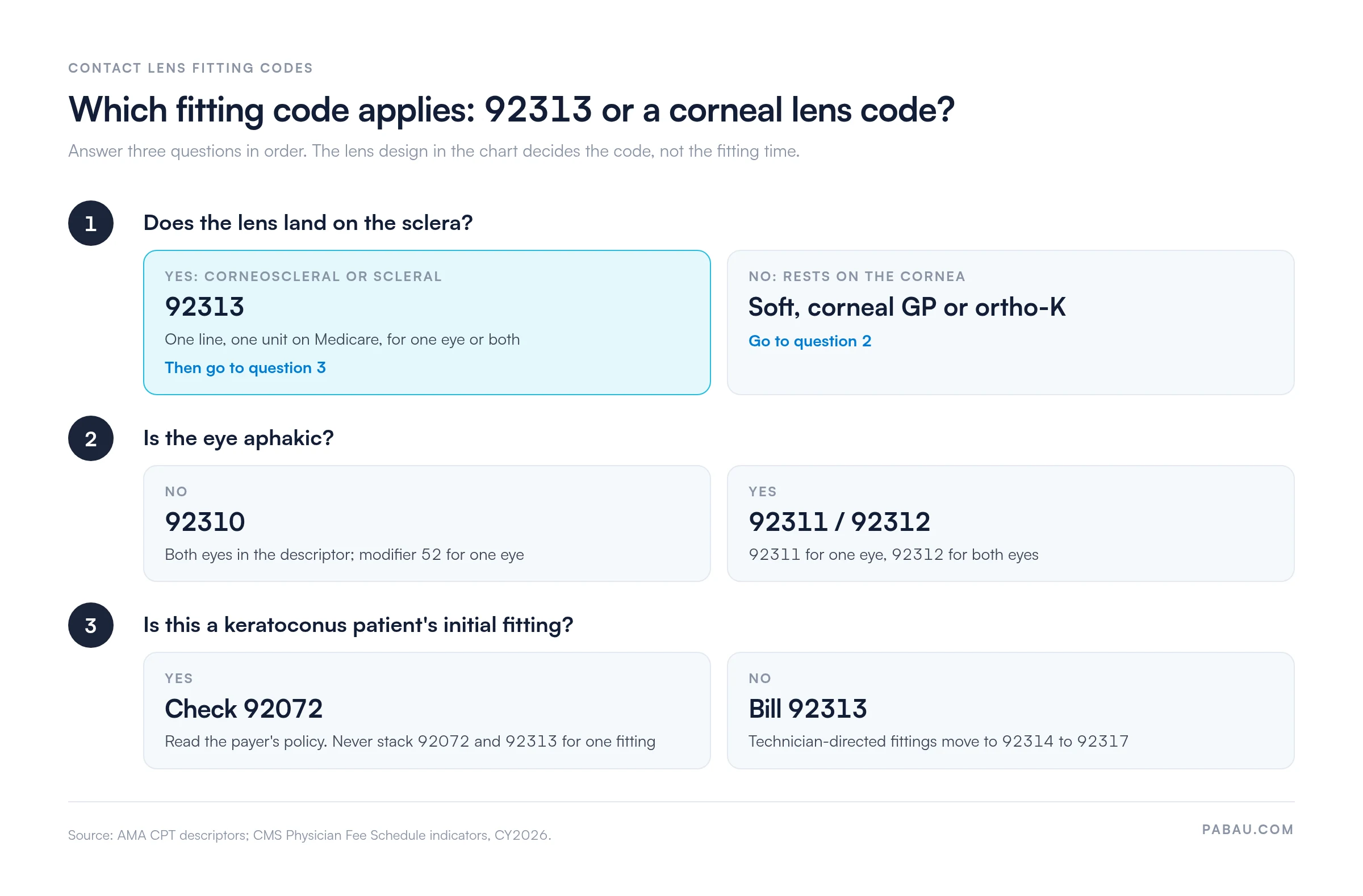
CPT Code 92313 is correct when the provider prescribes and fits a corneoscleral or scleral lens. In short, the lens design selects the code, and the diagnosis establishes medical necessity.
CPT 92072 covers the initial fitting of contact lenses for keratoconus management. Specifically, coding references apply it to a keratoconus patient’s first fit, whatever lens design is chosen. Some payers limit it to once per lifetime, and CPT directs later keratoconus fittings to E/M or general ophthalmological service codes.
Read the payer’s policy before choosing between 92072 and 92313 for a keratoconus patient. The two codes describe the same fitting work, so never stack them for one fitting.
Medicare pays 92313 on one line whatever the eye count, so pick the diagnosis that matches the eyes you fitted. A bilateral fitting takes the bilateral code, such as H18.613 or H18.623.
Verify current ICD-10-CM codes with the CDC/NCHS ICD-10-CM web tool for the active fiscal year before billing. In fact, the code set is updated every October.
Medicare coverage for CPT Code 92313 is narrow. Medicare pays for contact lenses mainly under its prosthetic lens benefit, which centers on aphakia. In addition, routine vision care, including contact lenses for refractive correction, is excluded.
Verify the patient’s insurance eligibility before the appointment, so coverage questions surface before the fitting starts. Overall, coverage typically breaks down like this.
When Medicare coverage is uncertain, issue an Advance Beneficiary Notice (ABN) before the fitting starts.
Before billing 92313 to Medicare, call your MAC’s provider line and ask how it treats scleral lens fittings for your diagnosis. Then, note the answer, the date, and the representative’s name in the chart. If coverage is still uncertain, have the patient sign an ABN before the fitting.
The chart note must support all three service components bundled into the code. Auditors disallow 92313 claims when even one component is absent. Therefore, build these elements into every scleral lens fitting template.
The spectacle trial can also change which code you report. When single-vision spectacles correct the patient, the fitting bills as CPT 92340, not a contact lens code.
A clean claim for 92313 needs all seven elements above in the chart. Check each payer’s rule on which date of service to report. Then confirm the adaptation notes are filed before the claim leaves.
The Medicare Physician Fee Schedule gives CPT Code 92313 a bilateral surgery indicator of 0. Bill it once, as one unit, whether you fit one eye or both. Some commercial payers ask for separate RT and LT lines, so check each contract before you split a claim.
Attach GY when you bill Medicare for a scleral fitting that falls outside any benefit. The claim then denies cleanly, so you can bill the patient or a secondary payer. Overall, review the CMS ABN guidance with your compliance officer before you set up the workflow.
Medicare sets 92313 reimbursement annually through the Medicare Physician Fee Schedule. Specifically, for CY2026, the code carries 0.90 work RVUs and 2.86 total non-facility RVUs.
That works out to about $95.53 nationally at the non-qualifying APM conversion factor of $33.4009. At the qualifying APM factor of $33.5675, it is about $96.00. In contrast, the facility rate is about $35.74, and geographic indices adjust every figure by locality.
Commercial rates are contract-specific. Therefore, tracking payments per payer through electronic remittance advice (ERA) helps identify underpayments against contracted rates.
Denials for CPT Code 92313 cluster around eight root causes. Each one has a documentation or workflow fix. Overall, effective denial management starts with knowing which ones hit your practice.
Reviewing denial codes in medical billing helps staff map each CARC reason code to its root cause. CO-4 (modifier inconsistent with the procedure), CO-16 (missing information), and CO-50 (not deemed medically necessary) are common on contact lens claims. Overall, tracking them by payer shows which carriers set the strictest documentation bar.
Build a 92313 pre-submission checklist into your billing workflow. First, confirm the lens design is corneoscleral or scleral, and rule out 92072 for a keratoconus initial fit. Second, check that topography and an adaptation note are in the chart. Third, bill one line for one or both eyes, with a diagnosis that matches the eyes fitted. Then pick the correct benefit path.
CPT Code 92313 can be billed on the same date as an eye exam when a separately identifiable, medically necessary exam is performed. National Correct Coding Initiative (NCCI) edits govern the pairing, so modifier use needs care.
Your optometry superbill should prompt for the exam-code modifier whenever 92313 and an eye exam share an encounter. Therefore, review NCCI edit pairs for the 923xx family at least annually, because CMS updates bundling edits each year.
For practices submitting electronically, a medical claims clearinghouse can catch many NCCI edit conflicts before claims reach the payer.
Scleral lens claims tend to fail on chart details. For example, an adaptation note gets filed late, the lens design goes unrecorded, or the diagnosis doesn’t match the eyes fitted.
Practice management software like Pabau keeps the fitting note, lens parameters, and follow-up visits on one patient record. In addition, its claims management software pre-fills claims from that record. It then submits them to US payers through the Claim.MD clearinghouse.
ERA files post back against each claim, so your team sees what every payer paid for 92313 without rekeying statements. Consequently, your billers spend less time chasing chart notes after a denial.


Pabau keeps fitting notes, lens parameters, and adaptation visits on one record. It then submits 92313 claims through Claim.MD and posts ERA responses back.

CPT Code 92313 rewards precision about lens design. Code the corneoscleral or scleral lens the chart records, and bill it once whether you fit one eye or both. Therefore, check 92072 for any keratoconus initial fit.
Get those calls right and the claim holds up at audit, because every bundled component sits in the record. In short, the price is discipline at the adaptation visit, where 92313 documentation most often falls short.
Book a demo to see how Pabau keeps scleral lens fitting notes and claims on one record.

Need to understand how claims reach payers? Electronic claims via 837 file format explains the EDI transaction that carries 92313 claims to Medicare and commercial payers.
Worried about payer credentialing delays affecting 92313 reimbursement? Credentialing with insurance companies covers the enrollment process that must be complete before scleral lens claims pay.
Choosing software for scleral lens billing? Best medical billing software for US practices compares the platforms that handle specialty billing and ERA automation.
Unsure whether a scleral fitting is covered? Insurance eligibility verification walks through the checks to run before the patient sits down for the fitting.
Seeing repeat denials on contact lens claims? Denial management in healthcare shows how to track root causes and fix them before resubmission.
CPT code 92313 covers prescription, fitting, and medical supervision of adaptation for a corneoscleral (scleral) contact lens. Medicare pays it once per encounter, whether one or both eyes are fitted. Therefore, all three components must be performed and documented to support the code.
Medicare coverage for 92313 is limited and depends on your MAC and the documented diagnosis. For a keratoconus patient’s initial fitting, many payers expect CPT 92072 instead. Therefore, confirm your MAC’s position, and issue an ABN when coverage is uncertain.
Yes, when a separately identifiable eye examination is medically necessary and documented. Many payers expect modifier 25 on the exam code (92004, 92014, or an E/M code), not on 92313. Overall, the chart must support the exam and the fitting as separate services.
Prior authorization requirements vary by payer and plan. Specifically, many commercial payers require it for scleral lens fitting. Verify requirements before the date of service, because a missing or expired authorization is a common cause of technical denials.