CPT code 38571: Laparoscopic pelvic lymphadenectomy
CPT code 38571 covers a full pelvic node dissection on both sides CPT code 38571...

Last Updated: Oct 20, 2026
V2599 is the HCPCS Level II code for contact lens, other type. It covers any lens that none of the 14 specific V2500-series codes describes, such as hybrid, orthokeratology, piggyback and custom bandage lenses.
Scleral lenses never qualify, since V2530 and V2531 describe them. V2599 is also carrier-priced, so payers usually want the lens invoice and a description with the claim. Medicare excludes routine contact lenses, and aphakia lenses normally bill under the specific V2500-series codes, chosen by lens type. Get those details right and the claim rarely needs resubmitting.
Let Pabau's smart automation suggest the right codes, reduce claim denials, and keep your practice compliant—effortlessly.
Automate repetitive tasks and focus on what matters most—your patients.
Reduce coding errors and ensure compliance with the latest regulations.
Clean claims, fewer denials, and faster reimbursements.
Powerful insights and reporting to help your practice thrive.
HIPAA compliant SOC 2 certified GDPR-compliant Trusted by 4,000+ clinics worldwide

HCPCS code V2599 carries the official descriptor “Contact lens, other type” and covers lenses with no specific V2500-series code.
Only 15 codes are assigned in V2500-V2599, and 14 of them name a specific PMMA, gas permeable, hydrophilic or scleral lens.
Scleral lenses bill as V2530 or V2531, so V2599 is for hybrid, orthokeratology, piggyback, bandage and other custom lenses.
V2599 is carrier-priced, so payers usually want the manufacturer invoice and a lens description with the claim.
Medicare excludes routine contact lenses, and aphakia lenses normally bill under the specific V2500-series codes, chosen by lens type.
HCPCS code V2599 is the Level II supply code for a contact lens that no other code in the V2500 series describes.
Its official CMS descriptor is “Contact lens, other type.” Payers often call it a catch-all or “not otherwise classified” code. That label is shorthand, so keep the official wording on claims and in your notes.
The contact lens range has only 15 assigned codes. Fourteen of them name a specific material and design: PMMA, gas permeable, hydrophilic (soft) and scleral. Every other number between V2500 and V2598 is unassigned, so V2599 picks up any lens type the 14 codes leave out.
The Centers for Medicare and Medicaid Services (CMS) maintains the code through the HCPCS Level II update cycle. V2599 carries pricing indicator 46, which means it is carrier-priced. In practice, the payer sets the allowance claim by claim, usually from the invoice and a description of the lens.
V2599 fits lenses whose design does not match any of the 14 specific codes. The lens types most often billed this way are:
If the dispensed lens has its own code, that code must be used instead. These lenses are excluded from V2599:
Scleral lenses are the most common miscode. They have their own codes, V2530 and V2531, so a scleral lens billed as V2599 is an incorrect code assignment. Payers typically deny it as “a more specific code applies.”
The V2500 series assigns codes by lens material first, then by optical design or wearing schedule. Work through four quick checks in order, and V2599 is only what remains at the end.
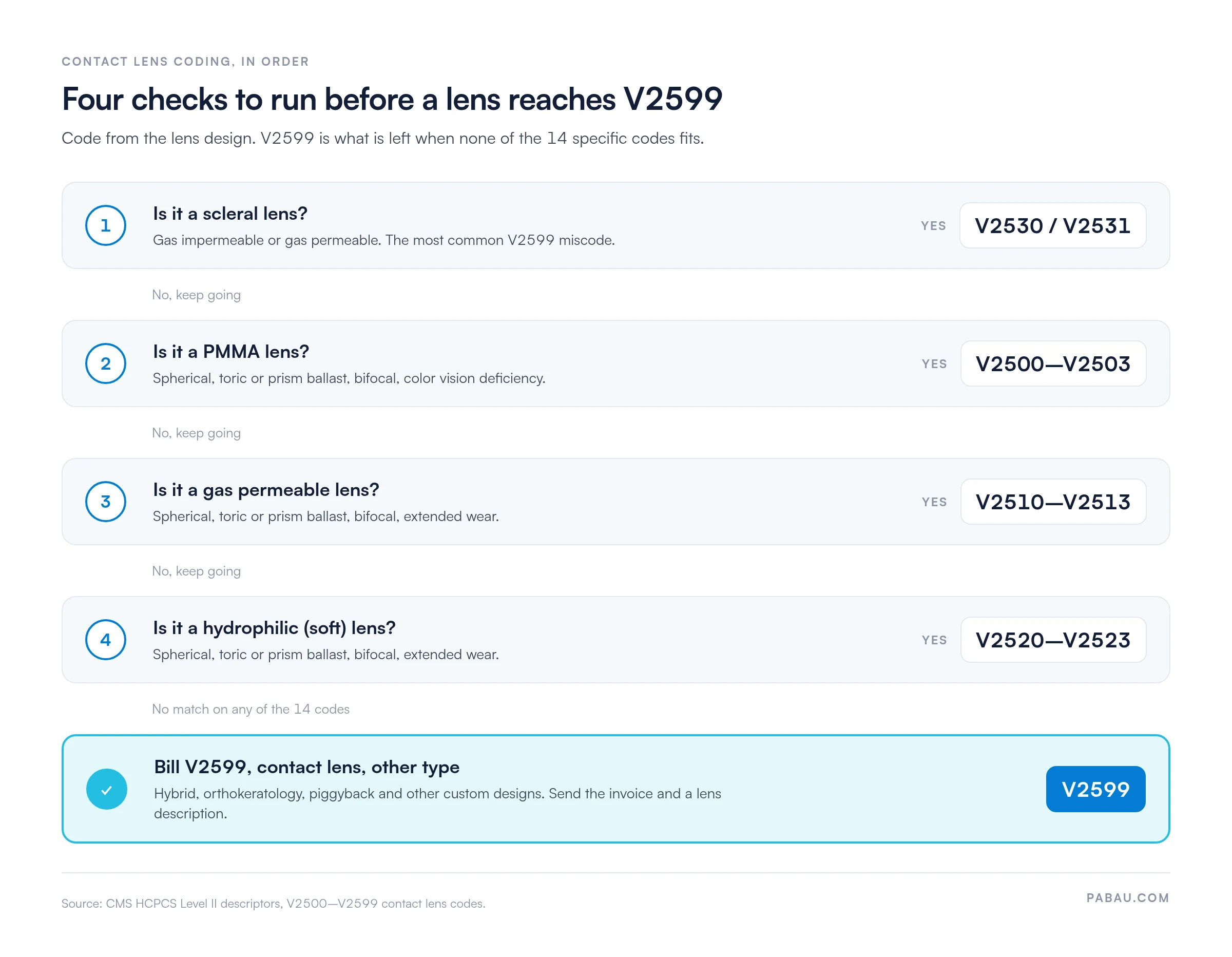
The full code list below shows where each descriptor lands. Check the dispensed lens against it before you reach for V2599.
Medicare excludes routine contact lenses under Section 1862(a)(7) of the Social Security Act. A lens dispensed only for refractive correction is non-covered, whichever code goes on the claim. That leaves a narrow covered pathway for contact lenses.
The main exception is aphakia. Section 1861(s)(8) covers prosthetic lenses for a patient who lacks the natural lens, for example after cataract surgery.
Medicare aphakia contact lens claims normally bill under the specific V2500-series codes, chosen by lens type, such as V2513, V2520 or V2530. V2599 enters the picture only when the aphakic lens matches none of those descriptors.
These supply claims go to the DME MAC, not through the Physician Fee Schedule. Check the DME MAC’s local coverage determination and policy article for documentation and modifier requirements before you submit.
Other payers set their own rules for V2599:
Because V2599 names no lens design, the claim has to describe the lens for the payer. Meeting medical billing compliance requirements means the chart supports each element below before submission. Pulling it together after a denial takes far longer.
Keep the LOMN and invoice in the patient record so they can be attached on request or retrieved quickly on audit.
A clean V2599 claim follows a set sequence, and skipping a step is what usually sends it back. The walkthrough below assumes the lens has already been fitted and dispensed.
Each step maps to a field payers check before they price the lens. A clean claim submission carries all of them on the first pass.
Catch-all codes draw extra scrutiny, because the payer has to confirm that no specific code applies. The denial codes billers see on a V2599 remittance usually point to one of these causes.
Run an eligibility check when you schedule the fitting, not on the day you dispense. That leaves time to request prior authorization, get the LOMN signed, and collect the lens invoice before the claim goes out.
The lens design decides the code, and the diagnosis explains why the patient needs it. The same condition can lead to V2531 for one patient and V2599 for another. Here is how that plays out in the four situations coders meet most.
Keratoconus is coded H18.611, H18.612 or H18.613 when stable (right, left, bilateral), and H18.621, H18.622 or H18.623 when unstable. The fitting is CPT 92072, fitting of contact lens for management of keratoconus.
Scleral lenses are common in keratoconus, and they bill as V2530 or V2531, not V2599. V2599 applies when the patient wears a hybrid lens, a piggyback system, or another design without its own code.
Aphakia is coded H27.01 (right eye), H27.02 (left eye) or H27.03 (bilateral). Fitting codes come from the family that runs from 92310 to 92313, which includes the aphakia fitting codes 92311 and 92312.
Medicare aphakic contact lenses normally bill under the specific V2500-series codes, chosen by lens type, for example V2513 or V2520. Reserve V2599 for an aphakic lens that matches none of those codes. Check the DME MAC’s requirements before you submit.
After penetrating keratoplasty or DSAEK, an irregular graft surface may call for a specialty lens. Z94.7 (corneal transplant status) records the history, and T86.84- codes capture transplant complications such as rejection or failure.
Many of these patients wear sclerals, which bill as V2530 or V2531. Use V2599 only for a design with no specific code, and say in the LOMN why conventional lenses are inadequate.
Bandage lenses treat persistent epithelial defects, recurrent corneal erosion and post-surgical healing. The fitting is CPT 92071, fitting of contact lens for treatment of ocular surface disease.
Recurrent corneal erosion is coded H18.831 (right eye), H18.832 (left eye), H18.833 (bilateral) or H18.839 (unspecified eye). A corneal ulcer uses the H16.0- codes, such as H16.009 for an unspecified ulcer. Bill V2599 for the lens only when its design has no specific code.
V2599 does not appear on the Medicare Physician Fee Schedule because it is a DMEPOS supply code, not a physician service. Fitting codes such as 92071 and 92072 are priced on the Physician Fee Schedule instead.
The CMS DMEPOS fee schedule carries no fixed amount for V2599, because the code is carrier-priced. The contractor prices each claim, usually from the invoice and lens description. Commercial vision plans often apply their own allowance, so verify contracted rates with each payer.
Commercial vision plans and Medicaid managed care organizations commonly require prior authorization before you dispense a lens billed as V2599. Requirements change by payer and plan year, so recheck them at each benefit renewal.
A typical prior authorization package includes:
Send the package at the fitting exam, not when the lens arrives. That keeps the dispensing date inside the authorization window.
Carrier-priced claims stall when the invoice, lens description or authorization number goes missing. Teams that work from paper files and payer portals often learn about a problem only when the denial comes back.
Pabau, the practice management platform we build, sends claims straight from the patient record through its Claim.MD integration. Its claims software for practices then shows each claim’s status. Your team sees a rejected V2599 claim while the invoice and LOMN are still on hand.

Pabau sends V2599 and other lens claims through Claim.MD and tracks each one’s status. Denials surface while the invoice and lens notes are still on hand.

V2599 earns its place only after the 14 specific codes have been ruled out, and sclerals never qualify. Code from the lens design, then let the diagnosis and fitting code explain why the patient needs it.
The trade-off is paperwork. A carrier-priced claim pays only when the invoice, lens description and medical necessity record travel with it. Build those into the dispensing routine, and denials become the exception.
Book a demo to see how Pabau keeps specialty lens claims moving from submission to payment.

Fitting scleral lenses for the same patients? CPT code 92313 covers the scleral lens fitting that pairs with V2530 and V2531.
Need help managing claim denials across your practice? Denial management in healthcare covers the workflows that reduce rework on rejected claims.
Want a reference on clean claim requirements? Clean claim submission guide explains what payers check before processing a HCPCS or CPT claim.
Looking for an overview of medical billing compliance? Medical billing compliance requirements covers the documentation standards behind supply code claims.
Comparing billing systems for a specialty practice? Medical practice billing software compares the tools that submit and track claims like these.
Yes. V2599 is an active code in the 2026 HCPCS Level II set, and its descriptor still reads “Contact lens, other type.” Check the quarterly HCPCS update before each new plan year.
No. Scleral lenses have their own codes: V2530 for gas impermeable and V2531 for gas permeable lenses. Billing a scleral lens as V2599 usually triggers a “more specific code applies” denial.
Medicare excludes routine contact lenses. It covers prosthetic lenses for aphakia, which normally bill under the specific V2500-series codes, chosen by lens type. V2599 applies only when the aphakic lens matches none of those codes.
V2599 is carrier-priced, so it has no fixed fee schedule amount. The payer sets the allowance from the manufacturer invoice and the lens description on the claim.
Bill the fitting as its own CPT line. Common choices are 92072 for keratoconus, 92071 for ocular surface disease, and 92310-92313 for other fittings, including aphakia.
Bill one unit per lens. A patient fitted in both eyes gets two lines, each with RT or LT where the payer asks for the eye.