CPT Code 98981: RTM Treatment Management Billing Guide
CPT code 98981: Definition and official descriptor CPT code 98981 is an add-on c...

Last Updated: Nov 9, 2026
Q4184 is the HCPCS Level II code for Cellesta or Cellesta Duo, per square centimeter. It is an add-on code, listed separately in addition to the primary skin substitute application procedure.
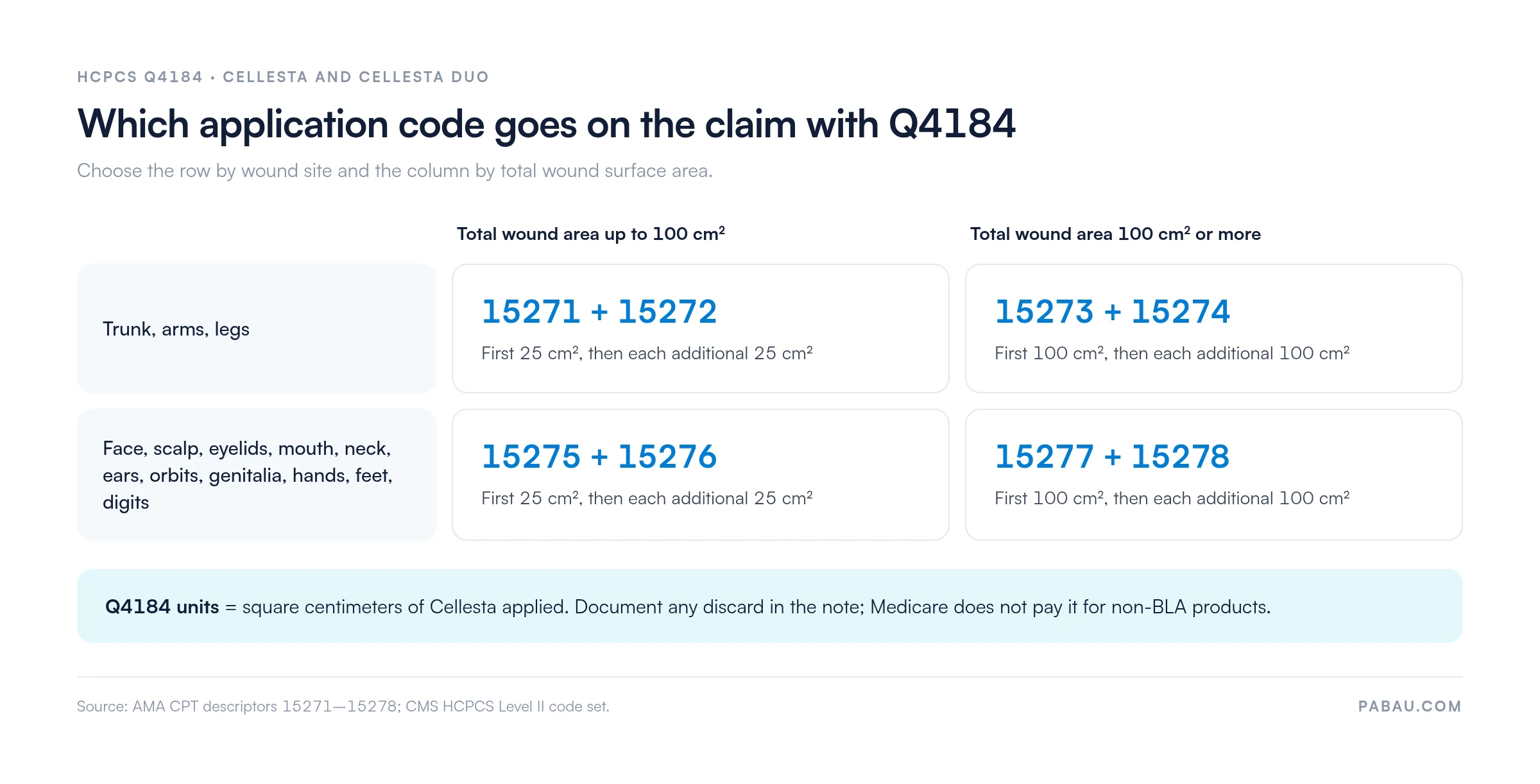
Units follow the square centimeters of product applied. Medicare does not pay the discarded portion of non-BLA skin substitutes, so document it in the note and bill only administered units. Each Q4184 line is paired with an application code from CPT 15271-15278, chosen by wound site and total wound area.
Let Pabau's smart automation suggest the right codes, reduce claim denials, and keep your practice compliant—effortlessly.
Automate repetitive tasks and focus on what matters most—your patients.
Reduce coding errors and ensure compliance with the latest regulations.
Clean claims, fewer denials, and faster reimbursements.
Powerful insights and reporting to help your practice thrive.
HIPAA compliant SOC 2 certified GDPR-compliant Trusted by 4,000+ clinics worldwide

HCPCS Code Q4184 covers Cellesta and Cellesta Duo, billed per square centimeter as an add-on code alongside the application procedure.
Units follow the square centimeters applied; Medicare pays only administered units, and the wound measurement supports medical necessity.
Q4184 is normally paired with a CPT application code from 15271-15278, chosen by wound site and total wound area.
From January 1, 2026, Medicare pays non-BLA skin substitutes such as Cellesta at a flat national rate of about $127 per square centimeter.
Pabau, practice management software with claims management built in, supports insurance billing for US practices.
HCPCS Code Q4184 covers Cellesta or Cellesta Duo, per square centimeter, and it is an add-on code.
You list it separately in addition to the primary skin substitute application procedure. The code applies to both the single-layer Cellesta product and the dual-layer Cellesta Duo, which share one descriptor. Both are human amniotic membrane allografts, classified as cellular and tissue-based products (CTPs) under CMS’s HCPCS Level II coding system.
Q4184 is a temporary Q code, which CMS issued outside the annual CPT cycle so the product could be billed before a permanent code existed. Codes in the Q4100-Q4397 range cover skin substitutes and CTP products, and our HCPCS code reference lists the rest of the range.
Q4184 is product-specific. It does not cover other amniotic membrane or skin substitute products, even when they are clinically similar to Cellesta. Using Q4184 for a different manufacturer’s amniotic product is a coding error that will trigger a denial.
Units for Q4184 equal the square centimeters of Cellesta or Cellesta Duo applied at the encounter. Record any discard in the note, but Medicare does not pay it for non-BLA products. The wound measurement does a separate job. It supports medical necessity and decides which CPT application code goes on the claim.
Calculation steps:
From 2026, Medicare treats Cellesta as an incident-to supply rather than a Part B drug, so the JW and JZ modifiers do not apply. CMS does not pay for discarded amounts of incident-to supplies under any circumstances. Keep JW and JZ for BLA-licensed products and for any payer that still asks for them.
The wound area also sets the application code. The examples below assume a wound on the trunk, arms, or legs.
When you treat multiple wounds at one encounter, add the areas of all wounds in the same anatomic site group for the CPT application code. One group covers the trunk, arms, and legs. The other covers the face, scalp, neck, hands, feet, genitalia, and digits. Report one primary code (15271/15273 or 15275/15277) plus add-on codes for the combined area. Wounds in different site groups are not added together, and each group gets its own primary code. Q4184 units equal the total square centimeters of Cellesta applied for the wounds those CPT codes cover. Payers differ on whether Q4184 goes on one line or is split per site group, so follow your MAC or payer.
Document wound length, width, and area, plus the product size opened, the amount applied, and any amount discarded. Say you open a 5 × 5 cm piece (25 cm²) and apply 20 cm². The note should then say what happened to the other 5 cm². Units that the note cannot account for are a common audit finding.
Medicare and most commercial payers require specific medical record elements before they will pay a Q4184 claim. Missing even one of these is enough to trigger a denial or a post-payment audit request.
A structured superbill that captures product identifiers alongside diagnosis and procedure codes reduces the risk of incomplete claims leaving your practice.
Q4184 covers only the skin substitute product itself. The work of applying it is reported separately with a CPT application code from 15271-15278. Wound site and total wound area decide which one.
Confirm which CPT codes your MAC LCD authorizes alongside Q4184 before billing. Some MACs restrict the application CPT to specific wound types even when the Q code is covered. A consistent claims management workflow keeps the code pair and the note in step. The matrix below shows how site and total area pick the pair.
The Q4xxx series contains dozens of skin substitute codes, and the product names are similar enough that coders regularly transpose them. The table below covers the codes most often confused with Q4184.
Verifying the product name, manufacturer, and registration against the current CMS HCPCS code file before billing is the only reliable safeguard against product-code mismatches. Use the AAPC HCPCS code lookup as a secondary check when the CMS file is not immediately available.
If the box on the shelf says AlloWrap rather than Cellesta, the claim belongs under Q4150, with its own units and documentation.
Medicare coverage for Q4184 depends on the Medicare Administrative Contractor (MAC), and no single national coverage policy applies uniformly. The new skin substitute LCDs for diabetic foot ulcers and venous leg ulcers were withdrawn on December 24, 2025, before they took effect. CGS, Novitas, and First Coast kept their legacy skin substitute LCDs unchanged. Palmetto, NGS, WPS, and Noridian have no active LCD, so claims are judged on whether the service is reasonable and necessary. Check which applies in your jurisdiction before assuming coverage.
Where a legacy LCD applies (CGS, Novitas, First Coast), covered indications commonly include chronic diabetic foot ulcers, venous leg ulcers, and pressure ulcers. Each must follow failed standard care. Those LCDs typically require at least four weeks of standard wound care first. Where no LCD exists, medical necessity is judged case by case. Non-covered indications typically include acute traumatic wounds, surgical wounds healing by primary intention, and wounds that have not been given a trial of conservative treatment.
Prior authorization: Traditional Medicare has no universal prior authorization requirement for skin substitute Q codes, with one exception. From January 1, 2026, the CMS WISeR model requires prior authorization for skin and tissue substitutes in selected states. The model runs in Arizona, New Jersey, Ohio, Oklahoma, Texas, and Washington. The skin substitute component did not start on January 1, 2026, in Arizona and Washington, because neither state had an active LCD. It still applies in New Jersey, Ohio, Oklahoma, and Texas, so verify against current CMS WISeR guidance.
Commercial payers and many Medicare Advantage plans also require prior authorization, and their rules vary by plan and market. Contact the payer before the first application, and record the authorization number in the medical record and on the claim. A claim sent without a required authorization is denied, and that denial is hard to appeal. Keeping up with medical billing compliance requirements across payers matters for any practice that bills skin substitutes regularly.
Run an eligibility and benefits check before every Cellesta application encounter. Confirm whether the patient’s plan, or WISeR in your state, requires prior authorization for Q4184, and document the response with a date and reference number. This takes two minutes and prevents the most common reason Q4184 claims are denied on first submission.
Wound care practices billing Cellesta see a predictable set of denial patterns, and catching them before submission costs less than appealing afterward. A structured denial management process that stops these claims before they leave the practice cuts rework.
Reviewing each of these categories against a clean claim checklist before submission catches most Q4184 denials before they leave the billing queue. Make it a standard pre-submission step for all skin substitute encounters.
From January 1, 2026, Medicare pays skin substitutes that are not licensed as biologics, Cellesta among them, as incident-to supplies under the Physician Fee Schedule. They are paid at a single national rate per square centimeter, about $127. After the November 2025 correction, CMS set it at $127.14. Always verify the current rate with the CMS Physician Fee Schedule search tool on the CMS site.
Reimbursement also varies by place of service. The three most common settings for Q4184 are:
These facility payment rules cover sheet-form skin substitutes such as Cellesta. Non-sheet products stay packaged under OPPS in 2026, so confirm the rules with your MAC before you bill.
A wrong POS code on a Q4184 claim is a denial in its own right, separate from any clinical documentation issue. Cross-check the POS against the performing location before submission. A medical billing process that checks the POS against the scheduled location stops that mismatch before it reaches the payer.
In many wound care practices, the Cellesta size, the wound measurement, and the authorization number live in three places. The chart holds one, a spreadsheet holds another, and the payer portal holds the third. Each hand-off is a chance for the units or the companion CPT code to drift away from the note.
Pabau, the practice management platform we build, keeps the patient record and the billing work in one system. Its claims management supports insurance billing in the US, so your billing team prepares the Q4184 claim from the same record the clinician documented in.
The outcome is less time chasing paperwork between the treatment room and the billing desk. Fewer claims come back for documentation the note already held.

Pabau’s claims management supports insurance billing in the US, so wound care practices can prepare Q4184 claims from the record that holds the visit notes.

Every Q4184 claim rests on two decisions. The units come from the Cellesta you applied. The application code comes from the wound site and the total wound area. When the note answers both, the product mismatches and missing companion codes described above rarely reach the payer.
The rules shifted in 2026, with a flat national payment rate and WISeR prior authorization in selected states. Re-check your MAC’s guidance each quarter rather than trusting last year’s billing sheet.
Pabau’s claims management supports insurance billing in the US. Book a demo to see how your team can prepare skin substitute claims from the same record as the visit.

Need a broader overview of HCPCS billing workflows? Medical billing fundamentals covers how HCPCS and CPT codes interact in a complete revenue cycle.
Seeing recurring claim rejections across your wound care encounters? Denial management in healthcare outlines a systematic approach to tracking, appealing, and preventing repeat denials.
Want fewer errors before claims leave your practice? Pabau’s claims management software supports insurance billing in the US.
Billing skin substitutes to Medicare Part B? Medicare billing walks through the claim rules that sit behind every Q code.
Working with AlloWrap as well as Cellesta? HCPCS code Q4150 covers the neighboring amniotic product’s billing.
HCPCS Code Q4184 is the billing code for Cellesta and Cellesta Duo amniotic membrane skin substitutes, billed per square centimeter. It is an add-on to the application procedure, and it does not cover other amniotic or skin substitute products.
Yes. Both the single-layer Cellesta and the dual-layer Cellesta Duo are reported under Q4184, because the official descriptor names both. Verify this remains current against the active CMS HCPCS code file for the billing year.
Report only the square centimeters applied. For non-BLA products such as Cellesta, Medicare no longer pays the discard and JW/JZ do not apply. Document the discard in the note. The wound’s length times width supports medical necessity and picks the CPT application code. Add wound areas within the same anatomic site group to pick the CPT application code. Report Q4184 units as the total square centimeters applied, split by site group only if your payer requires it.
Traditional Medicare has no universal prior authorization rule for Q4184, with one exception. From January 1, 2026, the CMS WISeR model requires prior authorization for skin and tissue substitutes in selected states. The model runs in Arizona, New Jersey, Ohio, Oklahoma, Texas, and Washington. Skin substitutes were left out in Arizona and Washington, which had no active LCD. Verify against current CMS WISeR guidance, and check Medicare Advantage and commercial plans, which often require it too.
The most common are POS 11 (physician office), POS 22 (hospital outpatient or wound care center), and POS 24 (ambulatory surgical center). In POS 11, Medicare pays Q4184 under the Physician Fee Schedule. In POS 22 and POS 24, the facility is paid for the product, and the physician bills only the application code from 15271-15278. The POS must match the setting where the application occurred, so confirm the rules with your MAC.
The most frequent denial triggers are missing prior authorization and billing Q4184 for a product other than Cellesta or Cellesta Duo. Units the note cannot account for, missing lot numbers or wound photographs, and a missing companion CPT code from 15271-15278 follow close behind.