CPT Code 27425: Lateral retinacular release billing guide
CPT Code 27425: Official descriptor and procedure overview CPT code 27425 is def...

Last Updated: Nov 16, 2026
Q4137 is the HCPCS Level II code for amnioexcel, amnioexcel plus or biodexcel, per square centimeter (add-on, list separately in addition to primary procedure).
AmnioExcel, AmnioExcel Plus and BioDExcel are dehydrated human placental tissue grafts made by Integra LifeSciences Corporation. Q4137 is the product code only. It is reported per square centimeter applied, alongside a CPT 15271-15278 application code on the same claim.
Let Pabau's smart automation suggest the right codes, reduce claim denials, and keep your practice compliant—effortlessly.
Automate repetitive tasks and focus on what matters most—your patients.
Reduce coding errors and ensure compliance with the latest regulations.
Clean claims, fewer denials, and faster reimbursements.
Powerful insights and reporting to help your practice thrive.
HIPAA compliant SOC 2 certified GDPR-compliant Trusted by 4,000+ clinics worldwide

HCPCS Code Q4137 describes AmnioExcel, AmnioExcel Plus or BioDExcel, skin substitute grafts made by Integra LifeSciences Corporation and reported per square centimeter.
Q4137 is an add-on product code, so it always travels with a CPT 15271-15278 application code on the same claim.
Since January 2026, Medicare pays Q4137 as an incident-to supply at a per-square-centimeter rate, not at an ASP-based price.
Most denials stem from missing prior authorization, the wrong ICD-10 diagnosis code, or thin documentation of failed standard wound care.
Pabau’s claims management software sends claims through the Claim.MD clearinghouse and posts remittances against the patient record.
HCPCS Code Q4137 is the Level II code for AmnioExcel, AmnioExcel Plus or BioDExcel grafts, billed per square centimeter. CMS maintains it in the HCPCS Level II code set. Its official descriptor reads: Amnioexcel, amnioexcel plus or biodexcel, per square centimeter (add-on, list separately in addition to primary procedure).
All three products are dehydrated human placental tissue grafts made by Integra LifeSciences Corporation. They are applied over chronic wounds that have not responded to conventional wound care.
Q-codes are temporary HCPCS Level II assignments. CMS can reassign, delete, or convert them to permanent codes at any annual update cycle. Always verify Q4137 is still active for the current year before submitting a claim.
Key product details billers need on file:
Coverage for Q4137 requires documented evidence of a chronic wound that meets specific clinical criteria before application. Medicare’s Local Coverage Determinations govern which indications qualify, and the exact language varies by Medicare Administrative Contractor (MAC) jurisdiction.
Covered wound types under most LCDs:
Prerequisites that must be documented before the graft is applied:
Denials most often cite four non-covered situations:
Documentation drives Q4137 claim approval or denial more than any other single factor. The medical record must support every element of the claim at the time of service, not reconstructed after a denial.
What must be in the clinical note on the date of application:
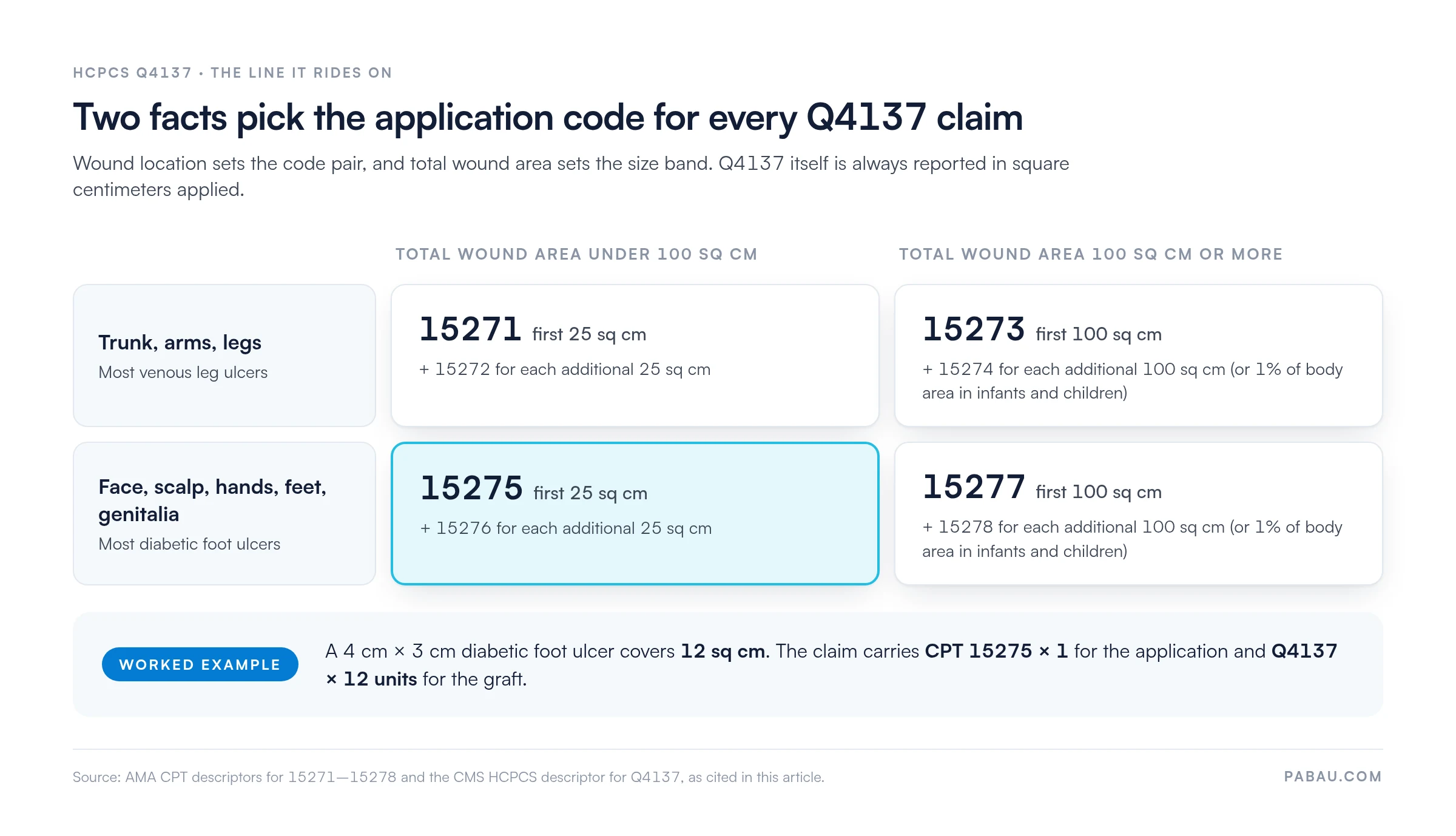
To calculate wound area, multiply length by width in centimeters. A 4 cm x 3 cm wound = 12 sq cm = 12 units of Q4137. If a second graft goes on a different wound on the same date, bill a separate line for each wound with its own measurement.
Keep wound photographs and measurement logs as a standing document in the patient record, updated at every wound-care visit. Auditors look for consistency between the measurement recorded at application and the quantity billed.
Q4137 is a product code only. It is never billed alone. Every Q4137 claim must include a companion CPT application code from the 15271-15278 series on the same date of service. That code describes the procedure of applying the graft.
The correct application CPT depends on wound location and total wound surface area. The table below shows the standard mapping:
Diabetic foot ulcers bill with CPT 15275, because the foot falls in that code’s location group. Venous leg ulcers on the lower leg bill with 15271 when the total wound area is under 100 sq cm.
Confirm the wound site in the operative note before selecting the application CPT. A mismatch between the stated wound location and the CPT billed is a common edit trigger.
Both choices fit on one grid, shown below with the 12 sq cm foot ulcer from the documentation section worked through.
Same-day billing rules: You may bill Q4137 and the application CPT together on the same claim line date. Do not bill two different skin substitute product codes for the same wound on the same date. Stacking two Q-codes on a single wound on a single date will trigger an automatic denial.
Linking the product code and the application code at the encounter level prevents the most common Q4137 edit before the claim leaves the practice.
Since January 1, 2026, Medicare pays skin substitutes such as Q4137 as incident-to supplies, not as biologicals priced on average sales price (ASP). CMS finalized the change for physician offices under the PFS and for hospital outpatient departments under the OPPS.
CMS now sorts skin substitutes into three groups by FDA regulatory status: premarket approval, 510(k), and 361 HCT/P products. AmnioExcel is regulated under PHS 361, so Q4137 sits in the 361 HCT/P group. For 2026, CMS set one payment rate across all three groups and plans to differentiate them in later years.
In the hospital outpatient setting, the product is no longer packaged into the application procedure. It is paid separately under APC 6002, the new class for 361 HCT/P products. To find the rate for a date of service:
Commercial payer rates: Private insurers are not bound by Medicare’s supply rate. Many negotiate a separate contracted rate for skin substitute products, or they may apply a percentage of Medicare. Contact each payer’s provider relations team to confirm Q4137’s contracted allowable before the procedure date.
Before the first Q4137 application of the year, pull the current CMS fee schedule entry for Q4137 and confirm the code is still active. Note the payment amount per sq cm for your setting and add it to your billing reference sheet. Ten minutes here stops claims going out against last year’s rate.
Local Coverage Determinations are the primary policy documents controlling whether a Q4137 claim will pay. Each MAC publishes its own LCD for skin substitute products, and the documentation requirements differ from one to the next. The LCDs most commonly governing Q4137 come from these contractors:
Always look up the controlling LCD for your specific MAC jurisdiction. LCD numbers change when policies are revised, so use the CMS LCD database (lcd.cms.gov) to find the current version.
Insurance eligibility verification before the first application also shows whether the patient’s plan adds coverage requirements beyond Medicare Part B.
Prior authorization for Q4137 varies by payer and by MAC. Medicare does not universally require prior authorization for skin substitutes. Some MACs run prior authorization programs for high-cost CTPs, and many commercial plans always require it. Steps for payers that require prior auth:
Every Q4137 claim needs at least one supporting ICD-10-CM diagnosis code that confirms the wound type and clinical status. Submitting a diagnosis code outside the payer’s covered list produces an automatic denial. The table below shows commonly accepted codes by wound type:
Confirm the accepted ICD-10 list against the controlling LCD for your MAC before billing. Some LCDs include explicit lists of covered and non-covered diagnoses. Submitting E11.621 when the patient has Type 1 diabetes (E10.621) is a specificity error that triggers a denial.
Wound-care practices often stock multiple skin substitute products. Using the wrong Q-code for the product applied is a billing accuracy error that can constitute a false claim. The table below compares Q4137 to closely related Q-codes coders frequently confuse:
The neighboring code, Q4138, covers a different product, so a one-digit slip bills the wrong graft. At the point of care, the clinical note should identify the product applied by its trade name and lot number. The biller then matches that trade name to the current-year CMS HCPCS Alpha-Numeric file to confirm the Q-code.
Cross-referencing against the AAPC HCPCS code lookup or the PGM Billing HCPCS lookup tool can confirm the descriptor before submission.
Create a product-to-Q-code reference card for every skin substitute stocked in your wound-care practice. Update it at the start of each calendar year when CMS publishes the new HCPCS Alpha-Numeric file. Post it in the billing area and in the clinical notes template so the product name and Q-code stay synchronized from documentation to claim.
Improper billing of skin substitutes is an Office of Inspector General (OIG) audit focus area. Denials on Q4137 claims tend to cluster around the same handful of root causes. Each one has a straightforward preventive action.
When a Q4137 claim is denied, start with the CARC (Claim Adjustment Reason Code) on the remittance advice. Each CARC points to a specific denial reason. Working through denial management in healthcare with the CARC as the starting point is faster than re-examining the whole claim.
For a full reference, the denial codes in medical billing guide maps each CARC to an action across payer types.
Submitting a clean claim on the first attempt is the most reliable way to avoid write-offs on Q4137. That means every field verified, every companion code present, and every documentation requirement met before the claim transmits.
A Q4137 claim draws on details recorded in different places. The wound measurement sits in the clinical note, the lot number on a product sheet, and the authorization number in a payer portal. Re-keying them onto the claim form is where units and codes drift apart.
Pabau, the practice management platform we build, keeps the clinical record and the claim in one system. Its claims management software sends CMS-1500 claims through the Claim.MD clearinghouse, runs eligibility checks, and posts ERA remittances against the patient record.
So the biller codes the Q4137 units from the same note that recorded the wound measurement. When a remittance comes back with a denied line, it posts to that patient’s record the day it arrives.

Pabau’s claims management software sends claims through the Claim.MD clearinghouse, checks eligibility, and posts remittances against the patient record. See how it handles skin substitute claims.

A Q4137 claim pays when five details line up on one date of service. They are the product code, the application CPT, the LCD documentation, the prior authorization, and a specific ICD-10 code. Each one can be checked before the graft goes on the wound, and that is when the check belongs.
The 2026 payment change raises the stakes on the units line. With Medicare paying a set amount per square centimeter, the measurement in the note and the units on the claim have to agree. Book a demo to see how Pabau keeps the wound note and the Q4137 claim in one record.

Unclear on how clearinghouses process wound-care claims? Medical claims clearinghouse explains how claims route from practice to payer and where edits fire.
Want to streamline your revenue cycle from intake to payment? What is revenue cycle management covers the full workflow from patient registration through ERA posting.
HCPCS Code Q4137 describes AmnioExcel, AmnioExcel Plus or BioDExcel, skin substitute grafts made by Integra LifeSciences Corporation. It is billed per square centimeter of wound area covered, as an add-on to an application procedure. It is a temporary HCPCS Level II Q-code maintained by CMS.
Since January 2026, Medicare pays Q4137 as an incident-to supply at a per-square-centimeter rate, replacing the old ASP-based pricing. Look up the current amount in the CMS Physician Fee Schedule for office claims, or in OPPS Addendum B for hospital outpatient claims.
The required ICD-10-CM codes depend on the wound type. Use E11.621 or E11.622 for Type 2 diabetic ulcers and I83.009 or I83.209 for venous leg ulcers. Pressure ulcers at Stage 3 or 4 take L89.xx, and other chronic lower-extremity ulcers take L97.xx. Always confirm the accepted code list in the controlling LCD for your MAC jurisdiction before submitting.
Prior authorization requirements vary by payer and MAC. Some MACs run prior authorization programs for high-cost skin substitute CTPs, and most commercial payers always require it. Confirm the payer’s PA requirement before the application date. A claim submitted without a required authorization number is denied automatically.
The most common reasons are missing prior authorization, an ICD-10 code not on the payer’s covered list, and thin documentation of failed standard wound care. Others include a missing CPT 15271-15278 application code, units over the LCD’s per-episode limit, and the wrong place of service. Billing two skin substitute product codes for the same wound on the same date is denied too. The CARC on the remittance advice identifies the reason for each denied claim.
Q4137 must always be billed with a CPT application code from the 15271-15278 series. When the total wound area is under 100 sq cm, CPT 15271 or CPT 15275 covers the first 25 sq cm. CPT 15271 is for the trunk, arms and legs, and CPT 15275 for the face, scalp, hands, feet and genitalia. Add-on codes 15272 and 15276 cover each additional 25 sq cm, and 15273-15278 apply to larger wounds. Diabetic foot ulcers usually bill with CPT 15275, because the foot falls in that code’s location group.