CPT code 21011: Excision of soft tissue tumor of the face
CPT code 21011: Official descriptor and procedure overview CPT code 21011, as pu...

Last Updated: Oct 8, 2026
Q4150 is the HCPCS Level II code for allowrap ds or dry, per square centimeter (add-on, list separately in addition to primary procedure).
Medicare covers Q4150 for chronic non-healing lower extremity wounds that meet the medical necessity criteria in the applicable Local Coverage Determination.
Let Pabau's smart automation suggest the right codes, reduce claim denials, and keep your practice compliant—effortlessly.
Automate repetitive tasks and focus on what matters most—your patients.
Reduce coding errors and ensure compliance with the latest regulations.
Clean claims, fewer denials, and faster reimbursements.
Powerful insights and reporting to help your practice thrive.
HIPAA compliant SOC 2 certified GDPR-compliant Trusted by 4,000+ clinics worldwide

HCPCS Code Q4150 describes Allowrap DS or dry, billed per square centimeter, as a temporary Q-series skin substitute code assigned by CMS.
Medicare covers Q4150 for chronic non-healing wounds when the medical necessity criteria and the documentation requirements are met.
Units come from the measured wound surface area in sq cm, and unit errors are the most common reason a claim is denied.
Q4100, the non-specific skin substitute code, was deleted effective December 31, 2025, so it is not billable in 2026.
Pabau, a practice management platform, helps wound care practices record wound measurements and track Q4150 claims through adjudication.
Short description: Allowrap DS or dry, per sq cm. Long description: Allowrap DS or dry, per square centimeter.
Q4150 is a temporary Level II code that identifies a bioengineered skin substitute graft applied during a wound care procedure. CMS assigns and maintains these Q-series codes through its HCPCS Level II process. The code sits in the Q4100 series, which covers skin substitute products billed per square centimeter applied.
Coders often ask which formulation Q4150 covers. It covers both the DS (dual-sided) and the dry forms of Allowrap. Confirm which one was applied by checking the product invoice and the operative note before submitting.
Allowrap DS is a bioengineered skin substitute used on chronic, non-healing wounds, particularly lower extremity ulcers. It works as a scaffold that supports tissue regeneration at the wound site. The product is applied directly over the wound bed and secured in place, where it integrates with the surrounding tissue over the following weeks.
Clinically, Allowrap DS is indicated for diabetic foot ulcers, venous leg ulcers, and pressure injuries that have not responded to standard wound care. Medicare coverage requires that the wound meets chronicity criteria.
Those criteria are usually defined as a wound present for four or more weeks with no improvement under conventional treatment. Document the chronicity and the prior treatment history before billing HCPCS Code Q4150.
Medicare reimburses HCPCS Code Q4150 at facility and non-facility rates that are updated annually. Both are adjusted geographically using the Geographic Practice Cost Index (GPCI).
Verify current rates against the CMS Physician Fee Schedule lookup tool before submitting claims, since rates vary by Medicare Administrative Contractor (MAC) jurisdiction.
Because payment runs per square centimeter, accurate wound measurement at the time of service is critical. A unit count that does not match the measured wound is a frequent trigger for post-payment audits. Standardize the measurement protocol and record it in the clinical note on the same date of service.
Verify the 2026 Q4150 rate for your own MAC jurisdiction using the CMS Physician Fee Schedule lookup before each plan year starts. Geographic adjustment moves the effective rate between high-cost and rural jurisdictions. A national average figure in your revenue projections will produce consistent shortfalls.
Medicare covers HCPCS Code Q4150 for chronic non-healing wounds of the lower extremity under the applicable Local Coverage Determination.
Coverage is not automatic, and every claim is subject to medical necessity review. Sound medical billing compliance starts with confirming that the patient meets the payer’s clinical criteria before the product is applied.
CMS and most commercial payers require the following criteria to be documented before a Q4150 claim will be considered for payment.
Commercial payer coverage for skin substitutes varies widely. Blue Cross Blue Shield policies, for example, differ by state affiliate and may require prior authorization for Q4150 applications. Verify prior authorization requirements with each payer before the first application, not after a denial arrives.
Practices billing several payers should keep a payer-specific coverage matrix for the Q4100 series. LCD policies list both the covered ICD-10 codes and the exclusions that trigger an automatic denial. It pays to know which denial codes a skin substitute claim tends to attract.
Every Q4150 claim needs a supporting ICD-10 diagnosis code that establishes medical necessity. The codes below are among those commonly accepted under Medicare LCDs for skin substitute applications on lower extremity wounds. This list is representative, not exhaustive. Always verify against the LCD and the payer policy that apply in your MAC jurisdiction.
Code specificity matters. Medicare edits flag claims that use a non-specific laterality or severity code when a more specific one exists.
For diabetic ulcer cases, use the code that identifies the anatomical site and, where applicable, the severity. For venous ulcers, document the involved extremity and the ulcer location so the most specific code can be assigned.
Accurate Q4150 billing depends on the unit calculation, the place of service, the modifiers, and the bill type. An error in any one of them can produce a denial or a post-payment recovery.
Insufficient documentation is the leading reason Q4150 claims fail on audit. The clinical record for each date of service needs all of the following elements.
Those elements are gathered in a fixed order, because each one is a precondition for the next. A payer’s reviewer walks the same sequence in reverse when a Q4150 claim is audited.
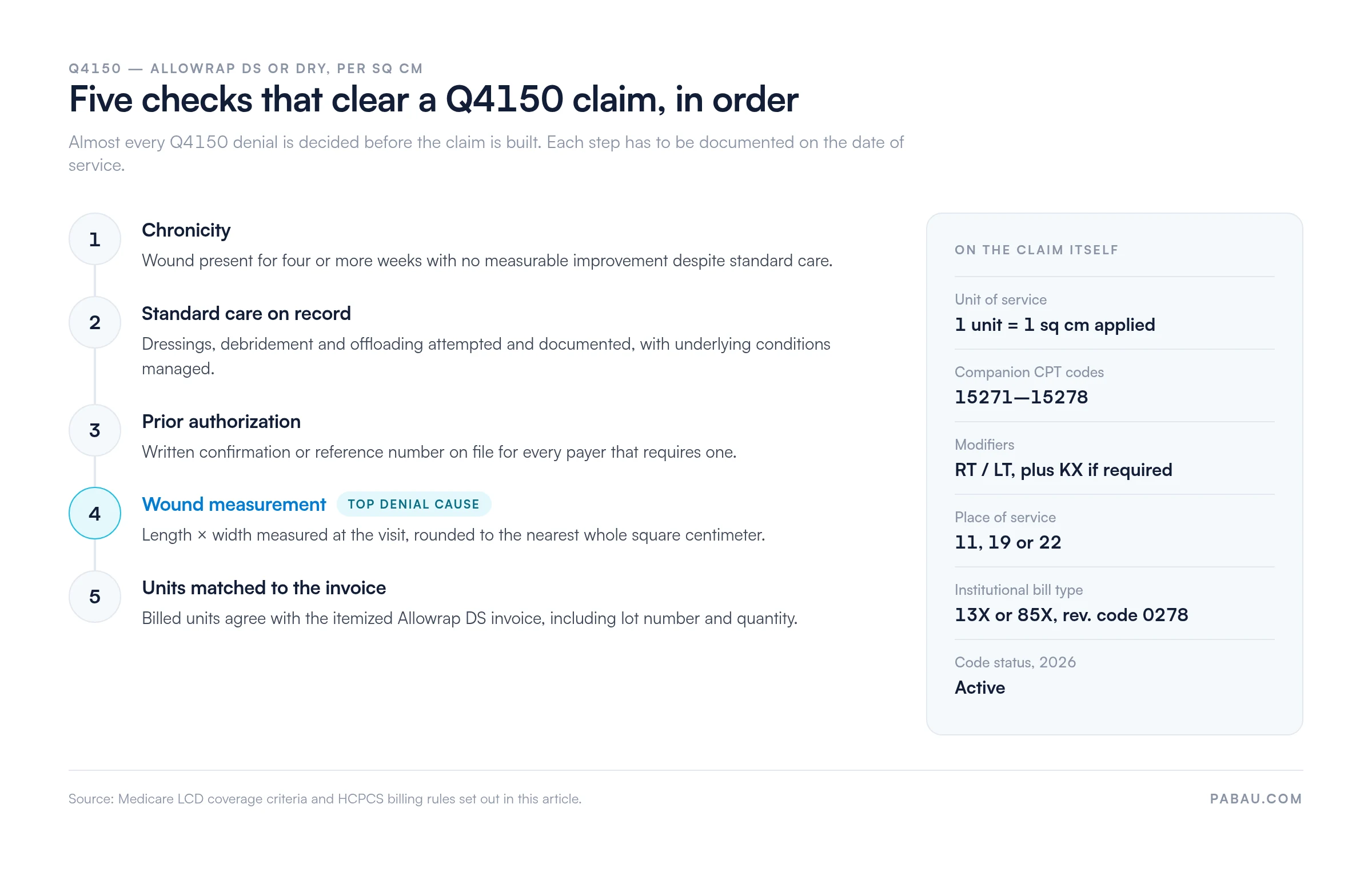
A digital documentation workflow for wound care visits captures these elements consistently. That lowers the risk of a claim being paid on submission and then recovered on retrospective audit.
The Q4100 series covers the range of skin substitute graft products billed to Medicare and commercial payers. When selecting a code, confirm the exact product applied against the HCPCS code description.
Using the wrong Q-code for the product on the invoice is an automatic denial trigger and a False Claims Act risk. The AAPC HCPCS code lookup carries searchable Q4100-series listings for cross-reference.
Q4100 used to be the non-specific fallback for a skin substitute with no product-specific code. CMS deleted it effective December 31, 2025, so a 2026 claim carrying Q4100 rejects as an invalid code.
Map each product SKU or lot number to its own HCPCS code in a reference table. Review that table whenever CMS publishes a quarterly HCPCS update.
Wound care practices billing HCPCS Code Q4150 work through a documentation-heavy process. One missing measurement, a miscalculated unit count, or an unconfirmed prior authorization can stall payment for weeks.
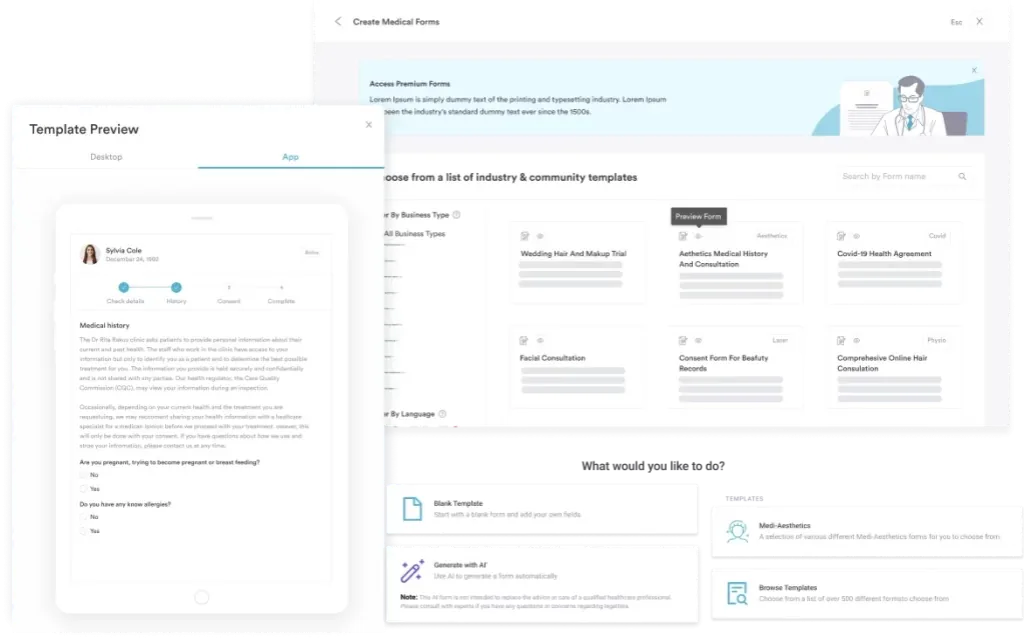
Pabau is practice management software, and its wound care claims software gives billing teams a structured workflow for that record. Staff capture wound measurements at the point of care, and the system flags missing documentation before the claim is submitted. Each Q4150 submission is then tracked through the payer’s adjudication process.
For practices managing several payers with different Q4150 policies, Pabau’s reporting identifies denial patterns by payer and by code. Billing teams can then fix the systemic cause instead of chasing individual rejections. Configurable treatment forms keep the measurement fields and the product invoice inside the patient record.

Pabau helps wound care practices capture accurate wound measurements, manage documentation for skin substitute claims, and catch billing errors before claims are submitted.

HCPCS Code Q4150 is a simple code sitting inside a demanding billing environment. The description is fixed: Allowrap DS or dry, per square centimeter, active for 2026. The work that decides payment happens before the claim is built.
All five checks above are documentation tasks rather than billing tasks. Practices that move them into the clinical visit, instead of into the appeals process, carry much cleaner accounts receivable on skin substitute claims. The trade-off is a slightly longer visit in exchange for a shorter collection cycle.
Pabau’s wound care documentation tools capture each required element at the point of care. Book a demo to see how that works for skin substitute billing and Q4150 claims.

Want the full path from charge capture to collections? Revenue cycle management covers each stage a skin substitute claim passes through.
Seeing repeated denials on skin substitute claims? Denial management in healthcare explains how to analyze denial patterns and build a systematic appeals process.
Want more Q4150 claims paid on first submission? What a clean claim is sets out the fields a payer checks before it adjudicates.
Building the charge sheet for a wound care visit? How a superbill works shows which fields the form has to carry.
New to the billing side of wound care? What is medical billing walks through the process from encounter to payment.
HCPCS Code Q4150 is a temporary Level II HCPCS code that describes Allowrap DS or dry, billed per square centimeter. CMS assigns it to identify the Allowrap bioengineered skin substitute when it is applied to chronic, non-healing wounds. The code is part of the Q4100 series, which covers skin substitute graft products billed to Medicare and commercial payers.
Allowrap DS is a bioengineered skin substitute applied to chronic lower extremity wounds. Those include diabetic foot ulcers, venous leg ulcers, and pressure injuries that have not responded to conventional wound care. In billing terms, Q4150 is reported alongside the skin substitute application CPT codes (15271-15278). The claim then identifies both the procedure performed and the product used.
Q codes are temporary Level II HCPCS codes assigned by CMS. They describe drugs, biologicals, and specific medical products, including skin substitutes, that have no permanent code assignment yet. CMS maintains them rather than the AMA, and updates them through the year as new products receive HCPCS assignments. HCPCS Code Q4150 is one such Q-series code, covering the Allowrap DS skin substitute.
Medicare reimburses Q4150 under the Physician Fee Schedule, at the facility or non-facility rate depending on the place of service. The rate is then adjusted by the Geographic Practice Cost Index for the MAC jurisdiction. Payment runs per square centimeter applied, so the unit count on the claim must match the wound measurement documented that day. Confirm actual 2026 rates through the CMS Physician Fee Schedule lookup tool.
Required documentation includes wound measurements in centimeters, evidence of chronicity over four or more weeks of prior treatment, and a signed treatment plan. You also need an itemized product invoice matching the billed units. Add dated progress notes for each application visit, plus prior authorization confirmation where the payer requires it. A single missing element is enough to support a denial or a post-payment audit recovery.
Coverage varies by payer and by plan. Many commercial payers follow the Medicare LCD criteria for skin substitutes. Others require separate prior authorization, or cap the number of applications covered per wound. Verify prior authorization requirements and coverage criteria with each payer before applying Allowrap DS, because retroactive denials on high-cost skin substitutes are difficult to reverse.