CCSD Code B2710: Radical mastectomy including block dissection
CCSD Code B2710: Definition and clinical scope CCSD Code B2710 is the UK private...

Last Updated: Nov 13, 2026
HCPCS Code Q4144 is a Level II supply code for a named skin substitute graft product, billed per square centimeter applied to a chronic wound. It covers the product only, so every claim also carries an application CPT code from the 15271-15278 range. Since January 1, 2026, Medicare has paid skin substitutes as incident-to supplies at one flat national rate. That rate is $127.14 per cm² in the corrected CY 2026 fee schedule rule.
Most Q4144 denials trace back to three causes. The unit count does not match the measured area, or the prior-authorization number is missing. Otherwise, the notes fall short of the MAC’s Local Coverage Determination (LCD). This guide covers the descriptor, indications, billing mechanics, Medicare payment, and the fix for each common denial.

HCPCS Code Q4144 describes a named skin substitute graft product, billed per square centimeter (cm²) of product applied.
An application CPT code from 15271-15278 must appear on the same claim as Q4144, plus 97597-97598 when debridement is performed.
Since January 1, 2026, Medicare pays skin substitutes as incident-to supplies at one flat national rate of about $127.14 per cm².
Units round up to the next whole cm², and missing authorization numbers draw CO-15 or CO-197 denials.
Pabau’s claims management software tracks prior-authorization codes and dates on the case and submits claims through Claim.MD.
HCPCS Code Q4144 is the Level II supply code that the Centers for Medicare and Medicaid Services (CMS) assigns to a named skin substitute graft. It is billed per square centimeter of graft applied. It sits in the skin substitute series that starts at Q4100, which covers cellular and tissue-based products (CTPs) for wound care. That range has grown past Q4380 through CMS’s quarterly updates.
The table below summarizes the key reference data for Q4144. Always verify the current descriptor and effective date against the CMS HCPCS Level II annual update files. CMS reassigns product-specific Q codes when manufacturers change formulations or when a product loses its coding status.
Because Q codes are temporary, CMS can retire, replace, or renumber them at the annual HCPCS update. Before billing, confirm Q4144 remains active in the year’s official code file. Use the AAPC Codify HCPCS lookup or the CMS Alpha-Numeric file to cross-check the current descriptor verbatim.
Q4144 applies when a clinician applies the specific skin substitute product it describes to a chronic wound that meets the payer’s medical-necessity criteria. The code is not appropriate for acute lacerations, surgical incision closures, or burn debridement unless the applicable LCD specifically permits those uses.
The wound types most commonly supported by LCD coverage criteria for skin substitute CTPs include:
Coverage is never automatic. The clinical record must show the wound type, its duration, prior treatment attempts, and the treating clinician’s judgment that the wound meets the payer’s criteria. Missing any of these elements is a primary denial driver for Q4144 claims. For a diabetic foot ulcer, the diagnosis line typically pairs E11.621 with an L97 code that records the ulcer’s site and depth.
Q4144 is billed per square centimeter of skin substitute product applied. Accurate units therefore depend on precise wound measurement at the time of application. Rounding errors and measurement omissions are the leading cause of unit-related denials.
Measure the wound’s longest length and widest width in centimeters. Multiply those two values to get the area in cm², which sets the number of units to report for Q4144. A wound measuring 3.2 cm × 4.1 cm covers 13.12 cm². Standard MAC guidance is to round up to the next whole unit, so you report 14 units. Follow your MAC or payer if it states another rule.
Product left over from a single-use piece is reported as waste with the JW modifier on its own line. When none is discarded, append JZ instead, following your MAC’s instructions.
When several wounds get the same product in one session, report the total cm² across all wounds as the unit count on a single line. Some MACs require separate lines per wound instead. Document each wound’s individual measurements in the clinical note regardless.
HCPCS Code Q4144 is a supply code that describes the product, not the application procedure. The same claim must carry a companion CPT code for the application, such as 15271 for a small leg wound. Without one, a CO-97 denial typically follows, because the supply has no procedure on the claim to attach to.
Two facts pick the application code pair: where the wound sits, and whether its total area is under 100 cm².
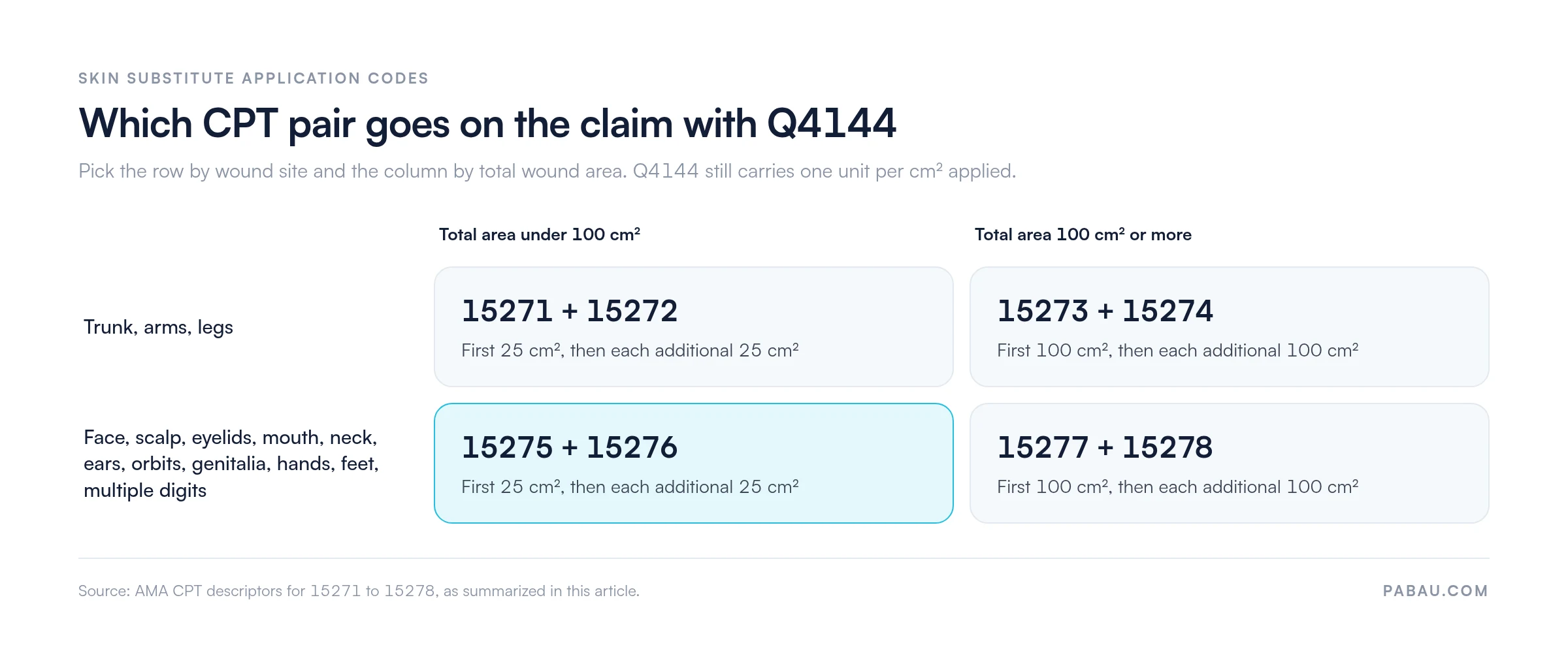
The table below gives each code’s abbreviated descriptor and when to report it with Q4144.
When debridement and graft application occur in the same session, append modifier 59 or the appropriate X modifier to the debridement CPT code. Some MACs bundle debridement into the application codes without modifier 59, so verify your MAC’s National Correct Coding Initiative (NCCI) edit guidance before submitting.
Document the wound measurement immediately before product application, not before debridement. Some MACs require the post-debridement wound area as the basis for unit reporting. Record both measurements in the clinical note to cover either audit scenario.
Since January 1, 2026, Medicare Part B has paid for skin substitutes such as Q4144 as incident-to supplies under the physician fee schedule. The same payment applies in office and facility settings. CMS set one flat national rate for these products, corrected to $127.14 per cm² in the Federal Register correction, before geographic adjustment. Products licensed as biologics under section 351 of the Public Health Service Act are the exception. Check the CMS Physician Fee Schedule search tool for the rate in your locality on the date of service.
No national coverage determination (NCD) covers the full class of skin substitutes, so coverage criteria still vary by Medicare Administrative Contractor (MAC). In December 2025, CMS had the MACs withdraw the new skin substitute LCDs planned for 2026. Coverage therefore follows each MAC’s existing (legacy) LCD, where one exists, at contractors such as Novitas, CGS, WPS, First Coast, and Palmetto GBA.
In Pabau, the practice software we build, claims management software keeps prior-authorization codes and dates on the case and submits claims through Claim.MD.
Check these coverage factors against your MAC’s policy before the first application.
Prior authorization requirements for Q4144 vary by payer and by MAC jurisdiction. Medicare fee-for-service does not require prior authorization for skin substitute CTPs as a universal rule, but many Medicare Advantage plans and commercial payers do. Following sound medical billing compliance practices means checking authorization requirements before each application, not at billing time.
When prior authorization is required, the submission typically needs:
For urgent cases where the wound requires immediate intervention, most payers allow a retrospective authorization request submitted within 24 to 48 hours of service. Document the clinical urgency clearly in the encounter note and obtain the retrospective authorization number before submitting the claim. Never bill without an authorization number on file when the payer requires one. A missing authorization draws a CO-15 or CO-197 denial, which takes a corrected claim or a full appeal to clear.
Documentation is where most Q4144 appeals are won or lost. Meeting the billing requirements for clean claim submission means every required element is in the chart before the claim is filed. Assembling it during an audit response is too late.
The following elements are required by most MAC LCDs for skin substitute CTP claims:
The skin substitute series that starts at Q4100 now runs past Q4380, and each product-specific code maps to a single named product. Billing the wrong code misrepresents what was administered, which makes it a compliance risk as well as a denial risk. The table below shows the most common points of confusion.
When no product-specific code exists, Q4100 is the not-otherwise-specified fallback. Use the PGM Billing HCPCS lookup tool to verify the correct Q code for the specific product administered on the date of service. The CMS HCPCS Alpha-Numeric file, updated annually, is the authoritative source when lookup tools diverge.
Q4144 claims attract a predictable set of denials. Most are preventable with a pre-billing checklist. Building systematic denial management strategies into the billing workflow reduces rework and shortens the revenue cycle for wound care services. Our guide to common billing denial codes decodes the CARC codes that appear on remittances.
Applying the wrong modifier or omitting a required one is a denial trigger that often requires a corrected claim rather than a simple appeal. The following modifiers apply to Q4144 in specific clinical and administrative scenarios.
Modifier GY requires a signed ABN to have been presented to the Medicare beneficiary before the service. Submitting GY without a completed ABN on file exposes the practice to compliance risk. The KX modifier carries a provider attestation. Appending it without the supporting documentation in the chart is a false certification.
Run a pre-billing audit on every Q4144 claim before submission. Check five points. Units match the wound measurement in the note, and a companion CPT code is present. A prior-auth number is populated if required. The diagnosis code is on the LCD covered-diagnosis list, and the correct modifier is appended. Catching these five points pre-submission eliminates the most common denial categories.
Without a shared record, the authorization number sits in a payer portal or a spreadsheet and gets keyed into the claim later. That handoff is where it goes missing, and where a CO-15 or CO-197 denial starts.
Pabau records the prior-authorization code, its dates and the approved sessions on the patient’s case, and warns staff when one is missing. Claims go out through Claim.MD as CMS-1500/837P files, with eligibility checks before the visit and ERA remittances posted back afterward.
Fewer Q4144 claims come back for a missing number, and your team works denials from a remittance trail instead of a stack of paper.

Pabau keeps each case’s prior-authorization code and dates on file and submits claims through Claim.MD. Q4144 claims leave with the number payers check.

Q4144 claims rarely fail because of the product or the wound. They fail on a unit count that does not match the note, a missing authorization number, or an application code left off the claim.
Measure at application, round up, pick the CPT pair by site and size, and attach the authorization before the claim leaves. Do that, and the 2026 flat rate is what your practice gets paid instead of what it appeals for.
Pabau tracks prior-authorization codes and dates on the case and submits claims through Claim.MD. Book a demo to see how it keeps skin substitute claims moving for your wound care practice.

Need a framework for reducing claim rejections across your practice? Denial management in healthcare covers the full workflow for identifying, correcting, and preventing recurring claim denials.
Looking for the CARC codes on your Q4144 remittance? Common billing denial codes decodes the most frequent CARC and RARC codes that appear on Medicare and commercial EOBs.
Want a plain-English overview of the medical billing process end to end? What is medical billing walks through the full claim lifecycle from patient encounter to payment posting.
Billing the application procedure as well? CPT code 15271 covers the first 25 cm² of graft on the trunk, arms, or legs, and when its add-on applies.
Debriding before the graft goes on? CPT code 97597 explains how to bill selective debridement in the same encounter.
HCPCS Code Q4144 is a supply code for a named skin substitute graft product, billed per square centimeter applied. It is used on chronic wounds such as diabetic foot ulcers and venous leg ulcers. It covers the product supply only. A companion CPT application code from 15271-15278 must be reported on the same claim to describe the procedure.
Multiply the wound’s longest length (in cm) by its widest width (in cm) to get the area in cm². That number is your unit count for Q4144. For example, a 3 cm x 4 cm wound equals 12 units. Document both measurements in the clinical note; the units billed must match the wound area recorded.
Yes. Medicare Part B covers Q4144 for medically necessary chronic wound care, subject to the MAC’s existing LCD where one exists. Since January 1, 2026, Medicare pays skin substitutes as incident-to supplies at one flat national rate of about $127.14 per cm². Coverage requires documented wound type, conservative care failure over at least four weeks, and wound measurements that support the units billed.
The application codes paired with Q4144 depend on wound site and total area. For the trunk, arms, or legs, use 15271 and 15272 under 100 cm², or 15273 and 15274 at 100 cm² or more. For the face, scalp, hands, feet, and similar sites, use 15275 and 15276 under 100 cm², or 15277 and 15278 at 100 cm² or more. When debridement occurs in the same session, CPT 97597 or 97598 may also be reported with modifier 59.
The most frequent denial reasons are unit counts that do not match wound measurements, a missing companion CPT application code, and absent prior authorization. Medical necessity notes that miss the MAC’s LCD criteria and a non-covered ICD-10-CM diagnosis code follow close behind. Each is preventable with a pre-submission checklist.
Prior authorization requirements depend on the payer. Traditional Medicare fee-for-service does not require prior auth for skin substitutes as a universal rule, but many Medicare Advantage plans and commercial insurers do. Check the specific plan’s authorization requirements before every application, not at billing time.
Each product-specific code in the skin substitute series that starts at Q4100 maps to a single named product and manufacturer. Q4144 describes one specific product, and neighboring codes describe different products. Billing the wrong Q code for the product administered is a compliance violation as well as a billing error. Always verify the Q code against the CMS HCPCS Alpha-Numeric file for the year of service.