HCPCS Code Q4175: Billing, coverage, and documentation guide
HCPCS code Q4175: Code description and product identity HCPCS Code Q4175 is the ...

Last Updated: Nov 20, 2026
Q4185 is the HCPCS Level II code for Cellesta flowable amnion (25 mg per cc). It is billed per 0.5 cc of product, not per square centimeter of wound.
One unit equals 0.5 cc administered, so a 1 cc application is two units. For 2026, Medicare pays it as an incident-to supply priced by your MAC, and the application goes on a separate G0681-G0684 line. Most errors come from mixing it up with the Cellesta sheet code, Q4184, or from units that do not match the documented volume.
Let Pabau's smart automation suggest the right codes, reduce claim denials, and keep your practice compliant—effortlessly.
Automate repetitive tasks and focus on what matters most—your patients.
Reduce coding errors and ensure compliance with the latest regulations.
Clean claims, fewer denials, and faster reimbursements.
Powerful insights and reporting to help your practice thrive.
HIPAA compliant SOC 2 certified GDPR-compliant Trusted by 4,000+ clinics worldwide

HCPCS Code Q4185 reports Cellesta flowable amnion (25 mg per cc), and one unit equals 0.5 cc of product administered.
Units come from the volume applied, not the wound area, so a 1 cc application is two units.
For 2026, Medicare pays non-sheet skin substitutes like Q4185 as incident-to supplies priced by your MAC, not at the flat per square centimeter rate.
Medicare reports applying a flowable product with HCPCS G0681-G0684, tiered by wound area, because CPT 15271-15278 describe sheet products only.
JW and JZ no longer go on a Q4185 claim, and discarded volume is recorded in the note but never billed.
HCPCS Code Q4185 is the Level II code for Cellesta flowable amnion, billed per 0.5 cc of product. The October 2026 release of CMS’s quarterly HCPCS update lists its descriptor as “Cellesta flowable amnion (25 mg per cc); per 0.5 cc.” The product is an amniotic membrane suspension rather than a sheet, and the Centers for Medicare and Medicaid Services (CMS) maintains the code.
That form decides how the code is billed. A sheet product is counted in square centimeters of graft applied. Q4185 is counted in 0.5 cc units of product, so the wound size never sets the unit count.
| Attribute | Value |
|---|---|
| HCPCS system | Level II (CMS-maintained) |
| Code category | Q, temporary codes |
| Code group | Skin substitutes and biologicals (Q4100-Q4299) |
| Product | Cellesta flowable amnion, 25 mg per cc |
| Product form | Flowable (non-sheet) |
| Unit of measure | Per 0.5 cc of product |
| Pricing indicator (2026 HCPCS file) | 13, priced by the Medicare contractor |
| Coverage code (2026 HCPCS file) | C, carrier judgment |
Verify the descriptor in the current CMS alpha-numeric HCPCS file before each billing quarter. CMS updates the Q4100 range quarterly as products are added, revised, or deleted.
One unit of Q4185 equals 0.5 cc of Cellesta flowable amnion. Divide the volume administered by 0.5 to get the unit count.
| Volume administered | Units of Q4185 |
|---|---|
| 0.5 cc | 1 |
| 1 cc | 2 |
| 1.5 cc | 3 |
| 2 cc | 4 |
Record the volume prepared, the volume applied, and any volume discarded in the procedure note. The units on the claim must match the volume applied. CMS does not pay for discarded skin substitute product in 2026, so the wasted amount stays in the note and off the claim.
Do not convert wound measurements into units. Length and width still belong in the note as evidence of medical necessity, but they do not set the quantity billed for a per-cc code.
Build the unit count from the vial, not the wound. Write the cc drawn up, applied, and discarded in the same note, then divide the applied volume by 0.5. If those three numbers do not reconcile, fix the note before the claim goes out.
Coverage for Q4185 runs through local Medicare contractors rather than a national coverage determination. The 2026 HCPCS file assigns coverage code C, which leaves the coverage decision to the MAC.
Most MACs withdrew their skin substitute LCDs in December 2025, ahead of the 2026 payment change. Novitas, First Coast, and CGS retain older LCDs. Where no LCD applies, the MAC decides on each claim whether the product was reasonable and necessary.
CMS has not run a skin substitute prior authorization program since 2020. The WISeR model, which began in January 2026, reviews skin substitute claims in Arizona, New Jersey, Ohio, Oklahoma, Texas, and Washington. It applies only where an active LCD still governs the item.
Commercial payers and Medicare Advantage plans set their own rules. Check each plan before the first application rather than after the denial.
From January 1, 2026, the CY 2026 Physician Fee Schedule final rule (CMS-1832-F) pays most skin substitutes as incident-to supplies. Sheet products are paid at a single national rate of about $127.14 per square centimeter.
That flat rate does not apply to Q4185 in 2026. CMS treats non-sheet products, flowables included, as incident-to supplies whose payment the MAC sets. The pricing indicator 13 on Q4185 reflects that contractor pricing.
| Setting | 2026 payment basis for Q4185 |
|---|---|
| Physician office (POS 11) | Incident-to supply, priced by the MAC |
| Hospital outpatient department | Packaged into the related procedure under OPPS, with no separate product payment |
| Commercial and Medicare Advantage plans | Plan contract or plan policy |
The CY 2027 Physician Fee Schedule final rule extends national per square centimeter pricing to non-sheet products from January 1, 2027. Check that rule and your MAC’s instructions for how a per-0.5 cc code is paid before you quote 2027 figures.
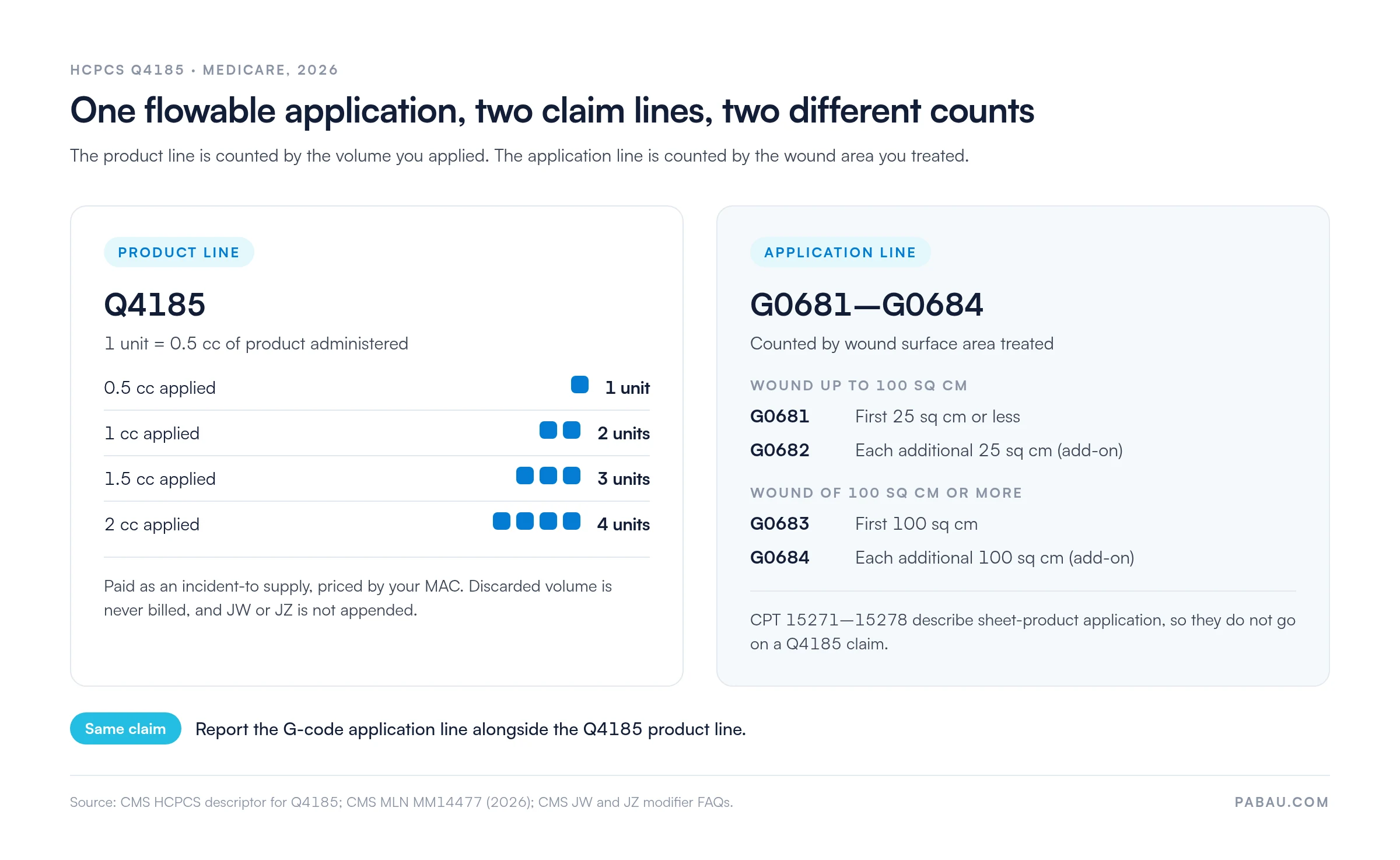
The per square centimeter logic still appears on the claim, but on a different line. The G0681-G0684 application code is tiered by wound area, while the Q4185 line pays only for the product, per 0.5 cc unit.
Q4185 reports the product only. For 2026 Medicare claims, the work of applying it is reported with HCPCS G0681-G0684 on the same claim as the Q4185 line.
CMS created these four codes for applying a non-sheet skin substitute, such as a flowable, gel, or powder. They are effective January 1, 2026, although CMS implemented them on April 1, 2026. Its July 2026 OPPS update (MM14477) tells providers not to use CPT 15271-15278 here. Those CPT codes describe applying sheet products.
| Code | What it describes | When it applies to Q4185 |
|---|---|---|
| G0681 | Application of a non-sheet skin substitute, wound up to 100 sq cm, first 25 sq cm or less | The first application line on a wound under 100 sq cm |
| G0682 | Each additional 25 sq cm, or part thereof, on a wound up to 100 sq cm | Add-on code, reported with G0681 |
| G0683 | Application to a wound of 100 sq cm or more, first 100 sq cm, or 1% of body area in infants and children | The first application line on a large wound |
| G0684 | Each additional 100 sq cm, or part thereof, or each additional 1% of body area in infants and children | Add-on code, reported with G0683 |
| 15271-15278 | Application of sheet-form skin substitute grafts, by wound surface area and anatomic site | Not used for Q4185. These codes belong with sheet products such as Q4184 |
Set side by side, the two lines on a Q4185 claim count different things.
Debridement codes such as 97597 and 97598 are not application codes. Report them only when debridement was separately performed and documented, under your payer’s rules.
Where your MAC still has an LCD, use its covered diagnosis list. Elsewhere, the diagnosis has to support the medical necessity of the product for the wound treated. The codes below are common wound diagnoses, not a coverage list.
| ICD-10-CM code | Description | Note |
|---|---|---|
| E11.621 | Type 2 diabetes mellitus with foot ulcer | Add an L97.4- or L97.5- code for the ulcer site and severity |
| E10.621 | Type 1 diabetes mellitus with foot ulcer | Add the L97 ulcer code as well |
| I83.009 | Varicose veins of unspecified lower extremity with ulcer of unspecified site | Use a code with laterality and site when documented |
| L97.419 | Non-pressure chronic ulcer of right heel and midfoot with unspecified severity | Use a code with the documented severity when available |
| L89.- | Pressure ulcer, by site and stage | Category only, so report the full site and stage code |
| L97.9- | Non-pressure chronic ulcer of unspecified part of lower leg | Not billable as L97.9, since it needs a fifth and sixth character |
Code to the highest specificity the record supports. A diabetic foot ulcer, for example, pairs E11.621 with an L97.4- or L97.5- code for the ulcer itself. Unspecified codes draw more review and give a payer less reason to accept the claim.
| Modifier | Meaning | When to use it |
|---|---|---|
| GA | Waiver of liability statement (ABN) issued as required by payer policy | You expect a medical necessity denial and the patient signed an ABN |
| GZ | Item or service expected to be denied as not reasonable and necessary, no ABN on file | You expect a denial and did not obtain an ABN |
| GY | Item or service statutorily excluded, or does not meet the definition of any Medicare benefit | Rarely fits Q4185, which is a covered benefit category subject to MAC judgment |
| KX | Requirements in the medical policy have been met | Only if your MAC’s policy requires it |
| RT, LT | Right side, left side | Where the payer asks for anatomic modifiers |
JW and JZ do not belong on a Q4185 claim for dates of service from January 1, 2026. The CMS JW and JZ modifier FAQs say non-BLA skin substitutes are now paid as incident-to supplies. Only the administered units are billable, and discarded units cannot be billed with JW or added to the administered amount. Record the discarded volume in the procedure note instead.
These neighboring codes are easy to transpose, and they differ in the unit as well as the product. Q4185 is the only one of the four billed by volume.
| Code | Product | Unit of measure | Key distinction from Q4185 |
|---|---|---|---|
| Q4184 | Cellesta (sheet) | Per sq cm | Same product line in sheet form, counted by area |
| Q4185 | Cellesta flowable amnion (25 mg per cc) | Per 0.5 cc | Flowable form, counted by volume |
| Q4186 | EpiFix | Per sq cm | Different manufacturer, sheet form |
| Q4187 | Epicord | Per sq cm | Different manufacturer, sheet form |
| A4100 | Skin substitute not otherwise specified | Per descriptor | Revised for 2026 so non-sheet products without a specific code can be billed |
The most costly mix-up is Q4184 and Q4185. Billing the sheet code for a flowable vial turns cc into square centimeters, and the unit count stops making sense. Read the product label before you pick the code.
Submitting a clean claim on this code comes down to two checks. The units match the volume administered, and the application line uses a G0681-G0684 code rather than CPT 15271-15278.
The CARC on the remittance tells you which fix applies. Good denial management workflows track each pattern. A repeat error then points to the step in the workflow that needs fixing, before it turns into a run of write-offs.
| CARC | Denial reason | Likely cause on Q4185 | Corrective action |
|---|---|---|---|
| CO-96 | Non-covered charge | The MAC judged the product not reasonable and necessary, or an LCD excludes it | Check the LCD or MAC guidance, and review the medical necessity record |
| CO-11 | Diagnosis inconsistent with the procedure | The diagnosis does not support the product or the LCD list | Resubmit with a supported, fully specified diagnosis |
| CO-4 | Modifier inconsistent or missing | A required modifier is absent, or JW or JZ was appended to the product line | Match modifiers to the payer’s policy |
| CO-16 | Claim lacks information or has a billing error | Units do not reconcile with the documented volume, or required details are missing | Correct the units from the documented cc and resubmit |
| CO-97 | Payment included in another service | The product was packaged, for example in a hospital outpatient setting | Confirm the setting’s payment rules before billing the product separately |
| CARC 24 | Charges covered under a capitation agreement or managed care plan | The claim went to original Medicare for a Medicare Advantage patient | Verify plan type at eligibility and redirect the claim |
The guide to remittance denial codes has CARC descriptions and appeal language for each one.
Review Q4185 remittances monthly. If CO-16 keeps appearing, the volume record and the unit count are drifting apart. If CO-96 dominates, compare your medical necessity notes against your MAC’s current guidance.
Maintaining medical billing compliance on a per-cc code means the note has to explain the volume as well as the wound. Each application note should include the following.
A per-cc supply code depends on the details in the note. When the volume, lot number, and wound record sit in different places, the unit count is hard to defend.
Pabau, a practice management platform with built-in billing, keeps the treatment note, consent, and photos on one patient record. Its software for cleaner claims pulls the details already on that record into the claim. It then submits through Claim.MD in the US and tracks the claim status and remittance.
Your coders still choose the codes and check the units. Pabau keeps the evidence and the claim history together, so a denial is quicker to trace and correct.

Pabau keeps treatment notes, product details, and claim status on the patient record. Your team can trace every supply code back to the note behind it.

Q4185 is billed by volume, and that changes the whole claim. The units come from the cc in the note, and the 2026 payment comes from your MAC rather than the national sheet rate.
Before submission, check the product label, the volume applied, and a G0681-G0684 application line in place of a CPT graft code. Those three checks prevent most of the rework. Book a demo to see how Pabau keeps the note and the claim on the same record.

Billing the Cellesta sheet instead? HCPCS Code Q4184 covers the sheet product, counted per square centimeter.
Need a full picture of how claim rejections are categorized? Denial codes in medical billing covers every major CARC and RARC with appeal guidance.
Unclear on what a clearinghouse does in the claims workflow? What is medical billing explains the end-to-end process from encounter to remittance.
Looking to tighten your overall billing compliance posture? Medical billing compliance outlines the documentation and audit-readiness standards that apply to skin substitute and wound care claims.
HCPCS Code Q4185 covers Cellesta flowable amnion at 25 mg per cc, billed per 0.5 cc of product. It reports the product only. For 2026 Medicare claims, the application is reported separately with HCPCS G0681-G0684.
Units equal the volume of product divided by 0.5, so 1 cc is two units and 2 cc is four units. The wound area does not set the unit count. Bill only the volume administered. Discarded volume is recorded in the note but never billed to Medicare.
For 2026, Medicare pays non-sheet skin substitutes such as Q4185 as incident-to supplies priced by the MAC. The flat national rate of about $127.14 per square centimeter applies to sheet products. In hospital outpatient departments, non-sheet products are packaged into the related procedure.
CMS has not run a skin substitute prior authorization program since 2020. From January 2026, the WISeR model reviews skin substitute claims in Arizona, New Jersey, Ohio, Oklahoma, Texas, and Washington. It applies only where an active LCD governs the item. Commercial and Medicare Advantage plans set their own rules.
Q4185 is Cellesta in flowable form, billed per 0.5 cc. Q4184 is the Cellesta sheet product, billed per square centimeter. Q4186 is EpiFix and Q4187 is Epicord, both sheet products billed per square centimeter.
For 2026 Medicare claims, report HCPCS G0681-G0684, tiered by wound surface area, on the same claim as Q4185. CPT 15271-15278 describe applying sheet products, so CMS says not to use them for a flowable. Debridement codes such as 97597 are not application codes.