HCPCS Code Q4185: Cellesta flowable amnion billing guide
HCPCS Code Q4185: definition and official descriptor HCPCS Code Q4185 is the Lev...

Last Updated: Nov 20, 2026
Q4181 is the HCPCS Level II code for Amnio wound, per square centimeter (add-on, list separately in addition to primary procedure). The product is a lyophilized human amniotic membrane allograft used on chronic and complex wounds.
Since January 1, 2026, Medicare pays it as an incident-to supply at about $127 per square centimeter, in every setting. The application is billed separately with a CPT code from 15271-15278. Unit counts, CPT site selection and diagnosis matching are where payers scrutinize hardest. A diagnosis that does not fit the procedure returns a CO-11 denial.
Let Pabau's smart automation suggest the right codes, reduce claim denials, and keep your practice compliant—effortlessly.
Automate repetitive tasks and focus on what matters most—your patients.
Reduce coding errors and ensure compliance with the latest regulations.
Clean claims, fewer denials, and faster reimbursements.
Powerful insights and reporting to help your practice thrive.
HIPAA compliant SOC 2 certified GDPR-compliant Trusted by 4,000+ clinics worldwide

HCPCS Code Q4181 reports Amnio Wound, a human amniotic membrane allograft, per square centimeter of product applied.
Since January 1, 2026, Medicare pays Q4181 as an incident-to supply at about $127 per square centimeter, the same in every setting.
Unused or discarded product is not billable under the 2026 policy, and the JW and JZ modifiers no longer apply.
The application goes on its own claim line, with a CPT code from 15271-15278 chosen by wound site and total area.
Most MAC skin substitute LCDs were withdrawn in December 2025, so a covered-diagnosis list applies only where Novitas, First Coast or CGS keep one.
HCPCS Code Q4181 is the Level II code for Amnio Wound, per square centimeter, a skin substitute used on chronic and complex wounds. Since January 1, 2026, CMS’s CY 2026 fee schedule final rule pays skin substitutes as incident-to supplies at a single rate of about $127.28.
That rate is per square centimeter, and a later Federal Register correction lists $127.14.
The product is a lyophilized human amniotic membrane allograft, listed under Applied Biologics in Wound Reference. Q4181 sits in the product-specific Q4100 series, where each code maps to one commercially available skin substitute. Verify the descriptor against the current CMS alpha-numeric HCPCS file before billing.
Q4181 is a supply code, so it identifies the product and not the procedure. The application is reported with a CPT code from the 15271-15278 family. The product HCPCS line and the CPT application code go on separate lines of the same claim.
According to CMS’s HCPCS overview, Level II codes are updated at least annually, with quarterly revisions as new products receive codes.
The table below summarizes the key billing attributes of HCPCS Code Q4181. Cross-reference the current CMS HCPCS quarterly file for descriptor updates before you submit.
CMS can reassign product-specific Q-codes when manufacturers change formulations or branding, so confirm the product linked to Q4181 each calendar year. An outdated descriptor does not trigger a denial by itself. A mismatch between the product label in the record and the billed code can still flag an audit.
Medicare covers Q4181 when the application is reasonable and necessary for the patient. Most MAC skin substitute LCDs were withdrawn in December 2025. Novitas, First Coast and CGS still apply older LCDs, so their covered-diagnosis lists and application limits still bind claims in those jurisdictions.
The other MACs decide claim by claim, on reasonable and necessary grounds, from the clinical record. The lists below reflect the scenarios payers commonly accept and reject.
Clinical documentation for Q4181 must show that the product was applied according to the manufacturer’s protocol, after wound bed preparation. Write the note on the date of service. Payers treat a note reconstructed later as a documentation deficiency.
These standard application steps should appear in the clinical record:
Units for Q4181 are reported per square centimeter of product applied to the wound, not per square centimeter of wound. Report a partial square centimeter of applied product as the next whole unit. Opened product that is unused or discarded is not billable under the 2026 incident-to supply policy.
The JW and JZ waste modifiers no longer apply to skin substitutes either. The worked examples below follow that method.
When the same product is applied to several wounds in one session, sum the square centimeters applied across all of them. Then round the combined total up to a whole unit. Splitting each wound onto its own claim line can trigger a maximum frequency edit, depending on the MAC’s policy.
Every Q4181 claim needs an ICD-10-CM diagnosis that matches the wound being treated. Where Novitas, First Coast or CGS still apply an LCD, that code must also sit on the LCD’s covered-diagnosis list. A diagnosis that does not fit the procedure returns CO-11, which means the diagnosis is inconsistent with the procedure.
The table lists common wound-type codes. Confirm exact codes against the current ICD-10-CM tabular list before you submit.
Q4181 identifies the product supplied. Report the application on its own line of the same claim, using a CPT code from 15271-15278. The wound site and total wound area pick the code.
Trunk, arm and leg wounds start at 15271. Face, scalp, eyelids, mouth, neck, ears, orbits, genitalia, hands, feet and multiple digits start at 15275. A wrong site code or under-reported area is a frequent trigger for post-payment audits.
Below 100 sq cm, the 25 sq cm add-on repeats per increment. A 55 sq cm leg ulcer takes 15271 plus 15272 x 2. The same wound on the foot is 15275 plus 15276 x 2.
At 100 sq cm or more, coding moves to 15273 or 15277. The grid below shows both questions together.
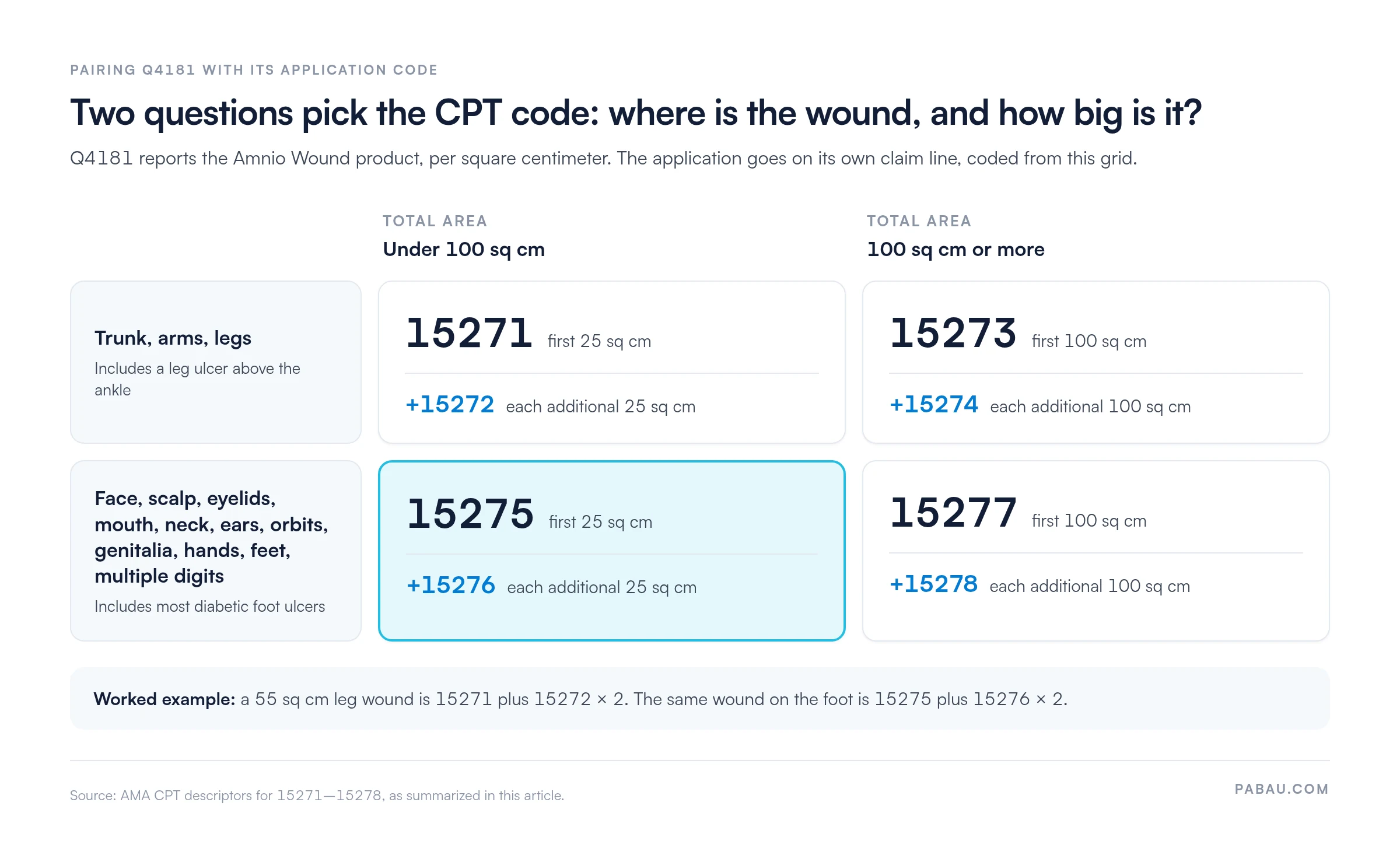
Before choosing 15271 or 15275, check whether the wound sits on a named site such as the foot, hand, face or genitalia. Foot wounds on diabetic patients often default to 15271 by mistake. Using 15271 when 15275 applies creates a site mismatch that can flag a post-payment audit.
The Q4100 series holds well over 100 skin substitute codes, and each maps to one specific product. Staff who search by product name and pick the nearest result can bill the wrong code for the right product. That error can mean a full denial or post-payment recoupment. Even the unit can differ, since code Q4174 bills liquid PalinGen and ProMatrX products per 0.25 cc rather than per square centimeter. Woundex and Bioskin, by contrast, share one code billed per square centimeter, HCPCS code Q4163.
The table below compares Q4181 with its immediately adjacent codes. For HCPCS Level II lookups, the AAPC Codify HCPCS search tool allows keyword-based code lookup.
Product-to-code assignments can shift with CMS HCPCS updates. The safest workflow matches the product name and manufacturer on the package label against the CMS quarterly file. Use the PGM Billing HCPCS lookup as a quick reference, but always validate against the current CMS release.
Medicare Part B pays for Q4181 when the application is reasonable and necessary. In the Novitas, First Coast and CGS jurisdictions, that judgment still runs through an LCD. Traditional Medicare coverage does not extend automatically to Medicare Advantage plans, which may add prior authorization.
Tracking coverage criteria and payment rates across payers is part of revenue cycle management for wound care practices.
Since January 1, 2026, Medicare pays non-BLA skin substitutes such as Q4181 as incident-to supplies. The old ASP-based payment no longer applies. The CY 2026 rules set one rate of about $127.28 per square centimeter, and a Federal Register correction lists $127.14.
The rate is the same in the physician office, the hospital outpatient department and the ambulatory surgical center. It stays fixed for the calendar year, so no quarterly ASP update moves it.
Traditional Medicare Part B does not require prior authorization for Q4181 in most states. The exception is CMS’s WISeR model, which adds prior authorization for skin substitute applications from January 2026.
WISeR runs in Arizona, New Jersey, Ohio, Oklahoma, Texas and Washington, and gates claims only where an active LCD still applies. Medicare Advantage plans and commercial payers frequently require prior authorization as well. A claim filed without a required authorization is denied with CARC CO-197.
Skin substitute claims rank among the most frequently denied in wound care billing. The denial patterns for Q4181 are predictable, and most are preventable with pre-submission checks. Structured denial management strategies that catch these errors before submission reduce rework and speed up payment.
The table maps common denial reasons to their Claim Adjustment Reason Code (CARC) and resolution steps.
The medical billing denial codes reference covers the full CARC set with resolution guidance.
A complete documentation package for each Q4181 claim reduces medical necessity denials and audit exposure. Good medical billing compliance means assembling it before the claim leaves the practice. Use submitting a clean claim as a companion reference for general pre-submission requirements.
Run a pre-submission audit on Q4181 claims with the checklist above. Have a second biller verify the unit count, the ICD-10 linkage, and the CPT site code. The two-minute cross-check catches rounding errors, billed waste and POS mismatches before they reach the payer.
A Q4181 claim carries two billed lines and comes back as one remittance. Wound care teams often track that cycle across a clearinghouse portal and a spreadsheet.
Pabau, the practice management platform we build, keeps the claim cycle in one place. In the US, its simpler claims management works through Claim.MD. It submits CMS-1500/837P claims, checks eligibility before the visit, and posts ERA remittances against each claim.
Your coders still choose the HCPCS, CPT and ICD-10 codes. Pabau submits the claim as built and shows its status. Once the remittance posts, your billers can compare what Medicare paid with the 2026 supply rate they expected.

Pabau’s claims management submits CMS-1500/837P claims through Claim.MD, checks eligibility, and posts ERA remittances against each claim. Your billing team sees what paid and what needs follow-up.

The 2026 supply policy made the payment side of Q4181 simple: one rate, the same in every setting, with no waste to bill. Whether the claim pays now rests on the work your team controls.
Report units for product applied, choose the application code from site and total area, and confirm the diagnosis fits the wound. In the six WISeR states, add prior authorization to that list before the first application.
Book a demo to see how Pabau submits wound care claims and posts the remittances that come back.

Need a broader overview of wound care billing workflows? Medical billing fundamentals covers the full revenue cycle from patient encounter to payment posting.
Seeing recurring claim rejections across multiple codes? Denial management in healthcare outlines a systematic approach to reducing first-pass denial rates across your claim portfolio.
Want to understand the compliance framework behind wound care billing? Medical billing compliance guidance covers OIG audit priorities, documentation standards, and how to build a defensible billing program.
Billing the application for a leg or trunk wound? CPT code 15271 explains the first-25-sq-cm application code that pairs with Q4181 on those sites.
Comparing the neighboring skin substitute code? HCPCS code Q4180 covers the product code that sits directly before Q4181.
HCPCS Code Q4181 covers Amnio Wound, a human amniotic membrane allograft, reported per square centimeter applied. Medicare pays it when the application is reasonable and necessary. Where Novitas, First Coast or CGS still apply an LCD, the diagnosis must be on its covered list. The application procedure is billed separately, with a CPT code from 15271-15278.
Since January 1, 2026, Medicare pays Q4181 as an incident-to supply at a single rate of about $127.28 per square centimeter. A Federal Register correction lists $127.14. The rate is the same in office, hospital outpatient and ASC settings, and it stays fixed for the calendar year.
Traditional Medicare does not require prior authorization for Q4181 in most states. CMS’s WISeR model adds it from January 2026 in Arizona, New Jersey, Ohio, Oklahoma, Texas and Washington, where an LCD still applies. Medicare Advantage plans and most commercial payers require it, and a missing authorization returns CO-197.
Units are reported per square centimeter of product applied, not per square centimeter of wound. A partial square centimeter of applied product rounds up to the next whole unit. Opened product that is unused or discarded is not billable under the 2026 supply policy, and JW and JZ no longer apply.