CPT code 93503: Swan-Ganz catheter billing and modifiers
CPT code 93503: Official descriptor and procedure overview In the AMA CPT code s...

Last Updated: Oct 23, 2026
L8030 is the HCPCS Level II code for breast prosthesis, silicone or equal, without integral adhesive, any type.
Medicare's claims management requirements for external breast prosthetics are specific. Suppliers need one prosthesis per side, verified medical necessity, and a physician's written order that meets Local Coverage Determination L33317.
Coding errors and incomplete documentation account for the majority of L8030 denials.
Let Pabau's smart automation suggest the right codes, reduce claim denials, and keep your practice compliant—effortlessly.
Automate repetitive tasks and focus on what matters most—your patients.
Reduce coding errors and ensure compliance with the latest regulations.
Clean claims, fewer denials, and faster reimbursements.
Powerful insights and reporting to help your practice thrive.
HIPAA compliant SOC 2 certified GDPR-compliant Trusted by 4,000+ clinics worldwide

HCPCS code L8030 describes a silicone (or equal) breast prosthesis without integral adhesive, billed as durable medical equipment under Medicare and most commercial payers.
Medicare limits coverage to one external breast prosthesis per side under LCD L33317. Billing a second prosthesis for the same side without documented medical necessity will be denied.
L8030 was revised in 2010 to add the “without integral adhesive” qualifier, distinguishing it from L8031. Submitting the wrong code is one of the most common denial triggers for DME suppliers.
Pabau’s claims management software helps DME suppliers and practices track documentation requirements, flag incomplete records before submission, and reduce L8030 claim denials.
HCPCS code L8030 is maintained by the Centers for Medicare and Medicaid Services, known as CMS, as part of the HCPCS Level II code set. The official descriptor reads: Breast prosthesis, silicone or equal, without integral adhesive.
The code sits within the Breast Prosthetics and Accessories category (L8000-L8039) under Orthotic and Prosthetic Procedures. It’s classified as a lump-sum purchase item under the DME, prosthetics, orthotics, and supplies (DMEPOS) billing category. The effective date is January 1, 1989, and the code remained valid through the 2026 HCPCS update cycle.
Other external prostheses are billed under DMEPOS too, and HCPCS code V2625 covers enlarging an existing ocular prosthesis rather than replacing it.
The 2010 PDAC HCPCS code update, published by the Pricing, Data Analysis and Coding contractor (Noridian), added the “without integral adhesive” qualifier to L8030. Before that revision, the code applied to all silicone breast prostheses regardless of adhesive type. The 2010 update simultaneously created L8031 (with integral adhesive), splitting the category to improve product specificity and PDAC verification accuracy. Patients who claim reimbursement themselves need an itemized receipt, which is what a superbill template sets out.
The difference between L8030 and L8031 is straightforward in theory but frequently confused in billing practice. L8030 covers prostheses that are worn in a mastectomy bra pocket or attached with separately applied adhesive products. L8031 covers prostheses with adhesive built directly into the prosthesis material.
A separately applied adhesive attachment is its own billable item, listed on the same claim under A4280. It does not pair with L8031, where the adhesive is already part of the prosthesis.
Submitting L8031 when the product has no integral adhesive (or vice versa) triggers an automatic mismatch against PDAC product verification records. PDAC assigns codes to specific manufacturer products, so the billed code must match the verified product code exactly. Check the AAPC Codify HCPCS lookup to confirm the correct code for a specific product before billing.
But matching the code to the product correctly doesn’t make L8031 billable to Medicare. LCD L33317 designates L8031 as non-covered because integral adhesive offers no demonstrated clinical benefit over L8030, so Medicare denies it as not reasonable and necessary regardless of coding accuracy.
L8030 does not stand alone. Mastectomy patients often qualify for multiple covered items, and claims for related codes are frequently submitted together. Understanding the full L8000-L8039 range reduces unbundling errors and missed revenue. For other DME billing guidance.
CMS Local Coverage Determination L33317 governs Medicare coverage for external breast prostheses, including HCPCS code L8030. The LCD is the primary authority DME suppliers must follow when determining whether a claim will be covered.
An external breast prosthesis is covered when the patient has undergone a mastectomy and has a documented clinical need for the prosthesis. The treating physician must provide a written order that establishes medical necessity before the prosthesis is dispensed.
Medicare’s position under LCD L33317 is explicit: more than one external breast prosthesis per side will be denied as not reasonable and necessary. This is a hard frequency limit, not a guideline. A second prosthesis for the same side requires documented medical necessity (such as significant weight change, prosthesis failure, or wound healing complications) to have any chance of coverage.
Suppliers using structured medical documentation workflows can flag these edge cases before submission rather than after denial. Building a review step that checks the claim against existing prosthesis history reduces avoidable write-offs.
LCD L33317 also governs the mastectomy bra code (L8000). A bra is covered when the patient has a covered mastectomy form (L8020) or a covered silicone breast prosthesis (L8030), and the pocket of the bra is used to hold the form or prosthesis. This means L8000 cannot be billed independently. It rides on the coverage of L8020 or L8030.
If the L8030 claim is denied, the associated L8000 claim will also be denied. Suppliers should confirm L8030 eligibility before submitting the bra code on the same claim or a subsequent claim.
When coverage is uncertain (for example, when a second prosthesis is being requested for the same side), suppliers must issue an Advance Beneficiary Notice of Noncoverage before dispensing the item. The ABN informs the patient that Medicare may not pay and that they may be financially responsible.
Dispensing without an ABN when coverage is questionable leaves the supplier unable to collect from the patient if the claim is denied. Suppliers can pair the ABN with a signed HIPAA authorization form to document that the patient understood and agreed to the financial disclosure.
Check PDAC product verification records before billing L8030. Not all silicone breast prostheses on the market carry a valid PDAC-assigned HCPCS code. Billing L8030 for a product that PDAC has not verified for that code results in an automatic denial that cannot be appealed on medical necessity grounds alone.
Documentation failures drive more L8030 denials than coding errors. CMS audits of DME claims consistently find that missing or incomplete physician orders, absent diagnosis codes, and inadequate proof of delivery are the top denial triggers for prosthetic items.
Every L8030 claim requires a minimum documentation package before submission. Missing any element gives payers grounds to deny the claim during post-payment audit or prepayment review.
Practices that use digital intake forms can build these requirements into the intake workflow, ensuring the documentation package is complete before the item is dispensed rather than assembled after a denial. Teams that need a starting point can adapt our patient intake form template instead of building one from scratch.
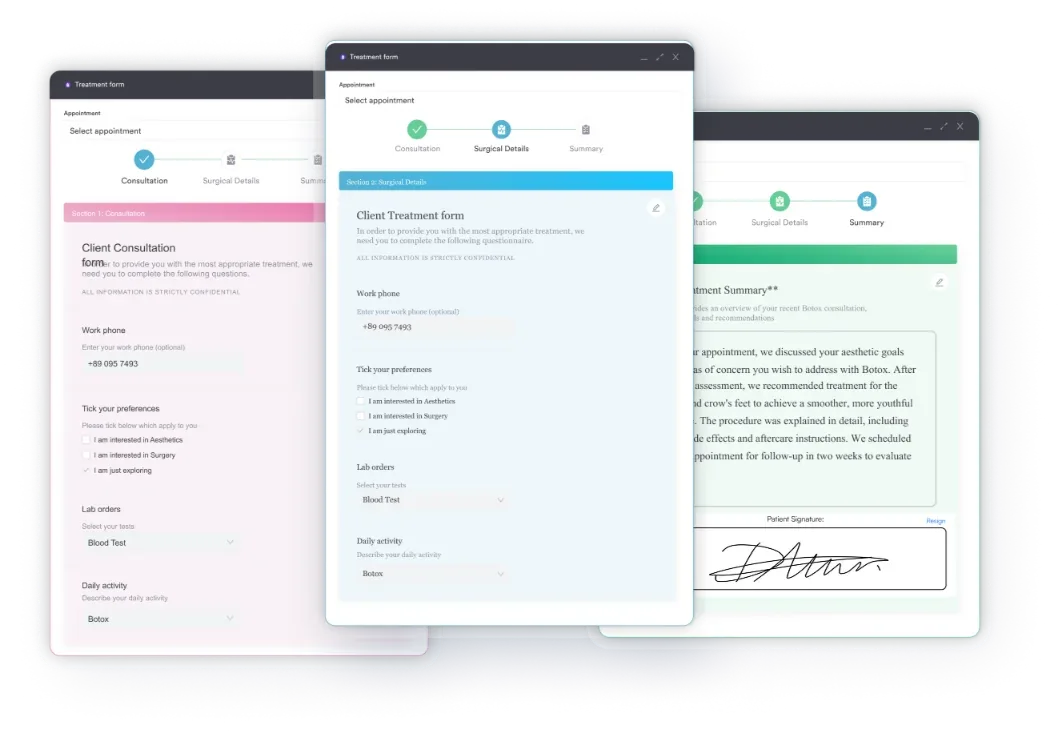

Pabau’s claims management tools help DME suppliers and practices build documentation checklists, track order completeness, and submit cleaner claims. See how it works for your team.

An osteopathy practice platform keeps device fittings, treatment notes, and billing codes in one patient record.
An L8030 claim without a covered ICD-10 diagnosis code will be denied for lack of medical necessity. The diagnosis on the claim must link the patient’s condition to the clinical need for an external breast prosthesis. The following ICD-10-CM codes are the most commonly accepted by Medicare and commercial payers for L8030 medical necessity purposes.
For bilateral mastectomy cases (Z90.13), bill L8030 separately for the right and left sides using the appropriate laterality modifier (RT for right, LT for left). Submitting both on a single line without modifiers triggers NCCI edits and will be rejected.
Coders using practice management software should verify laterality is documented in both the physician’s order and the patient’s clinical record before billing.
Z85.3 (personal history of malignant neoplasm of breast) is the most common diagnosis code submitted with L8030 claims, as most patients present post-mastectomy rather than during active cancer treatment. Confirm this code is in the patient’s active problem list or documented in the ordering physician’s notes before using it on the claim.
Clean L8030 billing requires attention at every stage: product verification, documentation collection, claim assembly, and post-submission follow-up. The most common denial patterns are preventable with the right workflow.
Medicare does not require prior authorization for L8030 under standard Part B DME coverage. However, many commercial payers and Medicare Advantage plans do require it. Suppliers should verify authorization requirements with each payer before dispensing. Failing to obtain required authorization when the payer mandates it results in a denial that typically cannot be appealed on medical necessity grounds alone.
Use the CMS Physician Fee Schedule tool to confirm current Medicare reimbursement rates for L8030 by jurisdiction. Rates vary by DME MAC region, and fee schedule amounts are updated annually. Verify the fee schedule for the billing jurisdiction before setting patient financial responsibility.
Redetermination (Level 1 appeal) is the first step for denied Medicare claims. The supplier has 120 days from the denial date to file. For denials based on missing documentation, gather the complete documentation package (physician order, clinical notes, proof of delivery, ICD-10 codes) before submitting the redetermination request.
For denials involving PDAC code assignment disputes, contact the PDAC contractor directly. PDAC decisions require a separate advisory process and cannot be resolved through the standard Medicare appeals pathway. Suppliers can also use the PGM Billing lookup tool to cross-reference code descriptions and confirm billing accuracy before filing an appeal.
Practices managing multiple prosthetics claims benefit from compliance management workflows that track denial reasons, document appeal submissions, and monitor deadlines. A systematic appeals process ties into broader revenue cycle management and recovers revenue that would otherwise be written off.
For DME suppliers focused on post-mastectomy care.

L8030 claim denials are almost entirely preventable. The most common failure points (wrong code, missing physician order, absent ICD-10 code, frequency limit violations, and missing proof of delivery) all come from incomplete pre-submission workflows.
Pabau’s claims management software gives DME suppliers and practice billing teams a structured workflow to verify documentation completeness, flag claim errors before submission, and track denials through the appeals process. If your team is losing revenue to preventable L8030 denials, book a demo to see how Pabau’s billing workflows can help.

Billing a combined OGD and colonoscopy? CCSD code G8082 billing guide covers billing a combined diagnostic OGD and colonoscopy performed during a single anesthetic session.
Billing a diagnostic colonoscopy? CCSD code H2002 billing guide covers billing a diagnostic colonoscopy performed without therapeutic intervention, including bowel cancer screening.
Billing a therapeutic sigmoidoscopy? CCSD code H2503 billing guide explains the ancillary codes and authorization rules that vary across insurers for this procedure.
Handling DME battery charger claims too? A4613 covers billing rules for portable ventilator and oxygen equipment battery chargers.
Need a lip neoplasm reference too? D10.0 covers documentation requirements for benign neoplasms of the lip.
Billing a colorectal reversal surgery? CCSD code H3390 billing guide covers billing the reversal of Hartmann’s procedure, a demanding elective colorectal surgery.
HCPCS code L8030 covers a breast prosthesis made of silicone or equivalent material, without integral adhesive, billed as a lump-sum durable medical equipment purchase. It applies to external prostheses worn by patients following mastectomy and is covered by Medicare when the claim meets LCD L33317 criteria, including a physician’s written order and a covered ICD-10 diagnosis code.
L8030 covers a silicone breast prosthesis without integral adhesive. L8031 covers a prosthesis with adhesive built directly into the material. The 2010 PDAC HCPCS update split the original L8030 code into these two codes to improve product specificity. Medicare denies L8031 as not reasonable and necessary under LCD L33317, regardless of whether the code was correctly matched to the product, so it can only be billed to the patient as a non-covered item.
Yes, Medicare covers L8030 under Part B DME benefit when the claim satisfies Local Coverage Determination L33317. Coverage requires a physician’s written order, a covered ICD-10 diagnosis code (such as Z85.3 or Z90.1x), proof of delivery, and a PDAC-verified product. Medicare limits coverage to one prosthesis per side. A second prosthesis for the same side requires documented medical justification.
Medicare covers one external breast prosthesis per side under L8030. Billing a second prosthesis for the same side without documented medical necessity (such as significant weight change, prosthesis failure, or wound complications) will be denied as not reasonable and necessary under LCD L33317. Bilateral mastectomy patients may receive one prosthesis per side, billed with RT and LT laterality modifiers.
The most commonly accepted ICD-10-CM codes for L8030 include Z85.3 (personal history of malignant neoplasm of breast), Z90.10-Z90.13 (acquired absence of breast and nipple, with specificity by laterality), and C50.x (malignant neoplasm of breast, active). Z85.3 is the most frequently used because most claims are submitted post-mastectomy rather than during active cancer treatment.
Billing L8030 requires a physician’s written and signed order, clinical documentation supporting mastectomy and medical necessity, a covered ICD-10 diagnosis code, proof of delivery with the patient’s dated signature, and confirmation that the specific product has a PDAC-verified L8030 code assignment. Missing any of these elements typically results in a denial that requires a Level 1 redetermination appeal to resolve.