CCSD Code J5520: Total pancreatectomy billing guide
CCSD Code J5520: Definition and procedure scope CCSD Code J5520 describes a tota...

Last Updated: Oct 20, 2026
L1810 is the HCPCS Level II code for knee orthosis, elastic with joints, prefabricated item that has been trimmed, bent, molded, assembled, or otherwise customized to fit a specific patient by an individual with expertise.
The device is constructed from elastic materials such as neoprene or spandex and incorporates one or more hinged joints to support the knee. Under Medicare billing rules, L1810 falls into the lump sum purchase category, meaning it is purchased outright rather than rented.
It sits within the broader Knee Orthotics range L1810-L1860, which covers the full spectrum of prefabricated and custom-fabricated knee supports.
Let Pabau's smart automation suggest the right codes, reduce claim denials, and keep your practice compliant—effortlessly.
Automate repetitive tasks and focus on what matters most—your patients.
Reduce coding errors and ensure compliance with the latest regulations.
Clean claims, fewer denials, and faster reimbursements.
Powerful insights and reporting to help your practice thrive.
HIPAA compliant SOC 2 certified GDPR-compliant Trusted by 4,000+ clinics worldwide

HCPCS code L1810 describes a prefabricated elastic knee orthosis with joints that has been trimmed, bent, molded, assembled, or otherwise customized to fit a specific patient by an individual with expertise.
Medicare coverage under LCD L33318 requires documented knee weakness or deformity needing stabilization. Claims without this documentation are denied as not reasonable and necessary.
L1810 differs from L1812 in one critical way: L1810 requires customization by a qualified individual, while L1812 is supplied off-the-shelf without modification.
L1810 is a HCPCS Level II code, not a CPT code, even though many billing searches use “CPT” language for it.
Pabau’s claims management software helps DME suppliers and orthotic practices track documentation checklists, modifier usage, and claim status to reduce L1810 denials.
The official CMS descriptor reads: Knee orthosis (KO), elastic with joints, prefabricated item that has been trimmed, bent, molded, assembled, or otherwise customized to fit a specific patient by an individual with expertise.
| Attribute | Detail |
|---|---|
| HCPCS Level | Level II (DME/Orthotics) |
| Code range | Knee Orthotics L1810-L1860 |
| Billing category | Lump sum purchase |
| Device type | Prefabricated, customized fit |
| Material | Elastic (neoprene, spandex, or similar) |
| Joint requirement | Yes, hinged joint(s) required |
| Customization required | Yes, by individual with expertise |
Medicare Part B covers L1810 under Local Coverage Determination (LCD) L33318, administered by the DME MACs, but coverage is not automatic. The LCD states that if L1810, L1812, L1820, or L1821 is provided without the medical necessity criteria being met, the orthosis is denied as not reasonable and necessary.
For physical therapy practices and orthotic providers treating Medicare patients, that standard should drive every documentation decision before a device is dispensed.
To meet Medicare’s standard for L1810, the patient’s medical record must document:
CGS Medicare’s Dear Physician documentation reinforces this threshold. The prescribing clinician’s notes must show knee weakness or deformity as the functional basis for the device. A diagnosis code alone is insufficient if the clinical narrative does not describe the functional limitation.
Noridian’s Documentation Checklist for Knee Orthoses spells out what “objective” means in practice. The exam note needs the actual test result, such as a Drawer test or varus/valgus stress test showing instability, not a general statement that the knee “feels unstable.”
Noridian’s CERT audit data shows this exact gap, missing the objective test result behind a subjective instability note, as one of the more common reasons L1810 claims get flagged.
LCD L33318 is specific about denial triggers. If the patient’s condition does not meet the criteria above, coverage is denied. Common denial scenarios include dispensing L1810 when the patient’s condition only requires a simple elastic sleeve (which would not carry any L-code at all), or billing L1810 when the device was supplied off-the-shelf without customization (which should be L1812). Both are audit red flags.
Before dispensing any L1810 device, verify that the physician’s documentation explicitly describes knee weakness or deformity requiring stabilization, not just a knee pain diagnosis code. A diagnosis of M25.561 (pain in right knee) alone will not support L1810 coverage without accompanying functional documentation.
The most common coding confusion in this category involves L1810 and L1812. Both describe a prefabricated elastic knee orthosis with joints. The difference is in what happens after the device arrives. For sports medicine practices and DME suppliers, the practical distinction shows up at the point of fitting rather than at prescription.
| Code | Description | Customization | Key distinction |
|---|---|---|---|
| L1810 | Knee orthosis, elastic with joints, prefabricated, customized | Required: trimmed, bent, molded, assembled, or otherwise fit to patient by an expert | Cannot be supplied without modification |
| L1812 | Knee orthosis, elastic with joints, prefabricated, off-the-shelf | Not required: dispensed as manufactured | Supplied directly without customization |
| L1800 | Knee orthosis, elastic with stays, prefabricated | No joints included | No hinged joint requirement |
| L1820 | Knee orthosis, elastic with condylar pads and joints, with or without patellar control | Custom fit: includes fitting and adjustment | Condylar pads distinguish it from L1810/L1812 |
| L1821 | Knee orthosis, elastic with condylar pads and joints, with or without patellar control, off-the-shelf | Not required: dispensed as manufactured | Off-the-shelf counterpart to L1820 |
| L1831 | Knee orthosis with locking knee joint | Prefabricated | For flexion or extension contractures |
| L1836 | Knee orthosis, rigid, without joint(s) | Prefabricated, off-the-shelf | Covered for nonfixed contractures with 10+ degrees of passive ROM |
CMS Policy Article A52465 clarifies that L1810 and L1812 describe the same device type. The billing difference rests entirely on whether customization occurred. If your staff modifies the brace to the patient’s anatomy before dispensing, L1810 applies. If it goes out of the box as-is, L1812 is the correct code. Billing L1810 for an off-the-shelf dispense is a documentation and compliance problem.
Within the same family, L1843 and L1845 cover single- and double-upright knee orthoses, while L1833 covers an adjustable locking-joint brace used for flexion or extension contractures.
An unloader-style brace that shifts load away from one side of the joint is not billed under L1810 at all. Those devices fall under L1831 or L1833 depending on the joint mechanism, so confirm the brace design before defaulting to L1810.
An osteopathy practice platform keeps device fittings, treatment notes, and billing codes in one patient record.
Noridian Medicare published a Documentation Checklist for Knee Orthoses (last updated September 2024) that outlines what records must support an L1810 claim. Incomplete documentation is the leading cause of post-payment audits and recoupment requests for DME suppliers in this category.
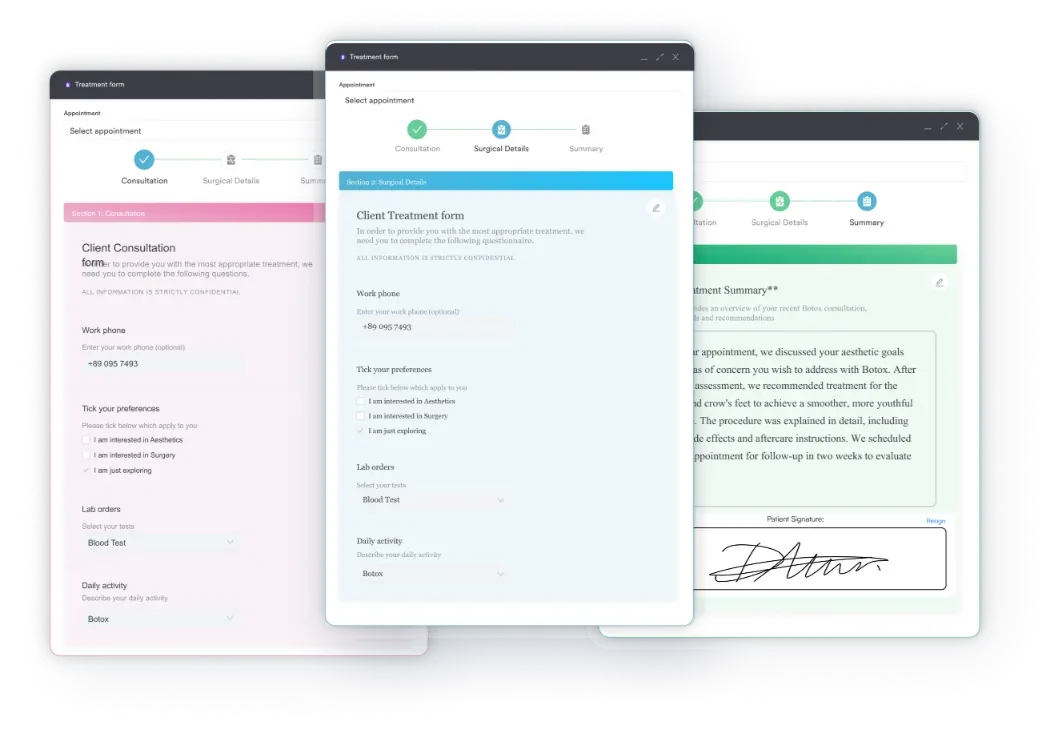
Capturing this information with digital patient intake forms at the point of care reduces the administrative burden of assembling records later.
Noridian’s checklist applies to L1810, L1812, L1820, L1830-L1833, L1836, L1843, L1845, L1847, L1848, L1850, L1851, and L1852 prefabricated knee orthoses. For codes like L1831 and L1836, additional clinical criteria around contracture apply, so keep separate documentation checklists for each code to avoid conflating requirements.
Practices that use claims management software can build these checklists into their pre-claim workflow so no supporting document is missed before submission.

Pabau helps orthotic practices and DME suppliers capture every required document before a claim goes out. Track modifier usage, store physician orders, and manage prior authorizations from one platform.

Modifiers communicate additional information about the claim circumstances to Medicare and other payers. Using the wrong modifier, or omitting a required one, can result in immediate denial or delayed processing. The following modifiers are commonly used alongside L1810.
| Modifier | Purpose | When to use with L1810 |
|---|---|---|
| RT | Right side | When the orthosis is for the patient’s right knee |
| LT | Left side | When the orthosis is for the patient’s left knee |
| KX | Requirements specified in the medical policy have been met | Required when billing L1810 under Medicare to affirm that all LCD L33318 criteria are documented in the patient record |
| GY | Item or service is statutorily excluded or not covered | When the item does not meet Medicare coverage criteria but the patient wants it anyway (without an ABN, you cannot bill the patient) |
| GA | Waiver of liability statement issued as required | When an ABN has been issued and the claim may be denied as not reasonable and necessary |
The KX modifier is the one that matters most for routine L1810 claims. Medicare requires it to confirm that the documentation in the file supports medical necessity. Missing the KX modifier on an L1810 claim will result in an automatic denial.
The RT and LT modifiers are required whenever a bilateral or unilateral coding scenario applies: a right knee brace needs RT, a left knee brace needs LT, and bilateral claims need both lines itemized separately. Never leave the laterality undefined on a knee orthosis claim.
The diagnosis codes on a claim must align with the medical necessity criteria in LCD L33318. Submitting L1810 with a diagnosis code that falls outside the LCD’s covered ICD-10 groups is a denial waiting to happen. The LCD organizes covered diagnoses into groups, and each group maps to specific orthosis types. Accurate ICD-10 coding for clinical documentation starts with selecting codes that precisely reflect the patient’s documented condition.
Always verify ICD-10 pairings against the current LCD L33318 Group codes; the list above is not exhaustive. The LCD specifies which diagnosis groups support coverage for L1810 versus codes like L1831 or L1836. The principle is consistent: the diagnosis must justify the specific device, not just any orthosis.
For an acute meniscal injury, a more specific code such as S83.241 (other tear of medial meniscus, right knee) may apply.
Run a crosswalk check between your planned ICD-10 codes and LCD L33318’s Group code lists before submitting any L1810 claim. If the diagnosis code is not in the covered groups, consider whether a different code more precisely captures the documented condition, or whether a prior authorization request is needed.
HCPCS code L1810 is billed as a lump sum purchase to Medicare DME MACs. Unlike rental items, there is no monthly recurring billing. The claim goes out once, at the time of dispensing. For practices familiar with procedure-code billing, the lump sum model is straightforward, but it means documentation must be complete before the first and only claim submission.
The Pricing, Data Analysis and Coding (PDAC) contractor assists suppliers in determining appropriate HCPCS codes for DME products. For L1810, PDAC approval of a specific brace confirms that the product’s design and construction are consistent with the L1810 code descriptor. While PDAC approval is not a Medicare coverage guarantee, billing a product that PDAC has verified as meeting the L1810 descriptor significantly reduces the risk of a coding challenge during an audit. What a superbill includes decides whether the patient insurer processes or rejects the reimbursement request.
Suppliers should request PDAC coding verification for new products before adding them to their L1810 billing lineup. The CGS Medicare coding verification resource provides current guidance on how the PDAC process works for DME products in Jurisdiction B. Noridian handles Jurisdiction D. Both publish documentation checklists and product coding guidance on their provider portals.
Medicare reimbursement for L1810 varies by DME MAC jurisdiction and is updated annually through the CMS fee schedule. Rates differ between competitive bidding areas and non-competitive bidding areas. Suppliers operating in competitive bidding areas receive rates set through the bidding process rather than the national fee schedule.
Always verify the current jurisdiction-specific fee schedule amount before quoting patients or setting internal billing expectations. Displaying outdated rate information to patients creates compliance risk around financial transparency.
Medicare does not universally require prior authorization for L1810, but some commercial payers do. Check each payer’s specific requirements before dispensing. The AAPC Codify HCPCS lookup includes payer-specific notes that can flag authorization requirements by code.
For commercial insurers, prior authorization requests should include the physician’s order, clinical notes documenting medical necessity. Practices that use purpose-built orthopedic billing workflows find that procedure code documentation standards across their practice stay more consistent when managed through a centralized system.
Denial patterns for L1810 are predictable. Most stem from incomplete documentation or incorrect code selection rather than clinical ineligibility. Tracking these patterns with claims management software lets practices identify systemic issues before they trigger a post-payment audit.
The PGM Billing HCPCS lookup tool can support pre-submission code verification. Cross-referencing your planned codes and modifiers against CMS data before the claim goes out is a low-cost quality check that catches errors before they become denial correspondence. Practices that also need to handle private healthcare procedure codes will recognize the same principle: payer-specific compliance starts with code selection accuracy.
HCPCS code L1810 is a technically specific billing code. The customization requirement, the KX modifier, the LCD-aligned diagnosis codes, and the Noridian/CGS documentation checklist each determine whether a claim is paid or ends in a recoupment demand. For DME suppliers and orthotic practices billing Medicare, the documentation trail for every L1810 device should be complete before the device is dispensed.
Suppliers billing across the orthotics range apply the same documentation discipline to adjacent prefabricated codes, including L0642 for lumbar support, L1906 and L1971 for ankle-foot orthoses.
Pabau’s claims management software helps practices build pre-submission documentation checklists, track modifier requirements by code, and manage claim status from one platform. To see how Pabau supports orthotic and DME billing workflows, book a demo with the team.

Billing a UK diagnostic test instead? CCSD code 0049C billing guide covers the invoice code labs use to bill private insurers for the test.
HCPCS code L1810 is used to bill for a prefabricated elastic knee orthosis with hinged joints that has been customized to fit a specific patient by a qualified individual. It applies when the device is trimmed, bent, molded, assembled, or otherwise modified before dispensing, distinguishing it from off-the-shelf dispensing under L1812.
Both L1810 and L1812 describe a prefabricated elastic knee orthosis with joints, but L1810 requires customization by a qualified individual before dispensing, while L1812 is supplied off-the-shelf without modification. Billing L1810 for a device dispensed without customization is a coding error that auditors actively look for.
Medicare Part B covers L1810 under LCD L33318 when the patient has documented weakness or deformity of the knee requiring stabilization, the device is medically necessary, and the clinical record supports the specific features of the orthosis. Claims that do not meet these criteria are denied as not reasonable and necessary.
Required documentation includes a physician’s written order specifying the orthosis type, clinical notes describing the knee weakness or deformity, a record that the device was customized to fit the patient by a qualified individual, and a dispensing record with the date, code billed, and fitter’s identity. The KX modifier must appear on the claim to confirm documentation is on file.
Commonly paired ICD-10 codes include M17.11 and M17.12 (primary osteoarthritis of the knee), M25.561 and M25.562 (knee pain), and M23.201/M23.202 (derangement of meniscus due to old tear). All diagnosis codes must fall within the covered groups specified in LCD L33318. Verify pairings against the current LCD Group codes before each submission.
L1810 is a HCPCS Level II code, not a CPT code. Both use a five-character format, which is why the terms get mixed up, but CPT covers physician procedures while HCPCS Level II codes like L1810, L1812, L1820, and L1821 cover durable medical equipment and orthotics. If a payer’s system asks for a “CPT code” for a knee orthosis, the L-code is correct.
The HCPCS code for a hinged knee brace depends on whether it was customized at fitting. L1810 applies to a prefabricated elastic knee orthosis with joints that a qualified individual trimmed, bent, molded, or otherwise adjusted to the patient. L1812 applies to the same style of brace dispensed off-the-shelf, with no fitting modifications made.