

HCPCS code E0198: Water pressure pad billing guide
HCPCS code E0198 is a water pad for a standard mattress HCPCS code E0198 is the ...

Last Updated: Oct 13, 2026
K0821 is the HCPCS Level II code for power wheelchair, group 2 standard, portable, captains chair, patient weight capacity up to and including 300 pounds.
The "group 2 standard" designation is important for billing. CMS organizes power wheelchairs into groups 1 through 5, based on drive configuration and clinical complexity. Group 2 chairs suit patients who cannot operate a manual wheelchair and need a powered device for activities of daily living. They do not require the drive programming of a group 3 or higher chair.
The captains chair specification refers to the seat style, as distinct from a sling or tilt-in-space seat. Per the CMS HCPCS Level II code set overview, CMS maintains K-codes outside the AMA CPT process. Changes take effect annually.
Let Pabau's smart automation suggest the right codes, reduce claim denials, and keep your practice compliant—effortlessly.
Automate repetitive tasks and focus on what matters most—your patients.
Reduce coding errors and ensure compliance with the latest regulations.
Clean claims, fewer denials, and faster reimbursements.
Powerful insights and reporting to help your practice thrive.
HIPAA compliant SOC 2 certified GDPR-compliant Trusted by 4,000+ clinics worldwide

HCPCS code K0821 describes a power wheelchair, group 2 standard, portable, captains chair, with a weight capacity up to 300 pounds.
K0821 is billed under Medicare Part B as durable medical equipment. Each claim needs a face-to-face physician examination and a written order first.
Prior authorization is required in the states designated by the CMS Power Mobility Devices program.
Standard power wheelchairs have carried no active competitive-bidding contract since December 31, 2018, so the fee schedule amount applies.
Pabau’s claims management software helps DME suppliers track documentation, manage prior authorization, and submit K0821 claims without missing required elements.
K0821 is covered under Medicare Part B as a durable medical equipment benefit. Coverage is governed by CMS Policy Article A52498, Power Mobility Devices, and the applicable DME MAC Local Coverage Determination (LCD). The beneficiary must meet specific medical necessity criteria, and the supplier must be enrolled as a Medicare DMEPOS supplier.
For K0821 to be covered, the patient must meet all of the following criteria as documented by the treating physician:
DME suppliers confirm each criterion in writing before delivery, because the supporting record has to exist before the date of service. Standard medical billing workflows put that check ahead of the delivery ticket rather than after it.
K0821 is non-covered when the primary use is outside the home. It is also non-covered when the patient cannot operate the device safely, or when the record does not support the diagnosis-device link. Medicare does not cover upgrades beyond what medical necessity requires. If a patient chooses a captains chair over a clinically justified standard seat, the extra cost falls to the patient. Document that with an Advance Beneficiary Notice (ABN).
CMS runs a prior authorization (PA) program for power mobility devices, including K0821. Suppliers must obtain approval before billing in the states CMS designates. Billing without prior authorization in a required state results in automatic claim denial.
State lists and requirements change periodically, so verify the current rules with your DME MAC before submission. The prior authorization process allows resubmission after a non-affirmed decision, so a rejected request is not a lost claim.
Keeping the PA file complete is also what medical billing compliance reviewers look for when they sample a supplier’s power mobility claims.
Documentation is where most K0821 claims fail audit review. CMS and DME MAC requirements are explicit. A claim that passes initial processing can still be recouped on post-payment audit if the documentation file is incomplete.
The required documentation set for K0821 includes:
Many suppliers also collect a mobility evaluation from a physical therapy or occupational therapy practice. That report documents the MRADL deficits in the detail a DME MAC reviewer expects to see.
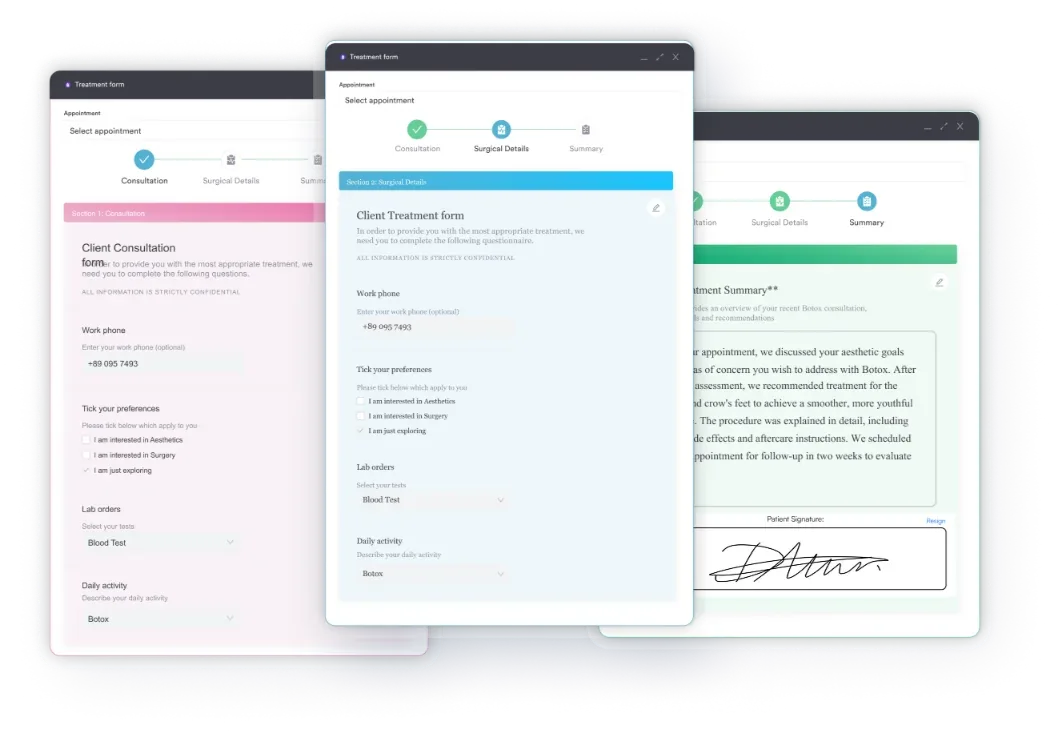
Holding the order, diagnosis codes, and device specifications in one patient record keeps the file audit-ready. Digital intake forms reduce the chance of missing a required field at the point of care. The same face-to-face and written-order rules govern other DME categories, so a supplier billing L1932 can run one checklist.
Keeping documentation in order also matters for HIPAA compliance. HIPAA-compliant workflows require that PHI collected during the PA and billing process is stored securely and transmitted only through approved channels.
The 2026 Medicare DMEPOS fee schedule rate for K0821 varies by geographic location. CMS publishes the fee schedule annually and adjusts the rates by locality. The allowed amount shown below is the non-facility rate.
Standard power wheelchairs are paid from that schedule everywhere, because no competitive bidding contracts are in force for the category. Verify the current amount in the CMS DMEPOS fee schedule for your jurisdiction before billing.
No CMS supplier contract is needed to bill K0821 today. The last round of standard power wheelchair contracts ended on December 31, 2018, and the category has stayed out of every round since. CMS keeps standard power wheelchairs excluded under the upcoming Round 2028.
The fee schedule amount is therefore the amount you bill against, wherever the beneficiary lives. Patients still owe the 20% coinsurance, which is easier to collect when the practice offers patient payment plans.
Modifier selection for K0821 depends on the rental or purchase status, medical necessity documentation, and whether the claim is expected to be denied. Using the wrong modifier is one of the top reasons K0821 claims are returned without payment.
KX and GA/GZ modifiers are mutually exclusive. Applying KX signals that coverage criteria are met. Applying GA or GZ signals an anticipated denial. Verify modifier guidance against your DME MAC’s published policy, because requirements vary by jurisdiction.
Run a modifier audit on your last 90 days of K0821 claims. Two patterns most often trigger a post-payment audit: Claims missing KX, and claims using GA without a signed ABN on file. Flag both for correction before your next submission cycle.
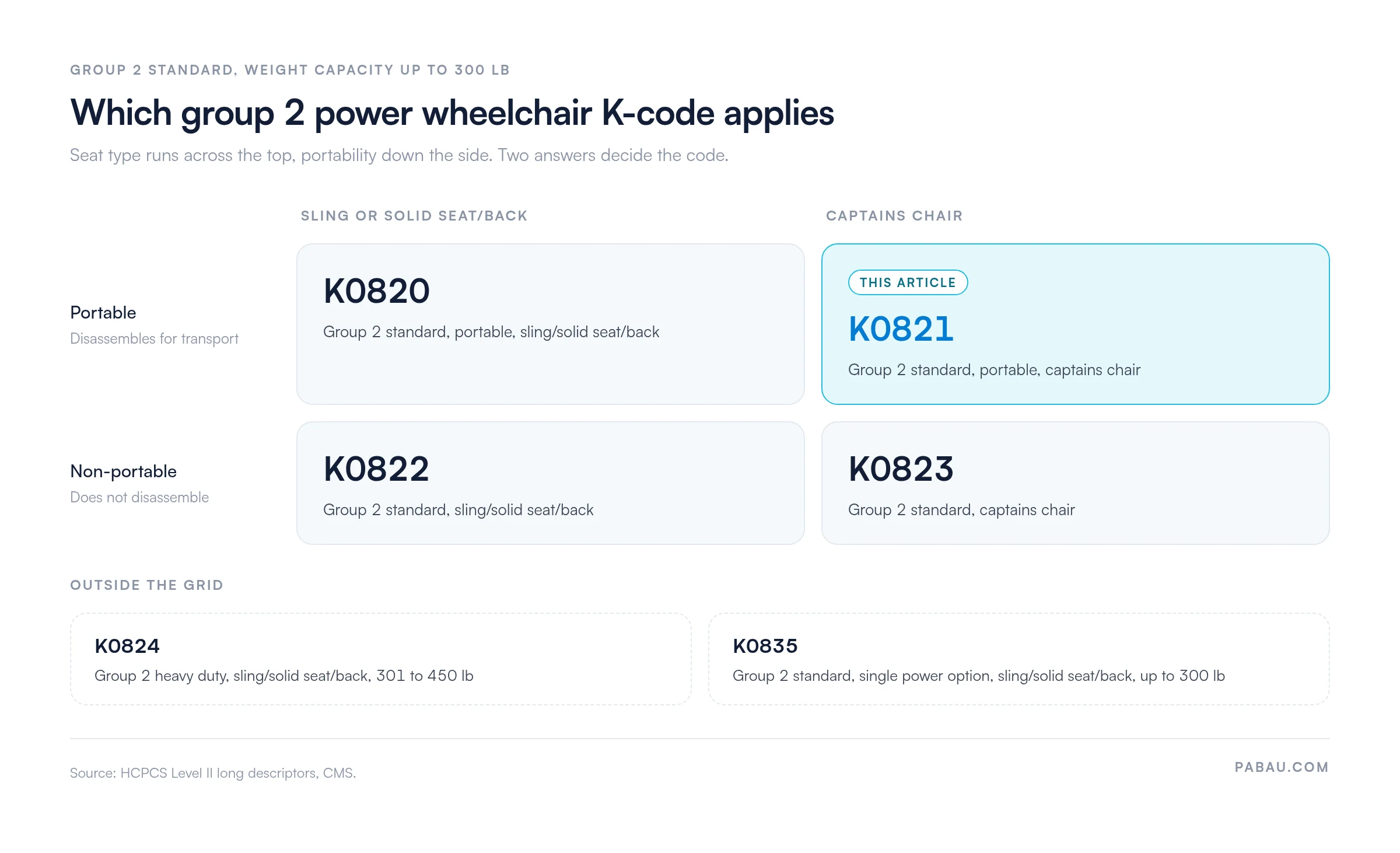
K0820 and K0821 are frequently confused, because they are adjacent group 2 standard power wheelchair codes. A claim scrubber will not flag the wrong choice, since both codes are valid on their own.
The physician’s written order must specify the seat type. If the order says “captains chair,” use K0821. If it says “sling seat” or “solid seat/back,” use K0820. Billing K0821 when the order specifies a sling seat constitutes upcoding and creates audit risk.
The K-code range for power wheelchairs spans groups 1 through 5. Understanding where K0821 sits in this family helps billers choose the correct code when the clinical documentation specifies a different device type.
Portability is the second distinguishing variable. K0821 is portable, meaning the chair is designed to be disassembled for transport. K0822 and K0823 cover the non-portable versions of the same two seat types. If the physician order specifies a non-portable captains chair, K0823 applies, not K0821.
K0824 sits outside that grid altogether, since it is rated for 301 to 450 pounds. Suppliers who also handle heavier-duty group 2 chairs will find the same coverage rules on K0843. The AAPC HCPCS code directory lists the full K-code range.
Claim denials for K0821 cluster around a small set of recurring errors, and fixing them before submission is faster than working the denial afterwards. A reference of denial codes shows which remittance messages point at each problem.
Strong denial management workflows catch these errors before submission rather than after the remittance arrives. A pre-billing checklist that reads the order, the exam date, and the modifier set takes minutes per claim. Reworking a denied K0821 rental takes far longer, and the capped rental clock keeps running while it happens.
DME billing for codes like K0821 creates a documentation burden that paper files and disconnected systems handle poorly. The face-to-face exam report, physician order, CMN, ABN, and prior authorization approval all need to be stored, timestamped, and retrievable at audit.
Practice management software like Pabau keeps that file with the patient rather than in a separate folder. Pabau’s claims management software stores physician notes, written orders, and authorization records against the patient record, so an audit request becomes a search. It supports clean claims by flagging missing required elements before a claim is batched.
Claims leave through the Claim.MD integration, which submits the file electronically and returns payer acknowledgments to the same record. For a supplier billing K0821 as a 13-month capped rental, each month’s claim inherits the documentation the first one carried.
The NLM also publishes a free HCPCS code lookup API that billing tools can query for current descriptors. Wiring that into the claim form catches a retired or mistyped K-code before submission. Together with a structured documentation workflow, it addresses the two leading causes of K0821 claim failure: Wrong modifier and incomplete documentation.

Pabau tracks prior authorization status and stores physician orders and face-to-face exam notes against the patient record. Claims go out with the required documentation elements in place. See how it works for your team.

The judgment worth carrying away from K0821 is that the physician’s order decides the code, not the chair on the truck. Seat type and portability are descriptor elements, so a substitution at delivery changes the code you should bill.
The competitive bidding rules that older billing guides still describe no longer bind this category. That removes a step from the workflow. It also narrows the cause of any denial down to documentation, timing, or a modifier.
Build the checklist once, run it before delivery, and the 13-month rental cycle looks after itself. Book a demo to see how Pabau keeps DME documentation and claims in one workflow.

Billing a heavier-duty power chair? K0843 covers the coverage criteria, prior authorization steps, and documentation the heavier-duty group 2 range needs.
Also billing orthotics? L1932 walks through the ankle-foot orthosis rules that share the same face-to-face and written-order requirements.
Chasing the 20% coinsurance? Patient payment plans shows how to set up, automate, and collect the balance Medicare leaves behind.
Billing DME supplies alongside chairs? A4755 sets out the coverage rules and the records a supplier keeps for that code.
HCPCS code K0821 is the billing code for a power wheelchair, group 2 standard, portable, captains chair. The patient weight capacity runs up to and including 300 pounds. It is billed under Medicare Part B as durable medical equipment. Prior authorization applies in designated states, and the clinical documentation has to be complete before the claim is submitted.
K0820 covers a group 2 standard, portable power wheelchair with a sling or solid seat/back. K0821 covers the same device with a captains chair seat. Both are portable and share the same 300-pound weight capacity, so the seat type is the billing differentiator. The physician’s written order must name the seat type.
Yes, in states designated by the CMS Power Mobility Devices prior authorization program, prior authorization is required before billing K0821. Requirements and the list of applicable states are updated periodically. Verify current PA requirements through your DME MAC before device delivery, because billing without authorization in a required state results in automatic denial.
The KX modifier is required when all LCD coverage criteria are met and documentation is on file. GA is used when an Advance Beneficiary Notice is signed and Medicare is expected to deny. GZ is used when denial is anticipated but no ABN is on file. NU, RR, and UE indicate the acquisition status. They cover new equipment, rental, and used equipment respectively.
No. Standard power wheelchairs, including K0821, are not part of an active competitive bidding round. Contracts for the category expired on December 31, 2018, and CMS has paid it from the fee schedule ever since. No supplier contract is required to bill K0821, and standard power wheelchairs stay excluded under the upcoming Round 2028.
You need a face-to-face examination report documenting mobility limitations and a written physician order naming the device type and diagnosis. Add a Certificate of Medical Necessity where your DME MAC requires one, plus home assessment documentation. A signed ABN is needed when coverage may be denied, and all records must be retained for post-payment audit.



