

HCPCS code E0198: Water pressure pad billing guide
HCPCS code E0198 is a water pad for a standard mattress HCPCS code E0198 is the ...

Last Updated: Oct 13, 2026
L1932 is the HCPCS Level II code for ankle foot orthosis, rigid anterior tibial section, total carbon fiber or equal material, prefabricated item that has been trimmed, bent, molded, assembled, or otherwise customized to fit a specific patient by an individual with expertise.
L1932 sits within the HCPCS Level II L-code series. The Centers for Medicare and Medicaid Services (CMS) uses that series to classify orthotic and prosthetic devices billed under the DMEPOS fee schedule. Knowing where L1932 sits between its custom-fabricated and off-the-shelf neighbors is the first step toward avoiding denials from your DME MAC.
The code is a covered item of durable medical equipment (DME) under Medicare Part B for eligible beneficiaries. CMS maintains the HCPCS Level II code set and updates it annually. For the most current code descriptor and status, refer to the CMS HCPCS overview.
Let Pabau's smart automation suggest the right codes, reduce claim denials, and keep your practice compliant—effortlessly.
Automate repetitive tasks and focus on what matters most—your patients.
Reduce coding errors and ensure compliance with the latest regulations.
Clean claims, fewer denials, and faster reimbursements.
Powerful insights and reporting to help your practice thrive.
HIPAA compliant SOC 2 certified GDPR-compliant Trusted by 4,000+ clinics worldwide

HCPCS code L1932 describes a prefabricated ankle-foot orthosis (AFO) with a rigid anterior tibial section, made of total carbon fiber or an equal material.
L1932 is prefabricated and custom-fitted by an individual with expertise. It is not a custom-fabricated code, and it is not an off-the-shelf code.
The fabrication ladder runs L1945 (custom-fabricated), then L1932 (prefabricated, custom-fitted), then L1933 (prefabricated, off-the-shelf, effective April 1, 2025).
L1932 requires a face-to-face examination and a written order prior to delivery (WOPD). Most Medicare claims also need prior authorization before delivery.
Modifiers RT or LT (laterality) and KX (coverage criteria met) are typically required. Missing either one is a leading cause of claim denial.
Practice management software like Pabau helps O&P practices and DME suppliers track documentation, prior auth status, and claim submissions for L-codes.
The rigid anterior tibial section is what sets L1932 apart from other AFO codes. That section runs along the front of the lower leg and foot, holding the ankle in a fixed position.
The rigidity corrects foot drop, limits unwanted plantar flexion, and steadies patients with neuromuscular conditions. The descriptor also fixes the material as total carbon fiber, or a material of equal performance.
The most common coding error in this category is billing the wrong fabrication tier. L1932 is exclusively a prefabricated device that an individual with expertise has customized to fit one patient. It is not a custom-fabricated code, and it is not an off-the-shelf code either.
Billing L1932 for a device that needed no expert trimming, bending, or molding is a frequent audit trigger for DME MACs. So is billing it for an orthosis that was fabricated from a model of the patient’s limb. Sound medical billing fundamentals require the fabrication method to match the prescription and chart notes precisely.
Three codes describe this device family at three fabrication tiers. L1945 is the custom-fabricated version, L1932 the prefabricated custom-fitted version, and L1933 the off-the-shelf version. L1933 applies to dates of service on or after April 1, 2025, and it exists precisely because L1932 was never an off-the-shelf code.
The tier is a payment distinction as well as a coding one. Each of the three codes carries its own fee schedule allowance, so the code you bill has to match the device the patient received. Ask the fitting practitioner to record the customization work in the chart on the day of the fitting.
CMS covers AFOs under its Local Coverage Determination (LCD) framework. Coverage for HCPCS code L1932 requires the device to be medically necessary for the patient’s condition. The CMS AFO policy article defines the indications and limitations of coverage that DME MACs apply when reviewing claims.
Coverage generally requires a neurological or musculoskeletal condition that significantly impairs the ankle or foot. The AFO must also be expected to restore or improve the patient’s ambulation. Conditions that commonly support medical necessity include foot drop, hemiplegia, spasticity, and certain peripheral neuropathies. The device must be ordered by a treating physician following a face-to-face evaluation.
Pairing HCPCS code L1932 with the correct ICD-10-CM diagnosis code is essential. CMS and the DME MACs require the diagnosis code to match the patient’s documented condition. It must also appear on the covered diagnosis list in the applicable LCD. Use the CDC ICD-10-CM tool to verify current code validity before submitting.
Always verify the diagnosis code against the current LCD for your DME MAC jurisdiction before submitting. Codes accepted in one jurisdiction may require additional specificity in another. Pairing an unspecified code where a laterality-specific code exists is a common denial trigger.
L1932 is reimbursed under the CMS DMEPOS fee schedule, which is updated annually and varies by geographic locality. The allowed amount reflects a percentage of the fee schedule rate. Medicare typically pays 80% after the beneficiary’s deductible.
The remaining 20% falls to the patient or to their supplemental insurance. Revenue cycle work for DME suppliers means tracking both the allowed amount and the locality adjustment for each claim.
Medicare fee schedule rates change each calendar year. Verify current allowed amounts through the CMS DMEPOS fee schedule, or through your DME MAC’s published fee schedule. The figures below reflect general published ranges; confirm exact locality amounts before billing.
Documentation failures account for the majority of L1932 claim denials. Before submitting a claim, every element below must be present in the medical record. Missing even one item gives the DME MAC grounds to deny payment on post-payment review. Good healthcare compliance documentation habits make retrieval straightforward if you receive an additional documentation request (ADR).
CMS added L1932 to the list of codes requiring both a face-to-face (F2F) examination and a written order prior to delivery (WOPD). The F2F must be performed by the treating physician or a qualified non-physician practitioner. It has to be documented in the medical record before the order is written.
Practices using digital clinical forms can capture and timestamp F2F notes and WOPD signatures electronically, making the documentation chain auditable from a single record.
Medicare has expanded its prior authorization (PA) program to include certain HCPCS L-codes, and L1932 falls under it. PA is mandatory before the AFO is delivered to a Medicare beneficiary. Failing to obtain it before delivery generally results in non-payment, with limited appeal options.
The prior authorization process works best as a separate, trackable task with its own deadline. Here is the standard submission sequence for L1932:
Track prior authorization deadlines separately from appointment scheduling. Set a reminder 5 business days before the device is due for delivery. That leaves time to chase a pending PA response from the DME MAC before the patient’s fitting appointment.
Two modifier omissions cause AFO claim denials more consistently than any others. One is a missing KX on a claim that meets coverage criteria. The other is a missing RT or LT where only one limb is affected. The chart below applies the modifiers in the order a biller reaches them.
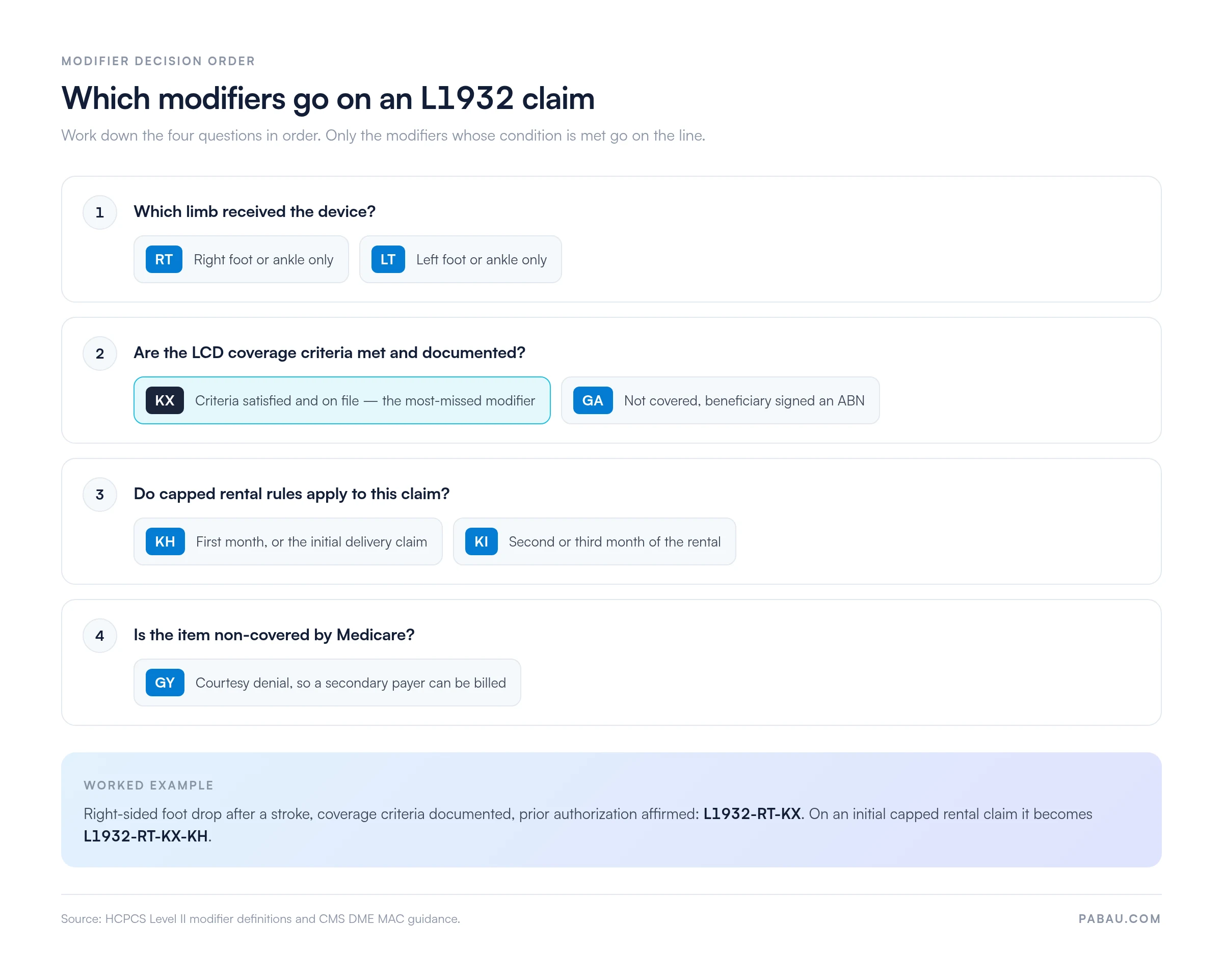
Typical claim scenario: A patient has right-sided foot drop following a stroke. They receive a prefabricated carbon fiber AFO with a rigid anterior tibial section, custom-fitted to the right foot.
The physician has completed the F2F, the WOPD is on file, and prior authorization was confirmed. The correct modifier string is L1932-RT-KX. If capped rental rules apply on the initial delivery date, add KH, giving L1932-RT-KX-KH.
A clean L1932 claim combines verified eligibility, confirmed prior authorization, complete documentation, and correct modifiers. All four have to be in place before the claim leaves your practice. The clean claim checks for DME items run in a predictable sequence. Below is the step-by-step workflow most DME MAC guidance recommends.
Four failures account for most rejected L1932 claims:
The L1900 to L2040 series covers a wide range of AFO and KAFO (Knee-Ankle-Foot Orthosis) devices. Fracture orthoses sit just past that range, where L2128 covers a custom-fabricated femoral fracture cast orthosis. Selecting the wrong code from this series is one of the most audited errors in O&P billing. The table below covers the codes most frequently confused with L1932, starting with its own two fabrication neighbors, L1945 and L1933.
When in doubt about code selection within the AFO range, consult the AAPC HCPCS lookup or your DME MAC’s coding verification resources. The PDAC (Pricing, Data Analysis and Coding) contractor also provides coding verification for specific products upon request.
When choosing between L1945, L1932 and L1933, check whether the manufacturer has a PDAC letter for that product. PDAC verification letters confirm which HCPCS code a product should be billed under. That letter is your audit protection if a DME MAC questions the fabrication tier you billed.
O&P practices and DME suppliers billing codes like L1932 carry a heavier documentation load than most outpatient practices. Prior authorization tracking, F2F and WOPD timelines, proof of delivery, and modifier selection all run concurrently across active orders. When those tasks live in spreadsheets or paper files, a missing document surfaces only when the denial arrives.
Pabau’s claims management software connects the documentation, scheduling, and billing steps of a DME encounter into one workflow. Prior authorization requests, their reference numbers, and delivery dates all track against the patient record. Billing staff keep one audit trail per L-code claim.
The physical therapy practice management and occupational therapy workflows in Pabau also suit multi-location O&P operations. The prescribing physician, the fitting practitioner, and the billing team can each work from a different site.
Cutting the lag between delivery and claim submission matters just as much. Pabau’s documentation tools let staff capture proof-of-delivery signatures and finish clinical notes at the point of care. That shortens the time from delivery to a submitted claim.

Pabau helps O&P practices and DME suppliers manage prior auth tracking, documentation workflows, and claim submissions for HCPCS L-codes. See how it fits your practice.

HCPCS code L1932 carries a higher compliance overhead than most DME codes. The combination of prior authorization, F2F and WOPD requirements, laterality modifiers, and an annual fee schedule update creates multiple points where a claim can fail. Getting each element right before the device is dispensed is what separates a paid claim from a denial that requires costly rework.
Pabau’s claims management and documentation tools are built for this kind of multi-step billing workflow. To see how Pabau helps O&P practices and DME suppliers manage L-code billing end to end, book a demo. We’ll walk through the workflow with your team.

Billing other DME items to Medicare? K0821 runs through the same prior authorization and documentation chain for power wheelchairs.
Need the heavy-duty power wheelchair rules? K0843 covers the coverage criteria, the modifiers, and the prior authorization steps.
Adding a soft interface to the orthosis? L2820 explains when that addition is separately billable and how to document it.
Assessing the ankle before you order an AFO? Peroneal tendon tear test gives you a structured exam to record in the chart.
Patients struggling with the 20% coinsurance? Patient payment plans shows how to spread that balance without chasing invoices.
HCPCS code L1932 is a Level II HCPCS code for a carbon fiber ankle-foot orthosis (AFO) with a rigid anterior tibial section. The device is prefabricated, then trimmed, bent, molded, or assembled to fit one specific patient by an individual with expertise. It is billed to Medicare Part B under the DMEPOS fee schedule.
Yes. CMS has added L1932 to its expanded prior authorization program for certain DME. Suppliers must submit a prior authorization request to the DME MAC and receive a provisional affirmation before delivering the device to the beneficiary. Delivering without prior authorization typically results in non-payment.
The most commonly required modifiers are RT or LT (indicating right or left laterality) and KX (confirming coverage criteria are documented and met). Additional modifiers such as KH (initial claim) or GA (advance beneficiary notice on file) apply in specific billing scenarios. Missing the KX modifier is the most frequent cause of coverage denial for this code.
Neither. L1932 is a prefabricated orthosis that an individual with expertise has customized to fit one patient. The custom-fabricated counterpart is L1945, and the off-the-shelf counterpart is L1933. Billing L1932 for a device that needed no expert fitting is a common compliance error in AFO billing.
L1933 is the off-the-shelf version of the same device: an AFO with a rigid anterior tibial section in total carbon fiber or an equal material. It applies to dates of service on or after April 1, 2025. Use it when the orthosis is dispensed as supplied, with no customization by a person with expertise.
The difference is the fabrication method. L1932 is a prefabricated carbon fiber AFO with a rigid anterior tibial section, customized to fit by an individual with expertise. L1940 is a custom-fabricated AFO in plastic or another material. The L1940 descriptor specifies no shell orientation, so posterior or anterior design is never the deciding factor.
Commonly accepted ICD-10-CM codes include M21.371 and M21.372 for foot drop, G81.10 for spastic hemiplegia, and G35 for multiple sclerosis. Stroke sequelae codes such as I69.354 also qualify. The full list is defined in the applicable CMS LCD and may vary by DME MAC jurisdiction. Always verify against the current policy before submitting.



