CCSD code F5010: Parotid duct transposition billing guide
CCSD code F5010 covers parotid duct transposition, one side or both CCSD code F5...

Last Updated: Oct 9, 2026
K0843 is the HCPCS Level II code for power wheelchair, group 2 heavy duty, multiple power option, sling/solid seat/back, patient weight capacity 301 to 450 pounds.
The official short descriptor is Pwc gp2 hd mult pow opt s/b. The Centers for Medicare and Medicaid Services maintains the descriptor and the code's status, and both feed the attribute set below.
Let Pabau's smart automation suggest the right codes, reduce claim denials, and keep your practice compliant—effortlessly.
Automate repetitive tasks and focus on what matters most—your patients.
Reduce coding errors and ensure compliance with the latest regulations.
Clean claims, fewer denials, and faster reimbursements.
Powerful insights and reporting to help your practice thrive.
HIPAA compliant SOC 2 certified GDPR-compliant Trusted by 4,000+ clinics worldwide

HCPCS code K0843 covers a group 2 heavy duty power wheelchair with multiple power options and sling or solid seating.
The chair has to support 301 to 450 lbs, and the chart must show why that capacity is needed.
Medicare wants a face-to-face examination, a written order, and a covered ICD-10 diagnosis before it pays for K0843.
Prior authorization applies in every state, so the DME MAC has to affirm the request before the chair is delivered.
Practice management software like Pabau keeps HCPCS entry, prior auth tracking, and claim submission in one workflow.
Multiple power option means the chair has more than one powered function beyond basic drive. In practice that is powered seat elevation, tilt, recline, or leg rests. Sling/solid seat/back describes the seating system, which is either a sling seat and back or a solid seat and back. A specialty cushion or positioning system is billed separately.
These distinctions decide whether K0843 applies or whether another code in the group 2 or group 3 series fits better. Misreading the descriptor is one of the most common reasons a power wheelchair claim comes back on first submission.
Group 2 heavy duty power wheelchairs serve beneficiaries who exceed the weight capacity of a standard group 2 chair. CMS sets heavy duty at a capacity of 301 to 450 lbs. The chair must run on an electric motor rather than muscle, and it must carry the power options named in the long descriptor.
Equipment rated above 450 lbs usually falls under a group 2 or group 3 extra-heavy duty code instead. More complex features, such as power standing, also move the claim to a different K-code. Check the equipment’s specifications against the supplier’s product documentation before you assign K0843.
Medicare covers K0843 when the beneficiary meets the criteria in the DME MAC Local Coverage Determination for power mobility devices. Running an insurance eligibility verification before the face-to-face visit confirms that Part B is active and flags any plan-level restriction.
The LCD asks for all of the following conditions to be met at the same time:
The documentation also has to support the heavy duty classification specifically. Patient weight and body habitus belong in the note, because they are what justify a 301 to 450 lb capacity chair over a standard model.
Every K0843 claim carries at least one ICD-10 diagnosis code that establishes medical necessity for a power wheelchair. That code has to sit on the LCD’s list of covered diagnoses. The following codes are among those DME MACs commonly accept with HCPCS code K0843:
Verify each pairing against the current version of the applicable LCD before you submit. The diagnosis has to reflect the patient’s documented condition. It also has to be specific enough to explain why a heavy duty chair is required.
Power wheelchairs are among the most heavily audited items in DME billing. Thin documentation is the leading cause of post-payment demand letters and recoupments, so every document below belongs in the file before the claim goes out.
Using digital forms for clinical documentation keeps face-to-face exam notes, patient attestations, and mobility assessments at the point of care. Nothing is reconstructed from memory weeks later.
Make sure the face-to-face note explains why the 301 to 450 lb capacity is necessary. Mobility limitation language without weight or body habitus data is what usually triggers medical review. Submitting a clean claim means each supporting document is checked off before the claim leaves the billing system.
Power wheelchairs sit on Medicare’s required prior authorization list for DMEPOS items. K0843 has carried that requirement nationwide since September 1, 2018, after CMS expanded the program from an initial set of high-fraud states. The affirmation has to be in hand before the chair is delivered.
What the process involves:
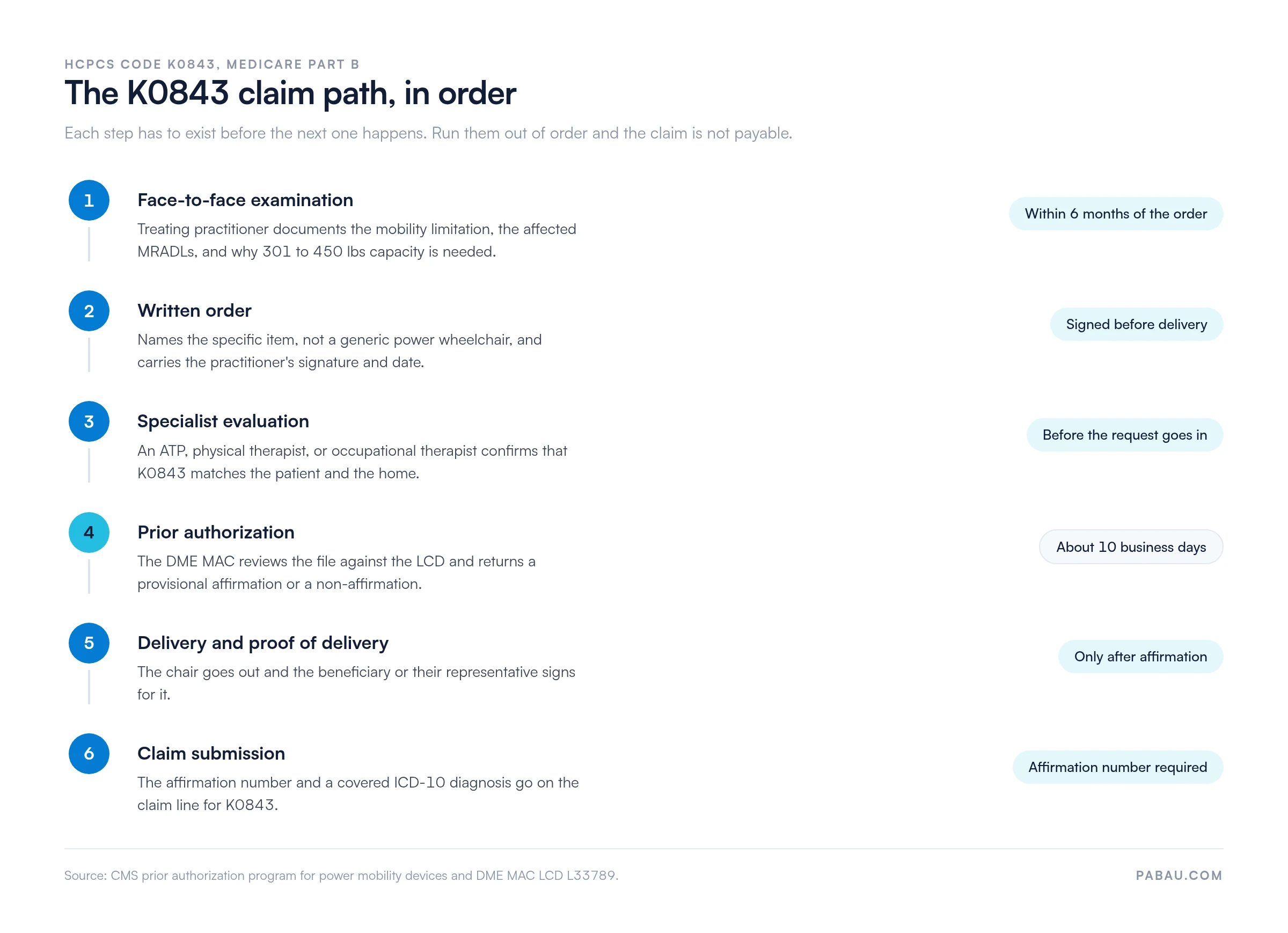
Delivering before the affirmation arrives puts the whole reimbursement at risk. Most DME MACs decide standard requests within 10 business days, and expedited review is available where clinical urgency is documented. The full sequence, from the examination to the claim line, runs like this.
HIPAA compliance for medical offices applies to these submissions too, since beneficiary health information travels with every prior authorization request. Practices that run authorizations across several payers can work from a single prior authorization process instead of one routine per payer.
Track prior authorization request dates and provisional affirmation numbers in your billing system against each K0843 claim. A missing or expired affirmation number on the claim is an automatic denial that cannot be corrected after adjudication in most DME MAC jurisdictions.
CMS publishes the rate for HCPCS code K0843 in the annual DMEPOS fee schedule, and the amount is adjusted by geography. The same file lists every other DMEPOS item you bill, from orthotic additions such as L0859 through the power mobility series.
Download the current year’s file and filter for K0843 to get the rate for your state and jurisdiction. A cached figure from a prior year will not hold, because the schedule is updated annually and can change with a Federal Register notice.
Most K0843 reference pages still describe competitive bidding as an active program, and that is out of date. Round 2021 contracts expired on December 31, 2023, and the DMEPOS Competitive Bidding Program has been paused since January 1, 2024. CMS has said the next round will not begin before January 1, 2028.
The practical effect is that contract supplier status is not a condition of payment right now. Any enrolled DMEPOS supplier can furnish K0843 and bill for it, including in a former competitive bidding area. What differs between those areas is the rate.
CMS keeps the program status and the current rules on its DMEPOS competitive bidding page. Check it before you quote a rate to a referral source. The pause changes what a former bid area pays and who may bill there.
Picking the right K-code from the power wheelchair series comes down to three variables: weight capacity, power options, and seating. Confirm each one against the equipment’s specification sheet and the patient’s clinical documentation before you code.
K0843 is the only group 2 code that combines heavy duty capacity with multiple power options and sling or solid seating. Match two of those three variables and a different code applies, so read all three before you commit the claim.
K0843 denials repeat in a small number of patterns, which makes them straightforward to design out. Managing claim denials for DMEPOS starts with spotting those patterns across similar claims:
The remittance advice tells you which document was missing. Reading the common denial codes alongside the CARC and RARC combinations on the explanation of benefits points you at the exact requirement that failed.
DME billing for power wheelchairs has more documentation touchpoints than most outpatient scenarios. A K0843 claim pulls together an exam note from the treating physician and an evaluation from an ATP or therapist. It also needs a prior authorization decision from the DME MAC and a signed proof of delivery. When those four steps live in four systems, the file is assembled by hand and something is always missing.
Practice management software like Pabau keeps the sequence in one place. HCPCS codes are entered once, and supporting documents are stored against the patient record. Claims go out electronically through our Claim.MD integration instead of being rekeyed into a separate billing tool.
Our claims management software also flags a claim that is missing an affirmation number before submission. That one check is what saves a K0843 line. For practices running clinical encounters and DME orders side by side, that removes the duplication that produces coding errors.
The same reporting covers the rest of your medical billing mix. You can see denial rates by code and judge whether K0843 is an outlier. Suppliers who also bill waiver services under T2012 track those lines in the same report.
Run a monthly report on your K0843 claims grouped by denial reason code. CO-197 means the precertification or authorization was missing, while CO-57 means the payer decided your documentation does not support the level of service billed. The two point at different fixes, so count them separately.

Pabau brings HCPCS code entry, prior auth tracking, documentation capture, and claim submission into one platform. Your billing team stops moving data between tools to get a K0843 claim out the door.

K0843 is not a difficult code to assign. It is a difficult code to support. Delivery has to follow an affirmation, and that affirmation rests on documentation written weeks earlier by someone else. Get the order of operations right and the coding takes care of itself.
The one judgment worth keeping: treat the affirmation date as the gate on delivery, not the claim date. Suppliers who work that way rarely see a K0843 recoupment, whatever their claim volume.
Pabau keeps each of those steps against one patient record, from documentation capture to prior auth tracking to claim submission. Book a demo to see how DME billing workflows run in a single system.

Billing other DMEPOS items this month? L0859 covers the coverage rules and documentation a halo addition needs.
Handling Medicaid waiver services too? T2012 explains per diem habilitation billing and the records payers ask for.
Billing infused drugs alongside equipment? J1556 walks through unit calculation and the documentation each claim needs.
HCPCS code K0843 is a Level II DMEPOS code for a power wheelchair, group 2 heavy duty, multiple power option, sling/solid seat/back. The chair carries a 301 to 450 lb weight capacity and at least one powered seating function beyond drive. Medicare Part B pays for it when a lighter-duty device cannot meet the beneficiary’s needs.
The rate for K0843 varies by jurisdiction, and CMS publishes it annually in the DMEPOS fee schedule. Former competitive bidding areas are paid from the area’s last single payment amount, updated for inflation. Pull the current file from CMS.gov for your state instead of quoting a national average.
Yes. K0843 has been on the required prior authorization list for power mobility devices nationwide since September 1, 2018. The supplier needs a provisional affirmation from the DME MAC before the chair is delivered. A claim submitted without that affirmation number is denied.
K0835 is a group 2 standard chair with a single power option and captain’s chair seating, rated up to 300 lbs. K0843 is the heavy duty version, with multiple power options, sling or solid seating, and a 301 to 450 lb capacity. Confirm capacity, power options, and seating against the specification sheet before coding.
Yes, K0843 is a Part B DMEPOS benefit when the beneficiary meets the criteria in the DME MAC Local Coverage Determination for power mobility devices. Coverage depends on a qualifying diagnosis, a face-to-face examination, a written order, prior authorization, and proof of delivery.
Diagnoses commonly accepted with K0843 include multiple sclerosis (G35), ALS (G12.21), and quadriplegia (G82.50). Spastic quadriplegic cerebral palsy (G80.0), hemiplegia after cerebral infarction (I69.354), and muscle wasting (M62.50) also qualify. The code has to appear on the applicable LCD’s covered list and match the face-to-face examination note.