Fertility clinic marketing: Strategies that attract & convert patients
Fertility clinic marketing is how a fertility practice attracts, educates, and c...

Last Updated: Oct 14, 2026

Patient payment plans let patients pay a medical bill in installments instead of one upfront sum, protecting access to care and practice cash flow.
Any plan payable in more than four installments can trigger Regulation Z disclosure, even when you charge no interest at all.
A signed agreement plus a stored card on autopay removes the two failure points that break most in-house plans.
Cap plans at six months where the balance allows, since longer terms invite card expirations and address changes.
Pabau’s built-in payment processing, recurring billing, and automated reminders run the full payment plan workflow without a separate billing platform.
Most practice owners reach the end of their first year and find the same problem. They delivered the care, but they did not collect the full amount they were owed.
Unpaid patient balances are one of the most common cash-flow problems in private practice, and they rarely start with an insurance dispute. They start with a bill the patient cannot pay in one go, and no other option on the table.
A patient payment plan turns one intimidating balance into a schedule the patient can meet. Financial access has become part of patient care management, not a separate administrative concern that sits outside the treatment relationship.
This guide covers how the plans work and how to set one up correctly. It also covers the compliance line that catches zero-interest plans, and how to automate collection so your front desk stops chasing installments.
Patient payment plans let patients pay a medical bill in installments over time rather than as one lump sum at the point of service. Instead of requiring full payment upfront, the practice agrees to a structured schedule. A set amount comes due each week or month until the balance clears.
Two broad models exist. In-house plans are managed by the practice itself, which sets the terms, collects each payment, and carries the credit risk if a patient stops paying. Third-party financing works differently. Platforms like CareCredit, Cherry, and PatientFi lend the patient the money, pay the provider upfront, and collect the repayments themselves.
Outstanding patient balances are the revenue cycle’s most stubborn problem. Many patients intend to pay but cannot manage a $600 or $2,000 lump sum on the day of their appointment. Without a structured option, they delay, avoid, or ignore the bill until it ages into a write-off.
The mechanism is straightforward. A patient who can pay $150 a month will clear a $900 balance over six months. The same patient handed a $900 demand at checkout often pays nothing, and the balance sits there until someone writes it off.
That arithmetic bites hardest where prices are high and insurance covers little. At a plastic surgery practice quoting a five-figure procedure, the practical choice is between installments and the patient walking away. The same pressure shows up across most self-pay patient work.
Setting up integrated payment processing is what makes the option practical to offer. The benefit lands on both sides of the desk.
Not all patient payment plans carry the same risk or administrative load. The table below maps the three common models against the dimensions that matter most to a practice operator.
Most private practices and med spas start with in-house zero-interest plans. They are the simplest to administer and the most transparent for patients. One caveat catches a lot of practices out.
Regulation Z’s four-installment rule treats a business as a creditor once payment is due in more than four installments. That holds whether or not you charge interest, and the down payment does not count toward the four.
A monthly plan running six to 12 months clears that threshold easily. Disclosure can therefore apply to a plan with no finance charge at all.
The rule sits in the definition of credit at 12 CFR 1026.2(a)(17)(i). There are two clean ways to handle it. Structure the plan as four installments or fewer, or provide the Regulation Z disclosures and keep them on file. A healthcare attorney should confirm which route fits your state and your plan terms.
Interest-bearing plans can be worth it for higher balances. A finance charge pulls in the full Truth in Lending Act disclosure set under 12 CFR Part 1026. That means an APR, a total cost of credit, and a payment schedule in writing before the patient signs.
If you are rethinking payment structure more broadly, the deposits for aesthetics businesses guide covers the upfront half of the same decision.
A payment plan program needs more than a handshake. Here is the sequence that moves a practice from written policy to collected revenue.
Those parameters usually end up scattered across a policy document, a billing system, and somebody’s memory. The card below collects the defaults this guide recommends, so you can settle the policy in one sitting.
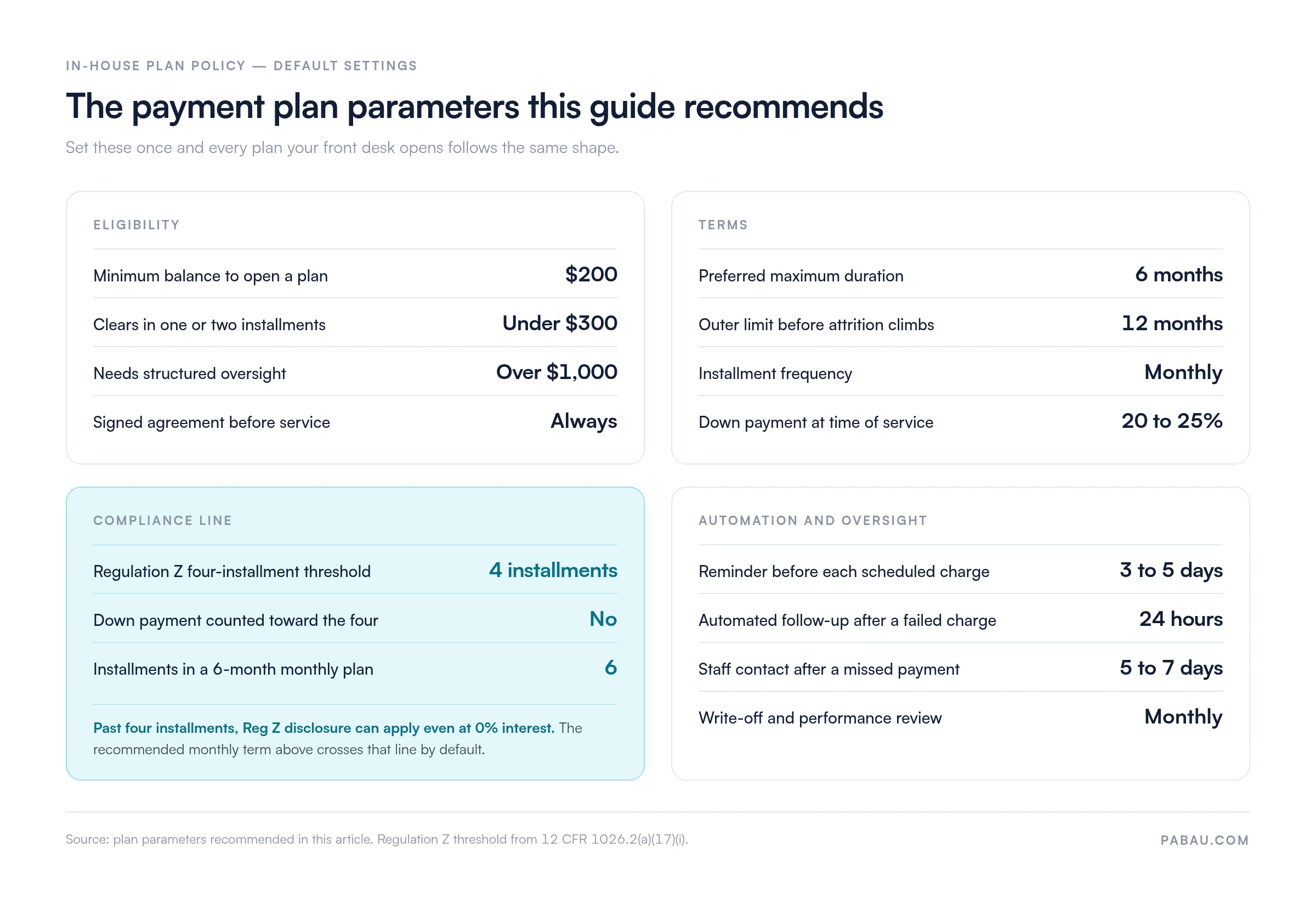
A signed agreement is your only legal protection if a patient stops paying. It also sets clear expectations, which heads off disputes later. Every agreement should include:
Keep plan durations short. Every extra month is another chance for a card to expire, an address to change, or a job to end. Six months or fewer keeps the balance in the patient’s line of sight and the relationship active. Longer terms are sometimes unavoidable on large balances, but those plans need tighter monthly review.
The practices that collect the most from their payment plan programs share a handful of operational habits.
Payment plan programs tend to fail on setup rather than on patient behavior. Five errors account for most of the damage.
Manual collection is the biggest cost driver in an in-house payment plan program. Every chase call, every hand-keyed charge, and every one-off invoice is staff time a workflow could absorb. The payment reconciliation workflows that high-performing practices run rest on three components.
A payment plan program only improves when somebody is measuring it. The med spa KPI framework applies directly here. Define the metric, set a baseline, review monthly, and adjust when the number moves the wrong way.
Treat these as starting points for setting your own baseline, not published industry averages. Your numbers will differ by specialty, average balance, patient mix, and how firmly you enforce plan terms. Track them monthly for at least three months before you change any plan terms.
For the wider picture, the revenue cycle management guide covers the flow from appointment to collected balance. Financial management for franchises goes deeper on the multi-location side.
Most practices run a payment plan across three systems. The agreement lives in a document folder, the card sits with the payment processor, and the reminders come from whoever remembers to send them. Practice management software like Pabau keeps all three in the client record.
Pabau’s payment processing stores the card against the client, so the recurring charge and the treatment history sit on one screen. Staff can see the balance, the next due date, and every attempt against the plan without opening a second system.
Automated SMS and email reminders fire against the patient’s own due date rather than a broadcast schedule. Transaction history sits on the same record, so the front desk can answer immediately when a patient asks why a charge failed.
Reporting rolls plan performance up across locations, so an owner sees write-off rates by site without exporting to a spreadsheet. Practices running memberships get the same billing engine for both, since recurring membership billing and installment plans share the infrastructure.

Pabau stores the card on file, runs the recurring charges, and sends the reminders from the same record that holds the appointment. See how practices collect more without adding admin time.

Offering a payment plan costs you the float on a balance you were probably not going to collect in full anyway. That is the trade worth remembering the next time a plan feels like a concession rather than a decision.
So write the policy first, then buy the workflow. A practice with clear parameters and a signed agreement can run plans on almost any billing system. A practice without them will leak money through the best software on the market.
And count the installments before you launch. Four or fewer keeps you outside Regulation Z’s definition of credit. Past that, the disclosure work becomes a decision you make on purpose rather than one you discover later.
Book a demo to see how Pabau runs card-on-file plans, recurring charges, and reminders from one client record.

Want to fix late payments and missed appointments together? How to improve your patient no-show rate covers the behavioral levers that apply to attendance and payment compliance alike.
Not sure what balance your plans should be carrying? How to choose a med spa pricing strategy works through the pricing decisions that set the size of every balance you finance.
Ready to model your practice finances properly? Medical practice business plan guide walks through the financial modeling that helps you set sustainable collections targets.
Running plans across more than one site? Multi-location scheduling software explains how to keep policy consistent when each location has its own front desk.
Patient payment plans are structured installment agreements between a healthcare provider and a patient. They let the patient pay a medical bill over time rather than in one lump sum. The practice and patient agree on a total balance, an installment amount, a frequency, and due dates. Those terms are documented in a signed payment plan agreement. Plans may be managed in-house by the practice or run through a third-party patient financing platform.
Introduce payment plans proactively at scheduling or before service, not after the bill is sent. Set a minimum balance threshold, and require a down payment and a signed agreement at the time of service. Store a card on file for autopay, then configure automated reminders in your practice management system. Front-desk staff should frame the plan as a service option rather than a collections conversation.
Yes, but a finance charge triggers Truth in Lending Act disclosure requirements under Regulation Z (12 CFR Part 1026). The practice then has to give the patient written disclosures covering the APR and the total cost of credit. Interest is not the only trigger. Regulation Z’s four-installment rule treats a plan as credit when payment is due in more than four installments, excluding the down payment. That applies at zero interest too, so a six-month interest-free plan can carry disclosure obligations. Consult a healthcare attorney before setting your plan terms.
With an in-house plan, the practice manages the agreement, collects each installment, and carries the credit risk if the patient stops paying. With third-party financing from CareCredit, Cherry or PatientFi, the patient takes a loan from the financing company. The provider receives full payment upfront and the patient repays the lender directly. Third-party options remove credit risk from the practice, but they may involve platform fees and take the practice out of the billing relationship.
A valid agreement should state the total balance owed, the down payment collected, and the installment amount, frequency and count. It should also list specific due dates, accepted payment methods, the late payment policy, and the consequences of default. Add the interest rate or a zero-interest confirmation, plus the patient’s signature and date. Without a signed agreement, the practice has no documented basis for escalating a missed payment.
Collect a card on file at plan signup and configure recurring charges on the agreed schedule inside your practice management platform. Add automated SMS or email reminders three to five days before each charge date. Set a follow-up trigger to fire within 24 hours of any failed payment. That removes manual follow-up for on-track plans and reserves staff time for genuine escalations.