CCSD code H4430: Examination of rectum under anaesthetic
CCSD code H4430 pays for the examination alone CCSD code H4430 is the UK private...

Last Updated: Oct 20, 2026
M0064 is the HCPCS Level II code for brief office visit for the sole purpose of monitoring or changing drug prescriptions used in the treatment of mental psychoneurotic and personality disorders. CMS terminated it with effect from 31 December 2014, so it is no longer valid for claims after that date.
The harder question is what belongs on the claim instead. CPT 90792 took over the ground M0064 held, but it is not a straight swap. Plenty of medication visits sit better on an E/M code.
Let Pabau's smart automation suggest the right codes, reduce claim denials, and keep your practice compliant—effortlessly.
Automate repetitive tasks and focus on what matters most—your patients.
Reduce coding errors and ensure compliance with the latest regulations.
Clean claims, fewer denials, and faster reimbursements.
Powerful insights and reporting to help your practice thrive.
HIPAA compliant SOC 2 certified GDPR-compliant Trusted by 4,000+ clinics worldwide

HCPCS code M0064 described a brief office visit whose only purpose was monitoring or changing a psychiatric drug prescription.
M0064 is deleted, so Medicare and commercial payers deny any claim that still carries it.
CPT 90792 replaced it, but it only fits when the note documents a psychiatric diagnostic evaluation with medical services.
A brief medication check with low-complexity decision-making usually belongs on CPT 99213 rather than 90792.
Practice management software like Pabau refreshes its CPT, HCPCS and ICD-10 lookup libraries with each official release, so billers search current codes.
M0064 was a Level II HCPCS code maintained by the Centers for Medicare and Medicaid Services (CMS). It covered a single encounter type. That was a brief office visit held only to monitor or change a drug prescription for a mental, psychoneurotic, or personality disorder.
“Sole purpose” carried the weight in that descriptor. The visit had to stay inside prescription review or adjustment. Add a psychotherapy component, a new psychiatric evaluation, or a wider clinical assessment, and the encounter fell outside M0064. That narrow boundary is part of why CMS eventually handed the work to a CPT code with clearer parameters.
The M-series sat in a miscellaneous corner of Level II, created for services CPT did not describe well at the time. As CPT built out its psychiatric coding, several M codes became redundant, and M0064 was one of them.
Anyone comfortable with the fundamentals of medical billing knows how this goes. A deleted code stays readable in old records forever, and it stays unbillable just as long.
M0064 is not active, not billable, and not reimbursable by Medicare or any commercial payer. A claim submitted with it today returns as a denial rather than a payment. There is no modifier, no attachment, and no appeal narrative that changes that.
The deletion came as CMS consolidated psychiatric billing under the AMA’s CPT framework. Provider documentation from the Los Angeles County Department of Mental Health noted the inactivation of M0064.
It pointed providers to CPT 90792 for the encounters M0064 used to carry. The direction of travel was toward descriptive coding, where what the clinician evaluated decides the code rather than how long the visit ran.
Watch for one practical trap. Some older records systems and billing platforms cache historical code sets. A practice that has not refreshed its code library may still show M0064 as a selectable option.
A stale dropdown is a system problem, not permission to bill. Practices with strong revenue cycle management habits check code status before the claim goes out, not after the denial lands.
CPT 90792 took over as the primary code for psychiatric evaluation visits that include medical services. The American Medical Association (AMA) maintains the CPT set and describes 90792 as a psychiatric diagnostic evaluation with medical services.
That descriptor is wider than M0064’s ever was. M0064 covered prescription monitoring. 90792 covers a full diagnostic evaluation that also carries medical decision-making, a physical examination, or both.
That difference decides a lot of claims. A medication check does not automatically qualify for 90792, because the evaluation component has to be there in the note.
Where the encounter amounted to a short prescription review with no evaluation findings recorded, an Evaluation and Management (E/M) code describes it more accurately.
Reimbursement for 90792 moves with the payer and the locality. The CMS Physician Fee Schedule lookup gives current Medicare rates by area. Commercial contracts set their own, so check coverage and amounts in each payer’s portal instead of assuming the Medicare rate carries across.
Before you code a psychiatric medication visit as CPT 90792, confirm the documentation includes a diagnostic evaluation element. If the visit was a brief prescription check with no evaluation findings, an E/M code holds up better on audit. Read the encounter note against the AMA descriptor before you pick the code.
With M0064 gone, medication management billing runs down three paths. What the clinician did, and recorded, decides which one applies.
Side by side, the choice comes down to what the note can support.
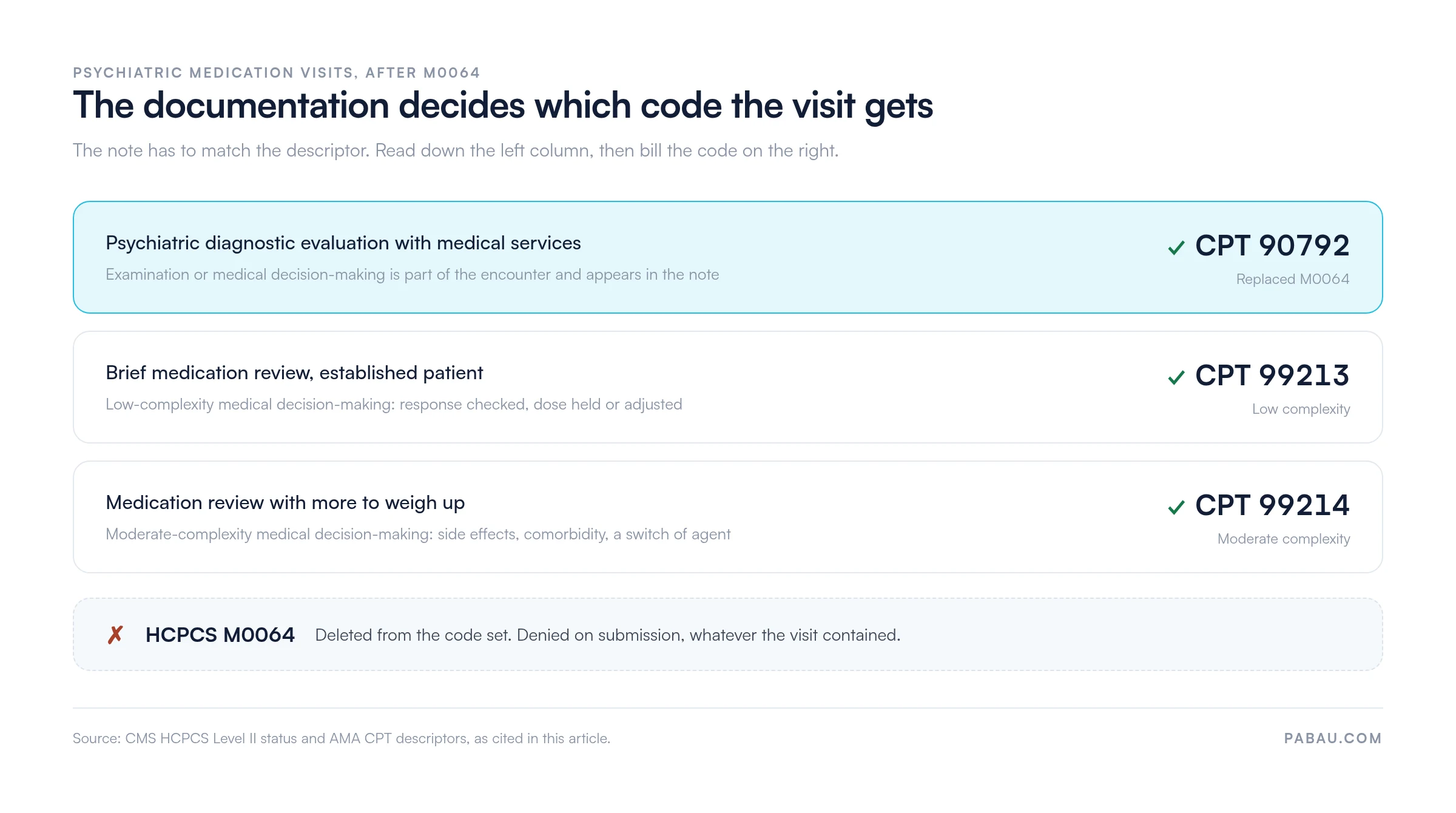
The most common misstep here is stretching 90792 over an encounter that was an E/M visit. Documentation has to support the evaluation element for the code to survive a review.
Payers running post-payment audits do flag 90792 claims whose notes read like a medication check, and those claim denials arrive months after the money did.
Provider qualification matters too. CPT 90792 calls for a qualified healthcare professional. In practice that means a physician, or an advanced practice provider with psychiatric training, depending on state scope-of-practice rules.
Check the rendering provider’s credentials against both the CPT descriptor and the payer’s own policy before you send the claim.
Reading M0064 in context means knowing the codes now doing its work. The table below covers what outpatient mental and behavioral health billing leans on most. Keeping to active codes is the plainest form of medical billing compliance there is.
Practices in states with Medicaid managed care should also check whether the state program has adopted its own behavioral health HCPCS codes.
Several maintain H-code sets that run alongside CPT. ResDAC’s coding resources explain how these codes appear in Medicare and Medicaid claims data, which helps when you are tracing what an old code covered.
Step back from the individual codes for a moment. HCPCS has two levels. Level I is the AMA’s CPT set, used for physician and outpatient procedures.
Level II belongs to CMS, and it covers what CPT does not describe well. That includes durable medical equipment, ambulance services, drugs given in a clinical setting, and the historical M-series.
M codes filled in for CPT at a time when behavioral health billing was thinner than it is now. Through the 2000s and 2010s the AMA expanded its psychiatric codes, and the M-series turned duplicative.
CMS retired those codes in batches. HIPAA’s standard code set requirement added pressure to consolidate under CPT rather than run parallel HCPCS codes for physician work.
That hierarchy explains why M0064 existed, and why its deletion was scheduled rather than sudden. The AAPC’s HCPCS code lookup tool carries the full Level II set with deletion history.
That helps when you are tracing an old code on an old claim. Practices building HIPAA-compliant billing workflows need this structure straight, because electronic claims only travel on standard code sets.
CMS did not retire the whole M-series. M0076 is still a valid HCPCS Level II code, and it covers prolotherapy injections.
Retired-code denials are avoidable at the desk, and they cost more to fix than to prevent. Run this list before the batch goes out.
Two mistakes account for most M0064 denials that still happen. The first is a superbill template nobody has audited since the code was live. The second is a biller copying codes forward from a legacy encounter record without checking their status.
Practices that moved to digital superbills with a maintained code list see fewer first-pass denials. The superbill generation process is exactly where a retired code slips back in.
Audit your code library once a year, when CMS publishes its annual HCPCS Level II update. Run a report of the codes the new file flags as deleted or inactive. Cross-reference those against your superbill templates and encounter form dropdowns, then delete every retired code you find.
Deleted codes cause trouble because they survive in two places. They sit in old records, and they sit in code libraries nobody has refreshed.
A biller who finds M0064 in a legacy encounter note has no signal that it retired years ago. The denial then arrives weeks later, and the rework costs more staff time than the visit earned.
Practice management software like Pabau works on that problem from the record end. In a psychiatry practice management software setup, billing and the clinical note live in the same system. The code on the claim then comes from the documented service rather than from memory.
Pabau’s claims management software pre-fills the claim from the client record. The CPT code attached to the service lands on the charge line, and the ICD-10 slots are seeded from the recorded problem list.
Its CPT, HCPCS and ICD-10 lookup libraries refresh with each official release. Billers search the current code set instead of a list that stopped updating.
Pabau also checks that the claim’s required fields are complete before the send button unlocks. On the US pipeline it runs eligibility checks, tracks claim status, and posts electronic remittance advice back against the invoice.
Plenty of mental health EMR users juggle CPT and HCPCS codes across several payers. For them, that adds up to fewer trips back to a claim that has already gone out. Clean claims reach adjudication faster, and your team spends its afternoons on patients rather than on rework.

Pabau’s claims management software pre-fills the claim from the client record and gives billers current CPT, HCPCS and ICD-10 lookup libraries. It also checks that every required claim field is complete before the claim goes out.

M0064 is billing history now, and the only live question is what replaces it on each claim. Use 90792 where the note carries a diagnostic evaluation, and an E/M level where the visit was a medication review. Get that call right, and the rest of a psychiatric claim is routine.
The wider fix is housekeeping. Clear retired codes out of your templates when CMS publishes its annual update, and work from a code library that refreshes with the official releases.
Pabau handles that part quietly, pre-filling the claim from the client record and checking required fields before it goes out. Book a demo to see how a psychiatric medication visit travels from note to paid claim.

Need to understand how behavioral health coding fits your EMR? Psychiatry practice management software covers what psychiatric providers should look for in a billing-integrated EMR.
Want to build cleaner claims from the start? What makes a clean claim breaks down the submission requirements that prevent first-pass denials.
Managing billing compliance across your practice? Revenue cycle management explained covers the end-to-end process from encounter to payment, including how deleted codes disrupt cash flow.
Most payers return claim adjustment reason code 181, meaning the procedure code was invalid on the date of service. Some send CO-16 with a remark code instead. Either way, the fix is a corrected claim carrying an active code, not an appeal.
No. Payers adjudicate against the code set in force on the date of service, but filing deadlines for those dates closed long ago. No live scenario puts M0064 on a claim, including a corrected or resubmitted one.
Not for the same encounter. CPT keeps the psychiatric diagnostic evaluation separate from the psychotherapy service codes. Where psychotherapy runs alongside a medication visit, the add-on codes 90833, 90836 and 90838 are reported with the E/M code instead.
Yes, the code itself does not change. What changes is the place of service code and the modifier, usually 95. Telehealth coverage differs by payer and moves often, so check the current policy before you send the claim.
Record the diagnostic evaluation, not only the prescription change. The note should show the history taken, the mental status findings, and the medical decision-making. It should also carry the diagnosis or treatment plan that came out of the visit.