CCSD code H4430: Examination of rectum under anaesthetic
CCSD code H4430 pays for the examination alone CCSD code H4430 is the UK private...

Last Updated: Oct 20, 2026
J0300 is the HCPCS Level II code for injection, amobarbital, up to 125 mg.
Documentation, rather than the code, is where J0300 claims usually fail.
This page covers the official descriptor, how units are counted, and what Medicare pays for J0300. You'll also find ASC payment rules, the adjacent J-codes, and the medical billing record a clean claim needs.
Let Pabau's smart automation suggest the right codes, reduce claim denials, and keep your practice compliant—effortlessly.
Automate repetitive tasks and focus on what matters most—your patients.
Reduce coding errors and ensure compliance with the latest regulations.
Clean claims, fewer denials, and faster reimbursements.
Powerful insights and reporting to help your practice thrive.
HIPAA compliant SOC 2 certified GDPR-compliant Trusted by 4,000+ clinics worldwide

HCPCS code J0300 pays for the drug amobarbital, up to 125 mg per unit, and not for the work of giving the injection.
Units follow the documented dose in 125 mg steps, so a 250 mg dose bills as two units rather than one.
J0300 is active for Medicare billing in 2025 and 2026, and CMS prices it from the quarterly average sales price file.
Amobarbital is a DEA Schedule II drug, so the signed order, the DEA number, and the administration record all belong on file.
Pabau’s claims management tools carry a HCPCS lookup library and check the payer’s required fields before a claim can be sent.
J0300 sits in HCPCS Level II, short for Healthcare Common Procedure Coding System. The Centers for Medicare and Medicaid Services (CMS) maintains it.
One unit covers amobarbital up to 125 mg, and the code is active and reportable for Medicare billing in both 2025 and 2026.
Read that 125 mg as the size of one unit rather than a ceiling on the claim. Medicare wants units reported as multiples of the dose in the code descriptor, rounded up to the next whole number.
A documented 125 mg dose is therefore one unit, and 250 mg is two. A 150 mg dose still bills as two units, because 150 does not divide evenly into 125.
J-codes are the part of HCPCS Level II that CMS uses for drugs given by injection or infusion. They also cover other non-oral routes in outpatient settings.
CPT codes come from the American Medical Association, while CMS publishes and updates J-codes each year. If your practice bills drug administration codes, check the current HCPCS file every January.
Amobarbital, sold as Amytal, is a barbiturate central nervous system depressant. The Drug Enforcement Administration (DEA) classifies it as a Schedule II controlled substance. That classification puts documentation obligations on the claim that other J-codes never see.
Two clinical uses drive most J0300 billing. The first is procedural sedation, where the drug calms or sedates a patient. The second is the Wada test, also called the intracarotid sodium amobarbital procedure. Neurologists use it before epilepsy surgery to work out which hemisphere holds language function.
The Wada test matters for billing because it needs its own supporting diagnosis codes. If you submit J0300 for a Wada procedure, make sure the record shows the procedural context and not only the drug.
Flag J0300 claims for a Schedule II controlled substance review before submission. DEA Schedule II drugs require a valid physician order on file, with the prescribing clinician’s DEA registration number documented. Missing this detail is one of the fastest routes to a MAC audit.
Yes, Medicare covers J0300, provided the drug goes to a covered outpatient setting and medical necessity is on the record.
Beyond that, the detail belongs to your Medicare Administrative Contractor (MAC). Each MAC publishes local coverage determinations (LCDs), so check the one for your region before you assume coverage.
Place of service matters too. J0300 turns up most often in hospital outpatient departments (HOPD) and ambulatory surgical centers (ASC).
A physician office can apply as well, depending on the clinical context. Each setting pays under a different methodology, which the ASC section below covers.
The CMS Physician Fee Schedule lookup tool returns current payment amounts and coverage indicators by code, year, and locality. Confirm the fee schedule year before you submit, because rates update in October or November for the following January.
Sound revenue cycle management habits catch coverage problems before a claim reaches the payer. A J0300 claim with no prior authorization on file, where the plan requires one, comes back as a denial. So does one missing a valid diagnosis code, however accurate the J-code is.
CMS does not publish one national rate for J0300. Payment comes from the CMS average sales price (ASP) methodology for drug codes, which is adjusted quarterly. Your own figure then moves with the billing year, the MAC jurisdiction, and the place of service.
Amobarbital is a low-volume specialty drug, so its reimbursement can swing more than a high-volume drug code does. Pull the current quarterly ASP rate for J0300 from CMS directly. Third-party databases often lag by a quarter or two.
Tracking electronic remittance advice (ERA) data across your submitted J0300 claims is the surest check. It shows whether your MAC pays at the rate you expect.
One value decides whether an ASC gets paid separately for J0300, and that is the ASC payment indicator. When the drug is packaged, the facility fee absorbs it and no separate payment follows.
When it is separately payable, the ASC bills J0300 and gets the ASC drug payment rate, which differs from the HOPD rate.
CMS assigns those indicators annually, as part of the ASC Payment System update. So the answer for J0300 can change from one billing year to the next.
Check the current ASC payment indicator with CMS before you bill J0300 in an ASC. Indicators move between packaged and separately payable with each annual update. Medical billing compliance routines should include a January review of the indicator for every J-code your facility bills regularly.
J0300 applies only when amobarbital is the drug administered. For any other drug a different code applies, and reaching for J0300 out of habit is a fast route to rejection. Crosswalk codes also come up when a payer asks for a substitute code.
The AAPC HCPCS Level II code lookup is a searchable directory for checking adjacent codes and confirming status for a given billing year. The NLM Clinical Table Search API offers free HCPCS Level II lookups for teams who want code verification inside their own billing system.
Then there is the NDC question. Some MACs and commercial payers want the National Drug Code on the claim alongside J0300. The NDC identifies the specific product administered, including manufacturer, package size, and strength.
Confirm your MAC’s NDC rules first, because inconsistent NDC reporting is a documented source of drug billing denials. If your superbill documentation captures NDC data at the point of service, this step stops being manual work.
A J0300 claim fails on documentation far more often than on the code. Payers look for four confirmations. Was the drug administered, who ordered it, why was it medically necessary, and were Schedule II rules followed? A complete record answers all four without anyone having to call the practice.
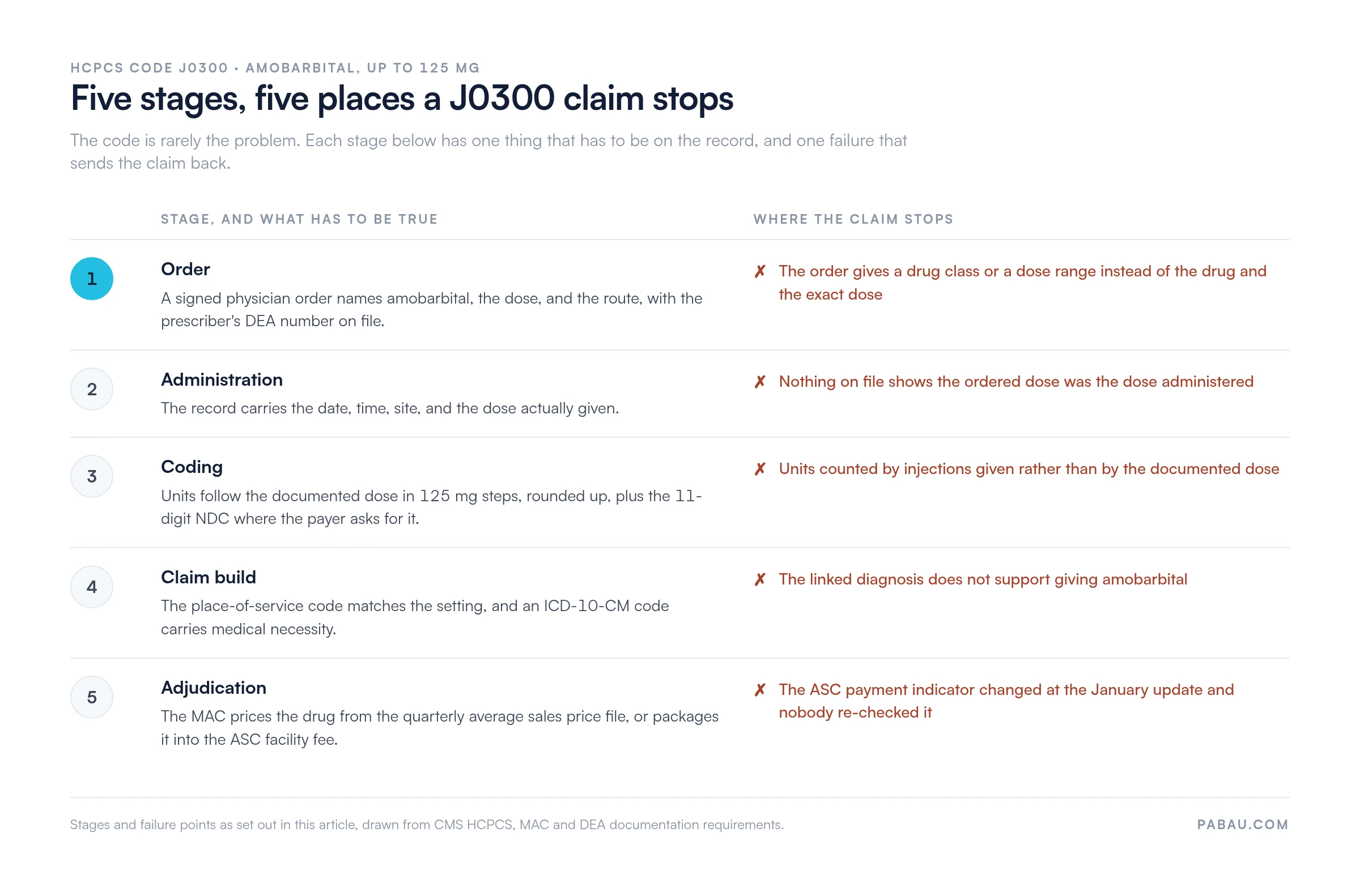
The claim passes through five stages, and each one has a single point where J0300 typically gets stuck. It starts with the order, which has to name amobarbital, the dose, and the route. The administration record then has to show the dose administered, with the date, time, and site.
Coding comes third. Units follow the documented dose in 125 mg steps, and the NDC goes on the line where the payer wants it.
Building the claim comes fourth. Here the place-of-service code and the ICD-10-CM diagnosis have to line up with the record. Adjudication is last, and there the ASC payment indicator or the quarterly ASP rate decides what gets paid.
The chart below maps those five stages against the failure that stops the claim at each one.
Missing or incomplete physician order. The order on file names a drug class or a dose range instead of the specific drug and the exact dose. Fix it by requiring a complete, signed order for every amobarbital administration before the claim goes out.
Units that do not match the dose. One unit of J0300 covers up to 125 mg, so the count has to follow what the clinician documented. Staff who count injections instead of dose increments get this wrong in both directions. Fix it by mapping the documented dose to units in your billing system, rather than the number of syringes.
Diagnosis code mismatch. The diagnosis on the claim does not support giving amobarbital. For a Wada test, the linked ICD-10 code should reflect the underlying epilepsy or the pre-surgical evaluation. Fix it with clinical staff, confirming the ICD-10 selection matches the documented indication. Good denial management strategies for drug codes include a pre-submission diagnosis check.
NDC missing when the payer wants it. The MAC expects NDC data on drug claims and the claim went out without it. Fix it by reading your MAC’s billing guidelines for NDC requirements on J-codes, then updating your claim template. Running a clean claim submission check before each billing cycle catches this before the payer does.
Run a quarterly audit of your J0300 claims using ERA data. Pull every J0300 remittance line, filter for denial reason codes, and find your top two denial patterns. Then fix the most common cause first, which is usually documentation or units. Working in that order tends to clear the largest share of rejections for the least effort.
Manual HCPCS lookups and hand-keyed drug codes create avoidable errors. When a biller reads a code from an external database and retypes it, transcription slips creep in. Stale code references cost the practice time and revenue.
Practice management software like Pabau takes that step out. Its claims management software carries HCPCS Level II and ICD-10-CM lookup libraries, refreshed with each official release.
The code you need is a search away inside the claim itself. The form then pre-fills from the record, so codes already attached to the service land on the charge line.
Before a claim can be sent, Pabau checks that the fields the payer requires are complete. That will not tell you whether 125 mg or 250 mg was given, so the dose still has to be documented properly.
What it does stop is a claim leaving with an empty membership number, authorization code, or other required field.
On the US pipeline, claims route through Claim.MD, which adds real-time eligibility checks, claim status tracking, and ERA remittance posting. So the denial patterns from the quarterly audit above land back in the same system that submitted the claim.
For practices that bill drug injection codes regularly, EHR integration capabilities matter. They remove the manual step of moving data between a clinical system and a billing platform.
That handoff is where most J-code errors start. The right medical billing software for drug-heavy practices supports NDC reporting, place-of-service mapping, and MAC-specific billing rules out of the box.
HIPAA compliance for medical offices is another reason an integrated platform beats separate billing tools. Fewer manual handoffs of drug administration records means fewer chances to mishandle patient data.

Pabau’s claims management tools carry HCPCS Level II and ICD-10-CM lookup libraries and pre-fill the claim from the record. Required payer fields get checked before the claim can be sent. Your team catches an incomplete J0300 claim at the desk, not six weeks later on a remittance.

J0300 is a low-volume code with high scrutiny attached. The Schedule II status means every claim carries documentation that ordinary J-codes never ask for. Getting the code right is the easy half of the job.
So work backwards from the remittance. Get the order, the administration record, the units, the diagnosis link, and the NDC in place before submission. Then there is very little left for a MAC to reject. Once a quarter, pull your J0300 ERA lines and check whether the same reason code keeps returning.
That check is easier when the record and the claim live in one system. Pabau’s claims management tools build the code lookups and the required-field checks into the workflow, so nobody has to remember them.
Book a demo to see how Pabau handles J-code documentation and claim submission end to end.

Need a full overview of drug injection billing workflows? Medical billing fundamentals walks through how drug administration codes move from clinical documentation to paid claim.
Want to understand how remittance data can improve your J-code denial rate? Electronic remittance advice explains how to read ERA files and use denial reason codes to fix recurring billing errors.
Looking to tighten your clean claim rate across all HCPCS codes? Denial management in healthcare covers systematic approaches to reducing payer rejections at the source.
No. J0300 pays for the amobarbital itself. The work of administering it is billed separately, using the CPT administration code that matches how the drug was given. Report both on the claim when the record supports both, and expect the payer to judge each line on its own merits.
They apply to Part B drugs that are separately payable and supplied in single-dose containers or single-use packages. JW reports a discarded amount, and JZ attests that none was discarded. Check the FDA labeling for the amobarbital product you stock, then confirm your MAC’s instruction before appending either one.
No. J0300 is a billing code for a drug and a dose increment. A National Drug Code identifies the exact product, including the manufacturer, the strength, and the package size. Some payers want both on the same claim line, so one never replaces the other.
Traditional Medicare rarely requires prior authorization on a Part B drug code, but Medicare Advantage and commercial plans can. Check the patient’s plan before the drug is administered, because a retroactive authorization is hard to win. Note the authorization number on the claim where the payer asks for it.