

HCPCS code E0198: Water pressure pad billing guide
HCPCS code E0198 is a water pad for a standard mattress HCPCS code E0198 is the ...

Last Updated: Oct 13, 2026
A4755 is the HCPCS Level II code for blood tubing, arterial and venous combined, for hemodialysis, each.
Let Pabau's smart automation suggest the right codes, reduce claim denials, and keep your practice compliant—effortlessly.
Automate repetitive tasks and focus on what matters most—your patients.
Reduce coding errors and ensure compliance with the latest regulations.
Clean claims, fewer denials, and faster reimbursements.
Powerful insights and reporting to help your practice thrive.
HIPAA compliant SOC 2 certified GDPR-compliant Trusted by 4,000+ clinics worldwide

HCPCS Code A4755 is the supply code for blood tubing, arterial and venous combined, for hemodialysis, each.
A4755 sits on Medicare’s ESRD PPS consolidated billing list, so the dialysis facility carries it inside its bundled payment.
Home hemodialysis follows the same rule, because Method II billing by DME suppliers ended on January 1, 2011.
A4750 covers one arterial or venous line, so recording two units of it for a combined set is a coding error.
Practice management software like Pabau helps billing teams keep supply records and claim status in one place.
HCPCS Code A4755 is the Level II supply code for blood tubing, arterial and venous combined, for hemodialysis, each. One unit is one combined tubing set. That set holds the arterial line carrying blood to the dialyzer and the venous line returning it to the patient.
The code rarely produces a payment of its own. A4755 appears on Medicare’s ESRD consolidated billing list, so the dialysis facility is paid for the tubing inside its per-treatment bundle. Anyone new to medical billing for dialysis should start with that distinction.
This reference covers the official descriptor, the consolidated billing rules, how payment reaches the facility in 2026, documentation, modifiers, and how A4755 differs from A4750.
A4755 is a Level II supply code maintained by the Centers for Medicare and Medicaid Services (CMS). It belongs to the A-series, which covers medical and surgical supplies, durable medical equipment (DME), and related items billed outside the physician fee schedule.
A hemodialysis session needs two tubing lines. The arterial line carries blood from the patient to the dialyzer, and the venous line returns the filtered blood. A4755 covers a set in which both lines are packaged and reported together as a single unit.
Combined sets are the standard configuration at most in-center facilities. Each set is single-use and replaced for the next treatment. A patient on three sessions a week goes through three combined sets a week, recorded under A4755 or A4750 depending on the configuration.
The one decision that matters is whether the session used a combined set or two separate tubes. Recording two units of A4750 for a combined set misstates the supply, and so does recording A4755 when only one line was used.
Confusing A4755 with A4750 is the most common error in dialysis supply coding. Both describe hemodialysis blood tubing, and both are valid codes, so the wrong one will not always bounce back. It still leaves the supply record wrong and the facility exposed at audit.
The supply record settles it. Note in the treatment record which configuration the session used, and the code follows from the record rather than from habit.
A4755 sits in a family of A-series dialysis supply codes, and each one covers a distinct item. The AAPC HCPCS lookup tool is useful for checking a full descriptor, including codes outside this range such as P9010 for blood products.
Note that A4760 and A4765 are peritoneal dialysis codes, so neither belongs on a hemodialysis supply line. Nephrology billing teams also handle codes well outside the A-series. Patients who move on to transplant bring immunosuppressant codes such as J7525 and J7502 into the same claim workflow.
Under the ESRD Prospective Payment System (ESRD PPS), the dialysis facility receives one bundled payment per treatment. That payment is designed to cover the supplies a hemodialysis session needs, blood tubing included. A4755 is therefore not separately payable to Medicare.
A4755 also appears on the CMS ESRD PPS consolidated billing list, which names the supply codes Medicare will not pay to a DME supplier. No second billing path exists. If the tubing was used for dialysis, the bundled payment to the facility has already covered it.
Set side by side, the payer picture is easier to hold on to.
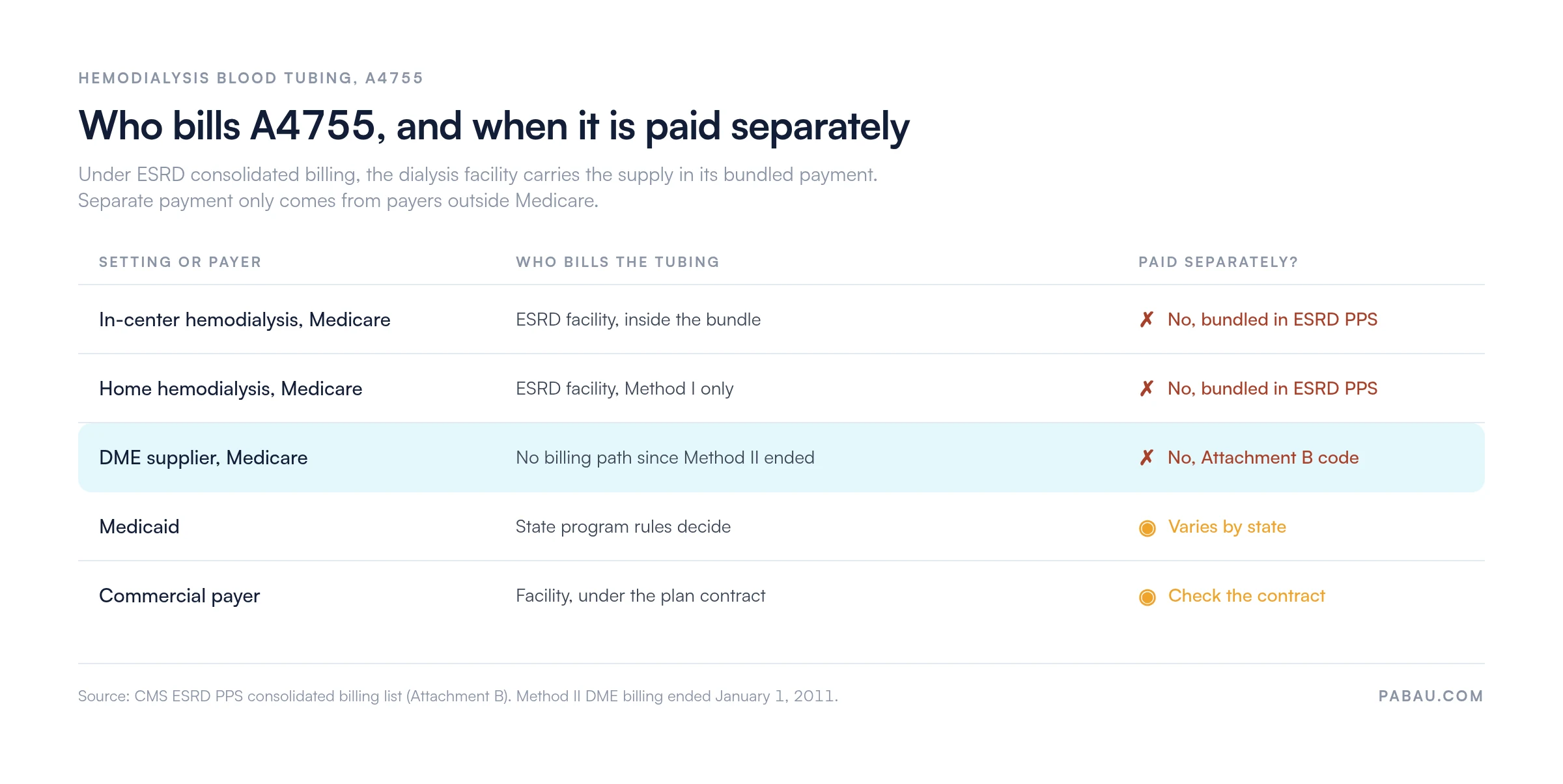
Keep Medicare’s rules apart from everyone else’s. Applying ESRD bundling to a commercial plan can leave a payable supply unbilled. Assuming separate payment under Medicare produces a line that will never pay. Medical billing compliance work on supply codes runs payer by payer.
Before you put A4755 on a claim as a separate line, check two things. First, whether the payer is Medicare, because consolidated billing settles the question there. Second, what the commercial contract or state Medicaid policy in front of you says about dialysis supplies.
There is no separate 2026 Medicare amount to look up for A4755. Payment reaches the facility through the ESRD PPS base rate, which CMS updates annually and adjusts for local wage levels. Separate payment for the tubing only comes from a payer outside that system.
The CMS DMEPOS fee schedule does not offer an alternative route. Because A4755 is on the consolidated billing list, a DME supplier cannot be paid for it, even when the patient dialyzes at home.
Quote a figure only with its year and its source attached. For this code that source is the annual CMS rule and the consolidated billing files, not a third-party lookup tool.
Documentation is what makes the code defensible, whether or not it draws a payment of its own. Clean claim work on dialysis supplies comes down to the treatment record, the supply log, and the code agreeing with one another.
Denials on supply codes cluster by payer rather than by claim. Reading remittance advice by code shows which payer keeps rejecting A4755, and the reason is usually a coverage assumption rather than a keying slip.
Most A4755 lines never reach a modifier question. Consolidated billing means the code is not separately payable to Medicare, so there is no separate line for a modifier to qualify. Modifiers only come into play where a payer accepts the code on its own.
Check the payer’s own guidance before appending any of them. No modifier turns a bundled supply into a separately payable one.
Medicare Administrative Contractors (MACs) process claims by region, and local coverage articles do differ between them. For A4755, the jurisdiction rarely changes the answer. The ESRD PPS base rate is national, adjusted for area wages, and consolidated billing applies everywhere. What changes the answer is the payer, since state Medicaid programs and commercial plans write their own supply rules.
Dialysis billing runs on volume. Recurring sessions, firm bundling rules, and payer-by-payer variation are hard to hold together by hand. Tracking denial management by HCPCS code shows which supply codes and which payers produce the rejections.
The same pressure shows up wherever treatment is recurring and supply-heavy. Teams weighing up infusion center software or a metabolic health EMR ask the same question about which supplies sit inside a bundled payment.
Run a quarterly check of supply inventory against the codes in your treatment records. If the facility stocks only combined tubing sets but A4750 keeps appearing, someone is coding the configuration wrong. Catching that early is far cheaper than correcting a year of records.
Most dialysis billing teams work across two systems. Supply use is written into the treatment record, the claim is built somewhere else, and somebody reconciles the two by hand every week. That is where a combined set turns into two units of A4750.
Practice management software like Pabau keeps the treatment record and the claim in one place. Supplies logged against a session stay attached to that patient’s chart. The code on the claim and the set that was used come from the same source. Pabau’s claims management software then tracks each claim by payer, from submission through to the remittance.
For US practices, claims leave through the Claim.MD integration, our clearinghouse connection. It submits what your team has already coded and reports back what the payer did with it. Your coders still decide the code, and nobody spends a morning hunting for the supply record behind a rejected line.

Pabau keeps supply use, patient records, and claim status in one system. Dialysis billing teams can see what was used, what was submitted, and what came back.

A4755 is an easy code to describe and an easy one to bill wrongly. Under Medicare the answer is already settled. The bundled payment to the facility covers the tubing, and no DME supplier route survives.
So the work sits elsewhere. Get the configuration right between A4755 and A4750. Keep the supply record lined up with the treatment log, and read every non-Medicare contract on its own terms. Practices that do those three things rarely have to rebill a supply line.
If denials keep landing on dialysis supply lines, the denial codes reference is the next stop. Book a demo to see how Pabau ties supply records to claim submission for nephrology billing teams.

Billing blood products alongside dialysis? P9010 covers whole blood for transfusion and follows its own payment rules.
Coding for transplant patients on immunosuppressants? J7525 sets out how parenteral tacrolimus is reported and documented.
Need the contrast with durable equipment? K0821 shows how a purchase and rental code differs from a single-use supply.
Patients carrying balances on dialysis-related care? Patient payment plans explains how to structure and track them without chasing.
A4755 reports blood tubing, arterial and venous combined, for hemodialysis, each. One unit is one combined set, holding the arterial line that carries blood to the dialyzer and the venous line that returns it. Facilities record a set per session, and Medicare pays for it inside the ESRD bundled payment.
A4750 covers a single blood tubing segment, either arterial or venous, per tube. A4755 covers a combined set in which both arterial and venous tubing are supplied together as one unit. Use A4755 when the session used a combined set, and A4750 only for individually supplied single tubes. Recording two units of A4750 for a combined set is a coding error.
Start with the payer. Under Medicare the facility does not bill the tubing separately, because the ESRD bundled payment already covers it. For a payer that does pay separately, record which configuration the session used. Pick A4755 for a combined set, or A4750 for each single line. Report one unit per set, and attach the documentation that payer asks for.
Medicare covers the tubing through the ESRD bundled payment rather than as a separate line. Medicaid coverage and bundling vary by state. Commercial payers may pay A4755 on its own, depending on the plan and the facility’s contract. Prior authorization rules differ too, so check each payer before you submit.
No. A4755 is on the ESRD PPS consolidated billing list, which names the supply codes Medicare will not pay to a DME supplier. The Method II route that once allowed it closed for dates of service on or after January 1, 2011. The facility bills the treatment, and the supply sits inside that payment.



