



HCPCS code E0198: Water pressure pad billing guide
HCPCS code E0198 is a water pad for a standard mattress HCPCS code E0198 is the ...

Last Updated: Oct 13, 2026

CPT code 99396 covers a periodic comprehensive preventive medicine visit for an established patient aged 40 to 64.
The visit must include a comprehensive history, a physical examination, age-appropriate counseling, and orders for immunizations or labs.
Traditional Medicare does not pay 99396, so use G0438 or G0439 for a Medicare Annual Wellness Visit.
Practice management software like Pabau pre-fills the claim from the patient record and checks required fields before submission.
CPT code 99396 is the annual physical code for an established patient aged 40 to 64. It covers a periodic comprehensive preventive medicine reevaluation, billed once a benefit year by most plans. One fact decides more 99396 claims than any other. Traditional Medicare does not pay it.
Most commercial plans do pay, and they usually pay in full, so the code is worth getting right. Claims fail for a short list of reasons. Chief among them are the wrong age band, a missing modifier 25, and a diagnosis that reads like disease rather than wellness.
The sections below cover the documentation a payer expects, the diagnosis pairings that hold up, and the checklist to run before the claim goes out.
CPT code 99396 is the American Medical Association’s code for a periodic comprehensive preventive medicine reevaluation of an established patient aged 40 to 64.
“Established” means the patient has received professional services from the same physician or group practice within the past three years.
Purpose is what separates it from an evaluation and management (E/M) code. An E/M visit answers a complaint.
A 99396 visit happens because a year has passed, and the reason for the appointment is the calendar rather than a symptom. The AMA maintains the descriptor in its CPT code set and revises it annually.
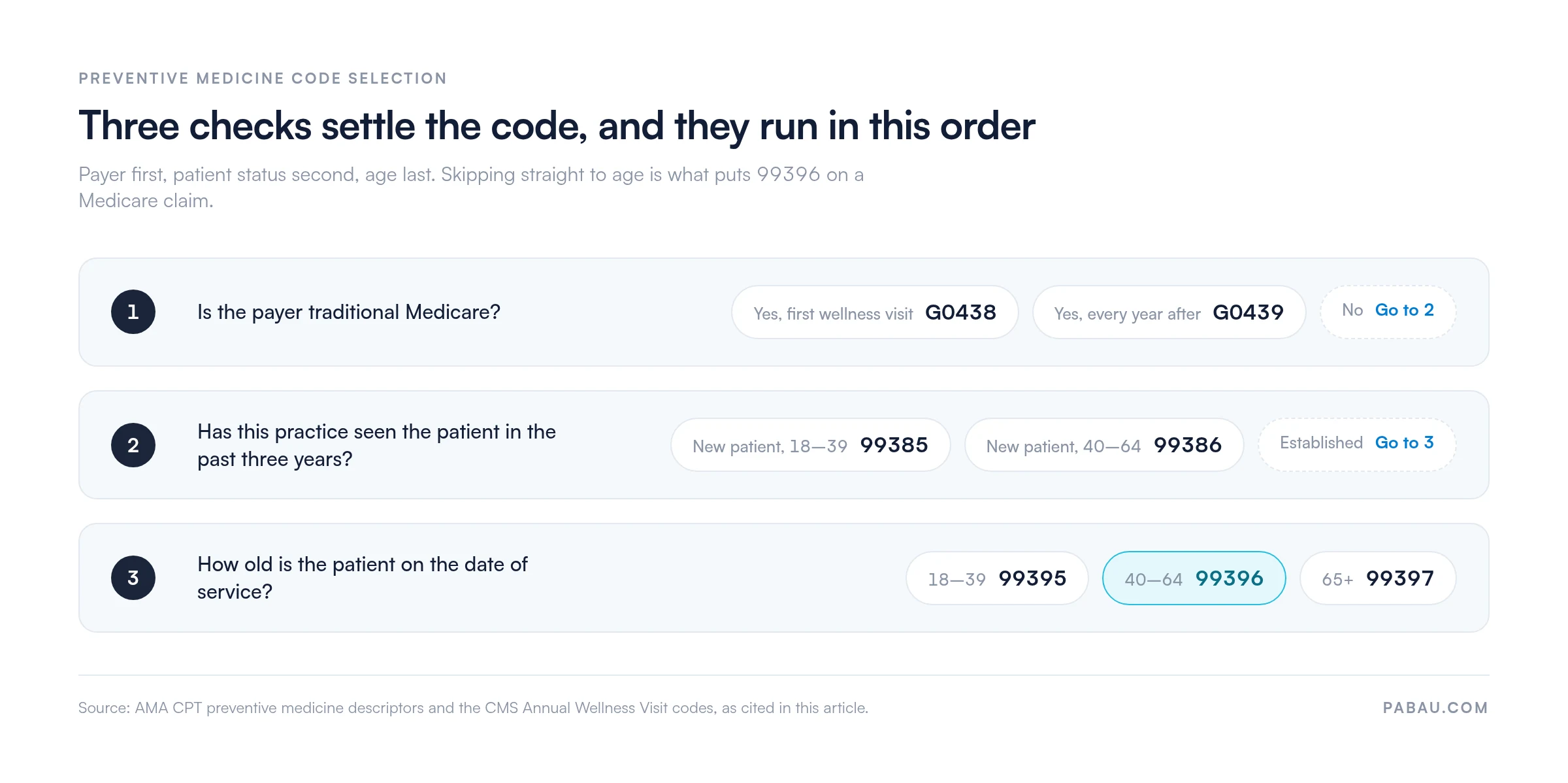
Both conditions have to hold at the same time. The patient must be established with the practice, and the patient must be 40 to 64 on the date of service. Miss either one and the claim is coded wrong before it leaves the building.
Age is measured on the date of service, never on the next birthday. A patient who turns 65 the following week still bills 99396. A patient who turned 65 the week before does not, even if the appointment was booked months earlier.
The order you check these in matters, though, because the payer overrides both of them. Work down the three questions below and the code answers itself.
The AMA descriptor names four components, and a reviewer expects to find all four in the chart. A visit that stops at the physical examination does not support 99396.
The note has to show that each one happened. A chart that records the examination but says nothing about counseling gives a reviewer grounds to downcode or deny.
Counseling is the component that goes missing most often, because the conversation takes place and never reaches the record.
The payer decides almost all of it. Traditional Medicare pays nothing for 99396, and you can confirm any code’s payment status in the CMS Physician Fee Schedule lookup. Commercial and ACA-compliant plans sit at the other end of the scale.
The annual preventive visit is one of the services non-grandfathered plans must cover in network with no cost sharing, under the federal preventive-services rules.
Billed as preventive and delivered in network, the visit costs the patient nothing. Same-day problem care is treated differently, as the modifier 25 section explains.
Your own remittances are the best rate source you have. Contracted preventive rates move with the plan, the region, and the negotiation, so a national average tells you very little about your own. Pull twelve months of paid 99396 claims by payer and you will have your own figure.
Medicare covers an Annual Wellness Visit (AWV) and has its own codes for it. Submit 99396 for a Medicare beneficiary and the claim denies, because Medicare excludes routine physical examinations by statute. Use these instead:
The two visits are not the same service. An AWV is built around a health risk assessment and a personalized prevention plan, and it does not call for a head-to-toe examination. A patient asking for the full physical is asking for a service Medicare does not cover.
That patient can still choose to pay out of pocket. The provider may perform and bill 99396 as a non-covered service, provided the patient knows in advance that Medicare will not pay. Have them sign an Advance Beneficiary Notice of Non-coverage, form CMS-R-131, before the visit.
Two documents get mixed up here, so it is worth separating them. The ABN is a signed CMS form the patient completes beforehand, and it records their agreement to pay. A superbill is an itemized statement of what was done, handed over afterward for the patient’s own claim or records.
Medicare does not require an ABN for a service it never covers, but a signed one still settles the argument about the bill. If Medicare makes up a large share of your panel, the broader Medicare billing rules shape far more than this one code.
Bill both services and append modifier 25 to the E/M code, never to 99396. That is the whole rule. The rest is documentation.
The situation itself is routine. A patient comes in for the annual physical and mentions a new rash, or asks about knee pain that has been getting worse. The preventive visit still happened, and so did a separate problem visit, so both can go out on the same date.
Then comes the awkward part at the front desk. The preventive half carries no cost sharing, but the problem half runs through the patient’s deductible and copay like any other office visit.
A patient who came in for a free physical gets a bill, calls to complain, and the practice often writes it off. Saying so at check-in costs one sentence and saves the write-off.
Leaving modifier 25 off is a primary denial trigger, and some payers audit these pairs after they pay. The note has to show two services, not one visit described twice.
A note reading ‘came in for annual physical, also discussed knee pain’ does not establish a separately identifiable service. Document the problem visit as though it stood alone, with its own history, assessment, and plan. That is what a reviewer looks for when the pair gets audited.
When the problem half is a level-five visit and the time runs well past its threshold, a prolonged-service add-on attaches to that E/M line. On a Medicare claim that add-on is G2212, while most commercial payers want CPT 99417 instead.
Lead the 99396 line with a Z code. Payers expect a wellness or preventive encounter code in the primary position. A chronic disease code sitting there is a common cause of a downcode or a denial.
Chronic conditions still belong on the claim. Hypertension, diabetes, and hyperlipidemia can sit in the secondary positions when they were reviewed during the visit. They simply cannot lead.
Every item below belongs in the note. A reviewer reading “annual physical completed, no concerns” has no way to match the note to the code. That is how a paid claim turns into a refund request.
Seven errors account for most 99396 denials, and each one is visible before submission.
Denials cluster by cause rather than by payer, so group last quarter’s rejections by reason code before you change any process. Good denial management starts with that report, because it tells you which of the seven above is costing you money.
Seven questions, answered at the desk, catch nearly all of it:
It helps to know what happens next. The claim leaves your system, hits the clearinghouse, and gets tested against that payer’s edits before the payer ever sees it.
A rejection at that stage comes back within a day and can be corrected and resubmitted. It is not a denial, so it needs no appeal, which is why front-end checks are worth more than back-end ones.
99396 is one of a family. The CPT siblings differ only by patient status and age band. The Medicare G codes sit alongside them as the alternative for a different payer.
99401 is worth a note of its own. It bills preventive counseling as a separate service in roughly 15-minute units, and 99402 through 99404 cover longer sessions. It can run on the same day as 99396 when the session is documented on its own. Payer policy on that pairing varies, so check before you count on the revenue.
Run a 90-day audit of your 99396 claims. Filter for three things: claims without a Z00.0x primary diagnosis, same-day E/M pairs missing modifier 25, and any claim sent to a Medicare payer. Those three filters surface most of your denial root causes in a single report.
The denials above share a root cause. The note and the claim get built in two separate steps, often by two different people. Counseling gets discussed and never charted.
The code gets picked from the appointment type instead of the patient’s age. Modifier 25 gets missed because the problem visit was added halfway through the encounter.
Practice management software like Pabau closes that distance by holding both in one record. Pabau’s billing and claims tools pre-fill the claim form from the patient record.
The CPT code attached to the service lands on the charge line, and the ICD-10 slots come from the recorded problem list.
Built-in ICD-10 and CPT lookup libraries let a biller confirm a code without leaving the claim. Before it can be sent, Pabau checks that the fields the payer requires are filled in.
Claims then go out electronically through a clearinghouse, with Claim.MD handling the US side for thousands of payers.
That pipeline also carries real-time eligibility checks, claim status tracking, and remittance posting. So your billers spend their time on claims that need a decision, not on ones missing a membership number.
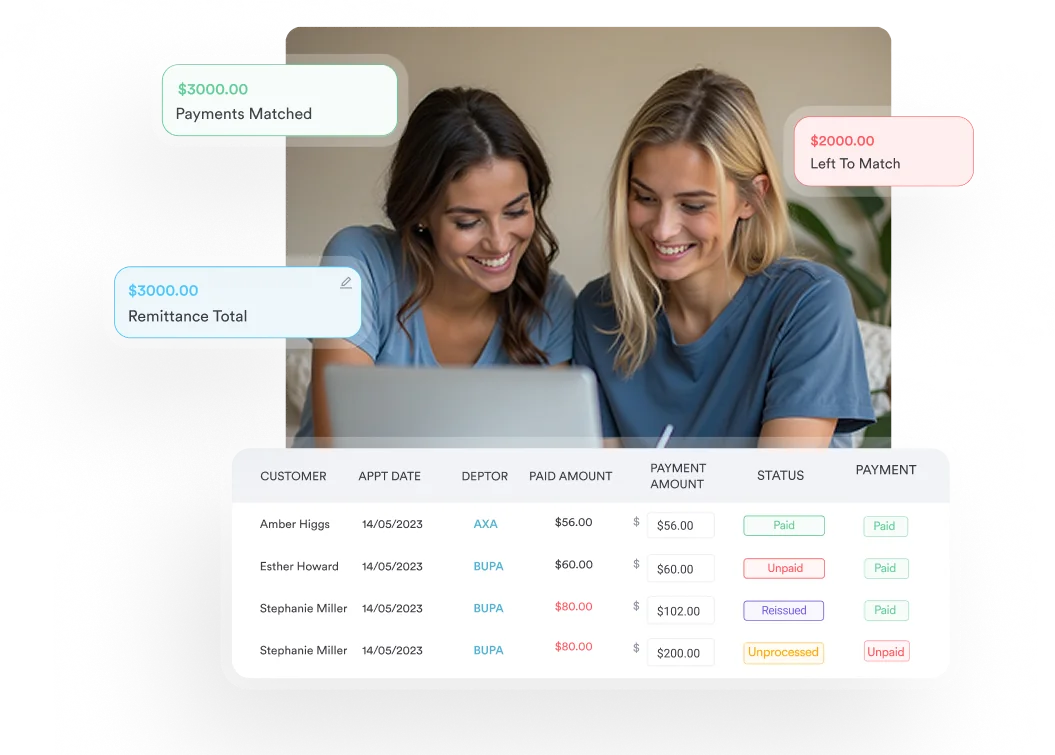

Pabau builds the claim from the patient record, checks that required fields are complete, and submits electronically through Claim.MD in the US. Your billers chase fewer rejections and rework fewer preventive visits.

The payer decides more about a 99396 claim than the examination does. Check that first, then patient status, then age, and the coding part becomes close to mechanical.
What is left is documentation, and documentation only stays complete when it is written during the visit rather than reconstructed on Friday afternoon.
So pick one habit to fix this month. Pull your paid and denied 99396 claims for the last quarter and group them by reason. One step is usually behind most of the rejections.
Book a demo to see how Pabau ties the preventive visit note to the claim. Those checks then happen before submission instead of after a denial.

Need to see how a claim reaches the payer? Medical claims clearinghouse overview walks through how claims move from your practice to payers, and where rejections get caught first.
Denials piling up across your preventive codes? Denial codes in medical billing decodes the CARC codes your remittance shows when a 99396 claim comes back unpaid.
Trying to work out why a claim was paid short? Electronic remittance advice explains how to read the 835 file that says what was paid, what was not, and why.
Yes, within their state scope of practice. In most states an NP or PA reports the preventive visit under their own NPI. Some commercial contracts still require the claim to go out under a supervising physician. Check the payer’s credentialing rules before the visit, not after the denial.
Usually not. The descriptor calls for a comprehensive multi-system physical examination, which a video visit cannot deliver. Most payers leave preventive medicine codes off their telehealth lists for that reason. A virtual conversation about risk factors bills better as counseling or as a problem-focused visit.
Two ways, and they are not interchangeable. Some plans reset on the benefit year, so a January visit and a December visit both pay. Others count 365 days from the last preventive visit, which turns an early rebooking into a denial. Check the member’s plan at scheduling.
Yes. The code covers ordering the labs, not performing them. A lipid panel, the blood draw, and any in-office screening go out on their own lines with their own diagnosis codes. Mammography and colonoscopy referrals are billed by whichever facility carries them out.



