CCSD code F4600: Incisional drainage of salivary gland abscess
CCSD code F4600: what the descriptor covers CCSD code F4600 covers incisional dr...

Last Updated: Oct 20, 2026
H2035 is the HCPCS Level II code for alcohol and/or other drug treatment program, per hour.
HCPCS code H2035 pays for one hour of alcohol and/or other drug treatment program time, and that hour has to be documented minute for minute. It is a Level II HCPCS code from the H-series, the range Medicaid uses for behavioral health services that CPT codes don't cover.
One unit equals one full hour of structured treatment, backed by a start time and a stop time in the note. Miss the modifier your state requires, or round 40 spare minutes up to a whole hour, and the claim comes back denied.
Let Pabau's smart automation suggest the right codes, reduce claim denials, and keep your practice compliant—effortlessly.
Automate repetitive tasks and focus on what matters most—your patients.
Reduce coding errors and ensure compliance with the latest regulations.
Clean claims, fewer denials, and faster reimbursements.
Powerful insights and reporting to help your practice thrive.
HIPAA compliant SOC 2 certified GDPR-compliant Trusted by 4,000+ clinics worldwide

HCPCS code H2035 bills one hour of an alcohol and/or other drug treatment program under HCPCS Level II.
Medicaid is the payer for H2035, and Medicare fee-for-service generally does not reimburse it.
One unit equals one full hour, so the start and stop times in the note set the unit count.
Modifiers such as HF, HH, HN, HO, HR, and HS tell the payer the program type and the staff credential behind the hour.
Practice management software like Pabau keeps the session times, the treatment plan, and the claim in one record.
HCPCS code H2035 covers one hour of an alcohol and/or other drug treatment program. It belongs to HCPCS Level II, the code set maintained by the Centers for Medicare and Medicaid Services (CMS).
The official long descriptor reads “Alcohol and/or other drug treatment program, per hour.” Its home is the H-series, which holds the behavioral health and substance use disorder (SUD) services that CPT codes never described.
Per CMS’s HCPCS overview, state Medicaid programs and some commercial payers are the ones that use these codes.
H2035 buys structured program time, so an individual psychotherapy visit belongs on a CPT code instead. A program that delivers both keeps them on separate lines, because the payer reads them as separate services.
H2035 belongs to Medicaid-certified programs, not to individual clinicians billing session by session. Your state Medicaid agency writes the enrollment rules, and they differ more than you would expect. An approved provider type in one state can be ineligible in the next.
These are the settings that commonly qualify:
Billing H2035 requires enrollment as an approved substance abuse treatment provider in your state. Staff credential rules, program accreditation such as CARF International, and facility licensure all vary from one state to the next.
Medicaid is the payer for H2035, and Medicare fee-for-service is generally not. Run eligibility verification before the first session, so you know which plan the patient sits under and what that plan limits.
The table below sums up where the code stands with each payer type.
Two patients sitting in the same group can belong to two different MCOs, with different modifier rules and different authorization thresholds behind them. The clinical hour is identical, and the claim is not.
No national fee schedule amount exists for H2035. Because Medicare generally doesn’t reimburse the code, CMS publishes no national payment rate for it.
What you get paid comes from your state Medicaid fee schedule or your managed care contract. The AAPC HCPCS code lookup is useful for code-level reference data, though not for the number on your remittance.
Reported state Medicaid rates for H2035 run from roughly $15 to $60 per hour. Program type, geographic adjustment, and the modifier on the line all move that number.
Treat the band as a reported range, then confirm your own rate against the fee schedule or the contract. Rates also shift with:
One unit of H2035 equals one full hour of program time. The unit count has to match the start and stop times in the note, not the hours the program was scheduled to run.
Leftover minutes stay off the claim unless your state manual allows smaller increments. The diagram below shows how that arithmetic lands across three program days.
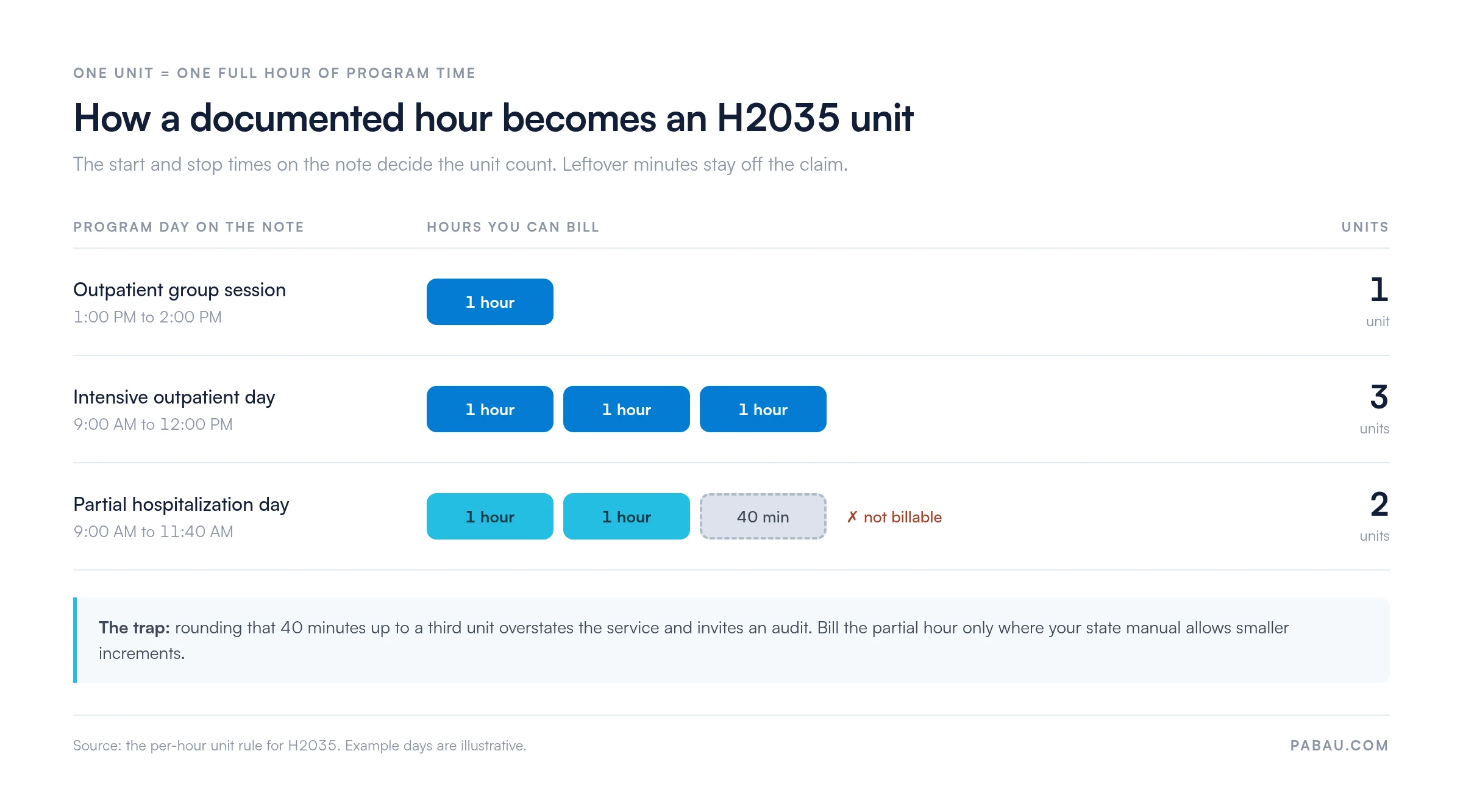
Take the partial hospitalization day above. The note runs 9:00 AM to 11:40 AM, which is two hours and 40 minutes of program time, so two units go on the claim. Rounding up to three bills 20 minutes the program never delivered. A Medicaid audit picks up that pattern across a whole quarter.
Scheduled hours make a poor substitute for documented ones. A group booked for three hours that finished after two and a half is a two-unit day, and the note has to say so. Programs that bill from the timetable rather than the record eventually owe money back.
Most state Medicaid programs want at least one modifier on every H2035 line. The modifier tells the payer what kind of program delivered the hour, and who delivered it. Submitting the code bare is one of the most common denial triggers on H2035.
Modifier policy does not travel across borders. A modifier the state next door accepts can reject in yours, and MCOs inside one state often differ from the fee-for-service manual. Read the behavioral health billing guide for each payer before you add a modifier to an H2035 line.
Before you send H2035 claims to a new MCO, ask for the plan’s behavioral health fee schedule and billing guide. Three questions settle most of it: which modifiers are required, how units are counted, and whether prior authorization applies to your program type.
An audit asks two questions. Did the patient need this level of care, and did the hours you billed happen?
Medical necessity is the more heavily scrutinized of the two, and your billing compliance records have to answer both from the file alone.
Consent deserves a second look on SUD claims. These records fall under 42 CFR Part 2, which sets tighter disclosure rules than HIPAA compliance on its own.
Get the consent language right at enrollment and every later records request costs your team minutes instead of days.
An H2035 claim follows the same medical billing path as any other, with two checkpoints that catch programs out: authorization and unit math.
Electronic claims reach Medicaid through a clearinghouse, and the Claim.MD integration is the route practice management software like Pabau uses to send them. Here is the sequence, start to finish.
Choose between H2035 and H2036 by asking how the payer buys the service, by the hour or by the day.
H2035 is the hourly code and H2036 is the per diem one. The rest of the H-series splits along much the same line.
The H2035 and H2036 mix-up is the expensive one. Billing per diem for an IOP that runs three hours a day claims a full day of service the program didn’t deliver. Outpatient and IOP settings almost always belong on the hourly code.
Few behavioral health programs bill a single H-code. Psychosocial rehabilitation services carry their own per diem code in H2018, and supported employment hours run on H2025.
Activities that prevent developmental delay in a patient’s dependent child go on HCPCS code H2037, billed per 15 minutes. Keeping each service’s code and unit basis on one reference sheet saves your billers a lot of lookups.
Six patterns account for the bulk of H2035 rejections, and five of them are catchable before the claim leaves your office. That is what makes denial management worth the effort up front rather than after the remittance lands.
Two minutes per claim beats three weeks of rework. Run every H2035 line past these six checks before the batch leaves the building.
One item on that list needs a calendar rather than a checklist. Treatment plan expiry invalidates every claim billed against the plan, so set the review date on the day the plan is signed. Catching it at submission means the hours were already delivered against a lapsed plan.
Most H2035 errors are handoff errors. Clinical staff document the hours, billing staff key the claim, and the unit count or the modifier changes shape somewhere in between.
Software built for behavioral health closes that handoff by holding both jobs in one record. That is where a mental health EMR earns its place, especially for a program still working off paper notes.
Pabau’s claims management software prepares the claim from the record itself. The HCPCS code attached to the service lands on the charge line, and the ICD-10 fields are seeded from the client’s recorded problem list.
Required claim fields are checked for completeness before the send button unlocks, so a line missing its authorization number doesn’t leave the building.
Session times sit in the same record as the note, which keeps the unit count and the documentation from drifting apart. Digital intake forms capture consent, eligibility details, and treatment plan acknowledgment at enrollment.
For a program pairing counseling with medication-assisted treatment, psychiatry EMR software covers the prescriber side of the same file.
The change a billing lead notices first is fewer resubmissions. Claim status and remittance come back into the system that produced the claim. A denial gets read, corrected, and refiled without a spreadsheet in the middle.
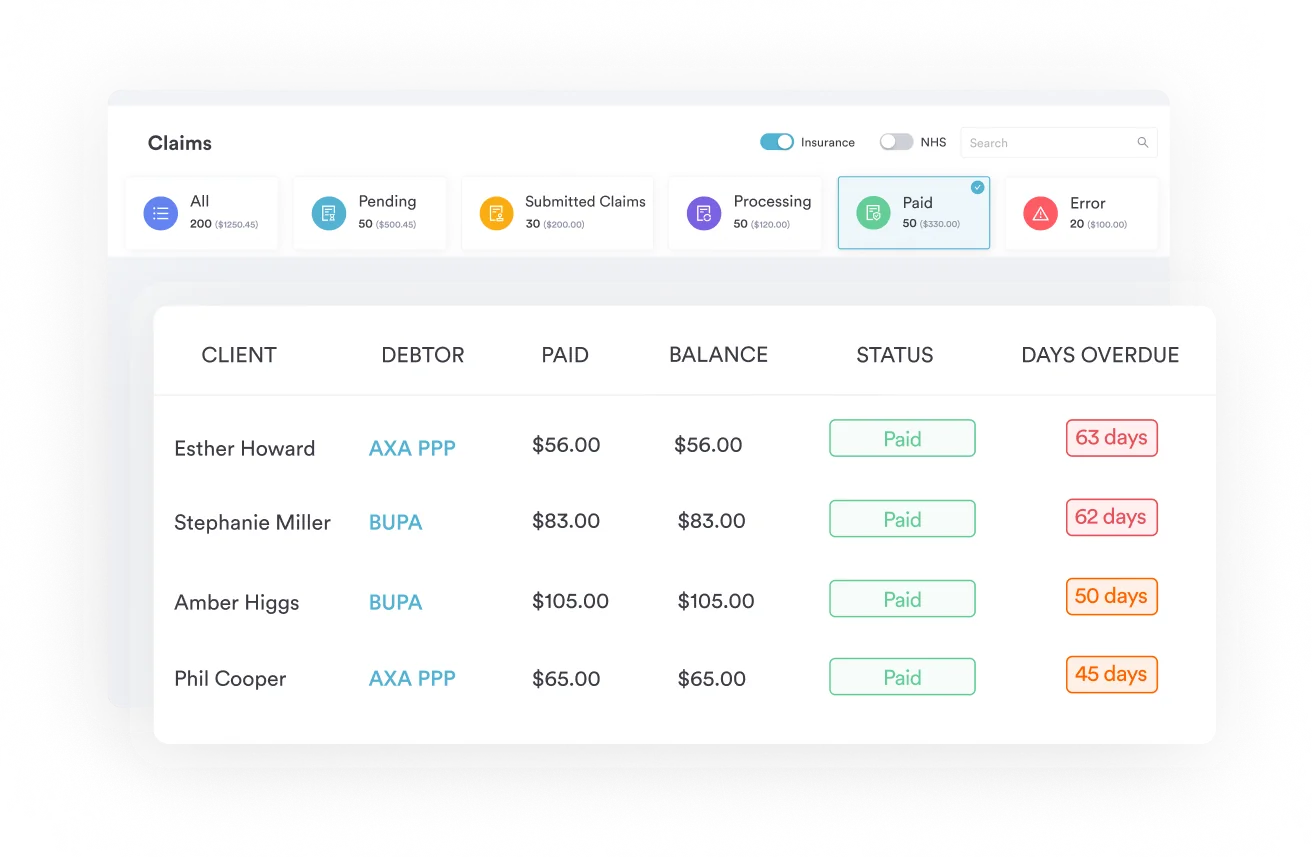

Pabau’s claims management software pre-fills the claim from the client record, checks that required fields are complete, and tracks every submission. Behavioral health programs get session documentation and claim status in the same system.

H2035 rewards programs that treat documentation as part of billing rather than a chore that follows it. The code itself is simple enough: one hour, one unit, one modifier your state has already told you it wants. What makes it hard is that the evidence lives in clinical notes written by people who never touch a claim.
So the fix is operational rather than clerical. Put the clock times in the note while the session is fresh. Keep the treatment plan inside its review window, and check the modifier against the payer rather than against habit.
When notes and claims live in separate systems, the handoff between them is where H2035 revenue leaks. Book a demo to see how Pabau connects behavioral health documentation to claim submission in one workflow.

Need a progress note format that survives an audit? The PIE note template gives you a problem, intervention, and evaluation structure you can write in minutes.
Billing wrap-around services alongside program hours? H2021 sets out the unit rules and modifiers for community-based wrap-around time.
Documenting the diagnosis behind the claim? The SCID-5 assessment guide walks through the structured interview clinicians use to record a DSM-5 diagnosis.
Tracking impulsivity through treatment? The UPPS Impulsive Behavior Scale scores the traits that shape relapse risk in substance use treatment.
Want a check-in your clients will finish between sessions? The mental health check-in worksheet keeps progress visible without adding admin for your team.
The place of service code has to match where the program hour happened. Office-based program hours usually take POS 11. A non-residential substance abuse treatment facility takes POS 57, and a residential one takes POS 55. Some MCOs restrict which values pair with H2035, so check the state manual.
H0015 is the per diem code for intensive outpatient programs, while H2035 bills the same treatment by the hour. Where your state pays IOP as a day rate, H0015 is the line. If it pays by program hour, H2035 is. Billing both for one day duplicates the service.
Only where your state Medicaid program allows it. Several states added program hours delivered by video to their telehealth-eligible code lists. Those states usually want a telehealth modifier plus the telehealth place of service. Confirm the policy in writing before you bill a remote hour.
No national daily limit exists, so the cap comes from your state manual or your MCO contract. Many set a maximum unit count per day and per week. Units above that cap deny even when the hours were delivered and documented, so find the limit before you build the schedule.
No. Group counseling on H0005 and program time on H2035 cannot both claim the same clock hour, because that reports one service twice. Where a program day includes both, split the documented times so no hour lands on two lines.