Mental health self-care checklist
A mental health self-care checklist is a structured daily tool for tracking the ...

6
Last Updated: Oct 20, 2026

PIE stands for Problem, Intervention, and Evaluation, the three sections of a progress note format used in therapy and social work.
PIE merges the Subjective and Objective parts of a SOAP note into one Problem section, so the note takes less time to write.
Specificity is what makes a note defensible, so name the technique you used and measure how the client responded.
Every Evaluation should link back to the Problem you opened with and to a goal in the treatment plan.
Keeping the note in the same record as the appointment and intake form cuts down on duplicate data entry.
A one-page form with a date field and open space for the Problem, Intervention, and Evaluation sections. Print it for the session, or keep it on file as the standard note layout for your team.
Download templateA PIE note records one session in three parts: Problem, Intervention, and Evaluation. Therapists and social workers favor it because those parts follow the shape of a session. You write what the client brought in, what you did, and how they responded.
Getting it right comes down to specificity. A note reading “client was anxious, provided therapy, client felt better” leaves a colleague or an auditor guessing.
Below you will find a free template, a worked example, five steps for writing your own, and the checks worth running before you sign.
A PIE note is a structured progress note that covers one session in three sections: Problem, Intervention, and Evaluation.
Counselors, therapists, social workers, and occupational therapists all use it. The format is common across mental health practices because a session record stays short without losing clinical detail.
Unlike a SOAP note, PIE does not separate what the client said from what you observed. Both belong in the Problem section. That removes a sorting step and trims the length of the note.
The order also matches how a session actually runs. You hear the presenting issue, you work on it, then you check what changed.
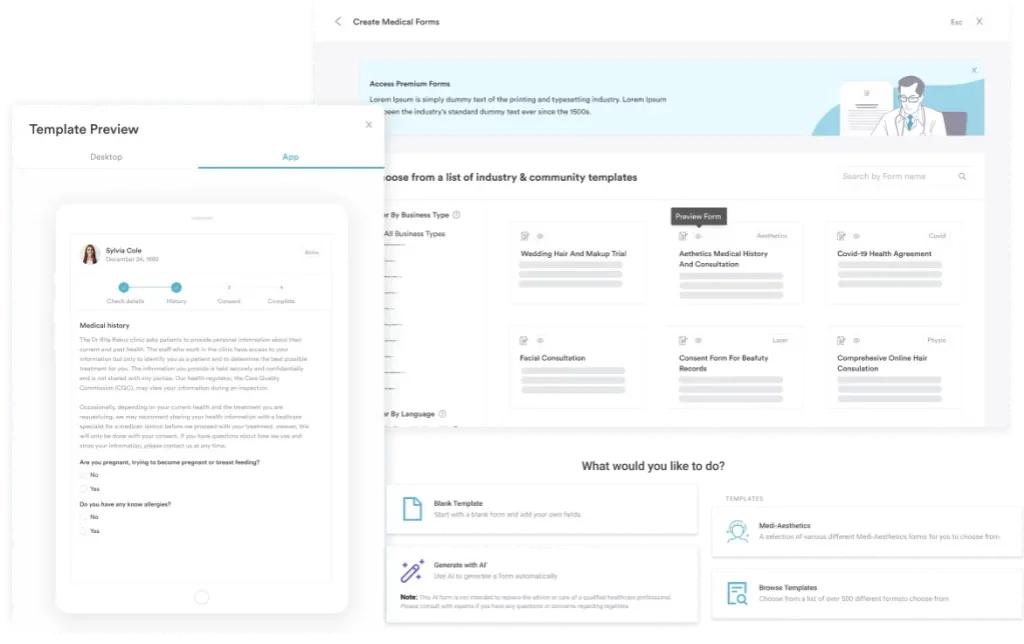
Digital intake forms gather the first part before the client sits down, so the Problem section starts half written.
Each section answers one question. Knowing which detail belongs where is what stops a note turning into a transcript of the hour.
The Problem section records the presenting issue at the start of the session. Include the client’s own words, your behavioral observations, and any context from the treatment plan. “Reports increased anxiety in work meetings” and “appeared withdrawn, minimal eye contact” both belong here.
Quote the client where you can. If someone says “I’ve been having trouble sleeping,” write that down. Then add your own observation, but only where it changes the picture, such as fidgeting or rapid speech.
The Intervention section names what you did, in clinical terms. Write the modality and the technique inside it. “Applied a 5-4-3-2-1 grounding exercise” works. “Provided psychotherapy” does not.
Detail matters more here than anywhere else in the note. A reviewer wants evidence that a trained clinician delivered a treatment. So write what you covered: which exercise, which scenarios, what psychoeducation.
The Evaluation section answers three questions. Did the client engage? Did symptoms shift? Did the session move them closer to a treatment goal?
Here is the shape it takes: “Engaged fully with the grounding exercise. Anxiety fell from 8/10 to 4/10 by the end of the session. Agreed to practice daily.” Numbers do a lot of work in this section.
Below is a full note from a session on work-related anxiety. Use it as a reference for the level of detail each section needs.
The method below takes about five minutes per session once it becomes habit.
For therapy, the three sections map neatly onto the parts of a session a reviewer asks about. The Problem carries the presenting complaint, mood and affect, and any DSM-5 diagnostic information. The Intervention names the modality, such as CBT, ACT, or psychodynamic work, then the technique used inside it.
Evaluation is where progress becomes measurable. Link the client’s response back to a goal in the treatment plan and the plan updates itself, session by session. That habit pays off most in busy therapy practices, where one clinician may write twenty notes a week.
Social work notes carry more context than therapy notes, and the Problem section absorbs most of it. Housing stability, benefits, family structure, employment, and the presenting crisis all sit there. The three headings still hold.
Intervention then covers case management alongside clinical work. A referral to a housing service, a benefits application, and a family meeting are all interventions. Evaluation tracks whether the client reached the resource and whether the situation steadied.
Many social workers move between settings and formats in a single week. Reading the same case written as a social work SOAP note makes the differences obvious.
Choose PIE for speed, SOAP for clinical breadth, and DAP when you want one combined data section. All three record the same session at different resolutions.
SOAP splits what the client said from what you observed, which makes it longer and more structured. PIE merges those two into Problem. DAP goes further and folds all observations into Data, leaving Assessment and Plan to carry the clinical thinking.
If your team is torn between them, write the same session in each and compare. The DAP note template and the mental health SOAP template use the same one-page layout as this one.
Weak notes tend to fail in the same few ways. Here is one session written twice, once too thinly and once with the detail a reviewer needs.
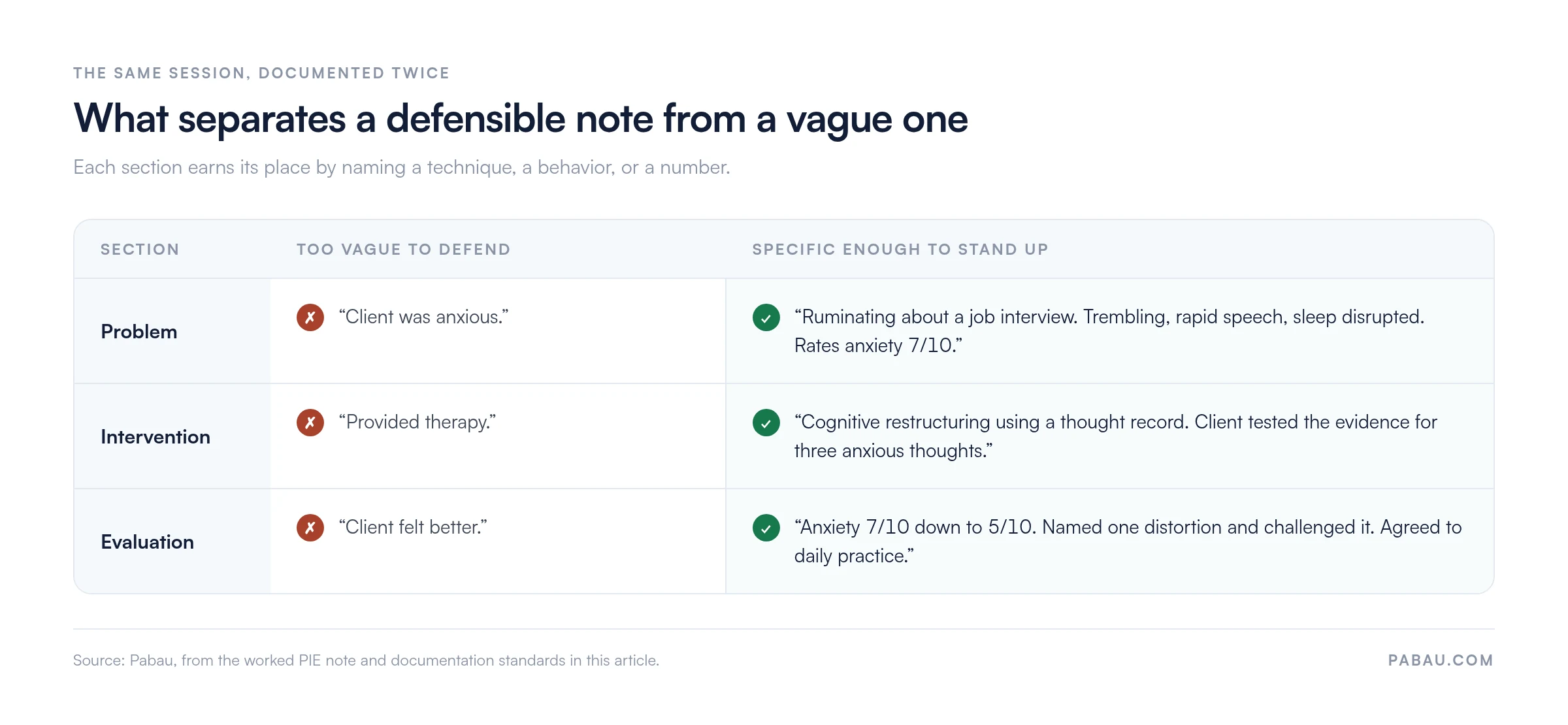
Five patterns account for most of the difference:
A note gets read long after you write it, sometimes by a payer and sometimes by the client. Two minutes of checking now saves a lot of explaining later.
Write as though the client will read the file one day, because they may well ask to. Neutral, specific language protects them and you, which is the argument behind safer clinical notes.
Three parts of the job depend on the quality of your notes. The first is clinical. A colleague picking up the client should understand what happened and why, without a phone call.
The second is financial. Payers want to see a problem identified, a treatment delivered, and progress measured. The third is regulatory. If your practice is audited, specific notes are the defense you present.
Handovers get easier too. When a clinician leaves or a client transfers, the receiving practitioner reads the trajectory in a few minutes instead of calling around.
Track one specific outcome in every note to make progress measurable. Choose a single metric, such as an anxiety rating, a symptom count, or a behavioral change. Record it before and after the intervention. Over a few months, that column shows whether treatment is working and gives the client something concrete to see.
Most practices still write notes in one place and run the diary in another. The note gets typed into a document, saved to a folder, then copied into the record later. Detail leaks at every hop.
Practice management software like Pabau closes that loop. Client records hold the note beside the appointment, the intake form, and the invoice for the same session. Templates carry the three headings, so every clinician on the team writes to the same shape.
Pabau Scribe, our AI scribe, drafts the note from the session so you review rather than type. Access controls and a full audit trail come with every subscription, which is what an inspection asks for first.
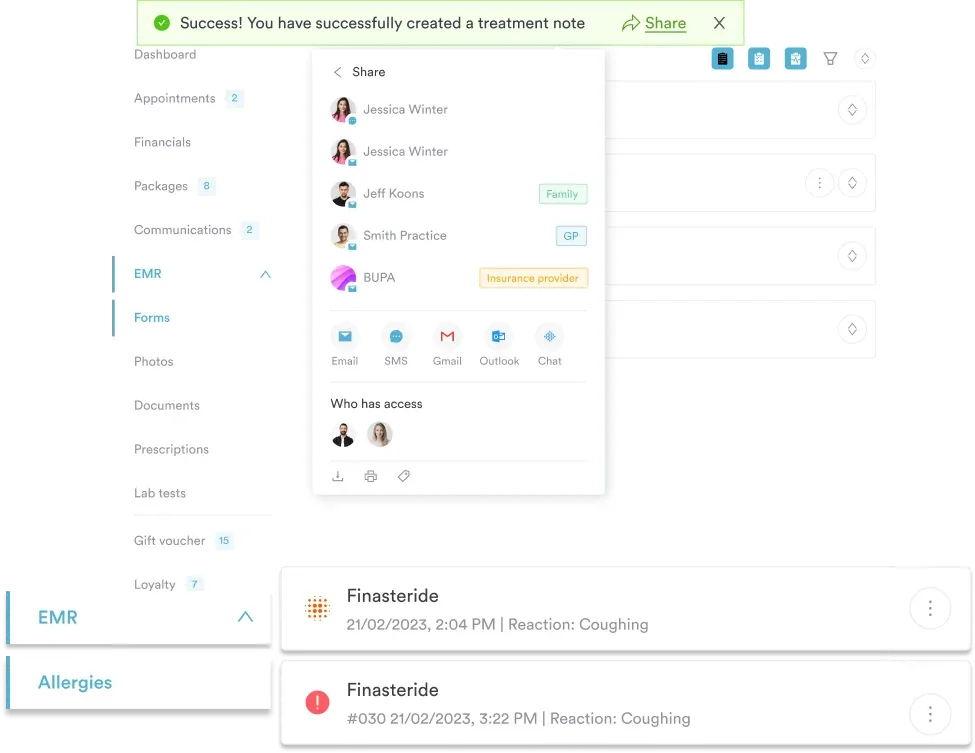

Pabau stores progress notes, intake forms, and billing against the same client record, and Pabau Scribe drafts the note for you. Your team documents faster and finds the history in one place.

The format is the easy part. Three headings take an afternoon to learn. What takes practice is writing entries a stranger could act on: a named technique, an observed behavior, a number that moved.
Start with the template above and write your next three sessions in it. If those notes read better than what you produce now, make the format your house standard and hold the team to it.
Documentation still takes time, and no format removes that. Book a demo to see how Pabau keeps notes, forms, and billing in one client record for therapy and social work teams.

Need a format that tracks the client’s response separately? The PIRP note template splits a session into problem, intervention, response, and plan.
Standardizing notes across a whole team? The progress note template covers the fields every progress note needs, whatever structure you write in.
Want better material for the Problem section? The mental health check-in worksheet gives clients a way to report mood and symptoms between sessions.
Documenting a formal diagnostic interview? The SCID assessment guide explains how the structured interview runs and what it leaves in the record.
Dictating notes instead of typing them? Our roundup of medical transcription software compares the tools clinicians use to turn speech into a written record.
Long enough to show what happened, which is usually a short paragraph per section. Reviewers look for specifics rather than length. Three vague pages carry less weight than eight precise lines.
Add a dated addendum rather than editing the original entry. Say what changed and why. Overwriting a signed note causes trouble in an audit. A dated correction does not.
Yes. Write one note per client, covering only that client’s problem, response, and progress. Refer to other group members by role, never by name.
They do. Add the modality, both locations, and confirmation that the client consented to a remote session. The three sections stay exactly the same.
A progress note is the record itself. PIE is one way to structure it, alongside DAP, SOAP, and BIRP. Your employer or payer may require a particular format.
Usually yes. HIPAA gives clients a right of access to their record, with narrow exceptions such as separately kept psychotherapy notes. Write every note on that assumption.