CPT Code 62284: Injection procedure for myelography
CPT Code 62284: official descriptor and procedure overview The American Medical ...

Last Updated: Oct 19, 2026
S0270 is the HCPCS Level II code for physician management of patient home care, standard monthly case rate (per 30 days).
One unit covers the physician's oversight of a home care patient across a 30-day period, not a single visit. S0270 is a non-Medicare S-code, so traditional Medicare denies it. Medicaid programs and some commercial plans pay it, and each plan's policy decides acceptance.
Let Pabau's smart automation suggest the right codes, reduce claim denials, and keep your practice compliant—effortlessly.
Automate repetitive tasks and focus on what matters most—your patients.
Reduce coding errors and ensure compliance with the latest regulations.
Clean claims, fewer denials, and faster reimbursements.
Powerful insights and reporting to help your practice thrive.
HIPAA compliant SOC 2 certified GDPR-compliant Trusted by 4,000+ clinics worldwide

HCPCS code S0270 covers physician management of a patient’s home care, billed once per patient per 30-day period rather than per visit.
The official descriptor is physician management of patient home care, standard monthly case rate (per 30 days).
S0270 is a temporary national S-code that traditional Medicare does not cover, so it goes to Medicaid programs and plans that accept S-codes.
S0271 and S0272 share its stem and bill the hospice and episodic case rates, so match the rate type to the payer’s policy.
Pabau, the practice management platform we build, keeps the care plan, oversight note, and monthly claim together. A missing note surfaces before submission.
HCPCS code S0270 is a Level II code in the S-series of the Healthcare Common Procedure Coding System (HCPCS). Its official descriptor is Physician management of patient home care, standard monthly case rate (per 30 days).
The CMS HCPCS overview describes S-codes as temporary national codes. Medicaid programs and commercial payers are their main users, and traditional Medicare does not cover them.
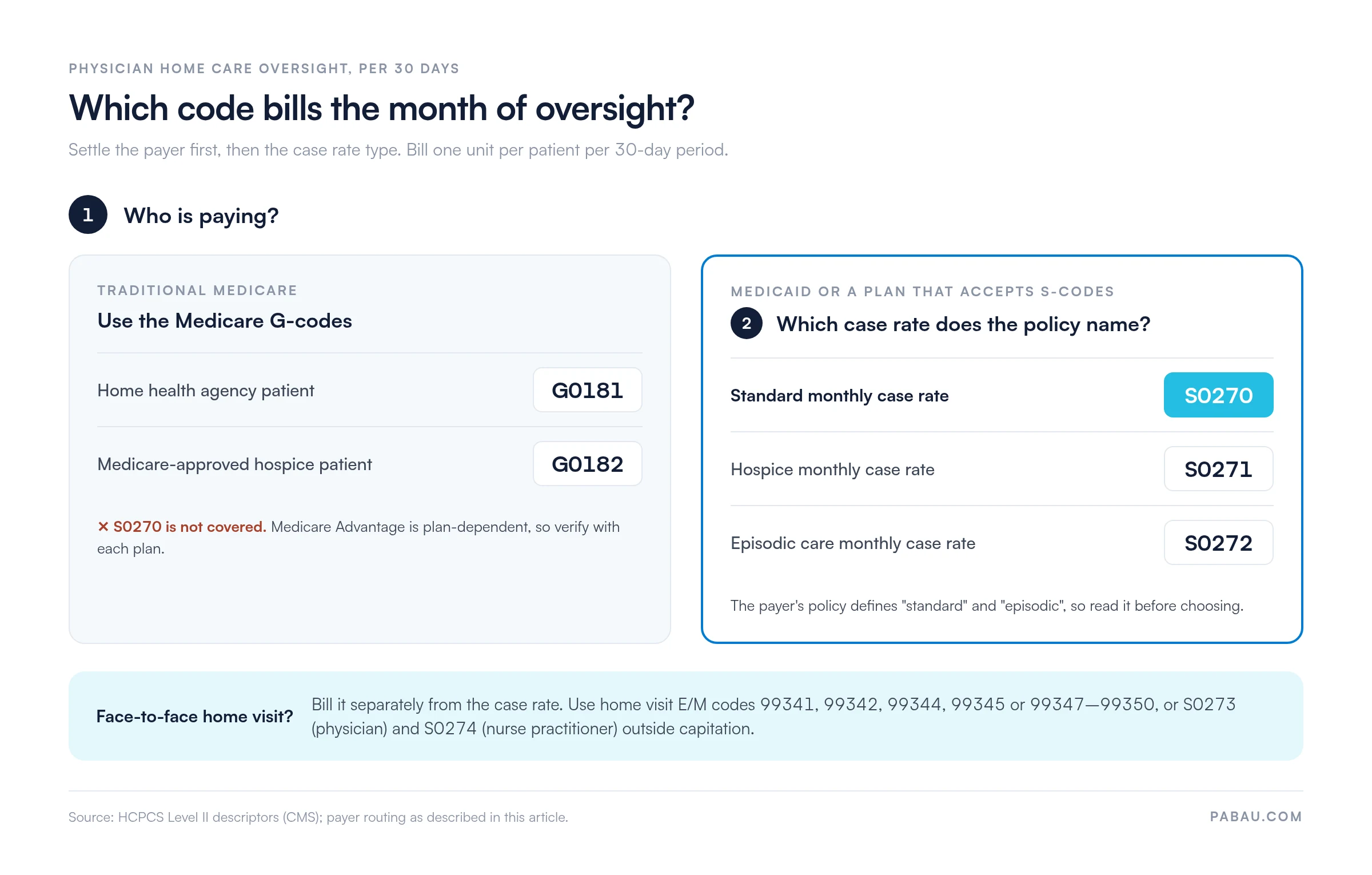
S0270 is one of three case rate codes for physician home care management. It bills the standard monthly rate, while S0271 bills the hospice rate and S0272 bills the episodic care rate.
The quick-reference table below captures the attributes coders need before placing S0270 on a claim.
S0270 bundles a physician’s management of a home care patient into a single monthly case rate. The rate pays for oversight of the patient’s care across a 30-day window. Individual face-to-face visits are not part of it.
A physician conference with the home care team, held with the patient present, is reported separately under S0220 where the payer lists it.
Payers that accept S0270 write their own coverage policy for it. The lists below reflect how physician home care case rates are commonly applied, so check them against the plan’s provider manual.
Services typically included in the S0270 case rate:
Services not included and billed separately:
S0270 and a home visit E/M code describe different work. If the physician travels to the home and provides a substantive clinical service, that encounter is an E/M visit, not case rate management. Billing both in the same month takes documentation showing the oversight work was distinct from the visit.
S0270, S0271 and S0272 share one descriptor stem, and only the case rate type changes. Picking the wrong one is a common coding error, because all three bill physician home care management per 30 days.
The descriptors do not define “standard” or “episodic” themselves. That definition sits in the payer’s policy, so read it before choosing the rate. Descriptor and status changes are published in the CMS HCPCS quarterly update.
Two facts settle most of these calls. The first is who is paying, and the second is which case rate the payer’s contract names. A Medicare patient routes to G0181 or G0182, while a Medicaid patient routes to the S0270 family. The diagram below walks both questions in order.
Our guide to HCPCS code S0271 covers the hospice case rate in detail.
One unit of S0270 covers all eligible physician management activity for one patient during one 30-day period. Billing more than one unit per patient per period is a frequent reason for denial.
Medical home programs follow the same per-period logic for their care coordination. S0281 covers maintenance of a medical home care plan, also at one unit per billing period unless the payer allows more.
Here is how the billing cycle operates in practice:
Because S0270 sits outside Medicare’s fee schedule, payer acceptance is the first question to settle. Read the insurance eligibility verification result carefully, because a Medicare Advantage plan may accept S-codes where traditional Medicare does not. Confirm the code in the AAPC HCPCS code lookup and in the payer’s own policy.
Prior authorization rules differ sharply across payers. Some plans authorize the home care episode as a whole, while others want authorization for each case rate period. Check the payer’s policy before the first claim, not after the first denial.
Incomplete documentation is a primary driver of case rate denials. The medical record has to support every element of the claim before submission. The following should be present and available for audit:
Strong medical billing compliance starts with building this check into the monthly billing routine. Reviewing records only after a denial is the slower and costlier path.
There is no national Medicare fee schedule rate for HCPCS code S0270. Because S-codes sit outside Medicare coverage, reimbursement is set entirely by each payer’s contract or state fee schedule.
Steps to find your contracted rate for S0270:
Request the payer’s current S-code fee schedule addendum in writing at each contract renewal. A verbal rate confirmation on a provider services call is not binding. A written addendum protects the practice in payment disputes and audits.
Most S0270 denials trace back to the payer, the unit count, or the record. Each one leaves a Claim Adjustment Reason Code (CARC) on the remittance advice, and most are preventable before submission.
Run a pre-submission check on every pending S0270 claim. Confirm one unit per patient, a signed care plan for that period, and at least one oversight event inside the 30-day window. Those three checks remove most S0270 denial volume.
A denied S0270 claim is recoverable in most cases. The steps below follow standard corrected-claim protocol:
Our reference on denial codes covers the most common CARC codes and what each one requires for resolution.
Most physician home care teams track S0270 in two places at once. The care plan and the oversight note live in the clinical record, while the monthly claim lives in a billing spreadsheet. Nobody reconciles the two until a denial arrives.
In Pabau, the care plan and the claim share one patient record. The signed plan of care, the physician’s oversight note, and the claim sit together, so a biller can check them without leaving the file.
On a monthly case rate code, that single view is what claims management software is for. Before the claim goes out, your team can confirm one unit, one documented oversight event, and a payer that accepts S-codes.
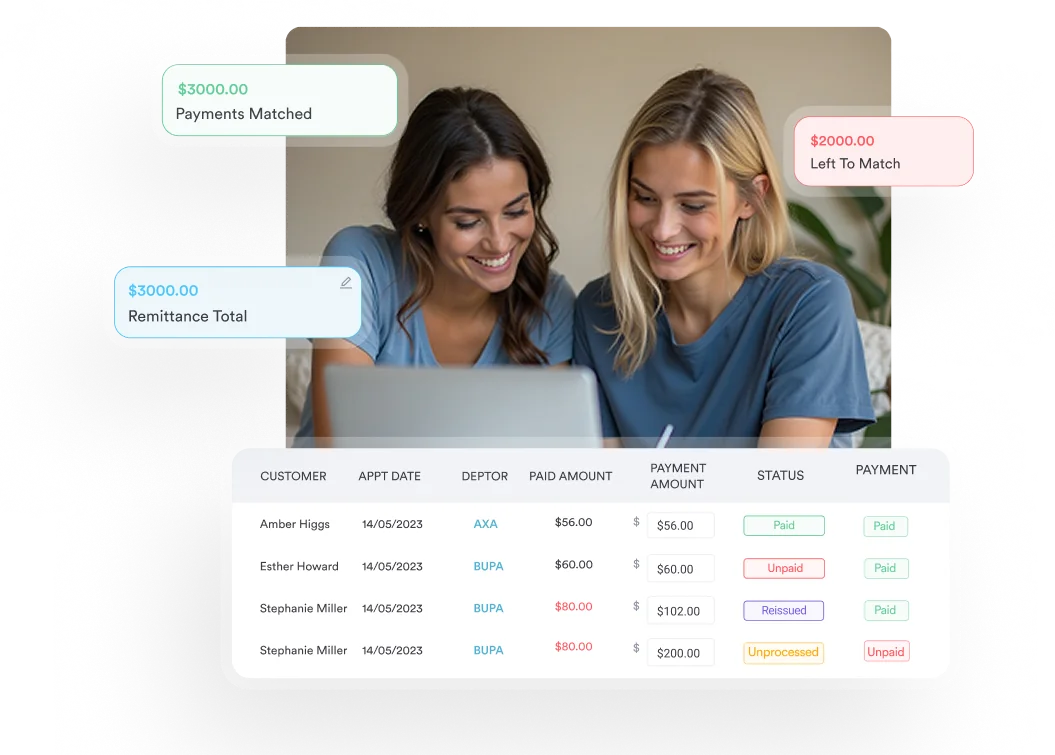

Pabau keeps the care plan, the oversight note, and the S0270 claim in one patient record. Your team can check a monthly case rate claim before it goes out.

S0270 rewards practices that treat it as a monthly routine rather than a claim raised after the fact. Settle the payer first, then the case rate type, then the unit count and the oversight note for that period.
The trade-off worth remembering is that S0270 has no Medicare rate to fall back on. Where a Medicare patient receives the same oversight, bill G0181 instead. Route the work to the right code rather than write it off.
Pabau keeps the care plan, the oversight note, and the monthly claim on one patient record. Book a demo to see how that shortens the check before an S0270 claim leaves your practice.

Billing the hospice case rate instead? HCPCS code S0271 covers the hospice monthly case rate, its payer rules, and its denial triggers.
Need the code for a nurse practitioner home visit? HCPCS code S0274 explains NP home visits billed outside a capitation arrangement.
Need a structured claims compliance framework? Medical billing compliance covers the documentation, audit, and corrected-claim protocols that apply to HCPCS billing.
Want to see how denials move through the revenue cycle? Revenue cycle management explains how each billing stage connects to denial prevention.
Tracking denials across several payers? Denial management in healthcare walks through systematic denial tracking and appeals.
HCPCS code S0270 covers physician management of a patient’s home care, billed as a standard monthly case rate per 30 days. The rate bundles the physician’s oversight for that period into one unit, such as care plan review and coordination with the home care team. Face-to-face home visits are billed separately.
No. S0270 is a temporary national S-code, and traditional Medicare does not cover S-codes. For a Medicare home health patient, physician supervision is billed with G0181 instead. Some Medicare Advantage plans set their own rules, so verify with each plan.
All three bill physician management of patient home care per 30 days. S0270 is the standard monthly case rate, S0271 is the hospice case rate, and S0272 is the episodic care case rate. The payer’s policy defines which rate applies to a given patient.
Bill 1 unit per patient per 30-day period. The case rate covers all qualifying oversight in that period, however many reviews or calls it took. Billing extra units is a common cause of denial.