Inpatient billing cheat sheet
An inpatient billing cheat sheet is a quick reference for the codes and claim ru...

Last Updated: Oct 19, 2026
L2134 is the HCPCS Level II code for a semi-rigid, prefabricated knee ankle foot orthosis (KAFO) used as a femoral fracture cast orthosis. Fitting and adjustment are included in the code.
Billers most often confuse it with L2132 and L2136, the soft and rigid versions of the same prefabricated fracture brace. The three codes differ only in rigidity. L2126 and L2128 are the custom-fabricated codes in the same family, so a brace built over a model of the limb never bills under L2134.
Let Pabau's smart automation suggest the right codes, reduce claim denials, and keep your practice compliant—effortlessly.
Automate repetitive tasks and focus on what matters most—your patients.
Reduce coding errors and ensure compliance with the latest regulations.
Clean claims, fewer denials, and faster reimbursements.
Powerful insights and reporting to help your practice thrive.
HIPAA compliant SOC 2 certified GDPR-compliant Trusted by 4,000+ clinics worldwide

HCPCS code L2134 covers a semi-rigid, prefabricated femoral fracture cast orthosis that spans the knee, ankle and foot, with fitting and adjustment included.
L2132 and L2136 are the soft and rigid versions of the same stock brace, so rigidity decides which of the three you bill.
L2126 and L2128 are the custom-fabricated codes in the family. A brace built over a model of the limb never bills under L2134.
Under LCD L33686, Medicare covers a KAFO for patients who walk, qualify for an ankle-foot orthosis, and need added knee stability.
In Pabau’s practice software, the written order, fitting notes and delivery receipt stay with the claim they support.
The Centers for Medicare & Medicaid Services (CMS) publishes the official descriptor for HCPCS code L2134. It reads: Knee ankle foot orthosis (KAFO), fracture orthosis, femoral fracture cast orthosis, semi-rigid, prefabricated, includes fitting and adjustment.
Three phrases in that descriptor carry the coding decision. “Semi-rigid” sets the brace’s stiffness, between the soft L2132 and the rigid L2136. “Prefabricated” means the supplier starts from a stock brace rather than building one over a model of the limb.
The third phrase, “includes fitting and adjustment”, bundles the fitting into the code. The supplier trims, straps and adjusts the brace to the patient, and that work carries no separate charge.
Clinically, the orthosis supports the femur, knee, ankle and foot while a fracture heals. Femoral shaft fractures are the usual indication. Other lower-limb fractures that need full-leg support also qualify where the record supports it.
L2134 sits in a five-code range of femoral fracture cast orthoses. Two codes are custom fabricated and three are prefabricated. Within the prefabricated three, only the rigidity changes. The table pairs each code with its official descriptor, so check it against the brace you delivered.
There is no L2130 in this family, so a claim under L2130 rejects as an invalid code. L2140 is not a neighbor either. It is a deleted code, so never bill it or treat it as an active alternative.
The closest neighbors to L2134 are L2132 and L2136. Choosing between them comes down to rigidity alone. The manufacturer’s product listing states the rigidity, so it belongs in the fitting record.
The costlier error runs across the construction line. A brace built over a cast or scan of the patient’s limb bills under L2126 or L2128, never L2134. A stock brace billed under a custom code is upcoding, and auditors check for it.
CMS separates orthoses into custom-fabricated and prefabricated devices. L2134 is prefabricated, so the product itself carries the coding decision. The tree below shows the two questions that separate all five codes in the range.
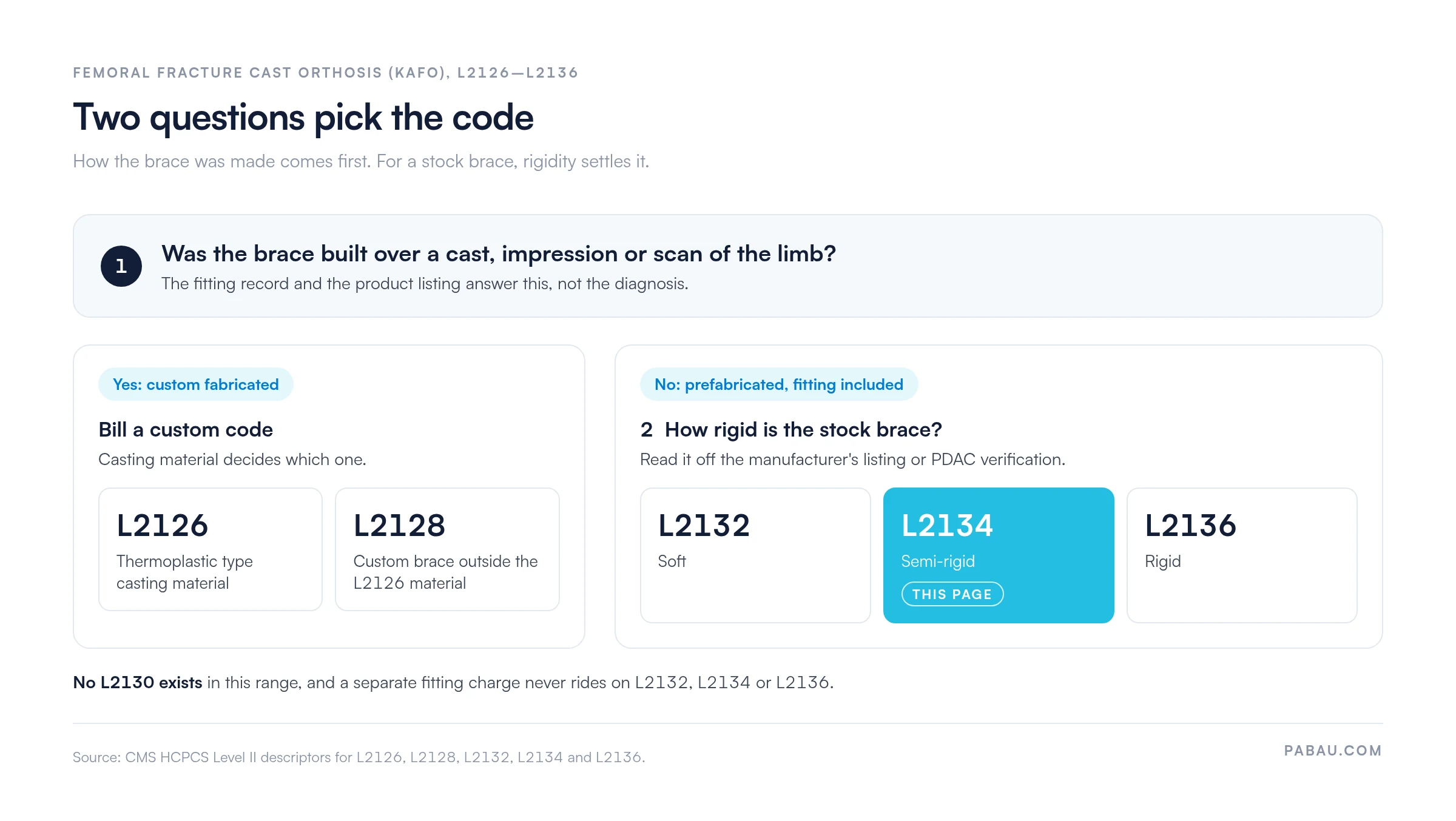
PDAC stands for the Pricing, Data Analysis and Coding contractor. It reviews manufacturer products and confirms which HCPCS code a supplier may bill for each one. For a prefabricated brace, that listing is the strongest evidence that the product is semi-rigid.
Check the product against the PDAC listing before you bill it under L2134. If the manufacturer has a coding verification for the model, record the product name, model number and verified code in the patient file. Where no verification exists, confirm the payer’s rules first, because an unverified product can bring full recoupment on review.
Medicare Part B covers L2134 under the brace benefit, and the claim goes to the DME MAC for the patient’s region. LCD L33686 governs coverage for ankle-foot and knee-ankle-foot orthoses. Its KAFO criterion is a single sentence. KAFO codes, L2134 included, are covered “for ambulatory beneficiaries for whom an ankle-foot orthosis is covered and for whom additional knee stability is required.”
The record has to support both halves of that test.
Confirm coverage before the brace goes out. Checking insurance eligibility at the ordering stage catches a lapsed plan or an Advantage plan with its own rules.
The ICD-10-CM diagnosis codes below commonly support medical necessity for L2134 claims. A diagnosis code on its own does not establish coverage. The record must also show why the knee needs more stability than an ankle-foot orthosis gives.
Pull the diagnosis from the current ICD-10-CM code set. A deleted or unspecified code weakens the necessity argument before a reviewer reads the clinical note.
Always use the most specific fracture code available. Laterality drives modifier selection, RT for right and LT for left, and it has to match across the diagnosis, the order and the claim.
Bill the initial encounter fracture code (7th character A) at supply. If the brace is still in use at follow-up, the diagnosis moves to the subsequent encounter code (7th character D). A mismatch between the encounter character and the date of service is an easy audit flag on KAFO claims.
CMS Policy Article A52457 sets out what a KAFO claim needs. A prefabricated brace needs no model or fabrication notes. The file has to prove which stock product was fitted instead. Miss one element and the contractor has grounds to deny on first pass.
Keep these documents with the claim, not in a shared drive. Compliance reviews expect you to produce the full file on request.
L2134 denials cluster around three root causes: Wrong code selection, incomplete documentation, and modifier errors. Each has a distinct fix, and a pre-billing check can catch each one before submission.
Remittance advice comes back carrying CARC and RARC reason codes. Our guide to denial codes maps each one to a fix, so a rejected L2134 claim goes back out as a clean resubmission.
Policy Article A52457 requires RT or LT on every orthosis base code. A claim line with no KX, GA or GZ modifier rejects as missing information.
A bilateral supply goes on two claim lines, one with RT and one with LT, each for one unit. Apply KX only when the documentation is complete. A KX modifier without support behind it is a false attestation.
Medicare Fee-for-Service does not ordinarily require prior authorization for L2134. CMS updates its required prior authorization list, so check the current list before relying on that. Medicare Advantage plans set their own rules, and many review KAFO codes before supply.
Commercial payers vary by plan and by contract year. Verify eligibility and authorization before fitting. A fracture brace is usually needed within days, so a late check leaves the supplier choosing between delay and an unpaid claim.
Medicare prices L2134 from the DMEPOS fee schedule, not from the physician fee schedule. CMS sets allowables annually, and they vary by state. They change every January 1, so a claim priced from last year’s file will not reconcile.
Download the current CMS DMEPOS fee schedule and read the allowable for your state. The patient generally owes 20% of that allowable once they meet the Part B deductible, unless a supplemental plan picks it up.
Suppliers and orthotics practices billing HCPCS L codes carry a documentation load that grows with claim volume. The written order, the fitting record, the product listing and the delivery receipt all have to be in place before a claim leaves the office. Most teams hold them across a shared drive, an email thread and the billing system.
Pabau builds its claims tools into the same patient record. Its claims management software centralizes documentation capture and runs eligibility checks before the appointment. It also pulls denial reasons off remittance advice for structured follow-up.
Rehab and orthopedic practices that order fracture braces face the same split, with the clinical note in one system and the claim in another. Capturing the HCPCS code, modifiers and diagnosis in one structured record cuts transcription errors at submission. Pabau’s denial tracking then flags unresolved L2134 claims before the deadline closes.

Pabau’s claims management tools help suppliers and billing teams capture orthosis documentation, run eligibility checks, and track denial reasons in one place. See how it fits an L-code billing workflow.

L2134 is a narrow code: A semi-rigid, stock femoral fracture brace, fitted and adjusted by the supplier. Most errors on it come from neighboring codes that look almost the same on paper. Soft and rigid braces bill under L2132 and L2136, and custom braces bill under L2126 and L2128.
So the claim stands on the product record more than on the clinical note. Name the model and its rigidity in the fitting notes, keep the order and delivery receipt with it, and the code choice defends itself. To see how Pabau handles HCPCS L-code workflows from order to payment, book a demo.

Billing a brace built over a model of the limb? HCPCS code L2128 covers the custom-fabricated femoral fracture cast orthosis and the records that support it.
Working with thermoplastic casting material? HCPCS code L2126 explains when a custom thermoplastic fracture brace bills under its own code.
Checking coverage before the brace goes out? Insurance eligibility verification walks through the checks that catch a lapsed plan before fitting day.
Want fewer DMEPOS claims coming back? Submitting a clean claim covers the data elements and pre-submission checks that prevent common billing errors.
Need to read a remittance denial fast? Denial codes in medical billing maps the common CARC codes to the fix each one needs.
HCPCS code L2134 covers a semi-rigid, prefabricated femoral fracture cast orthosis that spans the knee, ankle and foot. The code includes fitting and adjustment by the supplier. A soft brace bills under L2132, a rigid one under L2136, and a custom-fabricated brace under L2126 or L2128.
All three are prefabricated femoral fracture cast orthoses that include fitting and adjustment. They differ only by rigidity. L2132 is soft, L2134 is semi-rigid, and L2136 is rigid, so the product listing for the brace you delivered decides the code.
Yes, Medicare Part B covers L2134 under the brace benefit when the record meets LCD L33686. The patient must be able to walk, qualify for an ankle-foot orthosis, and need added knee stability. The file also needs a standard written order and proof of delivery. Medicare Advantage plans set their own authorization and coverage rules.
Every L2134 claim line needs RT or LT for the limb fitted. It also needs KX when the coverage criteria are met, or GA or GZ when they may not be. A bilateral supply goes on two lines, one RT and one LT, each for one unit.
No. The L2134 descriptor includes fitting and adjustment, so that work is part of the code. Billing it separately creates an unbundling error that payers deny or recoup.
The most common causes are the wrong rigidity level, a custom brace billed under a prefabricated code, or a missing written order or delivery receipt. Missing or mismatched modifiers cause the rest. Read the CARC code on the remittance advice, fix the element it flags, and resubmit or appeal within the deadline.