CPT Code 62284: Injection procedure for myelography
CPT Code 62284: official descriptor and procedure overview The American Medical ...

Last Updated: Oct 19, 2026
B4164 is the HCPCS Level II code for parenteral nutrition solution: carbohydrates (dextrose), 50% or less (500 ml = 1 unit) - home mix. It covers the dextrose component only, and dextrose above 50% is billed as B4180 instead.
In a home-mix regimen, amino acids (B4168 to B4178), lipids and additives each bill on their own line alongside B4164. The dextrose concentration and volume belong on the Standard Written Order and in the supporting clinical record. Claims without that detail are a common denial trigger.
Let Pabau's smart automation suggest the right codes, reduce claim denials, and keep your practice compliant—effortlessly.
Automate repetitive tasks and focus on what matters most—your patients.
Reduce coding errors and ensure compliance with the latest regulations.
Clean claims, fewer denials, and faster reimbursements.
Powerful insights and reporting to help your practice thrive.
HIPAA compliant SOC 2 certified GDPR-compliant Trusted by 4,000+ clinics worldwide

HCPCS Code B4164 is the dextrose (carbohydrate) component of a home-mix parenteral nutrition solution, at 50% or less, billed per 500 ml unit.
Dextrose above 50% bills as B4180, while amino acids, lipids and additives each go on their own claim line.
Medicare covers B4164 under the Part B prosthetic device benefit, and the DME MAC processes the claim.
CMS retired the CMN (CMS-10126) from January 1, 2023, so a Standard Written Order plus supporting clinical records now establishes medical necessity for B4164.
Claims management software like Pabau keeps the order, clinical records and DME MAC submissions in one place, which helps cut parenteral nutrition denials.
HCPCS Code B4164 describes the carbohydrate (dextrose) component of a home-mix parenteral nutrition solution.
It covers dextrose at a concentration of 50% or less, billed at 500 ml per unit. The code falls within the B-series of HCPCS Level II codes, which cover enteral and parenteral nutrition therapy. It is maintained annually by CMS’s Healthcare Common Procedure Coding System.
B4164 covers dextrose only and contains no amino acids. Dextrose above 50% is coded B4180 instead. In a home-mix regimen, amino acids are a separate component, billed under their own codes (B4168, B4172, B4176 and B4178) by concentration. Verify the exact descriptor in the current CMS HCPCS Alpha-Numeric file before billing, as descriptors are updated annually.
B4164 covers the dextrose (carbohydrate) component of a home-mix parenteral nutrition regimen for patients whose GI tract cannot absorb adequate nutrition. Coverage applies in the home setting under Medicare’s prosthetic device benefit. The patient must have a documented clinical need for total (TPN) or partial parenteral nutrition (PN).
Included under B4164:
Explicitly excluded:
The most common confusion point is billing B4164 for enteral products. Enteral and parenteral nutrition are separately coded. Using B4164 for a tube-fed formulation results in a denial indicating that the code does not match the product delivered.
Medicare covers parenteral nutrition under the Part B prosthetic device benefit when the patient has a documented, severe pathology of the alimentary tract. That pathology must prevent adequate nutrition by the oral or enteral route.
All indications must be documented by the treating physician in the clinical notes that support the Standard Written Order. Diagnosis codes must reflect the patient’s documented condition. The list below shows clinically appropriate codes, not a recipe for code selection independent of the clinical record.
Verify covered diagnosis codes against the current DME MAC Local Coverage Determination (LCD) for your jurisdiction before submitting. Each of the four DME MAC jurisdictions (A, B, C, D) may publish a slightly different covered-diagnosis list.
B4164 claims follow the Medicare Part B pathway through the DME MAC. A clean claim on the first pass depends on completing each step below before the claim is generated.
The current CMS HCPCS descriptor defines one unit of B4164 as 500 ml of dextrose solution. Verify the exact unit definition from the AAPC HCPCS code lookup or the CMS Alpha-Numeric HCPCS file each plan year before billing.
Worked example: an order calls for 1,000 ml of 50% dextrose a day for 30 days. That is two units a day, so the monthly claim line reports 60 units of B4164. If the order switches to 70% dextrose, the line moves to B4180 at the same unit count.
Common unit calculation errors:
Modifier selection determines whether the DME MAC accepts or rejects the claim at adjudication. The table below covers the modifiers most relevant to B4164 claims.
Verify modifier KX requirements against your specific DME MAC LCD before billing. Appending KX when the supporting documentation is incomplete is a compliance risk. The modifier attests that the documentation is on file, not that the claim will be paid.
Original Medicare does not require prior authorization for B4164. The CMS Required Prior Authorization List for DMEPOS covers items such as power mobility devices, lower-limb prostheses and certain orthoses. Parenteral nutrition is not on it, so medical necessity is proven through the claim’s documentation instead.
Medical necessity no longer runs through a Certificate of Medical Necessity. Under CMS SE22002, CMNs and DME Information Forms were eliminated for dates of service on or after January 1, 2023. That includes CMS-10126 for parenteral nutrition. A claim submitted with the old form attached is now rejected.
The Standard Written Order and the clinical record carry the case instead. They need to show the diagnosis, the permanent GI impairment, a nutritional assessment and the expected duration of therapy. DME MAC policy article A58836 sets out these requirements.
The records behind a B4164 claim should include:
Medicare Advantage plans, state Medicaid programs and commercial payers such as Blue Cross Blue Shield, Cigna and Aetna often require PA for home PN. Check each plan’s coverage policy before initiating therapy, not after the patient has already started infusion.
Incomplete documentation is the primary cause of B4164 denials. Assemble the full documentation package before the first claim is submitted, not after a denial arrives. The checklist below covers each record the DME MAC can ask to see.
Selecting the wrong B-series code is a common B4164 billing error. Home-mix parenteral nutrition codes describe components, not whole solutions. B4164 is the dextrose component only, and dextrose above 50% moves to B4180. Amino acids, lipids and additives each bill on separate lines. The map below shows which code each component takes.
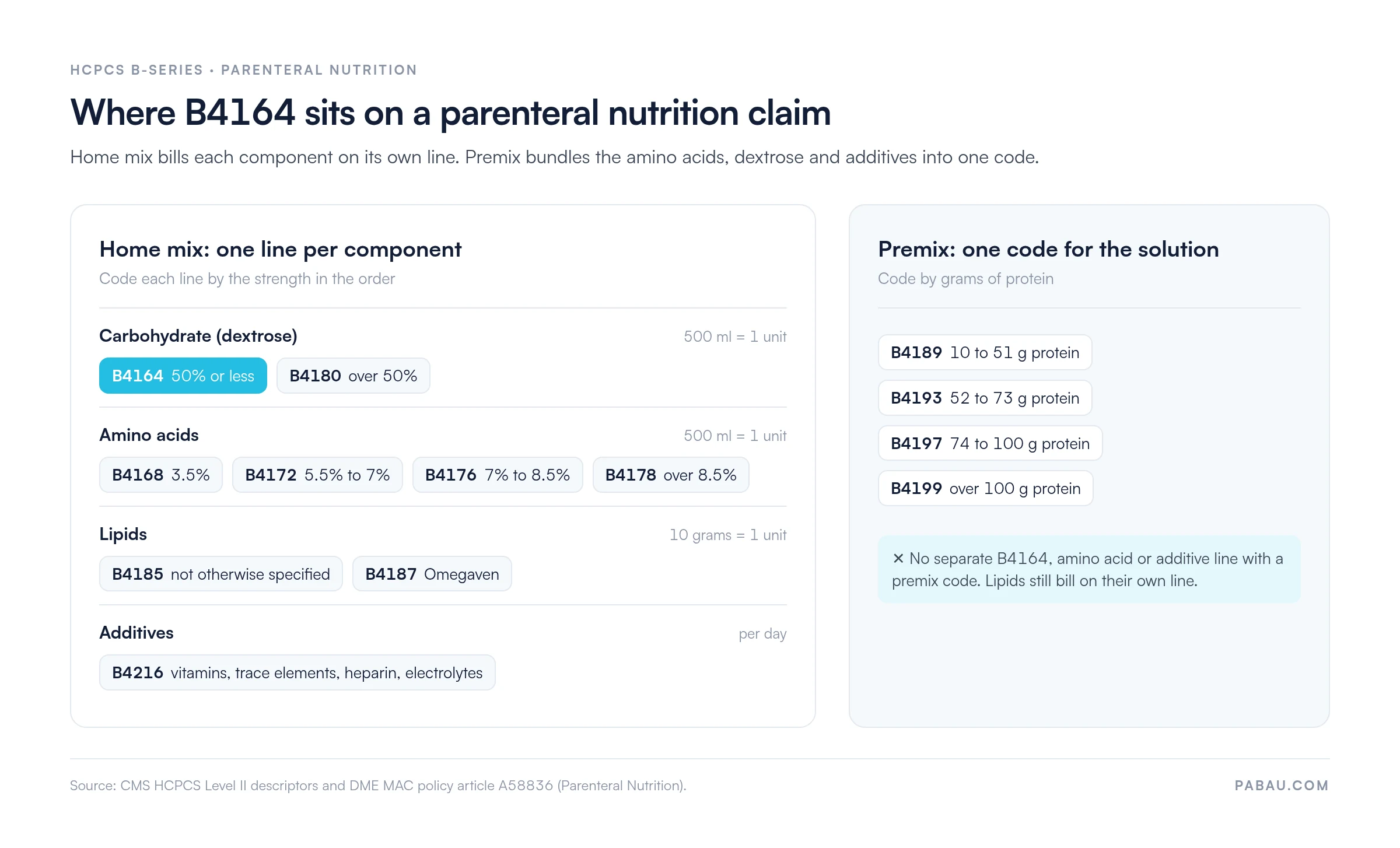
Lipids bill under B4185, one unit per 10 grams, so 500 ml of 20% lipids is 10 units. Premix solutions work differently. One premix code from B4189 to B4199 covers the amino acids, dextrose and additives together, so B4164 never appears alongside it. The hepatic premix B5100 follows the same rule and replaces the home-mix component lines.
B4149 and B4162 sit close by in number, but both are enteral formula codes for tube feeding. Neither belongs on a parenteral nutrition claim. Verify every threshold against the current CMS HCPCS Level II file before billing a new formulation.
B4164 and B4168 are a frequently confused pair, yet they describe different components. B4164 is carbohydrate (dextrose), and B4168 is a 3.5% amino acid solution. A home-mix regimen that contains both is billed with both codes, each for its own units. The order must state each component’s concentration and volume so the billed codes match it.
Most B4164 denials are preventable, and they follow a predictable pattern. The denial reason codes on the remittance advice point to the root cause. Reading them is the fastest way to correct the claim.
Medicare redetermination requests must be filed within 120 days of receiving the initial determination. Tracking denials by code and reason code shows billing teams which records fail most often, before unpaid claims pile up.
Medicare Part B pays for B4164 under the DMEPOS fee schedule, with rates updated annually. Check the fee schedule for the effective year before quoting a rate. Medicare pays 80% of the allowed amount after the patient’s Part B deductible. The remaining 20% is the patient’s responsibility or the secondary payer’s obligation.
Reviewing the electronic remittance advice for each claim cycle is the fastest way to catch underpayments. It also surfaces payer-specific adjustments before they age into write-offs.
B4164 is rarely billed in isolation. Home parenteral nutrition also needs a pump, daily supplies and often an IV pole. The pump bills as B9006 when stationary and B9004 when portable, with only one paid at a time. Medicare pays for each under its own code, as the table below shows.
External infusion pump codes such as E0779 and E0781, with their supplies A4221 and A4222, fall under a separate external infusion pump policy for drugs. They are not the pump codes for parenteral nutrition. Nursing visits and catheter placement are billed under their own codes, outside the PN benefit.
Review your DME MAC’s Local Coverage Article (LCA) alongside the LCD for B4164. The LCA holds billing and coding instructions the LCD leaves out, such as supply allowances, premix rules and units of service. For parenteral nutrition that article is A58836, so keep it open whenever you set up a new PN patient.
A single B4164 claim draws on several people’s records. The order sits with the prescriber, the nutritional assessment with the dietitian, and the infusion logs with the nursing team. Billing staff then match each component code to the order by hand, every month.
Practice management software like Pabau keeps the order, clinical notes and billing in one patient record. Used as infusion claims software, it builds each claim from that record. The dextrose, amino acid and lipid lines then match the order before the claim goes out.
Claim status and rejections are tracked in the same place. When a line comes back, the team fixes the record behind it and resubmits, instead of rebuilding the claim from scratch. You spend less time chasing monthly PN claims and more time on patient care.

Pabau’s claims management tools help home infusion providers track Standard Written Orders, manage DME MAC submissions, and reduce parenteral nutrition claim denials. See how it works for your practice.

Coding B4164 correctly starts with reading the order before touching the claim. The dextrose strength sets the code, and every other component earns its own line.
If your team bills home mix every month, build a pre-submission check around the three places these claims fail. Those are the concentration match, the SWO elements and the KX attestation. That check takes minutes per claim, while one rejection can hold up a full month of payment.
Book a demo to see how Pabau keeps orders, records and parenteral nutrition claims together for home infusion teams.

Need a framework for managing claim denials systematically? Denial management in healthcare covers the denial prevention and appeal workflow for DME and infusion claims.
Want to understand the clearinghouse step in your DME billing workflow? Medical claims clearinghouse guide explains how claims are scrubbed and routed before reaching the payer.
Trying to get more PN claims paid on the first pass? What makes a clean claim breaks down the checks a claim needs before it leaves your practice.
Reconciling monthly parenteral nutrition payments? Electronic remittance advice explained shows how to read the adjustment and reason codes on each payment.
HCPCS Code B4164 is a Level II code for the carbohydrate (dextrose) component of a home-mix parenteral nutrition solution. It covers concentrations of 50% or less, billed per 500 ml unit, while stronger dextrose bills as B4180. Amino acids are billed under separate codes such as B4168. The DME MAC processes it under the Medicare Part B prosthetic device benefit.
Units for B4164 follow the unit of service in the current CMS HCPCS descriptor, where 500 ml equals one unit. Verify the descriptor annually in the CMS Alpha-Numeric HCPCS file. A common billing error is reporting daily infusion volume rather than the per-unit quantity the descriptor defines. Always check the current descriptor and work the calculation from the physician’s order volume and the descriptor’s unit definition.
B4164 and B4168 describe different components of a home-mix solution. B4164 is the carbohydrate (dextrose) component at 50% or less, while B4168 is a 3.5% amino acid solution. Both are billed per 500 ml unit. A regimen that uses both is billed with both codes on separate lines, and swapping one for the other is miscoding.
No. Original Medicare does not require prior authorization for B4164, because parenteral nutrition is not on the CMS Required Prior Authorization List for DMEPOS. Coverage rests on the Standard Written Order, the clinical record and the KX modifier. Medicare Advantage, Medicaid and commercial plans often require PA, so check each plan before therapy starts.
Commonly used ICD-10-CM codes include K91.2 (postsurgical malabsorption), E43 (severe protein-calorie malnutrition), K50.x (Crohn’s disease), and K56.x (intestinal obstruction). Covered diagnoses must match the patient’s documented clinical findings and the DME MAC’s current LCD for parenteral nutrition. Code the condition the record describes, never the one most likely to be paid.
Common denial reasons include a missing or incomplete Standard Written Order, thin medical necessity records, or a missing KX modifier. Others are the wrong component code, a component code billed with a premix code, or the wrong MAC jurisdiction. Attaching the retired CMN (CMS Form 10126) also gets a claim rejected. Check the remittance advice reason code, then correct and resubmit, or request a redetermination within 120 days.