CCSD code F5010: Parotid duct transposition billing guide
CCSD code F5010 covers parotid duct transposition, one side or both CCSD code F5...

Last Updated: Oct 9, 2026
H2018 is the HCPCS Level II code for psychosocial rehabilitation services, per diem.
That single detail decides most H2018 claims. Rates, authorization rules, and eligible provider types all sit with your state Medicaid agency rather than with CMS.
Let Pabau's smart automation suggest the right codes, reduce claim denials, and keep your practice compliant—effortlessly.
Automate repetitive tasks and focus on what matters most—your patients.
Reduce coding errors and ensure compliance with the latest regulations.
Clean claims, fewer denials, and faster reimbursements.
Powerful insights and reporting to help your practice thrive.
HIPAA compliant SOC 2 certified GDPR-compliant Trusted by 4,000+ clinics worldwide

HCPCS code H2018 covers psychosocial rehabilitation services, and one unit equals one full day of program attendance under Medicaid.
Medicare does not pay H2018 at all, so the code belongs to state Medicaid programs and their managed care plans.
Most states set a minimum number of program hours before a full per diem day can be claimed.
Reported daily rates run from roughly $50 to $120, so your own fee schedule is the only reliable figure.
Practice management software like Pabau keeps treatment plans, daily service logs, and claims in one client record.
HCPCS code H2018 is a HCPCS Level II code maintained by the Centers for Medicare and Medicaid Services (CMS). Its official long description reads: Psychosocial rehabilitation services, per diem.
On a claim, the short description shows as “Psysoc rehab svc, per diem.” The code sits in the Mental Health-Related Services group of the H-code series, and CMS added it on April 1, 2003.
Two fields in the CMS data file matter more than the rest. The coverage code is I, meaning H2018 is not payable by Medicare. That is a categorical exclusion, so no amount of extra documentation turns it into a Medicare claim.
The type-of-service code is 9, which files H2018 under other medical items or services rather than under a therapy category.
A billable day is structured group programming that builds functional skills. Individual therapy is billed under its own codes.
Psychosocial rehabilitation, or PSR, serves people with serious mental illness (SMI) who need help holding down daily living, social, and work routines. Programs usually run in a group or milieu setting for several hours at a time.
Covered components generally include the following, though state plans differ on which elements a billable day must contain:
Programs that also teach crisis intervention strategies can count those sessions toward the billable day, as long as the treatment plan names them.
States differ most on the floor. That is the minimum hours of programming a member must attend before the day earns a full unit.
Check that number in your provider manual before you treat a short attendance as a full per diem.
Eligibility sits with each state Medicaid agency rather than with CMS. H2018 pays at program level, so the organization delivers the full day and bills for it. A clinician in solo practice has no route to this code.
Across most state programs, these provider types can enroll to deliver and bill PSR services, subject to local licensing and credentialing rules:
Inside the program, the staff delivering services may include licensed clinical social workers, mental health counselors, peer specialists, and psychiatric rehabilitation specialists.
Which of them count toward a billable day depends on state credentialing rules. Teams running psychiatry practice management software can hold staff credentials and expiry dates against payer requirements.
That stops a lapsed license from quietly voiding a month of claims.
Per diem billing sets one unit equal to one calendar day of attendance. That makes H2018 behave differently from the 15-minute codes in the same family, where more time on the floor means more units. Under H2018, a six-hour day and a nine-hour day pay the same.
Key billing rules that apply across most state Medicaid programs:
Practice management software like Pabau builds the claim from the client record, so codes and required fields carry over from what staff already documented.
Its claims management checks that required fields are complete before you submit. It will not audit your unit count, so the per diem rules above stay a human job.
Modifiers tell the payer who delivered the service, in what setting, and to which age group. State Medicaid programs disagree about which ones they require, recognize, or reject with H2018.
The table below covers the modifiers you will meet most often in behavioral health Medicaid.
Here is how that plays out on a line. Say your program runs adult group PSR with a master’s-level clinician supervising. In a state that wants both a setting and a credential modifier, the line reads H2018 with HQ and HO attached.
Drop the HO and the claim may still pay. A rate audit can claw it back later, because the record does not support the tier you were paid at.
Missing modifiers are a leading cause of H2018 denials, and they are cheap to catch. Build a modifier check into the daily batch review, and treat repeat rejections as a configuration problem rather than a data entry one.
Good claim denial management means the same rejection never reaches you twice.
Auditors look for one link above all others. The day you billed has to tie back to a goal in the treatment plan. Medicaid reviews of PSR claims cite thin documentation more than any other finding. The weak spot is almost always the daily log rather than the plan.
Required documentation typically includes:
A structured psychiatric evaluation template at intake sets the medical necessity baseline auditors look for. For the notes themselves, pick one format and hold the whole team to it.
A PIRP note works well for group programming, and SOAP notes for social work suit staff who already write that way.
Audit your daily service logs once a quarter, before a payer does it for you. PSR reviewers check whether the activities in the log line up with the functional goals in the treatment plan. Entries like ‘attended group activities’ will not hold up. Train staff to name the specific ITP goal each day’s session worked on, and spot-check ten logs a month to see whether the habit stuck.
There is no national rate for H2018. Each state Medicaid program sets its own figure and updates it on its own schedule. The annual CMS Physician Fee Schedule cycle that governs Medicare has no bearing on it.
Rate-setting methodology, cost of living, and program type all move the number. The chart below shows how far apart the reported ranges sit, and how much they overlap.
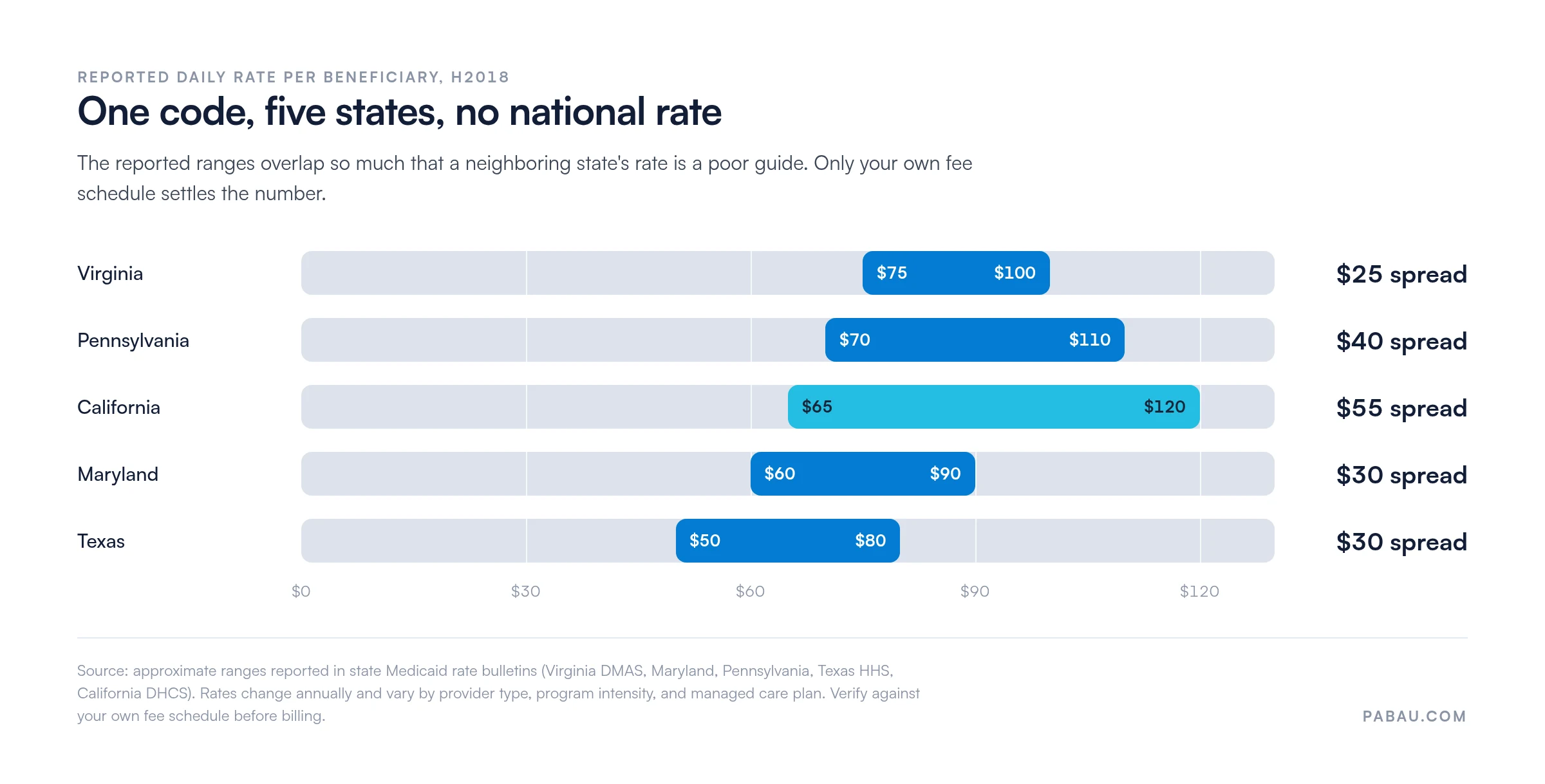
The table adds the detail behind each range, since provider type and program intensity usually explain the spread within a single state. Treat these as approximate and check the current figure before you bill.
The figure in your state’s fee schedule portal is the only one worth billing against. The AAPC HCPCS code lookup is useful for confirming the descriptor and code status, but it will not tell you what your program gets paid.
No two state Medicaid programs run H2018 the same way. The differences reach past rates into who may enroll, how long a day must be, and how many days a member gets in a year.
Authorization is where most programs lose days they already delivered. Build the renewal date into the member’s record rather than a spreadsheet, and start the prior authorization process before the current approval runs out.
Because these variables move with each rate update, your state’s provider manual stays the authority. CMS sets the descriptor, and the state sets the rules you bill under.
Watch the short day. Say a member leaves after 90 minutes and your state’s floor is three hours. That day is not a per diem unit, whatever the sign-in sheet says. Programs that bill it anyway usually keep the money until a post-payment review pulls a sample. Set the threshold as a hard field on the daily log, so staff record time in program rather than a tick against attendance.
H2018 needs a qualifying ICD-10-CM diagnosis showing serious mental illness with functional impairment that PSR addresses.
The codes below are the ones state Medicaid programs accept most often. Accepted lists differ by state, so confirm yours before you rely on any of them.
Anxiety and adjustment diagnoses usually fall short of the SMI threshold. A situational anxiety code such as F41.8 will not carry H2018 medical necessity in most state plans.
Autism and other developmental diagnoses are a state-by-state question, and several plans accept them only alongside a co-occurring SMI.
Whichever diagnosis you carry to the claim, the chart needs a licensed clinician’s assessment behind it. A structured interview such as the SCID assessment gives that work a shape a reviewer can follow.
H2018 sits in a cluster of behavioral health H-codes that cover different service types and different billing units.
Billing H2018 for work that maps to H2014 or H2019 is a frequent audit finding. The fix is usually a service definition rather than a coding one.
Choosing between H2017 and H2018 comes down to how your state built its rate structure, and some states run only one of the two.
Others pair PSR with a wrap-around program such as H2021, which brings its own same-day rules. Read the fee schedule and the provider manual together, since a code can be active in one and restricted in the other.
A clean H2018 claim moves in a straight line. Staff document the day, a biller matches that day to the treatment plan, and the claim goes out on a CMS-1500 or a UB-04.
From there it reaches either fee-for-service Medicaid or the managed care plan holding the member’s behavioral health benefit.
Seven checks worth running before the batch goes out:
Two mistakes account for most of the rework. The first is a full unit billed for a short day, which a claim edit will not catch and a post-payment review will.
The second is a service log reading “attended group” with no line back to the plan. Neither is a coding problem, which is why a scrubber alone never fixes them.
Most PSR programs keep the pieces of an H2018 claim in three places. Attendance sits on a paper sign-in sheet and progress notes sit in a clinical system. The claim then gets assembled from whatever reaches the biller by month end. Rebuilding that trail for an auditor takes days.
Pabau holds those pieces against one client record. Mental health EMR software keeps the treatment plan, the daily service log, and the progress note on the same member. A biller reads the day instead of reconstructing it. Electronic claims then leave through the Claim.MD integration, and the payer’s response comes back against that same record.
The practical result is a shorter month end. Attendance is already captured and the plan goal is already referenced. A reviewer’s request for one date of service becomes a report rather than a filing-cabinet job. That is the difference between defending a sample and defending a whole year.

Pabau holds treatment plans, daily service logs, and progress notes against the same client record, then builds the claim from it. Your billers stop rebuilding the month from paper.

H2018 is a short descriptor with a long list of state conditions attached. The code itself is settled and has been since 2003. What decides whether you get paid is your state’s minimum-hours floor, its modifier set, its authorization rules, and the record standing behind each billed day.
So treat the provider manual as the working document and the CMS descriptor as background. Pull your state’s PSR section, write down the minimum hours and the annual day limit, then hold your daily log template up against both. One afternoon of that prevents most recoupment letters.
If your treatment plans, service logs, and claims live in separate systems today, that split is where the audit exposure sits. Book a demo to see how Pabau keeps all three against one client record.

Billing therapeutic behavioral services alongside your PSR program? HCPCS code H2019 explains the 15-minute alternative and where it overlaps with a per diem day.
Need a note format your whole program can follow? Progress note template gives you a structure that ties each entry back to a treatment plan goal.
Coordinating care between PSR and case management? Case management note covers what to record when two services share the same member.
Documenting the clinical picture behind an SMI diagnosis? Mental status examination walks through each domain and how to write up what you observed.
No. H2018 allows one unit per beneficiary per calendar day, so the second claim hits a duplicate edit and denies. Programs that share a member need to agree in writing which one bills each date, before either claim goes out.
That depends on your state plan. Some Medicaid programs added virtual group programming and kept the per diem structure, while others require the member to attend in person. Check the telehealth section of the behavioral health manual rather than the state’s general telehealth policy.
H2018 pays at program level, so the organization is normally the billing provider. Some states also want a rendering provider NPI for the supervising clinician. Your provider manual names which fields the state expects, and enrollment records have to match them.
Usually not. The per diem unit pays for structured rehabilitation programming, and an assessment-only visit belongs under its own code. Confirm which assessment code your state pairs with PSR admission, then bill the program day from the point regular attendance starts.