Mental health self-care checklist
A mental health self-care checklist is a structured daily tool for tracking the ...

6
Last Updated: Oct 20, 2026

The SCID assessment is a semi-structured interview clinicians use to confirm DSM-5 diagnoses in adults.
The SCID-5-CV runs from module A to module L and covers about 10 diagnostic domains, including obsessive-compulsive and trauma-related disorders.
Three versions are in use: the CV for clinical diagnosis, the RV for research, and the PD for personality disorders.
A full interview takes 45 to 90 minutes, against 15 to 20 minutes for the shorter MINI.
Gate questions let you skip modules a patient screens negative for, which is what keeps the interview inside one appointment.
The template follows the SCID-5-CV module order, with space for gate-question answers, symptom probes, and a criteria-met decision for each disorder. It closes with a diagnostic summary you can lift straight into the clinical record.
Download templateThe SCID assessment is the Structured Clinical Interview for DSM-5, the interview clinicians use to confirm a psychiatric diagnosis rather than screen for one. You work through the diagnostic modules in a set order. Scripted gate questions open each module, and you probe in depth only where the patient endorses symptoms.
That design is what keeps a full interview inside a single appointment. It is also what makes the interview awkward to document. Every module ends in a decision that has to survive the trip into the clinical record.
This guide covers the three versions, the modules they contain, and the five steps of administration. It then follows the answers into the record, which is where a structured interview either saves the next clinician time or wastes it. The template above keeps the same module order, so you can write as you go.
The SCID assessment is a semi-structured diagnostic interview for DSM-5 disorders in adults, and the field treats it as the gold standard. Michael First, MD, and colleagues developed it at Columbia University and the New York State Psychiatric Institute. APA Publishing publishes the current versions and licenses their use.
Unlike a self-report questionnaire, the interview leaves room for clinical judgment. You follow a standardized sequence of questions, but you can rephrase them and follow up on any answer that needs more detail.
That combination is why it has stayed the most widely used diagnostic interview in psychiatry for three decades. In US practices, the appointment it usually sits inside is billed as 90791.
Administration follows five steps, and the order matters as much as the questions do. Plan a dedicated appointment around it rather than squeezing it into a routine follow-up.
A full interview runs 45 to 90 minutes, depending on how many symptoms are active. Plan for the top of that range until you have run it a few times. Paper booklets mean retyping the answers afterwards, and dictation or transcription tools only help if the module structure survives the transfer.
Three versions of the SCID-5 are in active use, and each one answers a different question. Picking the wrong one costs you either appointment time or diagnostic detail.
Most psychiatry practices use the SCID-5-CV, which balances diagnostic coverage against the time a clinical appointment allows. Read as one decision, the choice between the three versions and the shorter MINI looks like this.
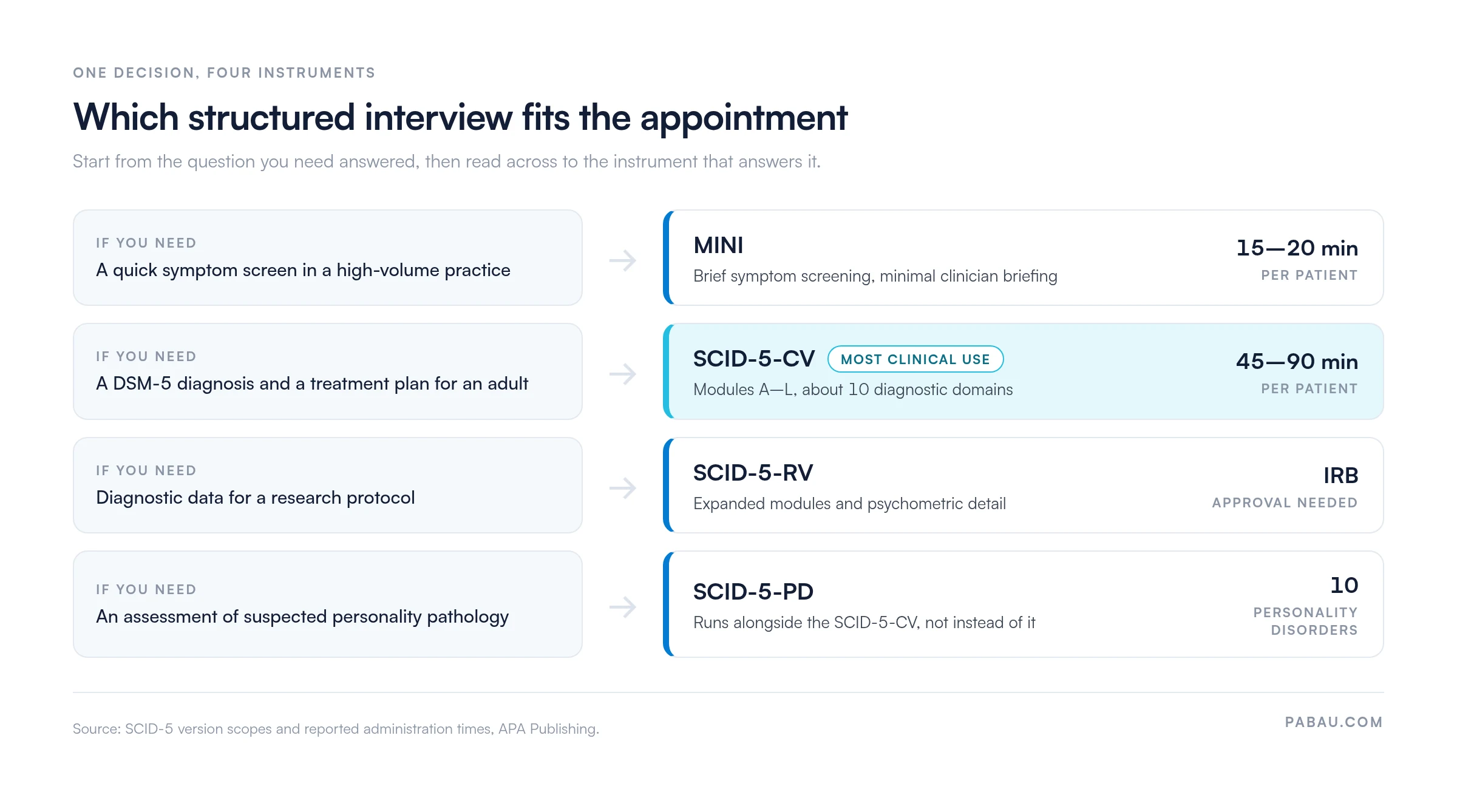
The SCID-5-CV runs from module A to module L and covers about 10 diagnostic domains. Each domain has its own gate questions, symptom probes, and scoring rule. That lets you see in advance which parts of the interview a given patient will need.
The gate-and-probe structure is what keeps the interview practical. You only administer a full module when its screening questions are endorsed, so a negative screen costs a minute instead of 10. Brief instruments such as the GAD-7 or the Beck Depression Inventory then track severity once the diagnosis is settled.
The MINI International Neuropsychiatric Interview answers a similar question in a quarter of the time, and it gives up depth to do it. The choice comes down to what the appointment is for.
Choose the SCID assessment when the diagnosis is genuinely in question and you have the appointment time to earn the answer. Choose the MINI for brief screening, or in a high-volume practice where 20 minutes is what the schedule allows.
The interview is for mental health clinicians with DSM-5 training and clinical oversight. That covers psychiatrists, clinical psychologists, clinical social workers, psychiatric nurse practitioners, and other master’s-level or doctoral-level clinicians.
Training usually means a two or three day workshop plus supervised practice with real or standardized patients.
Administrative staff, peer specialists, and bachelor’s-level personnel cannot administer it independently. Graduate programs in psychiatry, psychology, and counseling teach it as a core competency, so many psychology practices already have a trained administrator on the team.
The limit is clinical judgment rather than the script, because differential diagnosis is the part no form does for you.
APA Publishing maintains the current SCID-5 versions and their licensing terms, and it is the only legitimate source for the instrument. Free PDFs circulating online are unauthorized copies. The DSM-5 criteria that the interview scores are published separately by the American Psychiatric Association.
Validation studies, including inter-rater reliability data, are indexed on PubMed. The National Institute of Mental Health publishes guidance on using structured interviews in research and clinical settings. Training workshops run periodically through APA Publishing and affiliated universities.
In most practices the interview still happens on paper. The clinician marks up the module booklet during the session, then retypes the diagnostic summary into a PIRP note or a progress note afterwards. That second pass is where detail gets lost and where the appointment quietly overruns.
Practice management software like Pabau removes the second pass. You can build the module sequence into digital intake forms. Gate questions, symptom probes, and scoring then land in the client record as structured fields rather than free text.
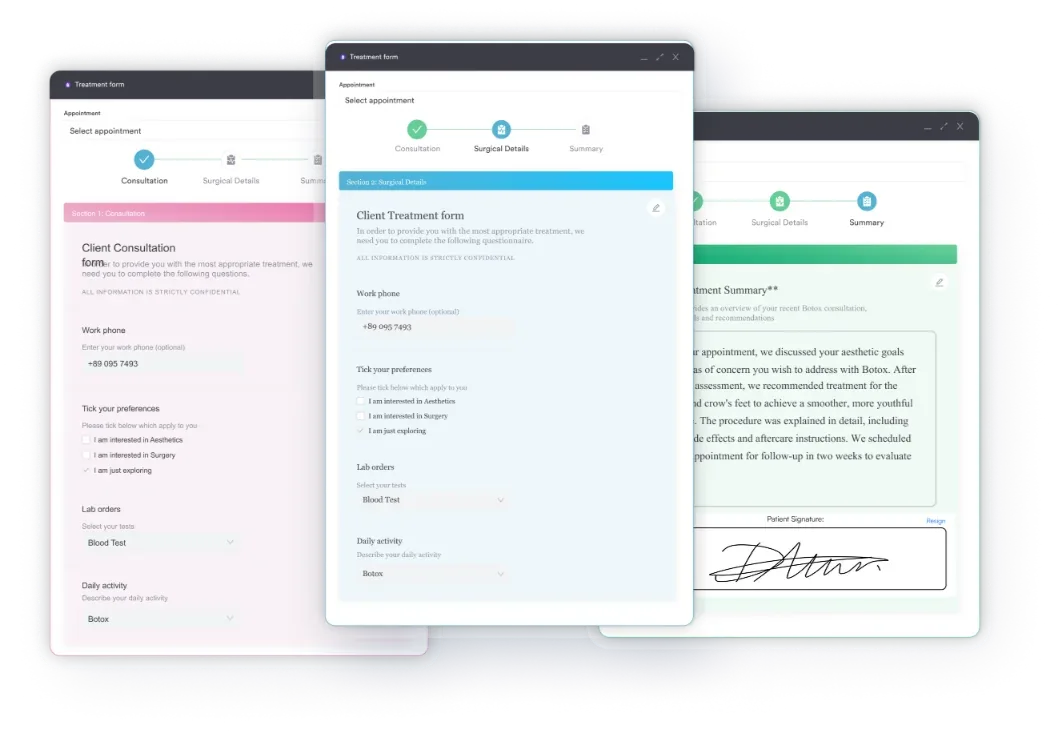
Because those fields are structured, the diagnosis travels with the patient. Clinical records hold the diagnostic summary beside the treatment plan and the next appointment. Whoever picks up the case can see which criteria were met and which were not.
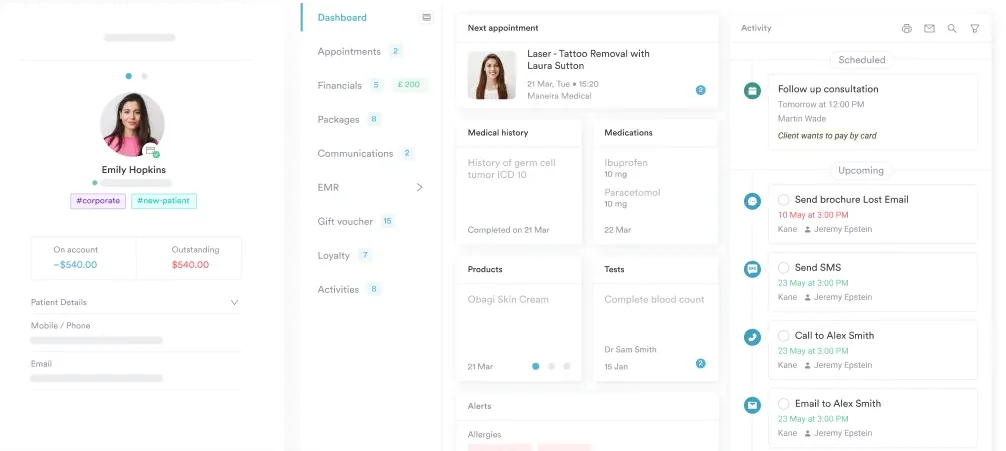
For the charting itself, Pabau Scribe, our AI scribe, drafts the summary from the session, so you edit rather than write from scratch. The outcome clinicians notice first is finishing the note before the patient has left the building.

Pabau’s digital forms capture SCID module answers as structured fields, then keep the diagnosis beside the treatment plan in the client record. Your notes are finished before the next patient arrives.

The SCID assessment earns its appointment slot when the diagnosis is genuinely in question. If you only need to know whether to look closer, a 20-minute screen does that job for a fraction of the time.
Whichever instrument you run, its value depends on whether the answers are still legible in six months. Pick the version that matches your setting, train properly on it, and record the outcome as structured data rather than prose. Book a demo to see how Pabau captures structured interview findings and keeps them in the client record.

Need a structure for the written evaluation? Psychiatric evaluation template lays out the sections for documenting clinical findings and treatment recommendations alongside your SCID results.
Collecting history before the interview? Adult biopsychosocial intake gathers the social, medical, and family history that the diagnostic modules assume you already have.
Want to reduce post-session charting burden? Pabau Scribe, our AI scribe turns the session into a structured diagnostic summary for the client record.
Setting up a new mental health caseload? Mental health intake covers the first-appointment questions that sit either side of a structured interview.
Assessing risk during the interview? Mental health safety plan gives you a documented plan to put in place when a module surfaces active risk.
The SCID assessment is the Structured Clinical Interview for DSM-5, a semi-structured interview used to diagnose psychiatric conditions against DSM-5 criteria. Michael B. First, MD, and colleagues developed it at Columbia University and the New York State Psychiatric Institute. APA Publishing publishes it.
A full interview takes 45 to 90 minutes, depending on how many symptoms the patient reports. First-time administrators should plan for the top of that range. The MINI covers less ground in 15 to 20 minutes.
The SCID-5-CV runs from module A to module L, across about 10 diagnostic domains. Those include mood, psychotic spectrum, anxiety, obsessive-compulsive and related, trauma- and stressor-related, substance use, feeding and eating, and sleep-wake disorders, plus adult ADHD. The SCID-5-PD assesses 10 personality disorders separately.
No. The SCID-5 is copyrighted and published by APA Publishing, so legal use requires a license or a purchase. Free PDFs circulating online are unauthorized copies. Buy it from APA Publishing or an authorized distributor to be sure you have a current, validated version.
The Clinician Version is built for routine diagnosis and treatment planning with adult patients. The Research Version is expanded for studies that need detailed diagnostic validation, and it typically requires IRB approval. Both cover the same major domains, but the RV adds modules and psychometric detail.
The SCID-D is a separate instrument for dissociative disorders, developed by Marlene Steinberg, MD. It assesses five symptom areas: amnesia, depersonalization, derealization, identity confusion, and identity alteration. The SCID-5 screens for dissociation but does not go into that depth.