

CCSD code G5100: Bypass of duodenum billing guide
CCSD code G5100 bills a bypass that leaves the duodenum in place CCSD code G5100...

Last Updated: Oct 16, 2026
H2025 is the HCPCS Level II code for ongoing support to maintain employment, per 15 minutes.
HCPCS code H2025 pays for the support that keeps someone in a job they already have. The descriptor reads "ongoing support to maintain employment, per 15 minutes," and that time unit drives the whole claim.
Every line has to trace back to start and end times written in the note. Medicaid is the only payer that recognizes the code, so coverage rules, rates, and modifiers all come from your state.
Let Pabau's smart automation suggest the right codes, reduce claim denials, and keep your practice compliant—effortlessly.
Automate repetitive tasks and focus on what matters most—your patients.
Reduce coding errors and ensure compliance with the latest regulations.
Clean claims, fewer denials, and faster reimbursements.
Powerful insights and reporting to help your practice thrive.
HIPAA compliant SOC 2 certified GDPR-compliant Trusted by 4,000+ clinics worldwide

HCPCS code H2025 covers ongoing support to maintain employment, billed in 15-minute units.
Medicaid is the only payer for H2025, so rates, coverage limits, and modifiers all come from your state.
Units follow the documented start and end times, so a 45-minute session bills 3 units, not 4.
Most denials trace back to a missing time entry, a vague note, or an authorization that has run out.
HCPCS code H2025 is the Medicaid billing code for ongoing support to maintain employment, billed per 15 minutes. It sits in the HCPCS Level II H-series, which the Centers for Medicare and Medicaid Services (CMS) maintains for behavioral health and social service programs.
The code applies once the participant is already working. Work done before that point belongs to a different code.
The H prefix tells you who pays. H-series codes go to state Medicaid programs and their managed care organizations (MCOs), not to Medicare.
So coverage, rates, and documentation rules come from state policy rather than one federal standard. That is why two neighboring states can pay very different amounts for the same 15 minutes.
Supported employment programs use H2025 for the retention phase. The participant has a job, and the work now is helping them keep it.
In practice that means coaching at the job site, contact with the employer, and coordination with the treatment team.
Most programs run this under the Individual Placement and Support (IPS) model. State Medicaid agencies that fund IPS usually recognize H2025 as the code for its support phase.
Vocational assessment, job development, and resume work do not belong here. Those earlier phases sit under separate codes, such as H2023 or H2024, depending on state policy. Getting that boundary right matters more than any other coding decision on this code.
No national list of eligible providers exists. Each state Medicaid plan names the provider types it will pay, and those lists differ.
Most states, though, recognize the same core group, as long as the agency is enrolled and running an approved supported employment program.
Check enrollment before the first claim goes out, not after the first denial. A lapsed agency enrollment or a stale NPI on file stops a claim just as reliably as a documentation problem does.
Time-based codes carry a heavier documentation load than flat-rate ones. Each unit on the claim has to trace back to a block of minutes and a described activity. Auditors pull time logs first, and thin entries are the top reason paid claims get taken back.
Five elements belong in every note. Together they are what medical billing compliance looks like for a time-based code:
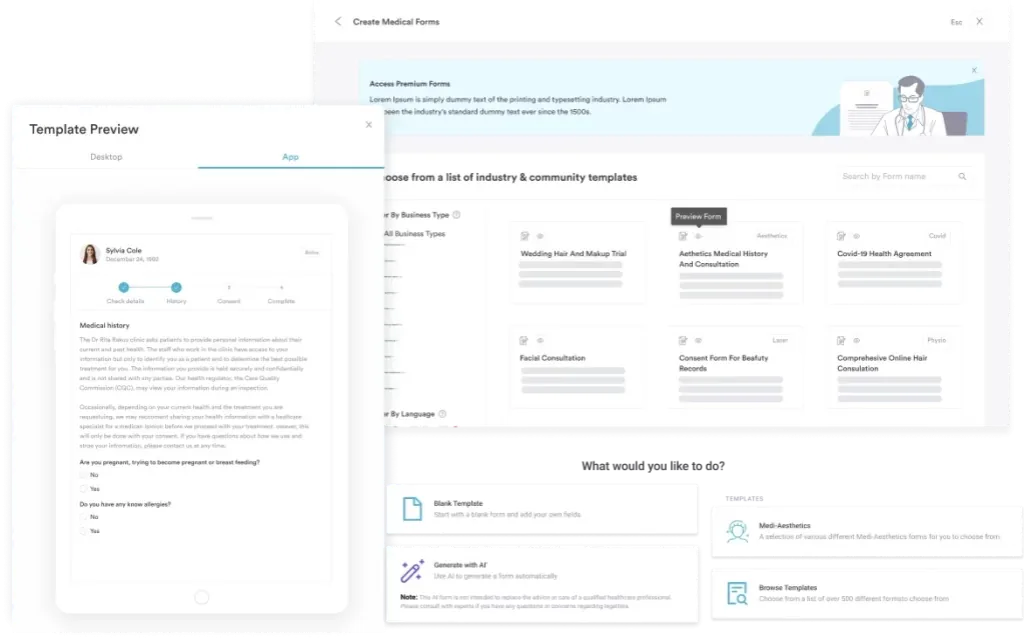
Building the note as a digital clinical form with required fields catches the missing minute while the specialist is still with the participant.
Payers generally want the note finished the same day, or within 24 to 72 hours, depending on state policy.
Many states also require authorization before H2025 services start. Read your provider manual for the prior authorization rules, the unit cap per authorization period, and the medical necessity criteria that apply.
Put the authorization end date where staff already look, next to the appointment. Most programs find out about a lapsed authorization weeks later, when a denial lands. A date on the client record, checked at scheduling, catches it while the visit can still be moved or re-authorized.
Unit math is where programs lose money in both directions. Some staff round up and invite a takeback. Others round down and give away work they delivered. The fix is to count from the documented minutes, then apply your state’s rounding rule to the 15-minute unit.
Most states use the 8-minute rule. Under it, a partial unit of 8 minutes or more counts, and a shorter block does not. The bands below follow from that arithmetic.
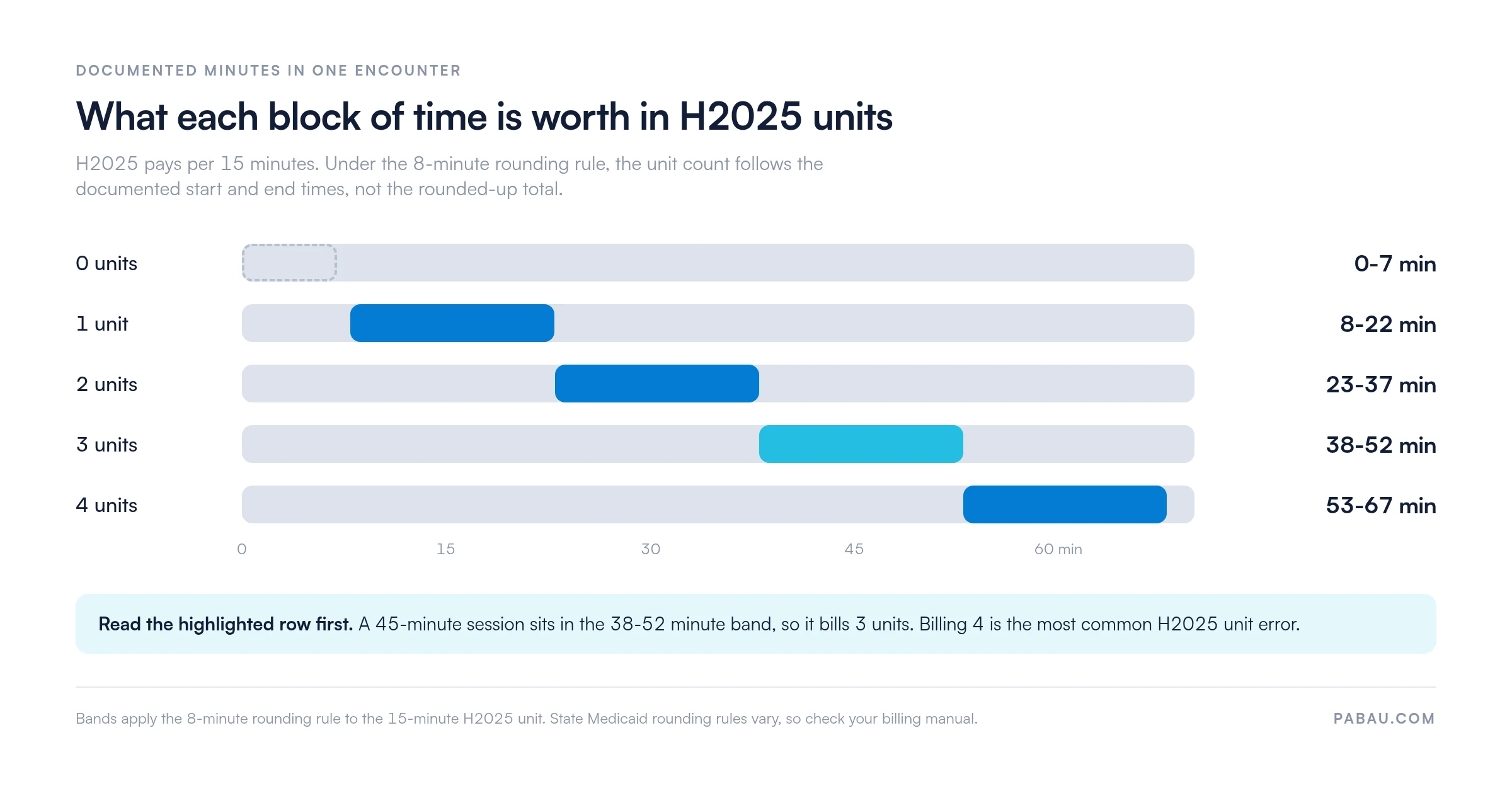
Here is how that plays out on a caseload. An employment specialist meets a participant at the job site from 10:05 to 10:52.
The note records both clock times, so the unit count is not a guess. That is 47 minutes, which lands in the 38 to 52 band, and the line bills 3 units.
Round that up to 4 units and the claim may well pay. It can also be reversed at audit, months later, when the time log no longer supports the number.
One caution before you write a rule for your team: some states total same-day minutes for a code before rounding, and others do not. Confirm which applies in your billing manual.
Coding is one step in a longer chain. Seeing the whole chain makes it obvious why so many H2025 denials are decided long before anyone opens the billing screen.
Notice where the work sits. Steps 1 through 4 all happen in the program, before billing ever sees the encounter. By step 5, whether this can be a clean claim has usually already been settled.
A short pre-submission pass catches most of what would otherwise come back. Six items, one minute per claim:
Programs that run this weekly, instead of at month end, still have time to correct a note. Once the claim is filed, a fix costs several times as much staff time.
There is no national rate for H2025. Each state Medicaid agency sets its own, and Medicare publishes none because Medicare does not cover the code.
Figures on third-party fee schedule sites are estimates, so treat them as a starting point and check them against your state’s table.
To find your number, open the behavioral health fee schedule on your state Medicaid provider portal. If the participant is enrolled with an MCO, check the contract rate as well, since it can differ from the state schedule.
That per-unit figure then drives revenue cycle management planning, because rate times billable volume is what funds the program.
A modifier tells the payer something the code itself does not say. It might be where the service happened, who delivered it, or how.
States differ sharply here. Some want a credential modifier on every line, and others deny claims that carry one they never asked for.
Check the current manual before you add or drop one. State modifier policy changes far more often than the code descriptor does.
Supported employment runs in phases, and H2025 covers only the retention phase. Billing it for job development is an incorrect-code error, and a repeated pattern of it draws attention. These are the codes that sit closest to it.
Confirm the descriptor and active status before you bill any of them. Both the AAPC HCPCS lookup and the NLM Clinical Tables lookup return current Level II descriptors.
Denials cluster. Six errors account for most of what comes back, and each one is fixable at the point of service. Running them through a denial management workflow turns a pile of separate rejections into one pattern you can fix once.
Each of these is visible in the record before submission. That is what makes them worth auditing internally, rather than learning about them from a remittance advice.
Pull 10 H2025 notes at random each month and score them yourself. Check four things: clock times recorded, activity described specifically, signature and credential present, and authorization active on that date. Finding your own weak notes costs an hour. Having an auditor find them costs the units back.
Supported employment programs carry a documentation load that grows with the caseload. An employment specialist holding 25 open cases writes dozens of short notes a week, often on a phone between visits.
Practice management software like Pabau keeps the note, the authorization date, and the claim in one client record. That way claims management is not a second system to reconcile.
For behavioral health agencies, Pabau’s mental health EMR gives specialists structured note templates. Each one asks for start time, end time, location, and activity before the note can be signed. That closes the most common documentation problem while the visit is still fresh.
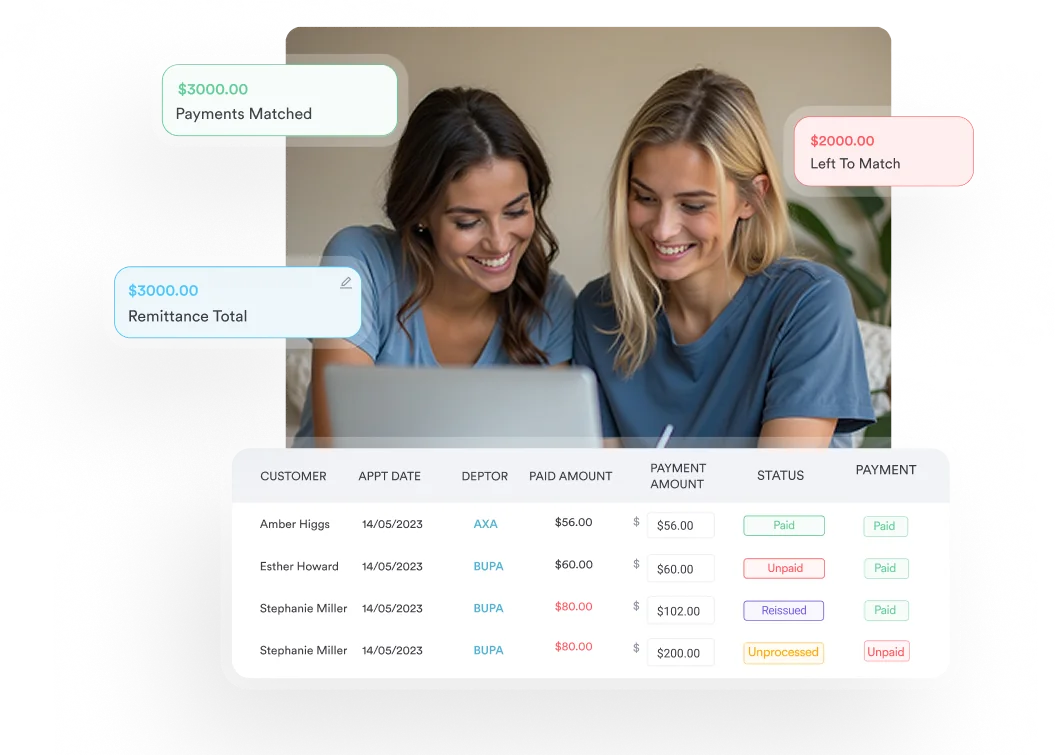
Some agencies run supported employment alongside prescribing services. Both sit in the same file, so a psychiatry EMR and an employment specialist’s notes share one client record.
At billing time, Pabau sends claims electronically through its Claim.MD integration. The line built from the note is the line the payer receives.

Pabau keeps behavioral health notes, authorization dates, and Medicaid claims in one client record. Your team documents the time once, and the claim is built from what they wrote.

H2025 is not a hard code to understand. The descriptor is one line, and the unit is 15 minutes. What makes it hard is where the data comes from. Staff capture it out at a job site, between a supervisor conversation and the drive to the next visit.
So put the effort upstream. Use a note template that asks for clock times. Keep the authorization date where staff see it at scheduling. Read 10 records a month. Those three habits prevent more denials than any appeals process, and the trade-off is small. You spend a few minutes of structure per encounter, and get back units that survive an audit.
Programs that fix documentation at the point of service get paid faster and argue less. Book a demo to see how Pabau handles time-based Medicaid billing for behavioral health teams.

Billing another 15-minute behavioral health service? HCPCS code H2018 walks through psychosocial rehabilitation billing, which many supported employment programs run alongside H2025.
Coordinating several services around one participant? HCPCS code H2021 covers wrap-around services and how states scope them against other H-codes.
Working under a Medicaid waiver program? HCPCS code T2012 explains per-diem habilitation billing, where the unit rules work very differently.
Tightening up how your team writes notes? PIE note template gives a structure that keeps behavioral health notes specific enough to support a claim.
Sometimes. Several states allow both when the activities are genuinely separate and each carries its own time log. Others treat the pair as mutually exclusive. Check your state’s concurrent billing rules before you file them together.
In most states one authorization covers a period and a unit cap, rather than a single visit. Services delivered after the period closes are not payable. Track the end date and request renewal before the last unit is used.
Only where the state allows group delivery, and usually with the HQ modifier attached. Group policy often caps how many participants one staff member can support, or reduces the per-unit rate. Confirm both points before you schedule group employment support.
The person who delivered the service signs it, with their name and credential. Some states also require a supervisor countersignature on top of that. A supervisor’s signature on its own does not support the claim, because the auditor is checking who did the work.
Many states pay for telehealth delivery with the GT modifier, though some restrict it for employment support specifically. A few also pay a reduced rate. Verify the delivery mode rules in your billing manual before you bill remote contacts.



