Mental health self-care checklist
A mental health self-care checklist is a structured daily tool for tracking the ...

6
Last Updated: Oct 20, 2026

This mental health check-in worksheet pairs a short mood check-in with goal setting, so a reflection ends as a written plan.
Section 1 asks for one 0-10 mood rating for the past week, an emoticon, and two open reflection questions.
Sections 2 to 4 cover three mental health goals, three action steps for each goal, and the people or services that can help.
Section 5 repeats the mood rating and sets a review date, which gives the next appointment a defined starting point.
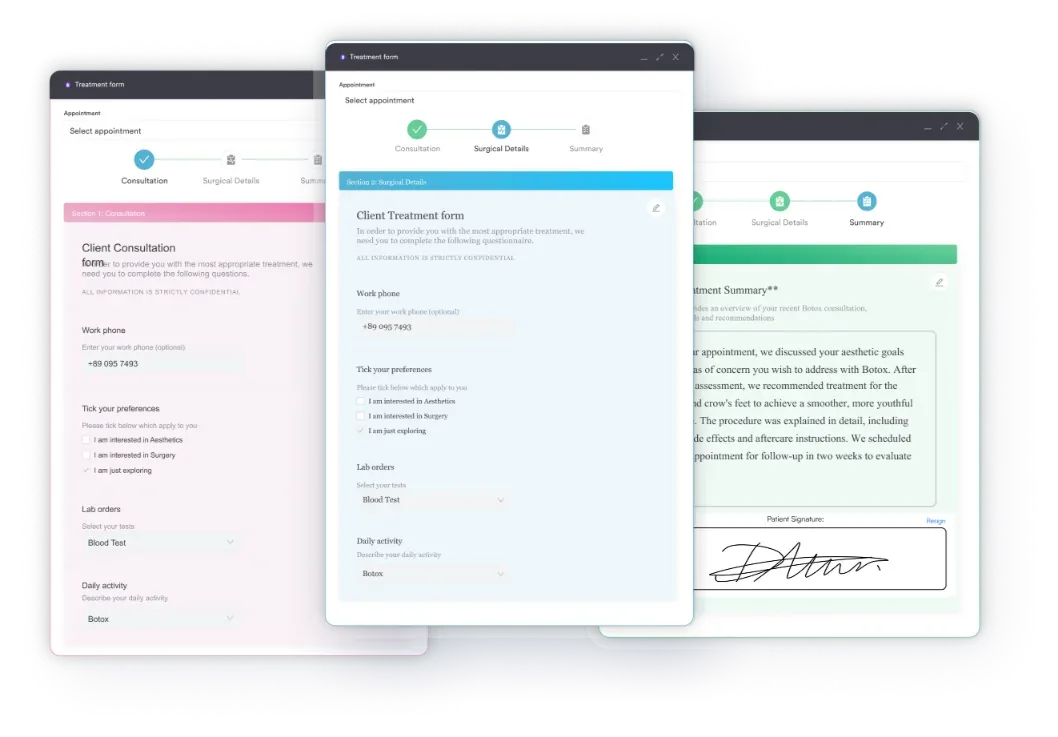
Practice management software like Pabau can rebuild the same fields as a digital form, so answers land in the client record.
A two-page clinical form covering patient and health information, a 0-10 mood check-in, and two reflection prompts. It then moves through three mental health goals, action steps, sources of support, and a review date.
Download templateA mental health check-in worksheet asks a person how they are doing right now, then turns that answer into goals they can act on. This template does both jobs across two printable pages, and it is built for a conversation rather than a daily diary.
The form opens with patient and health information, including current medications, allergies, and an emergency contact. Section 1 captures a single 0-10 mood rating for the past week plus two short reflection questions. Sections 2 to 5 then move from goals to action steps, to sources of support, to a booked review date.
Most people can complete it in 15 to 20 minutes, either alone before an appointment or alongside a provider during one. The pages below explain what sits in each section, how to fill it in, and where its limits are.
A mental health check-in worksheet is a structured self-reflection form that records how someone feels, what is affecting them, and what they want to change. This template goes one step further than a mood log. It carries the reflection into three goals, three action steps per goal, and a date to review progress.
The form does not diagnose. Its own disclaimer states that it supports self-reflection and does not replace professional mental health advice. According to Mental Health America, self-monitoring tools work best when they sit alongside professional support rather than in place of it.
The goal-setting half is what makes the worksheet useful in a clinical setting. A rating on its own tells a provider very little. A rating attached to a named concern, a goal, and a next step gives the following appointment somewhere to start.
The worksheet runs to two pages and seven parts. The map below shows what each part collects and what it produces. The sections that follow work through them one at a time.
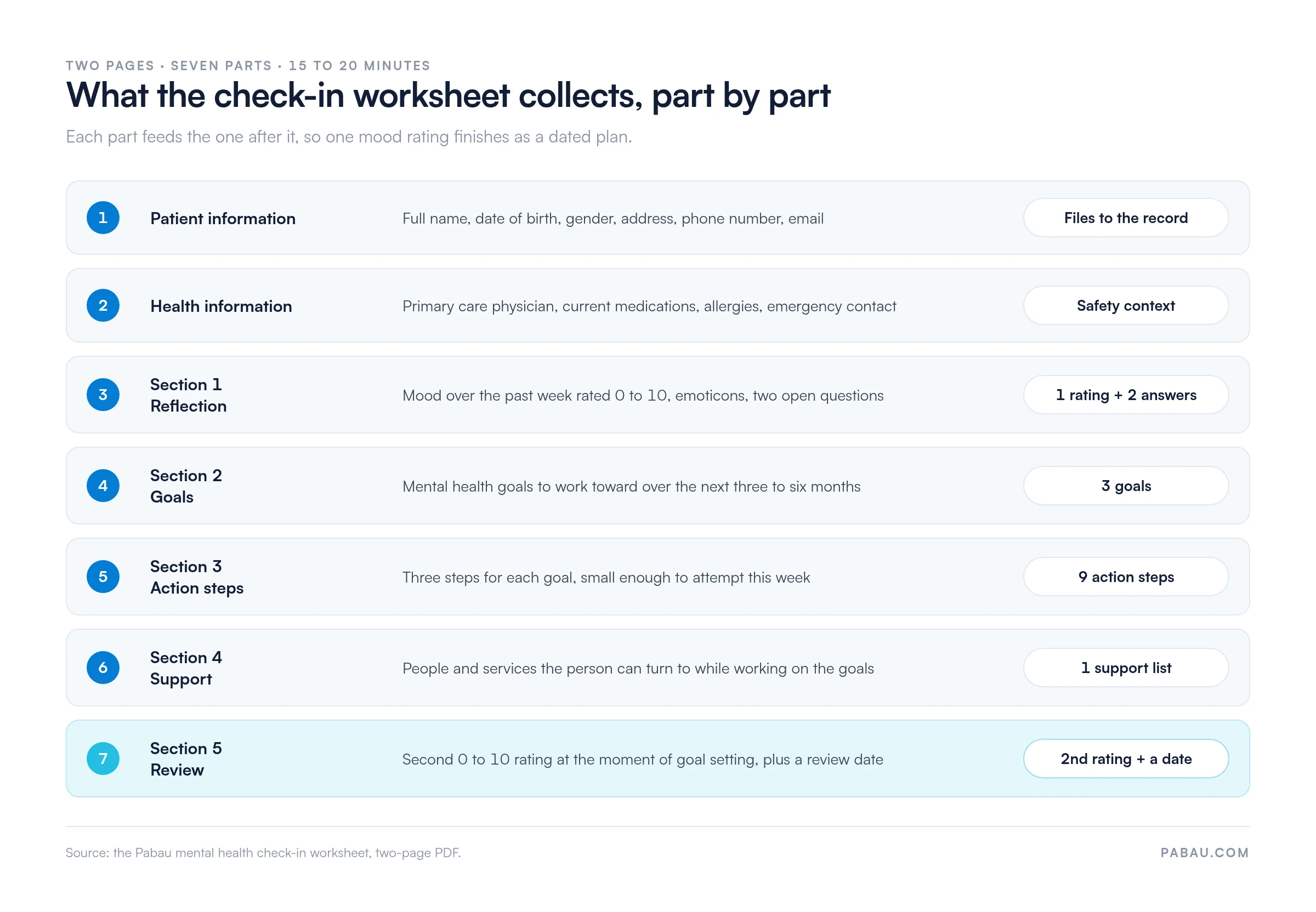
The first block collects full name, date of birth, gender, address, phone number, and email. These fields identify the form once it is filed, which matters when a practice keeps completed worksheets in a client record.
The second block covers the primary care physician, current medications, allergies, and an emergency contact with their relationship and phone number. Medication details matter here because mood changes are often tied to a new prescription or a missed dose. The emergency contact gives a provider a named person to call if the conversation raises a concern.
This section has three parts. The person rates their overall mood over the past week from 0 to 10, where 0 is extremely low and 10 is extremely high.
They then select one or more emoticons that match how they feel at that moment, choosing from happy, sad, angry, worried, and relieved. Blank faces are provided for feelings the list misses. A color-coded mood scale can sit beside the emoticons, and reusing the same bands in every note keeps scores comparable.
Two open questions follow. The first asks about the primary challenges or concerns affecting their mental health right now. The second asks which aspects of their mental health feel strong or resilient. The pairing is deliberate, because a form that only asks about problems produces a one-sided picture.
Here the person lists three specific mental health goals to work toward over the next three to six months. The window is set on the form, which keeps goals realistic. Vague entries such as feel better are worth reworking into something observable, like sleeping in my own bed five nights a week.
Each goal gets three actionable steps. This is the part clients most often need help with, since the jump from a goal to a first move is where plans stall. Steps should be small enough to attempt this week, not milestones restated in different words.
The person names the people or resources they can turn to while working on those goals. That can include family, friends, a therapist, a support group, a helpline, or a community service. Writing the list down is a practical safety step as well as a planning one.
The final section repeats the 0-10 mood rating, this time at the moment of goal setting. It also leaves space to draw an emoticon for how the person feels afterward. It closes with a review date and a date of completion. Those two ratings, taken minutes apart, often show whether making a plan shifted the mood.
The worksheet suits anyone who needs a check-in that ends in a plan rather than a score. In practice that covers four groups:
Work through the form in order. Each section feeds the one after it.
The review date is the step people skip. Without it, the goals sit in a drawer, and nobody finds out whether the action steps worked.
The form works as a treatment planning aid rather than a symptom tracker, whether you run a single counseling room or a larger therapy practice. Clinicians use it in five ways:
Bring the completed sheet to the review appointment and work down it goal by goal. Ask which action steps were attempted, which were not, and what got in the way. Then reset the goals that no longer fit and book the next review date. Record the session in your usual note format, such as a PIRP note.
Because the form is built around goals and a review date, it fits planning moments rather than daily monitoring. Use it:
A three to six month goal window suggests a review every four to eight weeks for most people. Someone in an acute episode needs closer contact than this form provides, and a clinician should set that cadence directly.
Knowing the limits of the form matters as much as knowing its sections. This worksheet has no sleep log, no anxiety or stress scale, and no physical symptom checklist.
It does not ask which coping strategies you used or how well each one worked. It captures one mood rating for the past week, not a daily trend.
It is also not a screening or diagnostic instrument. A validated tool such as the PHQ-9 or the GAD-7 measures symptom severity against a scored threshold, and this form does neither.
A structured interview like the SCID assessment sits further along the same scale. Pair the worksheet with one of them when you need a severity measure as well as a plan.
The sheet does not screen for risk of harm. A low rating or a distressing answer to the challenges question needs a direct clinical conversation. Follow your own service’s risk protocol, and use a mental health safety plan where one is warranted.
A completed sheet holds a name, a date of birth, contact details, medications, allergies, and written statements about someone’s mental health. In the US that is protected health information under HIPAA. In the UK and EU it is special category data under GDPR. Either way it needs the same handling as any clinical note.
Printed worksheets create work here. Someone has to scan them, name the file, and attach it to the right record, and every one of those steps can go wrong. A digital form removes the handling step entirely.
Therapy rooms and psychology practices usually start with the printed version, then hit the same three problems. Forms come back incomplete, and the review date lives only on the paper. Comparing this month’s mood rating with the last one means pulling the file.
Practice management software like Pabau lets you rebuild the worksheet as a digital intake form. Each section becomes a field. Mood gets a 0-10 slider, the two reflection questions get free-text boxes, and goals and action steps get repeatable rows.
The review date gets its own date field. Clients complete the form from a link before the appointment, so the answers are waiting when they arrive.
Because the form is part of the client record, the responses sit next to appointments, notes, and medication details rather than in a separate pile. You can pull a previous check-in while writing today’s note, and book the review appointment from the same screen.
Pabau supports HIPAA compliance and UK GDPR requirements, with access controls and an audit trail on every record. The outcome is a check-in that finishes itself. Staff no longer scan or file by hand, and the review date sits in the calendar rather than on a sheet of paper.
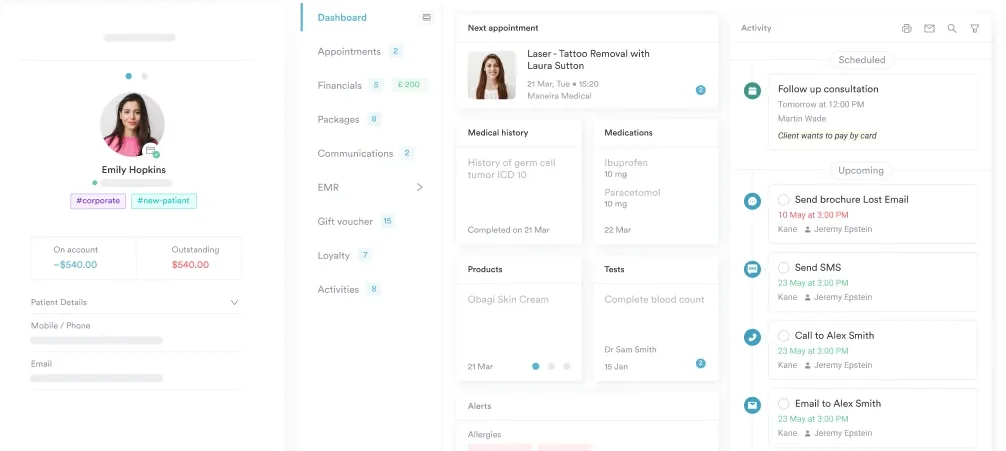

Rebuild this worksheet as a Pabau digital form, so mood ratings, goals, and review dates land straight in the client record. Clients complete it before the appointment, so there is no paper to scan.

Use this worksheet when you want a mental health conversation to end with something written down. Its value is in Sections 2 to 5. There, a feeling becomes three goals, nine action steps, a named source of support, and a date to review them.
Pair it with a validated severity measure if you need one, and never treat the mood rating as a risk screen. Download the template above and use it at your next intake or planning appointment. Book a demo to see how Pabau keeps completed check-ins, goals, and review dates inside the client record.

Need a full mental health intake form? Mental health intake form collects the history and consent this check-in assumes you already have.
Writing up the session afterward? Therapy progress notes cheat sheet shows how to turn the goals and steps into a clean clinical note.
Client stuck between a goal and a first move? Change plan worksheet breaks one change into reasons, steps, and obstacles.
Choosing an approach for the goal work? Counseling theories chart compares the main models side by side.
Moving your practice off paper? Running a paperless, HIPAA-compliant practice covers the scanning and filing work a digital form removes.
A mental health check-in worksheet is a structured form for recording how someone feels and what they want to change. This template captures a 0-10 mood rating, two reflection questions, three goals, action steps, sources of support, and a review date.
Four questions carry this worksheet. It asks for a 0-10 rating of your mood over the past week, the challenges affecting your mental health, and the aspects that feel strong. It then asks for three goals, three action steps per goal, the people you can turn to, and a review date.
Complete it whenever you set or review mental health goals, rather than on a daily schedule. The goal window on the form runs three to six months, so a review every four to eight weeks suits most people. Your clinician can set a different cadence.
Yes. Therapists use this form at intake and at treatment planning appointments to agree goals, action steps, and a review date. The two mood ratings bookend the session, and the support section shows who the client can reach.
Yes. This template is a free PDF download. You can print it, complete it by hand, or rebuild the same sections as a digital form in your practice software. Organizations such as NIMH and the American Psychological Association also publish free mental health resources.