CPT Code 31653: EBUS With 3+ Mediastinal Stations
CPT code 31653: Official descriptor and clinical scope CPT code 31653 is the pro...

Last Updated: Oct 20, 2026
99195 is the CPT code for phlebotomy, therapeutic (separate procedure). It covers blood removal performed as treatment for conditions such as hereditary hemochromatosis and polycythemia vera, under physician supervision.
Unlike a routine blood draw (CPT 36415), this procedure is the treatment itself. The volume removed is calibrated to reduce iron overload or excess red cell mass. It is reported once per session, with a linked diagnosis that establishes medical necessity.
Let Pabau's smart automation suggest the right codes, reduce claim denials, and keep your practice compliant—effortlessly.
Automate repetitive tasks and focus on what matters most—your patients.
Reduce coding errors and ensure compliance with the latest regulations.
Clean claims, fewer denials, and faster reimbursements.
Powerful insights and reporting to help your practice thrive.
HIPAA compliant SOC 2 certified GDPR-compliant Trusted by 4,000+ clinics worldwide

CPT code 99195 covers therapeutic phlebotomy as a treatment, which is different from routine venipuncture billed under CPT 36415.
Accepted diagnoses include hereditary hemochromatosis (E83.110), polycythemia vera (D45), and secondary polycythemia (D75.1).
Each session’s record needs a physician order, pre-procedure lab values, and the volume of blood removed.
Medicare covers 99195 when medical necessity is supported, and each MAC’s LCD sets the frequency limits and lab thresholds.
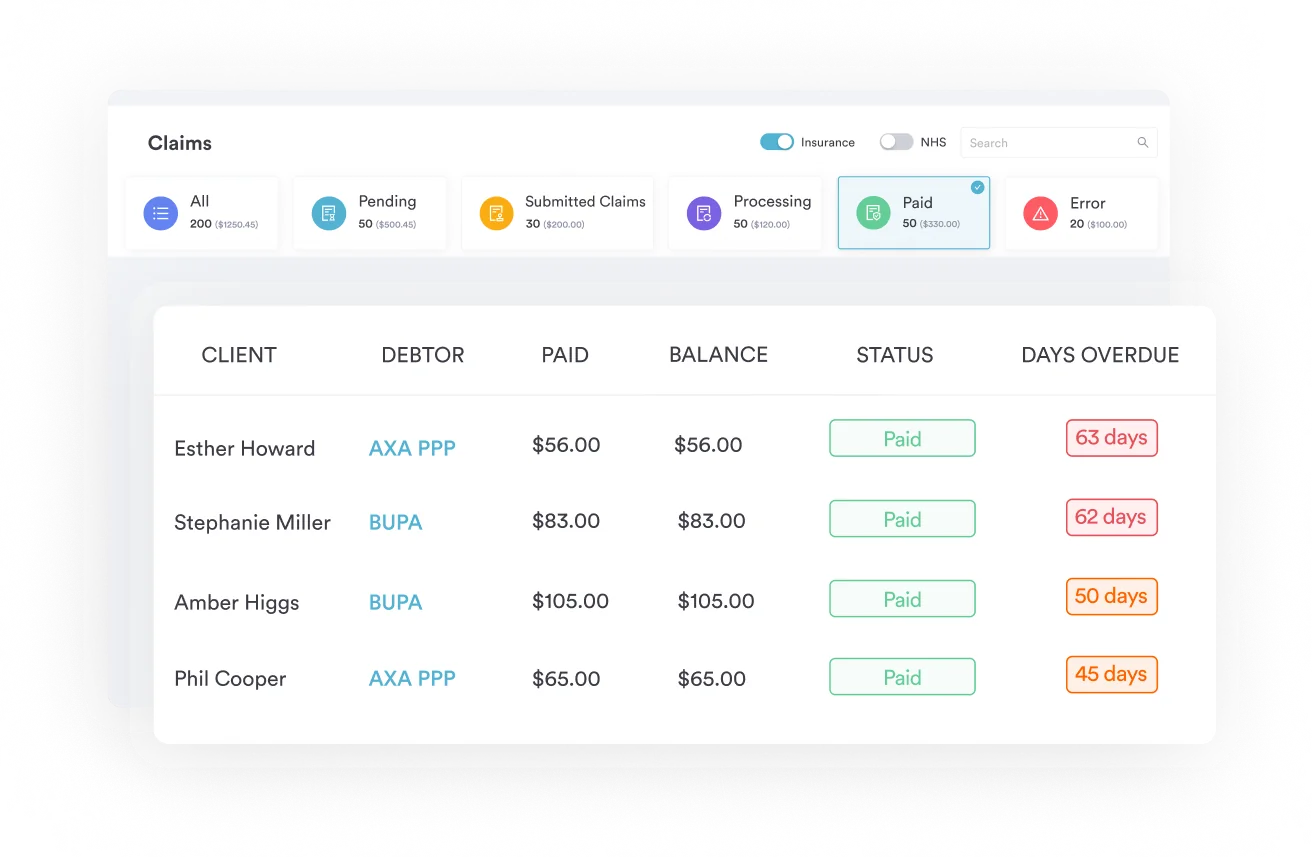
Pabau’s claims management tools help practices track documentation requirements and submit clean 99195 claims.
CPT code 99195 is the American Medical Association’s code for therapeutic phlebotomy. Its official descriptor reads “Phlebotomy, therapeutic (separate procedure).” Practices report it when blood is removed to treat conditions such as hemochromatosis or polycythemia vera, under physician supervision.
The key word in that descriptor is “therapeutic.” Documentation, billing, and medical necessity all turn on the difference between a treatment phlebotomy and a diagnostic draw.
The procedure itself involves withdrawing a clinically significant volume of blood (typically 450-500 mL per session) under physician supervision. The goal is to reduce iron stores or red blood cell mass, not to obtain a laboratory specimen.
CPT 36415 covers routine venipuncture for diagnostic purposes. The two codes aren’t interchangeable, and they can’t be billed together for the same therapeutic phlebotomy session. The National Correct Coding Initiative (NCCI) bundles 36415 into 99195 when both appear for the same encounter, so the lower-value code is denied.
CPT 99195 applies when blood removal is itself the treatment, most often for high hemoglobin, elevated hematocrit, or iron overload. Payers expect the medical record to show that therapeutic purpose, rather than a lab collection step.
The accepted clinical indications are narrow. Most payers follow their Medicare Administrative Contractor’s Local Coverage Determination, which typically covers these conditions:
For polycythemia, typical thresholds that support medical necessity are hematocrit above 52-54% or hemoglobin above 18 g/dL. For hemochromatosis, it’s usually serum ferritin above 300 ng/mL with elevated transferrin saturation. These figures vary by MAC LCD, so check the thresholds for your jurisdiction before submitting claims.
Every CPT 99195 claim needs a linked ICD-10-CM diagnosis code that shows why the phlebotomy was medically necessary. According to the CMS ICD-10 coding resources, the diagnosis must support the therapeutic intent of the procedure. The most commonly accepted codes are listed below.
Listing the wrong diagnosis is a frequent denial trigger for 99195 claims. If hereditary hemochromatosis is confirmed, code E83.110 rather than a general “iron overload” code. Polycythemia vera sessions link to D45, backed by the hematocrit recorded before each draw. Specificity reduces audit risk and supports medical necessity.
Thin documentation drives many 99195 claim denials and post-payment audits. The clinical record for each therapeutic phlebotomy session must contain six core elements.
Auditors look first for the pre-procedure lab values and the volume removed. Templated procedure notes sometimes leave these fields out, which triggers denial on post-payment review. Practice management software like Pabau can capture each field in a structured procedure note at the point of care.
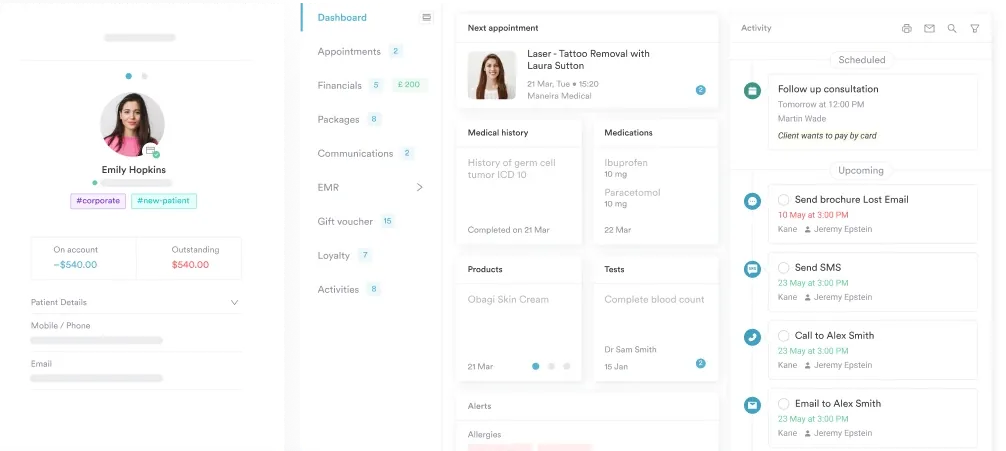
Audit your 99195 procedure note template against the six documentation elements above before the next session. Flag any missing field immediately. Post-payment auditors check volume removed and pre-procedure labs first, and unstructured notes often leave both out.
Billing CPT 99195 is straightforward once the documentation is complete. Follow these six steps to get the claim paid on the first pass.
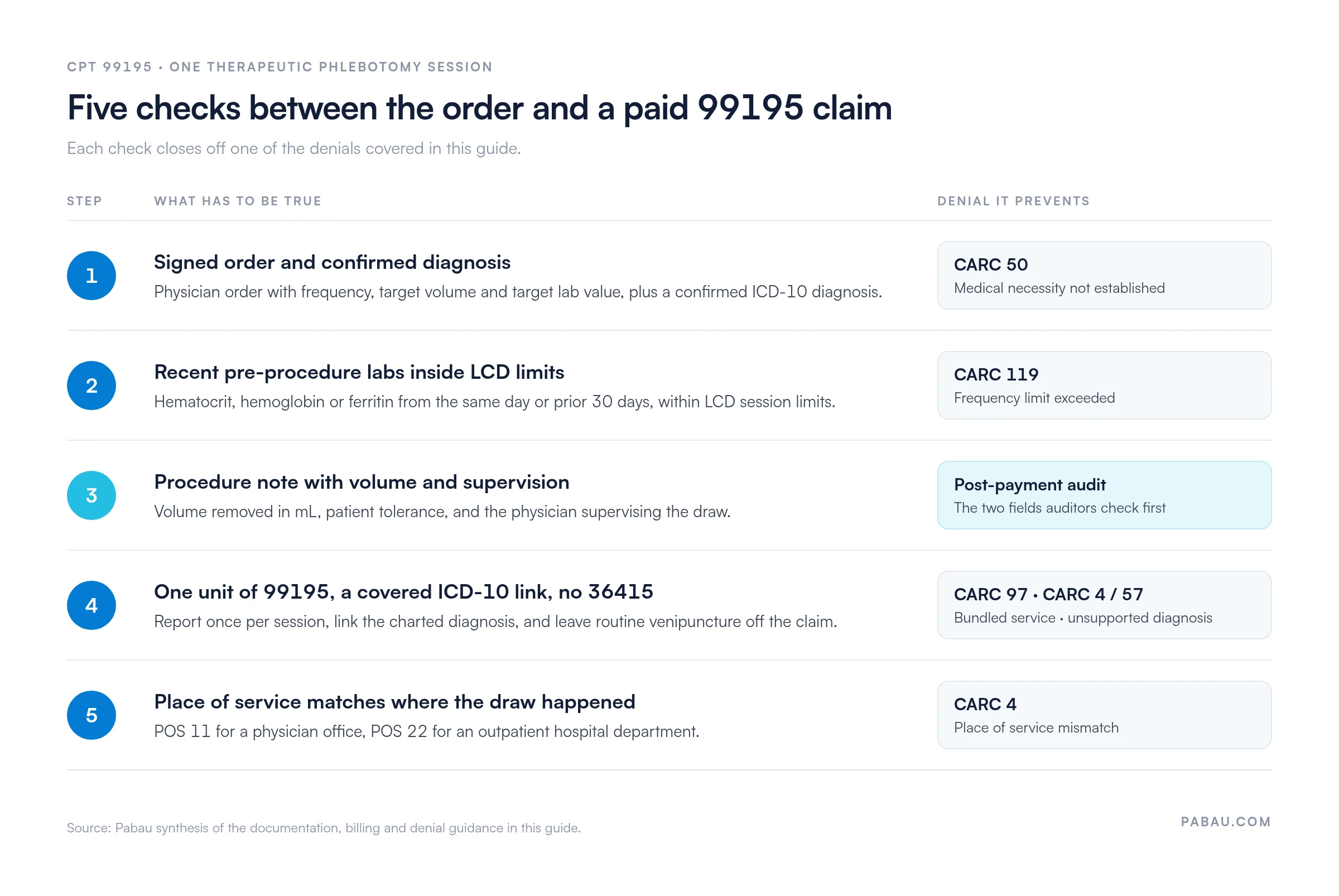
A clean 99195 claim needs all six documentation fields, the correct POS, one unit, and an appropriate ICD-10 link. Missing any one of them is enough to trigger a denial, and the chart below maps each check to the denial code it heads off.
Medicare covers CPT code 99195 when medical necessity is established through an appropriate ICD-10 link and clinical documentation. Coverage isn’t automatic, though. Each Medicare Administrative Contractor (MAC) issues its own Local Coverage Determination (LCD), which sets three conditions:
Look up the MAC LCD for your jurisdiction before building a phlebotomy billing workflow.
Limit-tracking claims software flags a session that would breach a payer’s frequency cap before the claim goes out.
Medicaid coverage varies by state. Some state programs cover 99195 with documentation rules similar to Medicare’s. Others require prior authorization or don’t cover therapeutic phlebotomy as a standalone procedure, so verify coverage with the state program before scheduling.
Commercial payers follow their own policies. Some use the MAC LCD as a reference. Others impose tighter frequency limits, or require prior authorization for every therapeutic phlebotomy session regardless of diagnosis.
Medicare doesn’t typically require prior authorization for CPT 99195. An Advance Beneficiary Notice (ABN) is still needed when a session may fall outside coverage, for example because of frequency limits or missing documentation. Commercial payers vary more. Some require authorization for every session, others only for the induction phase, and a few waive it for hemochromatosis confirmed by genetic testing.
Run an eligibility check before booking each phlebotomy session, so authorization requirements surface before the appointment rather than after a denial. Build that step into the scheduling workflow for every therapeutic phlebotomy patient.
Therapeutic phlebotomy denials follow a predictable pattern, and five reasons come up again and again on 99195 claims. Each has a fix for the denied claim and a process change that stops it recurring. Track them by denial reason code to see which billing step is losing the most revenue.
Our guide to denial codes defines every CARC and RARC code. Tracking 99195 denials by CARC code shows whether the problem sits in documentation (CARC 50) or in the billing process (CARC 97 or 119).
Medicare reimbursement for 99195 is modest and varies by place of service and geographic adjustment. The CMS Physician Fee Schedule lookup tool shows a higher non-facility rate (POS 11, physician office) than facility rate (POS 22, outpatient hospital). In the facility setting, Medicare pays the hospital separately for overhead.
Indicative 2026 Medicare fee schedule ranges for 99195 run about $25-$45 in the non-facility setting and $15-$30 in the facility setting, depending on location. These figures change with each annual fee schedule update. Verify current rates in the CMS lookup before projecting revenue. Then check the electronic remittance advice on paid claims to confirm what your MAC is paying.
The relative value unit (RVU) structure for 99195 reflects a low-complexity procedure, with minimal work RVUs, modest practice expense RVUs, and a standard malpractice RVU. The total RVU is multiplied by the annual conversion factor and the geographic practice cost index (GPCI) to reach the allowable.
For practices with high phlebotomy volume, the combined revenue adds up even at modest per-session rates. Use the FastRVU 2026 lookup tool to find current work, practice expense, and malpractice RVU values for 99195 by location.
No. CPT 99195 is the only standard code for therapeutic phlebotomy in most payer contracts, and no HCPCS Level II equivalent exists. Coders sometimes look for a crosswalk because some infusion and injectable drug procedures carry both a CPT and a HCPCS code.
Therapeutic phlebotomy doesn’t follow that pattern. It’s a physician-performed procedure, not a supply or drug administration service. The CMS HCPCS Level II system has no parallel code for blood removal therapy.
If a payer asks for a HCPCS code for therapeutic phlebotomy, contact them directly to confirm their billing requirements. A few Medicaid managed care plans run custom billing edits, but those are plan-specific exceptions rather than a standard crosswalk.
Check your MAC’s LCD for CPT 99195 at least once per year. CMS updates LCDs annually and frequency limits or covered diagnoses can change without direct notification to practices. Catching a policy change before it hits your claims is the cheapest way to prevent 99195 denials.
Therapeutic phlebotomy runs on a recurring schedule, so the same documentation has to be captured at every session. Split the order, labs and claim across three systems, and the volume removed or the latest ferritin result is easy to lose.
Pabau keeps those pieces in one patient record. Client records and digital forms capture the order, pre-procedure labs, volume removed and supervising physician in a structured procedure note. Claims then go out through the Claim.MD integration, which checks CPT and ICD-10 codes against payer edits before transmission.
The result is a 99195 claim that carries one unit, the right place of service and a linked diagnosis on the first pass. Your billing team spends less time appealing CARC 50 and 97 denials, and more time booking each patient’s next session.

Pabau’s integrated claims management tools help practices capture documentation, track authorization requirements, and submit clean CPT 99195 claims through Claim.MD’s US clearinghouse network.

At $25-$45 a session in the office setting, a single appeal can cost most of what a 99195 claim was worth. Therapeutic phlebotomy pays through volume, so the program only earns its keep when claims go through on the first pass.
That makes the fix a workflow job. Build the order, labs and volume removed into the procedure note template, and check your MAC’s LCD before the induction schedule starts. Then report one unit, leave 36415 off, and match the POS to where the draw happened.
Book a demo to see how Pabau captures 99195 documentation at the point of care and sends each claim out clean.

Want to reduce claim denials across your practice? Denial management in healthcare covers the workflows and tracking systems that cut rejection rates for practices of all sizes.
Need a clearinghouse that works with Pabau? Claim.MD clearinghouse overview explains how the integration validates CPT and ICD-10 codes before transmission and posts ERAs automatically.
Looking to understand how the full billing cycle connects? What is revenue cycle management walks through every stage from scheduling to payment posting.
Billing a diagnostic blood draw instead? CPT code 36415 covers routine venipuncture, including when it can be reported and when it bundles into another service.
CPT code 99195 covers therapeutic phlebotomy performed under physician supervision. It treats a documented condition such as hemochromatosis, polycythemia vera, or porphyria cutanea tarda. It does not cover routine venipuncture for specimen collection, which is billed under CPT 36415.
Yes, Medicare covers CPT 99195 when medical necessity is established through an appropriate ICD-10 diagnosis and clinical documentation meeting the applicable MAC LCD criteria. Frequency limits and required lab value thresholds vary by MAC jurisdiction, so review the specific LCD for your region.
No. NCCI edits bundle CPT 36415 (routine venipuncture) into CPT 99195 for the same session. Submitting both codes will result in denial of 36415 with CARC reason code 97. Remove 36415 from any claim that also includes 99195.
The primary ICD-10-CM codes paired with 99195 are E83.110 (hereditary hemochromatosis), D45 (polycythemia vera), D75.1 (secondary polycythemia), E80.1 (porphyria cutanea tarda), and E83.119 (hemochromatosis, unspecified). The diagnosis code must match what is documented in the clinical record and must be accepted under the payer’s coverage policy.
During the induction phase, hemochromatosis phlebotomy may be performed weekly until ferritin levels normalize. Each session can be billed as 99195 with supporting lab values. In the maintenance phase, frequency typically drops to every 2-4 months, subject to MAC LCD frequency limits. Always document current lab values at each session to support continued medical necessity.
Medicare reimbursement for 99195 runs about $25-$45 in a non-facility (office) setting and $15-$30 in a facility (outpatient hospital) setting. The exact rate depends on location and the annual conversion factor. Rates change each January; verify current allowables using the CMS Physician Fee Schedule lookup tool for your MAC region.