CCSD code H4430: Examination of rectum under anaesthetic
CCSD code H4430 pays for the examination alone CCSD code H4430 is the UK private...

Last Updated: Oct 20, 2026
H0037 is the HCPCS Level II code for community psychiatric supportive treatment program, per diem.
HCPCS code H0037 pays for one full day of community psychiatric supportive treatment, or CPST, for a person living with serious mental illness.
The billing unit is the day, not the visit. Whether the team makes one contact or four, the claim still carries a single per-diem unit.
That rule sits behind a large share of CPST denials, alongside the modifier that names the supervising clinician. Medicaid is the payer that matters here, and every state writes its own conditions on top of the code.
Here is how H0037 is defined, who can bill it, and what a clean claim needs before it leaves your system.
Let Pabau's smart automation suggest the right codes, reduce claim denials, and keep your practice compliant—effortlessly.
Automate repetitive tasks and focus on what matters most—your patients.
Reduce coding errors and ensure compliance with the latest regulations.
Clean claims, fewer denials, and faster reimbursements.
Powerful insights and reporting to help your practice thrive.
HIPAA compliant SOC 2 certified GDPR-compliant Trusted by 4,000+ clinics worldwide

HCPCS code H0037 covers one day of community psychiatric supportive treatment, billed as a single per-diem unit under Medicaid.
One calendar day equals one unit, no matter how many staff contacts happened that day.
Modifier AH marks psychologist supervision, AJ marks a clinical social worker, and KX attests that medical necessity documentation is on file.
Prior authorization rules and per-diem rates are set state by state, so never assume one universal rule.
Practice management software like Pabau pre-fills the claim from the client record and checks required fields before submission.
H0037 is a HCPCS Level II code. The Centers for Medicare & Medicaid Services (CMS) maintains that code set for services CPT does not describe well.
The H series covers mental health and substance use programs, and H0037 is the per-diem entry for community psychiatric support.
One unit means one calendar day on which the program delivered the minimum contact your state Medicaid policy requires.
Per diem never translates to a set number of hours. Two states can read the same code very differently, so the state provider manual is the document that settles any argument.
H0037 belongs to organizations, not to solo practitioners in private practice. The program has to be enrolled with the state Medicaid agency and approved to deliver CPST.
Provider-type rules differ from state to state, so confirm yours before the first claim goes out.
Commercial coverage is patchy. The code was written for Medicaid, and plenty of commercial plans leave it out of the benefit altogether.
Check the individual contract before you enroll a commercially insured client, because Medicaid approval tells you nothing about how a commercial payer will respond.
A day becomes billable once a qualified team member has contact with the client and writes it up in the record. CPST is team-based support for people living with serious mental illness (SMI), not a single therapy hour.
Most state policies want that contact to be face-to-face or telephonic, and they want it dated.
Activity inside a program day usually includes:
Take a worked example. On Tuesday a case manager visits a client at home to check medication adherence, then calls the client’s housing worker that afternoon. Both events are written up with times, staff credentials, and clinical observations.
Tuesday is one billable day carrying one unit. Wednesday brings no contact at all, so nothing is billable unless your state allows indirect-only days.
Crisis planning is part of the service rather than a separate event. The same crisis intervention strategies your clinicians use in the moment belong in the care plan. A reviewer should be able to see that the program anticipated the risk.
Modifiers are where most H0037 claims fall over. The modifier tells the payer which credential stood behind the service, and whether medical necessity documentation sits in the record.
Send the wrong one, or leave a required one off, and most Medicaid payers reject the claim outright.
KX carries an obligation the other two do not. Appending it says current medical necessity documentation exists in the record today, for this client.
Auditors pull KX claims first and ask to see the treatment plan behind them. If that plan expired three months ago, the attestation was false when you sent it.
Everything a payer asks for should already be in the record on the date of service. Documentation assembled after a denial rarely survives a post-payment review, and reviewers can tell the difference.
A psychiatric evaluation template gives the intake assessment a consistent shape. A repeatable symptom measure such as the PCL-5 then gives you something to re-score at each review, which is what turns “still symptomatic” into evidence.
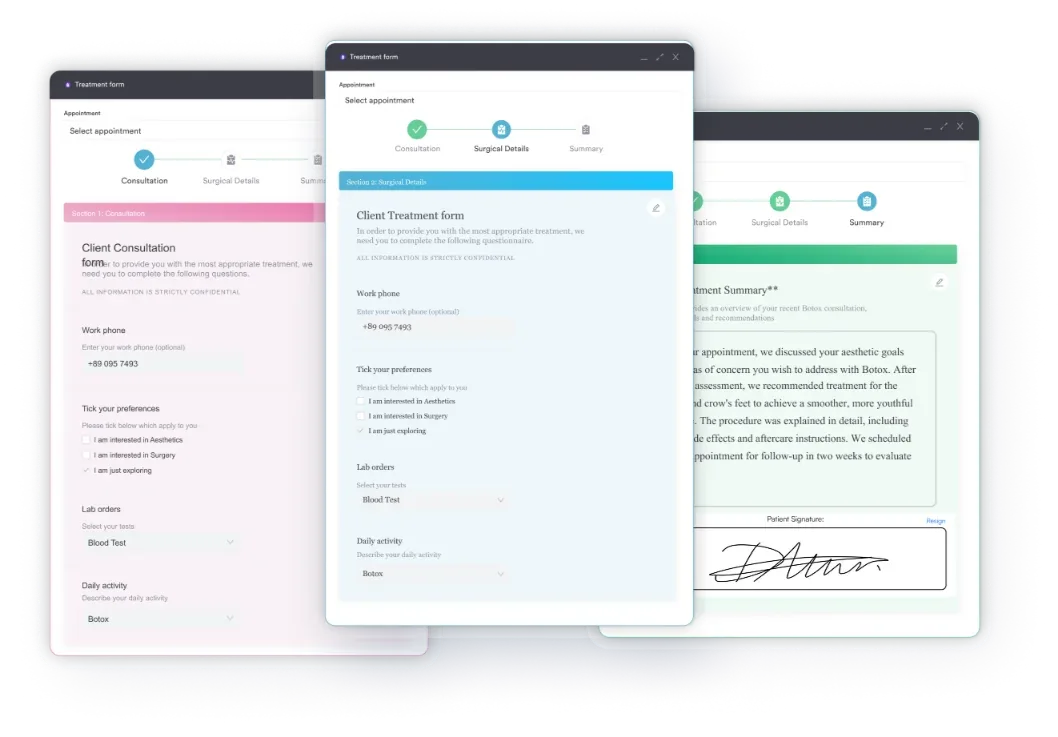
Documentation behind an H0037 claim usually includes:
Care coordination needs its own paperwork. A signed release of information lets the team speak to a housing worker or a family physician without a HIPAA problem.
Keeping a shared SOAP note structure also means daily notes read the same whether a nurse or a case manager wrote them.
Storage matters as much as content. Most centers now hold this in a mental health EMR rather than a paper chart, and digital intake forms capture consent as structured data. Pulling 12 months of notes for an audit then takes an afternoon instead of a fortnight.
The claim itself is short. What makes it clean is the sequence around it, and every step below has a failure point that shows up later as a denial.
Before you submit, run the six checks below. They take a minute per claim and catch nearly everything a Medicaid payer will bounce.
H0037 is not a Medicare code and does not appear on the CMS Physician Fee Schedule. Payment comes from state Medicaid programs, Medicaid managed care organizations (MCOs), and the occasional commercial behavioral health carve-out.
Because rates move by state and by contract, a figure quoted in a national round-up is worth very little to your billing team.
Use the AAPC HCPCS lookup to confirm the code is still active. For dollar figures, go straight to your state fee schedule or the managed care contracts your organization already holds.
Pull your H0037 rate from every active MCO contract at the start of the calendar year. Managed care rates often change on a different cycle from the state fee schedule. Billing the wrong figure in either direction creates a reconciliation headache at audit.
There is no single answer here, which is exactly why teams get caught out. Fee-for-service Medicaid may allow prospective billing with a retrospective review, while most managed care plans want an approval on file before the first billable day.
Tracking is where programs slip. An expired approval looks exactly like a valid one until the denial lands, so keep expiry dates somewhere the schedulers can see them.
The prior authorization process runs on the same clock for every payer, and prior authorization software holds the renewal date better than a shared spreadsheet.
One warning worth repeating. An approval granted for another H-code does not carry over to H0037. Payers authorize each service definition separately.
Payers read the diagnosis as the medical necessity signal. An H0037 claim attached to a mild anxiety code invites a review, because nothing in that diagnosis explains a full day of community psychiatric support.
Use the most specific code the record supports. Unspecified codes are fine when the documentation genuinely stops there.
A service line where nearly every claim carries an unspecified code will draw attention, though, and SMI records usually hold enough detail to do better.
All three codes describe community behavioral health work, and the same programs bill all three. The unit is what separates them.
H0036 is a face-to-face code billed in 15-minute increments, and H0037 covers the whole day. H0038 pays for peer support delivered by someone with lived experience.
H0038 causes the most trouble of the three. Peer specialist time is not clinician-supervised CPST, so neither code can stand in for the other.
Programs that also run short-term residential services hit the same question with its own per-diem definition, which has its own per-diem definition and its own contact rules.
Denials cluster. Work through a month of rejected CPST claims and the same handful of causes account for most of them.
That makes them straightforward to design out of the workflow. Good denial management starts before submission rather than after it.
Reconcile a month of H0037 claims against your active MCO contracts every quarter. Check the modifier on each claim against what that contract asks for. Mismatches that survive submission tend to resurface as small overpayments at audit rather than as clean denials.
Most CPST billing teams work across three systems at once: the clinical record, a spreadsheet of authorizations, and a clearinghouse portal. Re-keying between them is where the authorization number goes missing and the diagnosis drifts away from the note.
Practice management software like Pabau keeps those pieces together. Pabau’s claims management software builds the claim from the client record. The code attached to the service lands on the charge line, and the diagnosis comes from the recorded problem list.
Required fields are checked before the send button unlocks. That catches the blank authorization number that would otherwise come back as a denial two weeks later.
Submission for US payers runs through the Claim.MD integration, with eligibility checks, claim status tracking, and remittance posting in the same place. ICD-10 and HCPCS lookup libraries sit beside the claim for reference, while the coding decision stays with your team.
For a community program, that adds up to fewer hours in payer portals and fewer claims failing on something a form field could have caught. The same record keeps clinical notes, consents, and authorizations together. Good psychiatry EMR software has to do that before any billing feature is worth having. Common claim denial codes repeat by specialty, so the pattern is worth reading before reworking.

Pabau’s claims management software pre-fills each claim from the client record and checks that required fields are complete. Claims reach US payers through Claim.MD, so your billers spend less time in portals.

H0037 itself is simple. One day, one unit, one modifier that matches the credential of the clinician who supervised the work. Everything difficult about this code sits in the state and plan rules stacked on top of it.
So build the checks where the work already happens. When the authorization date, the supervision note, and the day’s contact all live in the client record, the claim mostly writes itself. Your billers then spend the week on genuine exceptions instead of copying numbers between screens.
Book a demo to see how Pabau builds behavioral health claims from the client record and tracks each one through to payment.

Coding a dehydration diagnosis instead? ICD-10 code E86.0 covers dehydration, most often paired with CPT codes for IV hydration or an office visit.
Documenting low potassium levels? ICD-10 code E87.6 covers hypokalemia, abnormally low serum potassium levels below the normal reference range.
Coding low blood albumin levels? ICD-10 code E88.09 covers hypoalbuminemia, abnormally low serum albumin levels under the plasma-protein metabolism category.
Documenting dementia from another disease? ICD-10 code F02.80 covers dementia that develops from another disease, without complicating behavioral or mood symptoms.
Billing community nursing alongside CPST? HCPCS code T1001 covers nursing assessment and evaluation, another line community programs bill regularly.
No. Assertive community treatment has its own codes: H0039 for face-to-face contact in 15-minute units, and H0040 for the per-diem program. ACT teams carry smaller caseloads and tighter staffing rules, so payers track the two services separately.
No. The per-diem unit belongs to the client, not to the worker. If a case manager and a nurse both see the client on Tuesday, the program still bills one unit. A second line for that date usually denies as a duplicate.
That depends on your state Medicaid policy. Many states accept telephonic and telehealth contact for CPST, sometimes with a modifier or a different place of service. Record the modality in the note either way, because reviewers ask how the contact happened.
The place of service reflects where the contact happened, not where your office sits. Community visits are usually reported as home or as another non-facility setting. Your payer’s companion guide lists the values it accepts, and MCOs sometimes differ from fee-for-service.
Medicaid timely filing windows vary by state and by contract, commonly landing between 90 and 365 days from the date of service. Managed care plans often set a shorter window than the state agency, so check each contract rather than applying one rule.