CCSD code H4430: Examination of rectum under anaesthetic
CCSD code H4430 pays for the examination alone CCSD code H4430 is the UK private...

Last Updated: Oct 20, 2026
J7626 is the HCPCS Level II code for budesonide, inhalation solution, fda-approved final product, non-compounded, administered through dme, unit dose form, up to 0.5 mg.
Bill one unit of service per vial of up to 0.5 mg. The per 0.25 mg math that circulates in nebulizer billing belongs to the concentrated codes, not to this one.
Let Pabau's smart automation suggest the right codes, reduce claim denials, and keep your practice compliant—effortlessly.
Automate repetitive tasks and focus on what matters most—your patients.
Reduce coding errors and ensure compliance with the latest regulations.
Clean claims, fewer denials, and faster reimbursements.
Powerful insights and reporting to help your practice thrive.
HIPAA compliant SOC 2 certified GDPR-compliant Trusted by 4,000+ clinics worldwide

HCPCS code J7626 covers budesonide inhalation solution, FDA-approved and non-compounded, given through a DME nebulizer in unit dose form up to 0.5 mg.
One unit of service equals one unit dose vial of up to 0.5 mg, so a 0.5 mg dose bills as 1 unit, not 2.
Every J7626 line needs a KO modifier, because budesonide is a single drug in a unit dose container.
Coverage follows the applicable MAC’s local coverage determination, and COPD and asthma are the primary supported diagnoses.
A current written order, a covered diagnosis, the dispensed NDC, and signed proof of delivery must be on file before you bill.
HCPCS code J7626 is the Healthcare Common Procedure Coding System Level II code for budesonide inhalation solution in unit dose form, up to 0.5 mg.
The descriptor adds two more qualifiers, FDA-approved final product and non-compounded, and it specifies administration through durable medical equipment.
It sits in the J-code section of HCPCS Level II, which covers drugs and biologicals that patients do not ordinarily self-administer.
That “FDA-approved final product, non-compounded” phrase is the qualifier that decides the code. It separates J7626 from J7627, which covers the compounded version of the same drug.
Submitting J7627 for an FDA-approved product, or the reverse, is one of the more common denial triggers on nebulizer drug claims.
Medicare Part B covers J7626 once the claim clears both the clinical and the administrative requirements below.
Coverage runs through Medicare Administrative Contractors, so a local coverage determination can add criteria on top of national policy. Check the LCD that applies to the patient’s region before you dispense.
Confirm the patient’s Medicare eligibility and your own DMEPOS enrollment before the first fill as well. Both are far cheaper to check up front than to unwind after a denial.
Every J7626 line needs a linked ICD-10 diagnosis that supports medical necessity, and the covered list comes from the applicable MAC’s LCD.
The table below carries the codes cited most often across national and regional policy. Verify your MAC’s current list before you rely on it, because coverage varies by jurisdiction.
Pick the most specific code the record supports. Using J44.9 when the chart documents J44.1 is technically accurate, but it invites scrutiny under audit.
The covered list that applies to J7626 sits in Group 8 of the CMS nebulizers policy article (A52466). That group pairs each nebulizer drug code with the diagnoses that support it.
One unit of service equals one unit dose vial of up to 0.5 mg of budesonide. Bill one unit for each vial dispensed, whether that vial holds 0.25 mg or 0.5 mg. CMS states the rule plainly in the nebulizers policy article (A52466).
A standard 0.5 mg dose is therefore 1 unit. Getting it wrong in either direction creates compliance exposure, whether you undercount or overcount.
The per 0.25 mg figure belongs to a different code family. J7633 and J7634 describe concentrated budesonide and bill per 0.25 mg of drug. Because J7626 is the unit dose form, the vial count drives the unit count instead.
J7633 also has no FDA-approved product behind it, which makes it invalid for claim submission. Side by side, the two rules diverge fast.
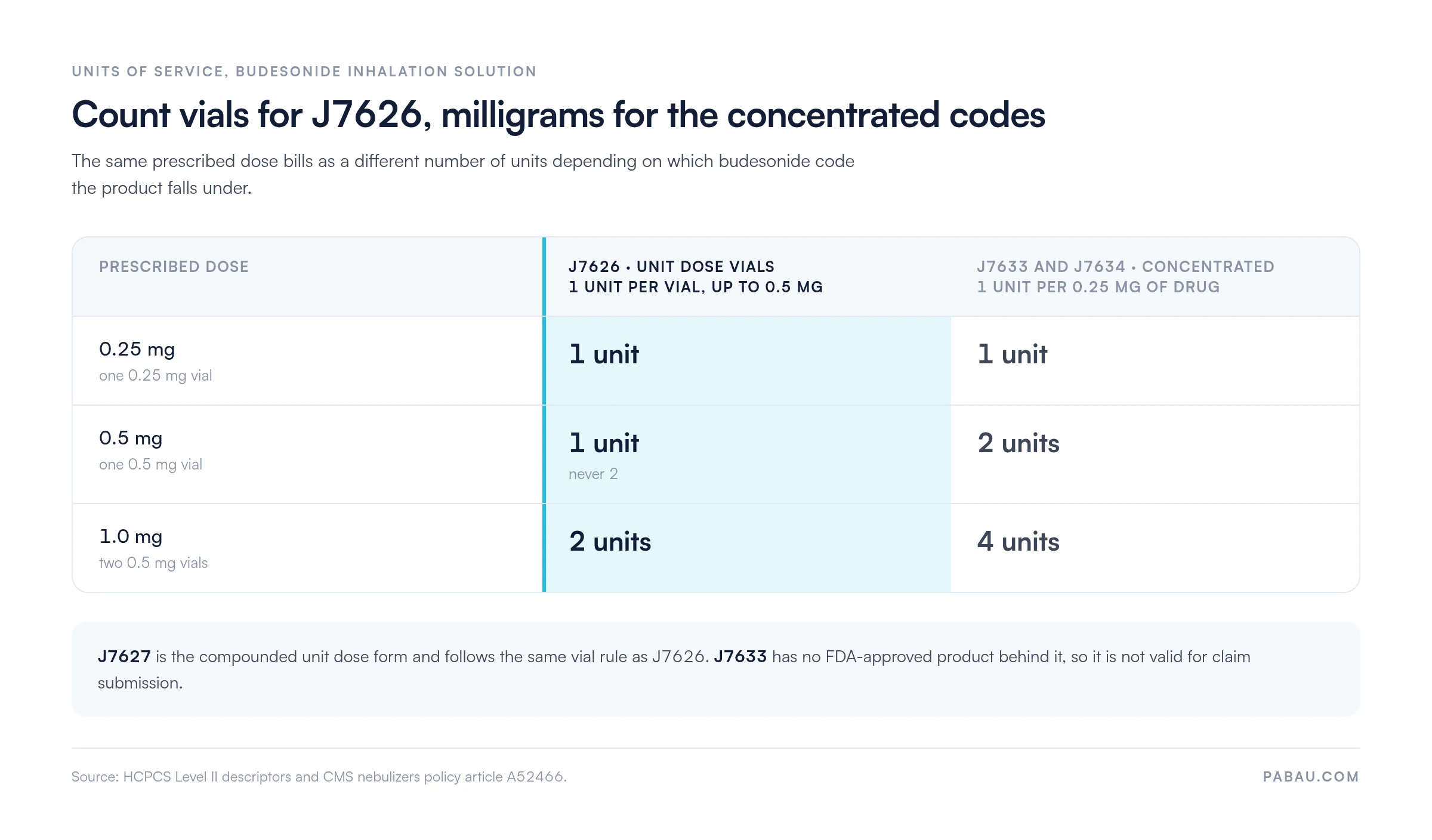
For multiple daily doses, multiply the per-dose units by the number of administrations in the billing period. A patient on 0.5 mg twice daily for 30 days comes to 60 units, or 1 unit × 2 doses × 30 days. Record the prescribed frequency in the written order, because an auditor will validate the claim against it.
Count vials, not milligrams. A 0.5 mg nebulization from a single respule is 1 unit of service, never 2. A 1 mg respule counts as 2 units, because the descriptor caps one unit at 0.5 mg. Drug left in a vial is already paid for inside that unit, so it is never billed on a second line.
J7626 is a unit dose form code, so CMS requires a KO, KP, or KQ modifier on every line. A line submitted without one of the three is denied as an invalid code. For budesonide, the answer is almost always KO.
Modifiers are validated at the claim line, not at the claim level. Build KO into your J7626 charge template so it cannot drop off a line on a busy dispensing day.
J7626 is reimbursed under the CMS DMEPOS fee schedule. It does not use the physician fee schedule, and it does not use the average sales price method that applies to Part B physician-administered drugs.
Rates vary by MAC jurisdiction and update annually, so pull the current figures before you bill.
Hardcoded dollar figures go stale quickly, because rates change every January and differ by region. Download the current DMEPOS file at the start of each calendar year, and check the HCPCS Level II descriptors for edits at the same time. Put both on the revenue cycle calendar so nobody bills against last year’s rate.
Pharmacy dispensers and DME suppliers usually report the National Drug Code alongside the HCPCS code.
The NDC identifies the manufacturer, the product, and the package size. For J7626, the relevant NDCs belong to FDA-approved budesonide inhalation solution products such as Pulmicort Respules.
Those numbers are manufacturer-specific and change with new approvals or repackaging. The authoritative source for the current NDC-to-J7626 crosswalk is the CMS Pricing, Data Analysis and Coding contractor. Check any NDC against the PDAC’s current product classification before you submit.
Report the NDC in the standard 11-digit (5-4-2) format, and include the unit qualifier such as UN for units or ML for milliliters.
Missing or misformatted NDCs are a common rejection reason on DME drug claims. Capture the number at the point of dispensing rather than reconstructing it at billing.
Both codes cover budesonide inhalation solution given through a DME nebulizer. The distinction is FDA-approved against compounded, and it changes how the claim is treated.
CMS cites the wrong-code error among the top findings in nebulizer drug audits.
The practical rule is short. If the patient receives Pulmicort Respules or another FDA-approved budesonide product from a licensed manufacturer, use J7626.
Where a compounding pharmacy prepared the solution to a custom strength or formulation, use J7627. Verify the product’s FDA approval status before you assign either one.
CMS names incomplete documentation as the leading cause of improper payment on nebulizer drug claims. For J7626, the five elements below have to exist before the claim goes out.
Each one has a natural point in the workflow where it gets captured.
That paperwork also protects the practice after payment. An audit trail running from prescription to signed delivery is the most reliable defense against a retrospective recovery demand.
Six steps sit between the prescription and the remittance, and each one leaves behind a document the DME MAC can ask for later. Walking the sequence once makes it clear where a claim tends to stall.
Steps two and three deserve the closest attention. The NDC and the delivery signature are captured by whoever dispenses, not by whoever bills, so they travel across a handoff.
Where the dispensing log and the billing system are separate, that handoff is worth auditing.
CMS’s MLN materials on nebulizer compliance describe recurring patterns in J7626 denials. Each one below maps to a fix you can build into the workflow instead of catching by eye.
When a denial does land, read the remittance code before you rework the claim. The denial codes reference explains what each one means, which beats guessing at the cause and resubmitting blind.
Seven quick checks, run in order, catch most of the errors above before the claim leaves the building.
A supplier billing budesonide works from three records that usually live in different places. The written order sits in the chart.
Vial counts and NDCs live in the dispensing log, while the delivery signature stays with the courier. Pulling all three together at claim time is where copy errors creep in.
Practice management software like Pabau closes that loop by holding the record and the claim in one system. Pabau’s claims software for suppliers pre-fills the claim form from the patient record.
Codes already attached to the service land on the charge line without retyping. ICD-10 and HCPCS lookup libraries sit behind a search icon on the same screen.
Before a claim can be sent, the system checks that the required claim fields are complete, then submits it electronically through the clearinghouse.
On the US pipeline that also covers eligibility checks, claim status tracking, and ERA remittance posting. The result is fewer trips back to the chart, and fewer claims returned over a blank field.

Pabau pre-fills the claim from the patient record, keeps the written order and delivery proof beside it, and checks the required fields before submission. See how that fits a DME billing workflow.

J7626 rewards suppliers who treat the vial as the unit and keep the paperwork current. Clinical judgment about budesonide therapy is rarely what stalls the claim. An expired order, an unsigned delivery, or a unit count converted from milligrams is what a DME MAC sends back.
So fix it at order entry rather than in the appeals queue. A charge template that carries KO and asks for a vial count takes minutes to build. Capturing the NDC and the delivery signature in the dispensing record costs little more. Together, those two habits remove the paperwork failures behind most rework.
Book a demo to see how Pabau attaches the order, the NDC, and the delivery proof to a nebulizer drug claim.

Billing the nebulizer as well as the drug? HCPCS code E0570 covers the compressor nebulizer that runs the budesonide, including its own coverage criteria.
Dispensing other unit dose inhalation drugs? HCPCS code J7613 walks through albuterol unit dose billing, where the same KO, KP and KQ rules apply.
Struggling with post-payment audit recovery? Denial management in healthcare explains systematic approaches to identifying root causes and reducing repeat denials.
Want to understand clean claim submission standards? Submitting a clean claim outlines the fields and documentation that prevent front-end rejections.
Need a framework for reducing claim rejections across your practice? Medical billing fundamentals walks through the end-to-end claim lifecycle and where most practices lose revenue.
Whoever dispenses the drug bills it, and that supplier has to be enrolled with Medicare as a DMEPOS supplier. The claim goes to the DME MAC for the beneficiary’s region, not to the local Part B MAC. A practice that hands out budesonide respules needs its own DMEPOS enrollment first.
Yes. Medicare bars suppliers from shipping DMEPOS refills automatically. Contact the patient no sooner than 14 days before the shipping date. Confirm the remaining supply and the continued need. Deliver no sooner than 10 days before the current supply runs out. Log the date, the item, and the patient’s response.
File a redetermination with the DME MAC within 120 days of the remittance advice. Attach the written order showing dose and frequency, the dispensing record listing vial strength and count, and the proof of delivery. Set out the vial math in the cover letter so the reviewer can follow it.
Yes. The drug and the equipment are separate line items with separate codes. E0570 covers the compressor nebulizer, and J7626 covers the budesonide that runs through it. Each line carries its own units and modifiers.
Medicare Advantage plans must cover at least what Original Medicare covers, so budesonide stays a covered benefit. The rules around it can still differ. Many plans add prior authorization, a preferred supplier network, or their own quantity limits, so check the plan’s DME policy before dispensing.