

CCSD code G5100: Bypass of duodenum billing guide
CCSD code G5100 bills a bypass that leaves the duodenum in place CCSD code G5100...

Last Updated: Oct 16, 2026
J7640 is the HCPCS Level II code for formoterol, inhalation solution, compounded product, administered through dme, unit dose form, 12 micrograms.
That difference decides the whole claim. Neighboring compounded codes bill per milligram, so a biller who carries the habit across submits 1 unit where 100 are due. The rest of the line is unforgiving too.
The modifier has to match how the drug was dispensed, and proof of delivery has to be signed before the claim goes out. Unit math is where J7640 claims fail most often, so that is where this starts.
Let Pabau's smart automation suggest the right codes, reduce claim denials, and keep your practice compliant—effortlessly.
Automate repetitive tasks and focus on what matters most—your patients.
Reduce coding errors and ensure compliance with the latest regulations.
Clean claims, fewer denials, and faster reimbursements.
Powerful insights and reporting to help your practice thrive.
HIPAA compliant SOC 2 certified GDPR-compliant Trusted by 4,000+ clinics worldwide

One unit of HCPCS code J7640 is a single 12-microgram unit dose of compounded formoterol, not one milligram of drug.
J7640 is covered under Medicare Part B when the drug is administered through a covered DME nebulizer with documented medical necessity.
Missing modifiers, milligram-based unit counts, and absent physician orders are the most common reasons J7640 claims are denied.
Practice management software like Pabau helps DME suppliers pre-fill claim lines from the record and keep supporting documents with the client file.
HCPCS code J7640 is a Level II J-code maintained by the Centers for Medicare and Medicaid Services (CMS). It covers compounded formoterol inhalation solution given through a covered DME nebulizer.
The code sits in the J7601 to J7686 inhalation range, where most compounded entries are billed per milligram. J7640 is measured by the unit dose instead, which is why its quantities look so different on a claim.
Formoterol is a long-acting beta-2 agonist (LABA) bronchodilator used in the ongoing management of chronic obstructive pulmonary disease (COPD) and asthma.
Unlike short-acting agents, it relaxes bronchial smooth muscle for up to 12 hours. That makes it suitable for twice-daily nebulizer therapy in patients who cannot coordinate a metered-dose inhaler.
J7640 covers the compounded form only. Compounded formoterol is mixed by a 503A or 503B pharmacy to specifications no FDA-approved finished product offers. Because compounded products are not FDA-approved finished drugs, they usually carry no standard National Drug Code (NDC).
Check with your compounding pharmacy whether an NDC applies before you submit a claim that requires NDC reporting.
The two formoterol codes differ in more than compounded status. J7606 covers the FDA-approved finished product, such as Perforomist, and bills in 20-microgram unit doses. J7640 covers the compounded preparation and bills in 12-microgram unit doses.
Pick the right code with the wrong unit basis and the claim is still wrong.
A supplier that stocks both products needs two catalog entries, each with its own unit conversion. Sharing one entry between them is how a 20-microgram conversion ends up on a J7640 line.
Medicare Part B covers J7640 when all five conditions below are met. CMS sets them out in Nebulizer Policy Article A52466.
The equipment and the drug travel on separate claim lines, so the nebulizer bills under E0570 with documentation of its own. E0571 was retired in 2011, which means a battery-powered compressor now bills under that same code.
Claims are adjudicated by DME Medicare Administrative Contractors (DME MACs), not physician MACs. Two contractors split the four DME MAC jurisdictions between them.
Jurisdictions A and D belong to Noridian, and Jurisdictions B and C belong to CGS. Each publishes its own coverage articles for nebulizer drugs, so read the one that applies to your patient.
Check your patient’s DME MAC jurisdiction before billing J7640. Coverage criteria and documentation checklists differ between Noridian and CGS. Filing under the wrong MAC policy is a common source of avoidable denials.
Payment for J7640 comes from the Durable Medical Equipment, Prosthetics, Orthotics and Supplies (DMEPOS) fee schedule. The Physician Fee Schedule does not apply, and its look-up tool excludes DMEPOS items altogether.
Rates are published as an allowed amount per 12-microgram unit, and they vary by MAC region and payment locality. CMS updates the file every year, so pull current figures from the CMS DMEPOS fee schedule rather than from last year’s spreadsheet.
Because rates differ by region and by year, no single national figure applies to J7640. Suppliers who post 835 remittances inside their DME billing software see a short payment on the line at posting rather than at month end.
A J7640 claim asks for DME-specific fields that a standard professional claim never touches. These six steps run in the order the claim needs them:
Work from the total micrograms dispensed for the billing period, then divide by 12. Do not bill the number of treatments, and do not convert the total into milligrams first. The three dosing patterns below run through that calculation.
Run that arithmetic backwards and you can see where the money leaks. A biller who reads 1,200 mcg as 1.2 mg sends the line out as a single unit.
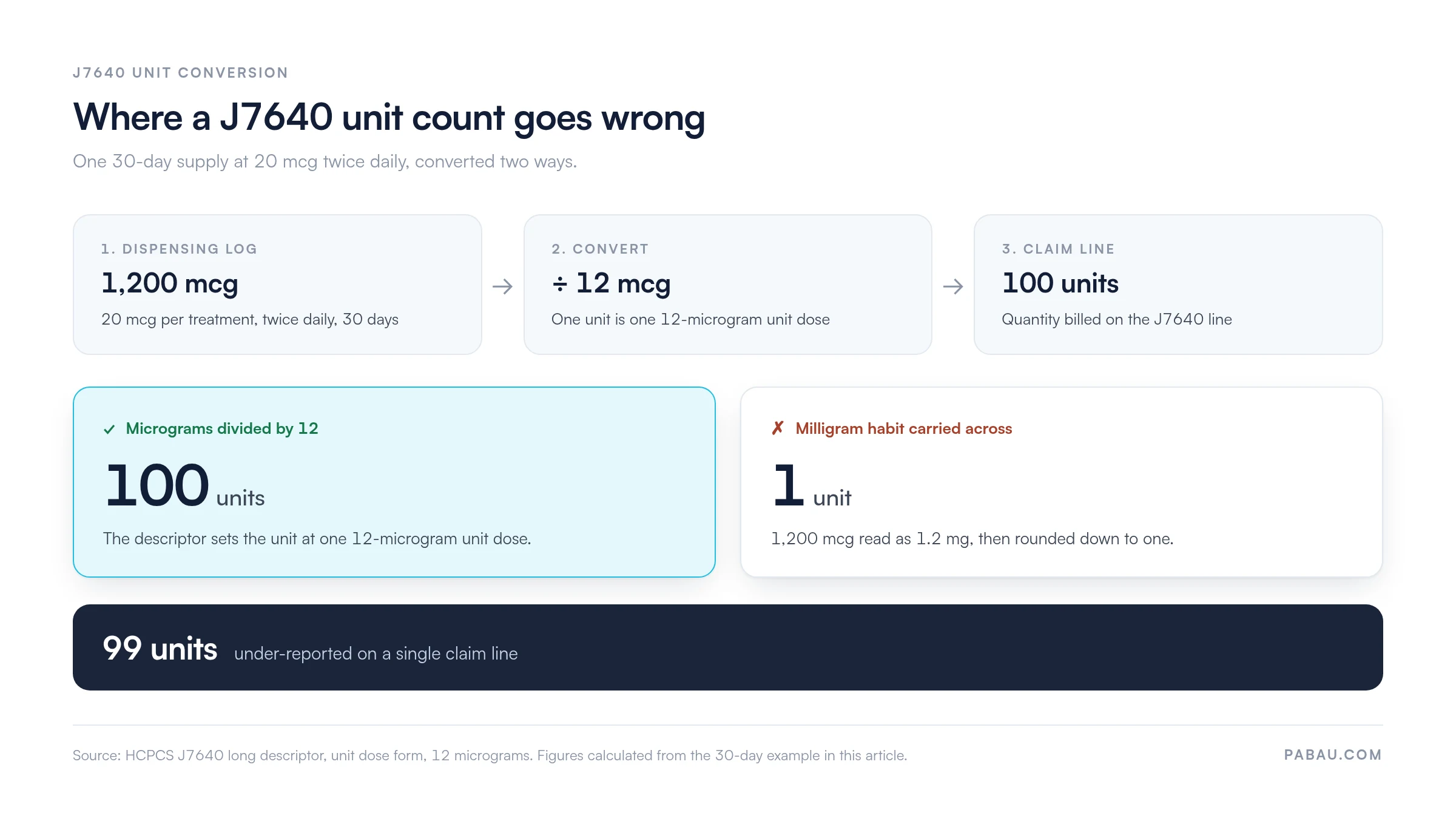
A 20-microgram unit dose is not a whole multiple of 12 micrograms, so per-vial arithmetic rarely lands on a round number. Bill from the period total rather than rounding each vial, and follow your MAC’s guidance on partial units.
Each check below maps to a denial the DME MACs issue routinely. Together they take about half a minute per line.
DME MACs require one of three modifiers on every J7640 line. The modifier identifies the dispensing scenario, so the wrong one, or none at all, usually means a denial or a suspension for review.
Requirements can change annually, so verify them against your MAC’s current billing article.
For a single-drug compounded formoterol vial, modifier KO is standard. If the formoterol is compounded with another drug such as ipratropium, one drug carries KP and the other carries KQ.
CMS policy article A52466 sets out how these modifiers interact with coverage and payment logic. Confirm with your MAC’s billing article before submitting combination products.
Compounded nebulizer drug claims draw audits more often than most DME codes, largely because compounded products sit under tighter FDA oversight. Assemble the file before the claim goes out, not after a request arrives.
Every document below belongs on file at submission:
Filed that way, an audit letter produces a folder rather than a scramble across three systems. Keep the dispensing log with the pharmacy records, because the units on the claim have to trace back to both.
Retain compounding pharmacy preparation records for at least seven years. DME MACs can conduct post-payment audits years after the claim date, and missing pharmacy lot documentation is difficult to reconstruct after the fact.
There is no published list of covered diagnoses for J7640. Policy Article A52466 groups the code with items billed under any ICD-10 code, so it sets out no fixed covered-diagnosis list for J7640. Coverage of a given diagnosis has to be verified directly with the patient’s DME MAC.
The diagnoses below are the ones that turn up most often on a J7640 claim, because they describe the conditions formoterol is prescribed for. Read them as clinical context, not as a coverage list.
Ask the DME MAC, or read its current nebulizer policy, before you rely on a diagnosis you have not billed before. A medical-necessity denial is hard to overturn once the claim has adjudicated.
Picking the wrong formoterol code is preventable. The table below shows when J7640 applies instead of the codes closest to it in the inhalation range. For the rest of the range, use the AAPC HCPCS code lookup.
These six categories account for most J7640 denials and underpayments. Preventing them before submission costs far less than appealing them afterwards.
When a line does come back, the denial codes reference explains the CARC and RARC pairs you will see.
Two of the six, the modifier and the unit count, are fixable in the minute before the claim is batched. The other four are won or lost weeks earlier, when the order and the delivery record are filed.
The dispensing log records micrograms, the claim needs 12-microgram units, and someone converts between the two on every refill. A transposed figure there becomes a denial, or an underpayment nobody notices.
Pabau, our practice management software, pre-fills the CMS-1500 from the client record instead. The HCPCS code attached to the service lands on the charge line, and ICD-10 slots are seeded from the client’s recorded problem list.
Required claim fields are checked for completeness before the send button unlocks, so an incomplete line does not leave the building.
Compounding pharmacy records and signed proof of delivery attach to the client file, so an audit request pulls a complete set. On the US Claim.MD pipeline, eligibility checks, claim-status tracking, and remittance posting run against that same record.
Your billers then spend their time on the claims that need judgment, rather than re-keying the ones that should have gone out clean.

Pabau pre-fills claim forms from the client record, checks required fields before submission, and keeps supporting documents with the patient file.

J7640 is a small line on a claim with an outsized number of ways to go wrong. The unit basis is the one to internalize. It is the only error here that pays you less without ever triggering a denial. A missing modifier bounces back and gets fixed, while a milligram unit count quietly underpays.
So build the conversion into the process rather than into one person’s habits. Reconcile the dispensing log to the claim line, keep the delivery record signed, and confirm an unfamiliar diagnosis with your MAC.
Those three habits answer most of what an auditor asks for. Book a demo to see how Pabau turns a dispensing record into a checked J7640 claim line.

Billing the nebulizer as well as the drug? HCPCS code E0570 covers the compressor line, its coverage criteria, and the documentation behind it.
Dispensing the FDA-approved arformoterol instead? HCPCS code J7605 sets out its unit dose, its modifiers, and how it differs from the compounded codes.
Compounding formoterol with a corticosteroid? HCPCS code J7627 explains how the budesonide component is billed on a line of its own.
Want the denial reason codes in one place? Denial codes in medical billing covers the CARC and RARC pairs behind most DME drug rejections.
Chasing a higher first-pass acceptance rate? Clean claim submission walks through every element a payer needs to accept a claim first time.
Part B pays for it. An inhalation drug delivered through covered DME nebulizer equipment sits inside the Part B durable medical equipment benefit. The enrolled supplier bills it, while Part D covers drugs a patient takes without that equipment.
Part B pays 80% of the allowed amount once the annual deductible is met. The beneficiary owes the remaining 20%, unless a secondary policy or Medicaid picks it up.
Contact the patient about a refill no sooner than 14 days before the current supply runs out. Deliver no sooner than 10 days before it runs out, and document the request.
Only if that pharmacy is separately enrolled and accredited as a Medicare DME supplier. Otherwise the enrolled supplier who dispenses the drug submits the claim.
It cannot. The DME benefit requires the beneficiary to be in a home. A hospital does not count as one, and neither does a Part A covered nursing facility. The facility supplies the drug during that stay.
No. Homebound status belongs to the home health benefit and has no bearing on DME drug coverage. The patient only has to be in a home setting as the DME benefit defines it.



