

CCSD code G5100: Bypass of duodenum billing guide
CCSD code G5100 bills a bypass that leaves the duodenum in place CCSD code G5100...

Last Updated: Oct 16, 2026
J7605 is the HCPCS Level II code for arformoterol, inhalation solution, fda approved final product, non-compounded, administered through dme, unit dose form, 15 micrograms.
Bill a whole month as one unit instead, and the payment comes back short by a factor of 60. From here, the page works through the code details, the units math, and the documentation a MAC expects.
The last sections cover place of service, the neighboring J-codes, and the denials that follow when a check gets skipped.
Let Pabau's smart automation suggest the right codes, reduce claim denials, and keep your practice compliant—effortlessly.
Automate repetitive tasks and focus on what matters most—your patients.
Reduce coding errors and ensure compliance with the latest regulations.
Clean claims, fewer denials, and faster reimbursements.
Powerful insights and reporting to help your practice thrive.
HIPAA compliant SOC 2 certified GDPR-compliant Trusted by 4,000+ clinics worldwide

HCPCS code J7605 covers arformoterol tartrate (Brovana) 15 mcg inhalation solution, FDA-approved and non-compounded, nebulized through DME under Medicare Part B.
Bill one unit per unit-dose vial dispensed, so a 30-day twice-daily supply is 60 units, not 1.
A signed certificate of medical necessity and a covered COPD diagnosis (J44.0, J44.1 or J44.9) are what support the claim.
A compounded arformoterol product never bills under J7605, whatever its concentration.
Practice management software like Pabau pre-fills the claim from the patient record and checks required fields before it can be sent.
J7605 covers arformoterol tartrate inhalation solution in a 15 mcg unit-dose vial, delivered through a DME nebulizer.
Brovana is the product behind the code. Compounded arformoterol sits outside J7605 entirely, whatever its concentration, and bills under a different code.
The long descriptor carries every limit that matters. It names the drug, the form, the FDA status, the delivery route, and the dose.
Arformoterol tartrate is a long-acting beta2-agonist (LABA) bronchodilator for the maintenance treatment of COPD. It is not a rescue medication for acute bronchospasm.
Each vial holds 15 mcg in 2 mL, ready to nebulize, and the usual dose is one vial twice daily.
The patient nebulizes it at home through equipment that qualifies as durable medical equipment, so the claim runs through Part B DME. That routing is what pulls in the CMN, the LCD, and the place-of-service rules further down this page.
For J7605, one unit of service equals one 15 mcg unit-dose vial. Bill the number of vials dispensed. Twice-daily dosing across 30 days is 60 vials, so the claim line carries 60 units. The CGS Medicare arformoterol calculator states the same methodology.
Walk one fill through it. A prescriber orders one vial twice daily, and the supplier ships a 30-day quantity. That is 2 vials a day, 60 vials in the box, and 60 in the units field. A 90-day fill at the same dose is 180 vials and 180 units.
Watch for three calculation errors in particular:
Medicare pays 80% of the allowed amount for J7605, and the patient owes the remaining 20% once the annual deductible is met. Allowed amounts come from the DMEPOS fee schedule, and they vary by MAC jurisdiction and locality.
Rates change every year, so check the current figure rather than one saved in a spreadsheet last winter. The DMEPOS fee schedule from CMS is the file that governs this code, not the physician fee schedule.
Every J7605 claim needs an ICD-10 code that supports medical necessity, and for arformoterol that means COPD. J44.9 is the code most claims carry.
Your MAC’s Local Coverage Determination is the list that governs, so confirm the diagnosis against the LCD in force for your jurisdiction.
A diagnosis outside the covered list denies on medical necessity, however complete the rest of the file is. Covered code lists also move with annual LCD updates, so a code that paid last year is not proof that it pays now.
Prior authorization for J7605 depends on the payer and the MAC jurisdiction, so there is no single national answer.
Medicare rules for DME drugs can change through rulemaking, and commercial plans keep their own criteria. Confirm the requirement before the vials leave the shelf, because a retroactive authorization is rarely on the table.
Where an authorization is required, these documents usually support the request:
Track the expiry date as carefully as the approval. A claim submitted a week after an authorization lapses will deny, even when the order, the diagnosis, and the units are all correct.
Medicare billing for J7605 requires a certificate of medical necessity. The CMN is the ordering physician’s formal statement that the patient meets the coverage criteria in the applicable LCD.
Missing, incomplete, and expired CMNs sit at the top of the denial list for this code.
A complete J7605 billing file holds six things:
CMNs are not one-time paperwork. They renew on the MAC’s recertification schedule. That is how a claim which paid cleanly for months suddenly starts denying, with no other change in the workflow. Keep the recertification date next to the refill date and that surprise disappears.
J7605 is billed with place of service 12, home, because the patient uses the nebulizer where the supplier delivered it. Three questions cover the rest:
The codes around J7605 each cover a different drug, or a different form of the same drug. J7605 and J7606 are the pair swapped most often.
Both are LABA bronchodilators nebulized at home, but J7605 is arformoterol (Brovana) and J7606 is formoterol fumarate (Perforomist).
J7604 and J7607 are the compounded entries in this range, which is why neither carries a brand name. The FDA-approved levalbuterol product bills under J7612 or J7614 instead of J7607.
Bill from the dispensing record rather than from memory, and check the drug name and NDC on the box against the prescription.
The rest of the J-code guides sit in our HCPCS code index. Checking a descriptor there takes less time than reversing a miscoded claim. CMS publishes the annual Level II updates on its HCPCS coding page.
Five checks catch the failures listed above, and they take about a minute at submission. The order below follows the claim itself, from the box on the shelf to the units field.
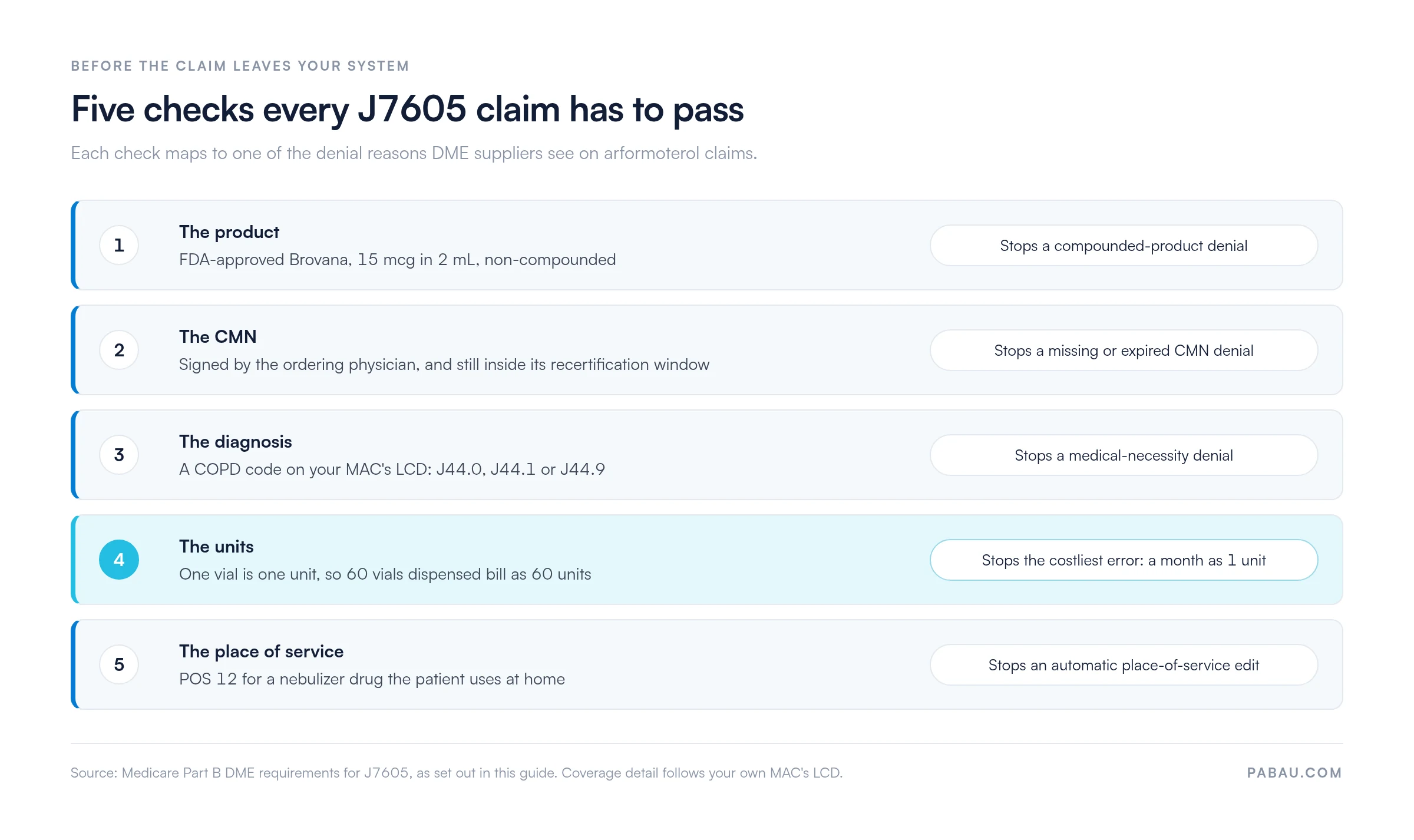
A line that fails one of these is far cheaper to fix now than to appeal in six weeks.
Denials on this code repeat themselves. Sort a month of them by reason code and they collapse into a handful of causes, each with its own corrective action.
Read the pattern before you change the workflow. A run of missing-CMN denials calls for a recertification reminder, not a coding review. A documented denial management process is what turns that reading into a habit.
In most DME billing setups, the documentation and the claim live apart. The order and the CMN sit in a chart or a folder. Vial counts sit in the dispensing system. Then the claim gets keyed a third time in a payer portal. Every one of those hops is a chance to type 1 where the file says 60.
Practice management software like Pabau closes that distance. Pabau’s medical claims management pre-fills the CMS-1500 from the patient’s record, so the codes already attached to the service land on the charge line.
HCPCS and ICD-10 lookup libraries sit behind a search icon on the form, refreshed with the official code releases. Required fields are validated before the send button unlocks, so a claim missing an authorization number does not go out at all.
On the US pipeline, claims go out through the Claim.MD connection. Eligibility checks, claim status tracking, and ERA remittance posting come back along the same route. Code selection stays with your billers, and the LCD check stays with your MAC.
What the software does is keep the record, the code libraries, and the claim in one place. The five checks above then happen where the work already is.

Pabau’s claims management software pre-fills each CMS-1500 from the patient’s record and keeps HCPCS and ICD-10 lookups a click away. Claims wait until the required fields are complete. See how it fits a DME billing workflow.

J7605 is a narrow code, and the money in it turns on arithmetic and dates. Count vials rather than months, keep the CMN inside its recertification window, and match the diagnosis to the LCD your MAC publishes. Those three habits pay more claims than any appeal strategy.
The trade-off worth remembering is where the minute goes. A check before submission costs a minute, while an appeal costs an hour and a six-week wait for the same money. Suppliers who move that minute to the front of the process stop seeing the same three reason codes every month.
If your team keys J-code claims in one system and tracks CMNs in another, the fix is structural rather than clerical. Book a demo to see how Pabau holds the order, the vial count, and the claim on a single record.

Need to understand how billing denials are categorized? Denial codes in medical billing explains the CARC and RARC system you will see on a rejected J7605 line.
Looking for a clearinghouse that handles HCPCS J-code submissions? Medical claims clearinghouse overview covers how claims clear before they reach the MAC.
Want to know what counts as a clean claim in DME billing? Clean claim requirements outlines the fields and documentation that keep a claim clear of automatic edits.
Managing revenue cycle across several HCPCS codes? Revenue cycle management guide gives you a full-practice framework for tracking claim performance.
Part B. The drug is nebulized through equipment that qualifies as durable medical equipment, so it falls under the Part B DME benefit. The claim goes to the DME MAC, not to a Part D plan.
Yes. J7605 covers the drug only. The compressor or nebulizer is durable medical equipment, so it bills under its own HCPCS code with its own coverage criteria.
Arformoterol is indicated for COPD maintenance, so an asthma-only diagnosis will not support medical necessity under a DME LCD. Check the covered diagnosis list for your jurisdiction before dispensing.
Send the documents that answer the denial reason. For a units denial, that is the dispensing record showing the vial count. For a necessity denial, send the CMN, the physician order, and the spirometry or PFT results confirming COPD.



