CCSD code H4430: Examination of rectum under anaesthetic
CCSD code H4430 pays for the examination alone CCSD code H4430 is the UK private...

Last Updated: Oct 20, 2026
J7633 is the HCPCS Level II code for budesonide, inhalation solution, fda-approved final product, non-compounded, administered through dme, concentrated form, per 0.25 milligram.
Bill J7626 instead for a commercially manufactured budesonide ampule, or J7627 when a pharmacy compounds it. That distinction decides whether the line pays or bounces back as an invalid code.
Below, the descriptor comes first, then the modifier and diagnosis rules, and then the checks that keep budesonide claims clean.
Let Pabau's smart automation suggest the right codes, reduce claim denials, and keep your practice compliant—effortlessly.
Automate repetitive tasks and focus on what matters most—your patients.
Reduce coding errors and ensure compliance with the latest regulations.
Clean claims, fewer denials, and faster reimbursements.
Powerful insights and reporting to help your practice thrive.
HIPAA compliant SOC 2 certified GDPR-compliant Trusted by 4,000+ clinics worldwide

HCPCS code J7633 describes budesonide inhalation solution, FDA-approved final product, non-compounded, administered through DME, concentrated form, per 0.25 milligram.
CMS Policy Article A52466 states that no FDA-approved final product matches that descriptor, so J7633 is invalid for claim submission.
J7633 and J7634 differ only by compounded status. Both describe the concentrated form, and neither describes a unit dose product.
For commercially manufactured budesonide ampules, bill J7626 instead, at one unit of service for each vial dispensed.
Practice management software like Pabau keeps the written order, the diagnosis, and the delivery record on a single encounter.
J7633 is an HCPCS Level II J-code in the J7601 through J7686 range. That range covers inhalation solutions delivered by nebulizer under the Medicare DME benefit.
One code in that range is not a nebulizer solution. J7665 covers mannitol inhalation powder, administered through an inhaler, at one unit of service for each 5 mg capsule.
The descriptor names budesonide in concentrated form, non-compounded, at 0.25 milligram per unit of service.
Two halves of that descriptor pull against each other. Concentrated form means a pharmacy dispenses the drug in a strength that needs a separate diluent.
No manufacturer sells budesonide that way, so the FDA-approved half has nothing to match. CMS says as much in writing.
The statement sits in Policy Article A52466. No FDA-approved final products are described by J7633, so the code is invalid for claim submission. Five other inhalation codes appear in the same sentence, among them J7648, J7649, and J7668.
The reason sits in the definition of concentrated form. A52466 defines it as a drug dispensed in a strength that needs a separate diluent. That diluent, usually saline, goes into the nebulizer at the time of treatment.
Budesonide inhalation suspension does not reach the patient that way. It arrives in ready-to-use ampules, which the policy calls the unit dose form. Nobody has ever manufactured the concentrate that J7633 describes as an FDA-approved product.
One practical consequence follows. A J7633 line never reaches a medical necessity review, because it is rejected as an invalid code first. Adding a diagnosis, a modifier, or more documentation does not change that.
J7633 and J7634 are the same drug, the same dose, and the same formulation. Compounded status is the only thing that separates them. J7633 reads non-compounded, and J7634 reads compounded product.
Neither code describes a unit dose product. That wording belongs to J7626 and J7627, which sit at up to 0.5 mg per vial. Mixing the two pairs up is the error that sends budesonide claims into the rejection queue.
J7634 is submittable, but it rarely pays. A52466 lists every ICD-10 code as one that does not support medical necessity for J7634.
Medicare also refuses a separate fee for compounding inhalation drugs, so the pharmacy’s mixing work carries no extra payment.
For commercially manufactured budesonide, the code to bill is J7626. Its descriptor covers the FDA-approved, non-compounded unit dose form at up to 0.5 mg. J7627 is the compounded version of the same formulation.
Two questions get you to the right one, and the chart below runs them in order.
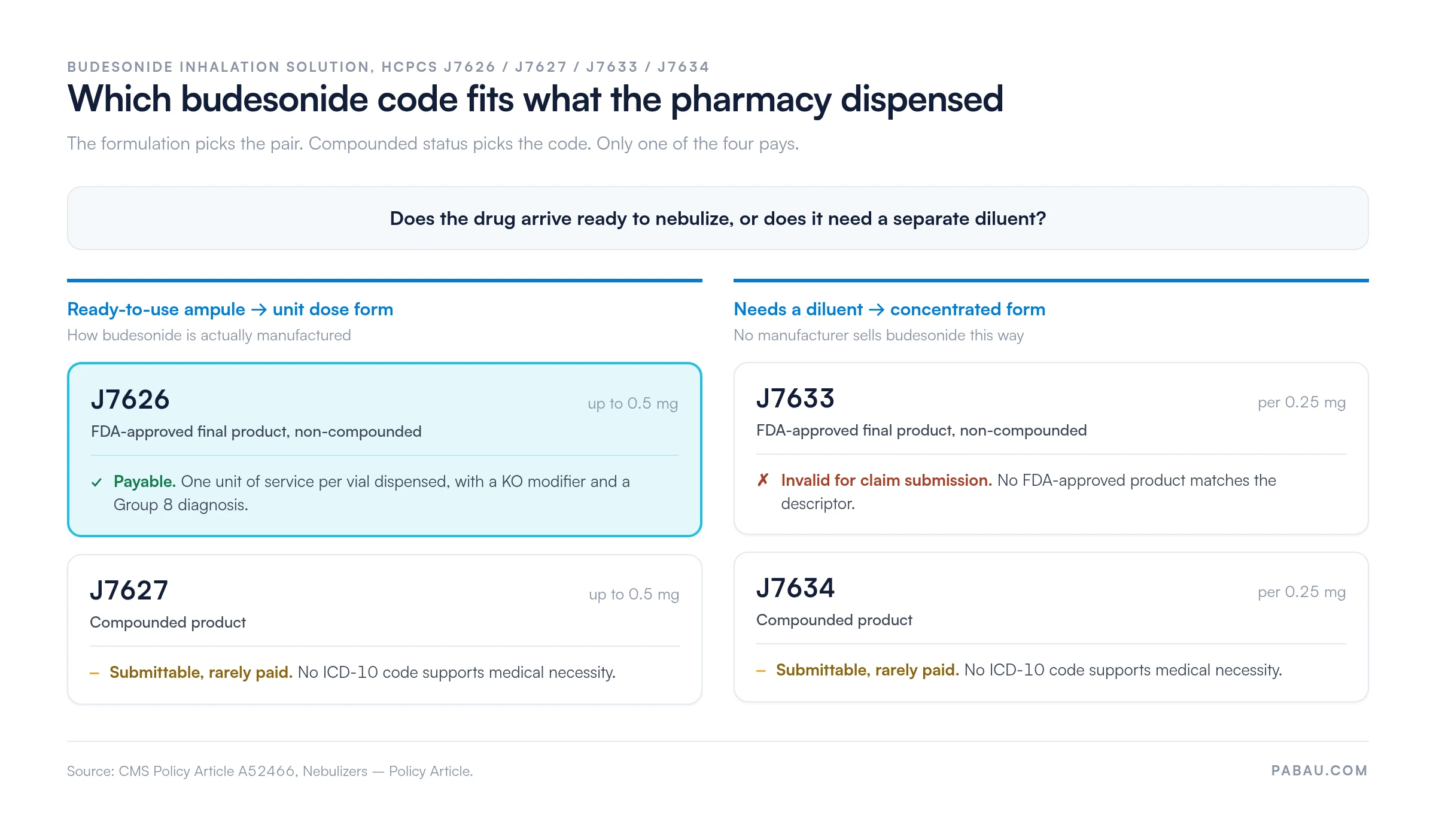
A52466 sets the unit count plainly for both unit dose codes. Bill one unit of service for each vial dispensed. That holds whether the vial contains 0.25 mg or 0.5 mg of budesonide.
Worked through on a real supply, the rule is easy to see. Take a 30-day supply of 60 budesonide ampules, each holding 0.5 mg. The claim carries J7626 with 60 units of service, one for each vial, plus a KO modifier and a Group 8 diagnosis.
Counting 120 units for the same supply is the classic overbill. It treats 30 mg of drug as 120 doses of 0.25 mg, which is the J7633 unit, not the J7626 one. There is no separate unit dose code for a 0.25 mg ampule, and J7633 is not it.
Run a report on any claim line carrying J7633, J7648, J7649, J7658, J7659, or J7668. A52466 lists all six as invalid for claim submission. Each one is a rejection you can stop before the batch goes out.
Coders working a nebulizer drug list meet several neighbors of the budesonide codes. Each carries its own dose in the descriptor, so none of them can stand in for another.
The AAPC HCPCS code range reference holds descriptors for the full set.
The KO, KP, and KQ modifiers describe how a unit dose container is packaged. A52466 requires one of the three on every unit dose form code, with J7620 as the exception. None of them belong on a concentrated form code.
A unit dose line without KO, KP, or KQ is denied as an invalid code. Since no multi-drug budesonide product exists, J7626 takes KO and nothing else. Sending KP or KQ on J7626 earns a rejection of its own.
A covered diagnosis matters for J7626, the budesonide code that pays. A52466 lists the supporting ICD-10 codes in its Group 8 set, which also applies to J7613, J7620, and J7644.
COPD and asthma codes make up most of that list, and you can look each one up in our ICD-10-CM code reference.
J7633 has no diagnosis list of its own, because no claim for it can be processed. J7627 and J7634 sit in the opposite section, where every ICD-10 code fails to support medical necessity.
A code from the list is a starting point rather than a guarantee, and A52466 says so directly. Report the most specific code the record supports.
Coding J44.9 when the note documents an exacerbation gives up the specificity that J44.1 would have carried. Official descriptions live in the CDC ICD-10-CM web tool.
Inhalation drugs furnished through DME have been paid at 106% of the average sales price since 2005. Those figures come from the CMS quarterly ASP drug pricing files, not the physician fee schedule. J7633 has no payable amount, because no claim for it can be processed.
Medicare also pays the pharmacy a dispensing fee, and the rules around it are strict. Only one fee applies per period, whatever the number of drugs, shipments, or pharmacies involved. The fee has to appear on the same claim as the drug, or it is denied as incorrect billing.
Commercial and Medicaid plans often follow the Medicare methodology, though not every plan does. Check the contract before you quote an expected payment to a DME coordinator. Tracking those variances is revenue cycle work rather than coding work.
Documentation for budesonide claims follows the nebulizer LCD and its standard documentation article. Treat it as a checklist, run the same way for every patient on nebulized budesonide.
Capture these elements at the point of care rather than reconstructing them for an auditor months later. Digital intake and consent forms drop the order details straight into the patient record, where the claim can pull them.
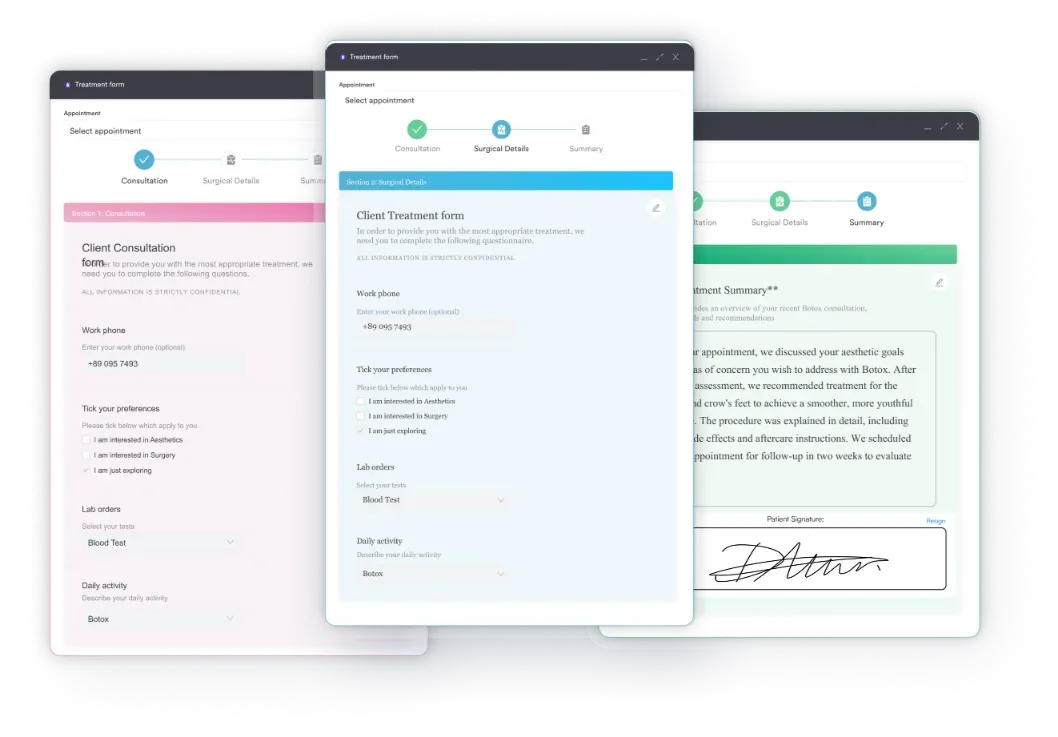
The rules above only matter in the order a claim meets them. Here is the path a clean budesonide line follows.
Swap J7633 into step three and the claim stops there. The line comes back as an invalid code, and no amount of documentation moves it forward. Nothing later in the sequence ever runs.
Most budesonide rejections trace back to a handful of causes. Each one has a specific fix at the scrubber stage, so this list doubles as a pre-submission check.
The handoff between the prescribing practice and the DME supplier is where most of these start. Agree upfront on what the charge sheet has to carry, then read what comes back. CO-4 points at a modifier problem, and CO-50 at medical necessity, and each recurring code is worth turning into a scrubber rule.
Check whether your claim scrubber still carries CMN fields for nebulizer drugs. CMS discontinued Certificates of Medical Necessity for dates of service from January 1, 2023. A claim that still sends CMN data is rejected and returned to the supplier.
J7633 sits in the HCPCS Level II file with its descriptor unchanged. Presence in the file is not the same as payability. A52466 has carried the invalid-for-submission statement across the 2024, 2025, and 2026 cycles.
The current file lives on the CMS HCPCS overview page.
Knowing that J7626 is the payable code is the easy part. The harder part is holding the order, the diagnosis, the unit count, and the delivery record together until the claim goes out.
Pabau is practice management software with billing built in, and its claims module is built for billing teams entering HCPCS Level II J-codes.
The budesonide order, the supporting diagnosis, and the delivery documentation attach to the encounter that produced the prescribing note. So an auditor asking for medical necessity support gets one file rather than three exports.
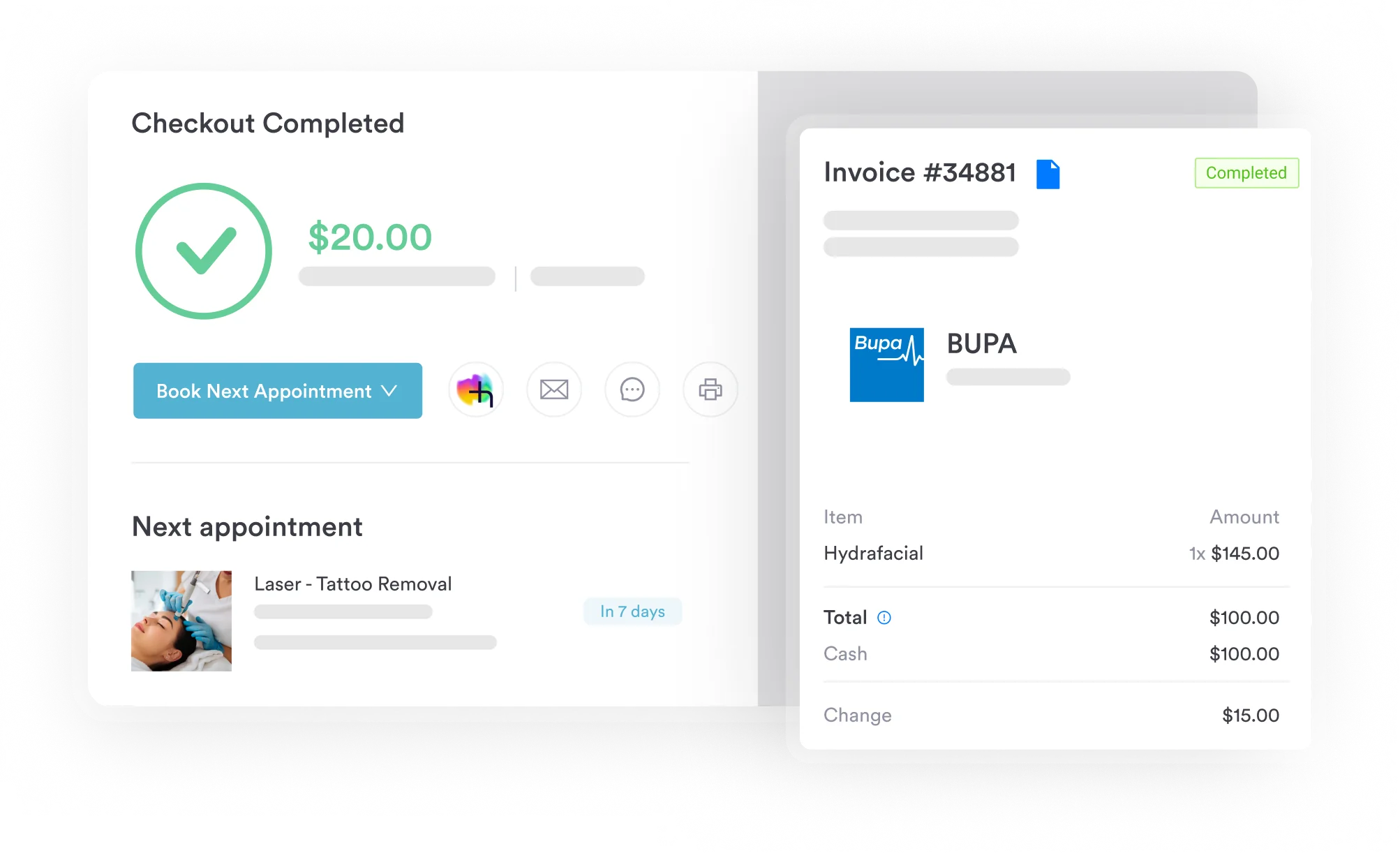
Written orders get recorded in a structured form, and each claim’s status is tracked after submission. A rejected J7626 line surfaces the same week instead of at month end. For teams running clinical and DME billing side by side, that removes the coordination work behind most coding errors.

Pabau’s billing module supports HCPCS J-code entry, DME documentation, and claim-ready workflows in one platform. Keep the order, the diagnosis, and the delivery record on one encounter, so fewer lines come back.

J7633 is the rare HCPCS code that reads correct and bills wrong. Its descriptor promises an FDA-approved product, and CMS confirms that no such product exists in concentrated form. Read the code as a warning label rather than a billing option.
So the working rule is short. Bill J7626 for manufactured budesonide ampules, one unit for each vial, with a KO modifier and a Group 8 diagnosis. Keep the written order, the delivery record, and the dispensing fee on the same claim.
Most of the effort goes into holding those pieces together long after the drug leaves the shelf. If that is where your budesonide claims slip, book a demo and see how Pabau keeps the order, the diagnosis, and the delivery record on one encounter.

Need a framework for clean claim submission? Clean claim best practices covers the elements every HCPCS claim needs to clear the first pass without rejection.
Trying to understand how remittance works once budesonide claims pay? Electronic remittance advice (ERA) explains how to read and action remittance files after Medicare DME payments post.
Want to reduce denial rates across your billing portfolio? Medical claims clearinghouse guide explains how clearinghouses validate HCPCS claims before they reach the payer.
No. Ready-to-use budesonide ampules, sold under the Pulmicort Respules brand, are billed with J7626. J7633 describes a concentrate that no manufacturer produces.
The supplier that dispenses the drug bills it, not the prescribing practice. The practice owns the written order and the note that supports the diagnosis.
Correct the line to J7626 and resubmit it. An invalid code comes back as a rejection rather than a denial, so there is no coverage decision to appeal.
No. An ABN and a GA modifier only help where the payer reviews a service and denies it. A J7633 line never reaches that review.
Part B covers it as a DME drug, provided the nebulizer itself is covered. Where the equipment is not covered, check the plan’s pharmacy benefit instead.
Treat J7633 as unbillable everywhere. Commercial edits track the HCPCS file and Medicare policy closely, so confirm the code list in your contract before submitting.