

HCPCS Code E0272: Foam rubber mattress billing guide
HCPCS Code E0272: official descriptor and code overview HCPCS Code E0272 is the ...

Last Updated: Nov 6, 2026
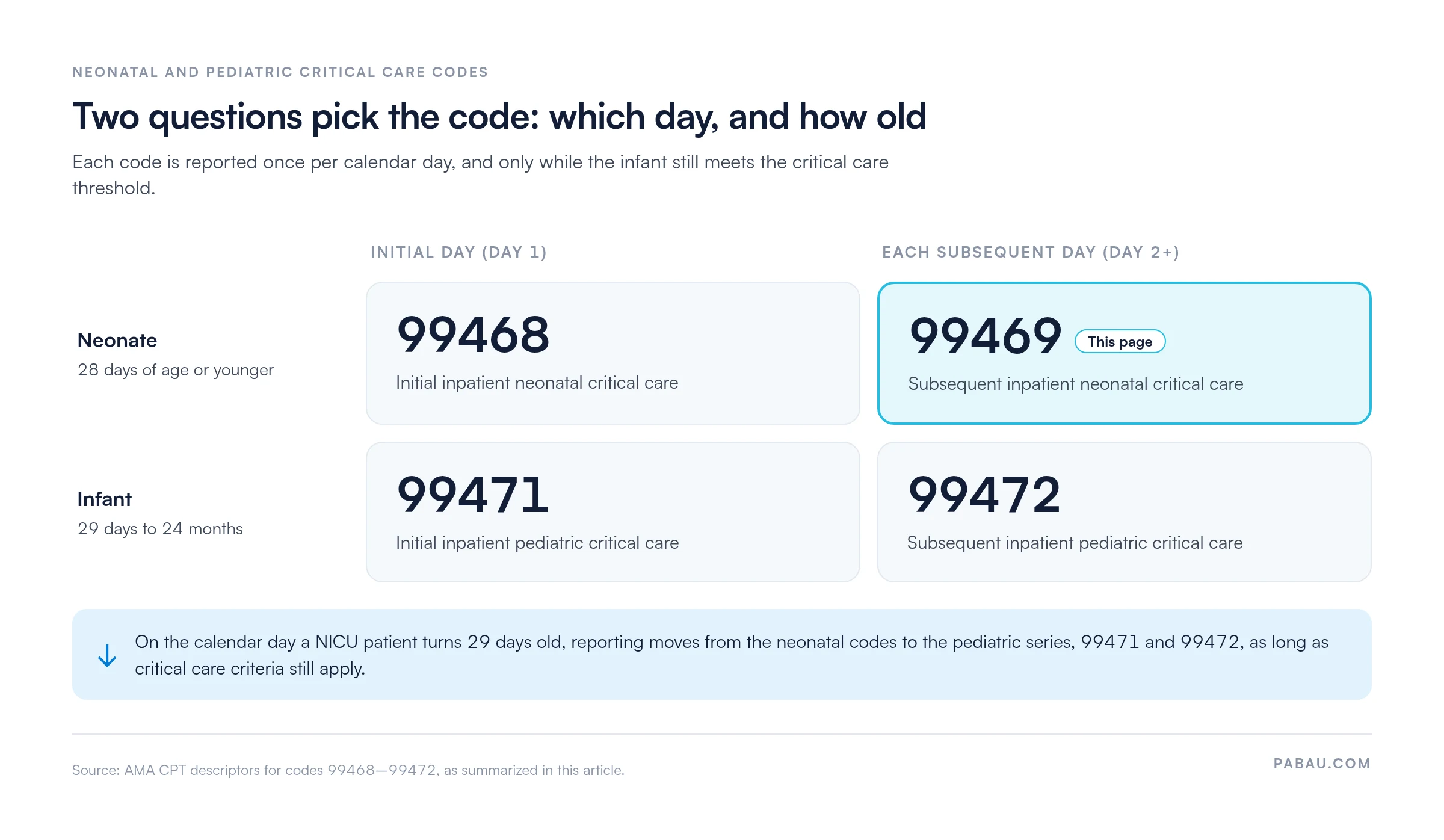
99469 is the CPT code for subsequent-day inpatient neonatal critical care, reported once per day for a critically ill neonate aged 28 days or younger.
It covers day two onward of the same admission, while CPT 99468 covers the initial day. Ventilator management, vascular access and other listed procedures are bundled into the daily code. Once the infant turns 29 days old, the pediatric critical care codes 99471 and 99472 apply instead.
Let Pabau's smart automation suggest the right codes, reduce claim denials, and keep your practice compliant—effortlessly.
Automate repetitive tasks and focus on what matters most—your patients.
Reduce coding errors and ensure compliance with the latest regulations.
Clean claims, fewer denials, and faster reimbursements.
Powerful insights and reporting to help your practice thrive.
HIPAA compliant SOC 2 certified GDPR-compliant Trusted by 4,000+ clinics worldwide

CPT code 99469 covers each subsequent day (day 2 onward) of inpatient neonatal critical care. CPT 99468 covers the initial day only.
The patient must be 28 days of age or younger, measured by chronological age rather than corrected gestational age.
Only one physician may report 99469 per patient per day. Bundled services such as ventilator management and umbilical line care cannot be billed separately.
Pabau, the practice management platform we build, checks each claim for missing or invalid details and submits it to US payers through Claim.MD.
CPT code 99469 reports each subsequent day of inpatient neonatal critical care for a critically ill neonate aged 28 days or younger. The American Medical Association (AMA) publishes the official descriptor, which reads in full:
Subsequent inpatient neonatal critical care, per day, for the evaluation and management of a critically ill neonate, 28 days of age or younger.
Three elements define when 99469 applies correctly. The patient must be neonatal (28 days of age or younger, by chronological age).
The care must meet the clinical threshold for critical care, meaning a high probability of imminent or life-threatening deterioration that requires constant physician availability. The service must occur on a subsequent inpatient day (day two or any later day of the same admission), not the initial day.
The code is reported per day, not per visit or per hour. If a neonatologist sees the infant twice in a calendar day, only one unit of 99469 is reported for that date of service.
The AMA CPT parenthetical notes for neonatal critical care list a broad bundle of services included in 99469. None of them can be billed separately on the same date.
Bundled services include cardiac and respiratory monitoring, pulse oximetry, and vascular access procedures, including umbilical arterial and venous line management. Endotracheal intubation, ventilator management, oral and nasogastric tube placement, suprapubic bladder aspiration, bladder catheterization, and lumbar puncture are bundled too. Delivery room resuscitation is not part of that bundle. CPT 99465 resuscitation can be reported in addition to 99468 on the date of birth.
Billing any of these services separately on a day when 99469 is reported creates a National Correct Coding Initiative (NCCI) edit violation.
Explicit exclusions are equally important to document.
The most common coding error in neonatal critical care is billing 99469 on the first day. The mirror error is forgetting to switch from 99468 to 99469 on day two. The table below clarifies the split.
The neonatal and pediatric critical care code family is age-stratified and setting-specific. Choosing the wrong code for a patient’s age or acuity level is a common upcoding risk that auditors flag directly. A healthy newborn falls outside it entirely. Normal newborn care is reported as 99460 in a hospital or birthing center, or with code 99461 in any other setting.
The boundary between 99469 and 99471 catches practices off-guard when a NICU stay extends past the first month of life. A neonate admitted on day 5 of life will reach 29 days of chronological age during a long stay.
On the calendar day the patient turns 29 days old, the reporting code moves from the neonatal series to the pediatric critical care series. That switch applies only if the infant still meets the clinical threshold for critical care. The grid below maps each combination of care day and age to its code.
Only one physician may report CPT code 99469 per patient per calendar day. The attending provider of record, typically a neonatologist, assumes this billing responsibility.
Several physicians may be involved in the infant’s care on the same day. Only the provider who assumed personal responsibility for critical care management on that date reports 99469.
Several provider-type restrictions apply under standard AMA CPT and payer rules.
Provider eligibility disputes are a frequent denial trigger. Confirm each payer’s credentialing and provider-type rules before submitting, particularly for hospitalist-neonatologist shared coverage models.
Every CPT code 99469 claim needs a daily progress note. It must show the infant still qualifies for critical care on that specific date. A note that mirrors the previous day’s documentation without updating clinical status is a medical necessity failure. Payers look for evidence that the physician independently evaluated the infant and made active management decisions.
The note must include the following elements for billing compliance documentation purposes.
Audit your NICU daily progress note templates against the CPT 99469 documentation checklist above. A note that checks every element before submission reduces denials. Payers run automated edits that target neonatal critical care claims with missing age documentation or generic medical necessity language.
Medicare reimbursement for CPT code 99469 is calculated using the CMS Physician Fee Schedule (PFS). The PFS assigns Relative Value Units (RVUs) to the code, then applies a conversion factor and a geographic adjustment to produce the payment rate.
Because the conversion factor and RVU values update each January 1, no fixed dollar amount published here will remain accurate across fee schedule years.
Use the CMS Physician Fee Schedule Look-Up Tool to retrieve the current national payment rate and locality-adjusted rate for 99469. The FastRVU 2026 RVU lookup tool shows current work, practice expense, and malpractice RVUs from the same CMS data, with location multipliers built in.
Several factors affect the final reimbursement amount.
Denials on CPT code 99469 cluster around a small set of predictable errors. Knowing which triggers fire most often lets billing teams build pre-submission edits that catch the issue before the claim leaves the practice. Understanding medical billing denial codes helps coders read the remittance and act quickly.
A denied CPT code 99469 claim is recoverable in most cases. Effective denial management workflows start with the claim adjustment reason code (CARC) on the electronic remittance advice (ERA). The appeal strategy depends on the specific denial type, so read it before taking action.
Before you appeal, confirm the original submission was a clean claim. A claim with a coding error needs a corrected claim, not just an appeal letter. Otherwise the same edit fires again.
Run a monthly audit of your 99469 claims against the 99468 claims from the same admission. The ratio should be one 99468 per admission and one 99469 per subsequent day. A mismatch, such as two 99468s on one admission or a 99469 on day one, points to a systemic coding error. Catch it before it compounds across multiple patients.
Neonatal critical care billing has a narrow margin for error. A single incorrectly coded day in a 30-day NICU stay can draw an audit of the whole admission. Once the payer flags it, denials can spread across multiple dates of service.
Your coders still decide between 99468, 99469 and the pediatric codes. Pabau’s claims software for coders then catches the errors that send claims back.
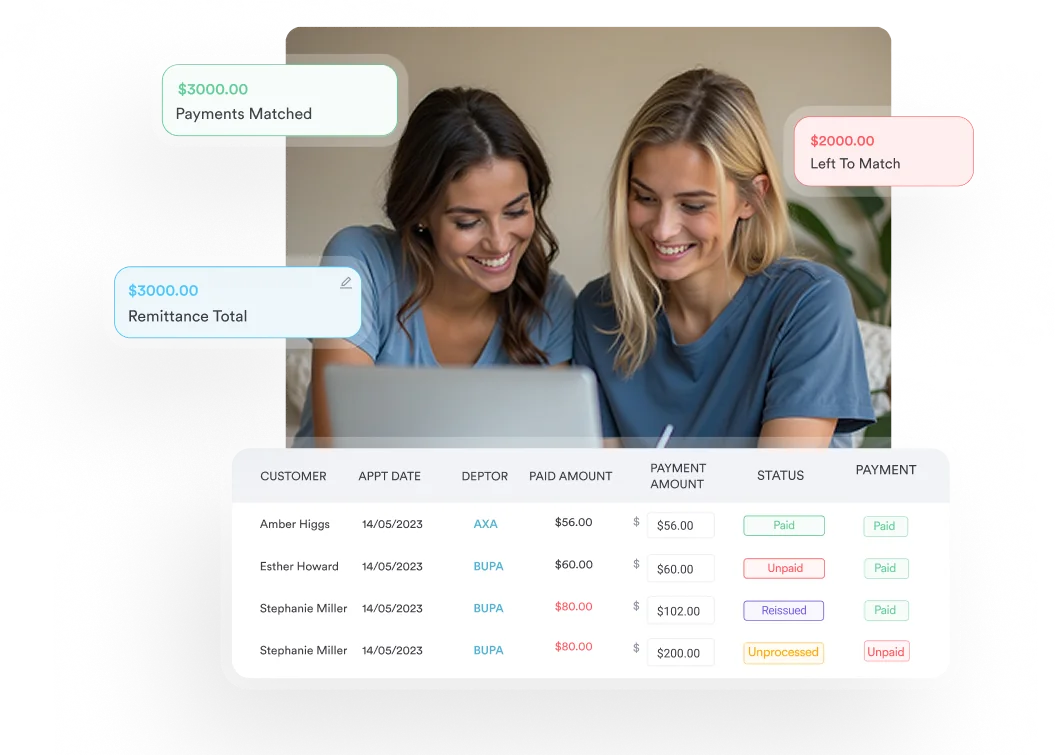

Pabau checks every claim for missing or invalid details, then submits it through Claim.MD, so your 99469 claims reach the payer complete.

Treat every 99469 claim as a fresh decision. Before submission, confirm it isn’t day one, the infant is 28 days old or younger, and today’s note shows critical status.
Build those three checks into the daily coding routine and the most common 99469 denials stop recurring. Skip them, and one wrong day can put the whole admission under review.
Pabau validates each claim and sends it through Claim.MD, so your coders can spend their time on the clinical rules instead. Book a demo to see how Pabau supports clean claims for neonatal critical care.

Coding a full NICU admission? Inpatient billing cheat sheet puts hospital E/M codes, ICD-10-CM sequencing and denial codes on one reference page.
Billing critical care for an older patient? CPT code 99291 covers time-based critical care outside the neonatal and pediatric per-day codes.
Want a complete overview of US medical billing workflows? Revenue cycle management fundamentals covers the end-to-end process from eligibility through payment posting.
Looking for guidance on clearinghouse submission and ERA processing? Electronic remittance advice explains how 835 ERA files map denial reason codes back to your claims.
CPT code 99469 is the procedure code for subsequent-day inpatient neonatal critical care. It is reported once per calendar day, from the second day onward, for critically ill patients aged 28 days or younger. It pairs with CPT 99468, which covers the first day of the same admission.
CPT 99468 is reported on the initial day of neonatal critical care. CPT 99469 is reported on each subsequent day of the same inpatient admission. The two codes are mutually exclusive, so billing both on the same date of service triggers an NCCI edit denial.
Each day’s claim needs a daily progress note with the patient’s date of birth and specific findings that meet the critical care threshold. The note also lists services rendered, such as ventilator management, monitoring and line care. It must show the billing physician’s direct personal involvement in the encounter.
The Medicare rate for CPT 99469 updates each year with the CMS Physician Fee Schedule and varies by geographic locality. Use the CMS Physician Fee Schedule Look-Up Tool or the AAPC Codify CPT lookup for current national and locality-adjusted rates. Published figures go out of date with each January 1 update.
CPT 99469 can be reported once per calendar day for each subsequent day of neonatal critical care. The patient must still be 28 days of age or younger and still meet the critical care threshold. There is no fixed cap on days. Billing continues daily until the patient no longer qualifies for critical care, reaches 29 days of age, or is discharged.
The most frequent trigger is a patient older than 28 days on the date of service. Another is 99469 reported on the initial day instead of 99468. Billing bundled services such as ventilator management as separate line items also causes denials. So do copy-forward notes without updated findings, and a non-physician NPI on a payer that restricts the code to physicians.




