HCPCS Code E0215: Electric heating pad (non-moist) billing guide
HCPCS Code E0215: Official description and device definition HCPCS Code E0215 is...

Last Updated: Nov 16, 2026
99480 is the CPT code for subsequent intensive care for a recovering infant, billed per day. It applies when the infant's present body weight on the date of service is 2,501-5,000 grams. The infant still needs intensive observation and frequent interventions but is no longer critically ill.
The code follows an initial day reported with 99468 or 99477. Lighter infants are reported with 99479 or 99478, and critically ill neonates with 99469.
Let Pabau's smart automation suggest the right codes, reduce claim denials, and keep your practice compliant—effortlessly.
Automate repetitive tasks and focus on what matters most—your patients.
Reduce coding errors and ensure compliance with the latest regulations.
Clean claims, fewer denials, and faster reimbursements.
Powerful insights and reporting to help your practice thrive.
HIPAA compliant SOC 2 certified GDPR-compliant Trusted by 4,000+ clinics worldwide

CPT code 99480 reports subsequent intensive care, per day, for a recovering infant whose present body weight is 2,501-5,000 grams.
It is an intensive care code for an infant who is not critically ill. Critically ill neonates are reported with 99468 or 99469 instead.
The code follows the infant’s weight on the date of service, not birth weight. Lighter infants are reported with 99479 or 99478.
Vascular access, intubation, ventilator and CPAP management, feeding tubes, lumbar puncture and bladder procedures are bundled into the daily code.
Once the infant weighs more than 5,000 grams or no longer needs intensive care, report subsequent hospital care codes 99231-99233.
CPT code 99480 reports subsequent intensive care, per day, for a recovering infant with a present body weight of 2,501-5,000 grams.
The AAFP guide to coding newborn care services sets out the descriptor and the three weight bands for 99478-99480. The infant is not critically ill but still needs intensive observation, frequent interventions and other intensive care services.
The official descriptor reads: Subsequent intensive care, per day, for the evaluation and management of the recovering infant (present body weight of 2501-5000 grams).
Three phrases in that descriptor drive code selection. “Subsequent” means a day after the first day of hospital care, which is reported with 99468 or 99477. “Recovering” means the infant has stepped down from critical illness, or never reached it. “Present body weight” means the weight recorded on the date of service.
CPT groups 99480 with the neonatal critical care and intensive care codes. The table below shows where each code fits.
Subsequent intensive care codes 99478-99480 follow an initial day reported with 99468 or 99477. They key on weight rather than age, so they can still apply after the infant passes 28 days.
The infant’s present body weight on the date of service decides between 99478, 99479 and 99480. Birth weight does not set the code. A baby born at 2,300 g who weighs 2,560 g today is billed with 99480, not 99479. The bands below show where each code starts and stops.
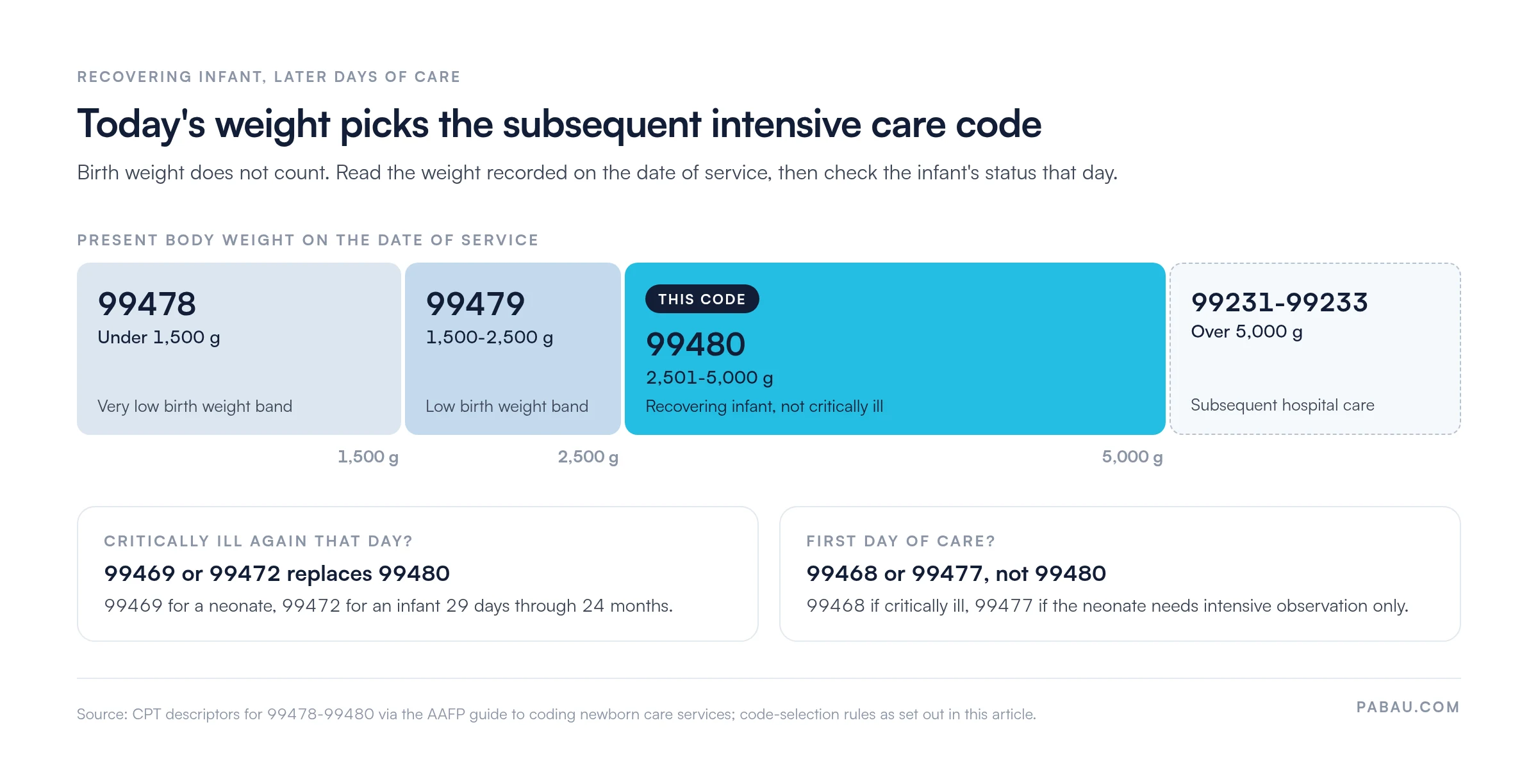
Weight moves in both directions during a stay. An infant who drops from 2,540 g to 2,480 g moves from 99480 to 99479 for that date. Record the day’s weight in every note so the weight band on the claim can be traced.
The 99480 band has a ceiling as well as a floor. Once the infant weighs more than 5,000 g, subsequent intensive care codes no longer apply. Report subsequent hospital care instead, using 99231, 99232 or 99233 by the level of medical decision making.
Label each weight in the note as birth weight or today’s weight. A birth weight diagnosis code such as P07.18 describes the infant at birth. It can differ from the present weight that sets the 99478-99480 band.
The right code changes as the infant’s condition and weight change. Walk through these questions for every date of service.
Only one physician reports a daily intensive care or critical care code for the infant on a given date.
CPT bundles the same procedures into intensive care codes 99477-99480 as into neonatal critical care. Billing any of them separately on the same date triggers an unbundling denial.
These services stay bundled however long they take. A difficult line placement on day five is still part of that day’s 99480.
Procedures that are not on the bundled list are reported separately. Other specialists also bill their own work on the same date.
A payer edit may still pair a procedure with 99480 when the same physician performs both. Append modifier 59, or the matching X modifier, only when the note shows a distinct service. Check the payer’s policy before you submit.
A 99480 note must show why the infant still needs intensive care. A NICU bed on its own does not prove that. The note also has to support the weight band and the subsequent-day status. Cover these five elements in every note:
“Infant remains on high-flow nasal cannula with gavage feeds, weight 2,640 g” supports the code. “NICU day 6, stable” does not.
The physician directing the infant’s intensive care reports 99480, usually a neonatologist or pediatric hospitalist. Only one physician reports an intensive care code for the infant per day.
Under Medicare teaching physician rules, the attending documents personal involvement when residents provide part of the care. A resident note alone does not support the attending’s claim.
Infants in this band are usually covered by Medicaid or a commercial plan rather than Medicare. Rules for nurse practitioner and physician assistant billing vary by payer and state, so confirm them before you submit.
The diagnosis must explain why a recovering infant still needs intensive care. Pick the condition code from the ICD-10-CM diagnostic codes, then pair it with any birth weight or gestational age code that applies.
Use the most specific code available. P22.0 is preferable to the unspecified P22.9 when the record documents respiratory distress syndrome. P07 and P05 codes describe weight at birth, so they never replace the present weight in the note.
CPT code 99480 is paid under the Medicare Physician Fee Schedule (MPFS). The 2026 national payment is about $101.20, down from $110.95 in 2025. Use the CMS Physician Fee Schedule lookup tool for your locality’s rate, since the geographic adjustment changes the final amount.
Check current work, practice expense and malpractice values in the FastRVU lookup tool. Commercial payers negotiate their own rates, so treat the Medicare figure as a benchmark for contract talks.
Most 99480 denials trace back to five causes. Each one has a prevention step that stops it recurring.
Track denials by CPT code and reason code in a denial management workflow. A cluster of bundling denials on 99480 points to procedure codes leaking onto the claim, so fix the charge capture before the note.
The daily 99480 line rarely needs a modifier. Modifiers come into play on the procedures billed alongside it.
The three codes split on two questions. Is the infant critically ill, and is the code daily or time-based? CPT 99469 covers continuing neonatal critical care, while CPT 99291 is time-based critical care.
For a critically ill neonate, 99291 covers critical care outside the daily inpatient codes, such as emergency department care before admission. Once the infant is admitted, the daily codes take over. A recovering infant in the 2,501-5,000 g band is billed with 99480, not with either critical care code.
Run a quarterly report of 99469 and 99291 claims for infants. If a note describes a stable, recovering infant, that day likely belonged to 99478, 99479 or 99480.
Billing teams for neonatology groups check three things on every 99480 claim: the weight band, bundled procedures and payer eligibility. A miss on any one of them sends the claim back for resubmission.
Pabau, the practice management and billing platform we build, submits CMS-1500/837P claims and secondary claims to US payers through its Claim.MD clearinghouse integration. The same connection runs eligibility checks and returns ERA remittances. Your team confirms coverage before a claim goes out and sees each payer’s remittance electronically.
With claims management software in the same system, claims and denials sit next to the patient record. Prior authorization codes, dates and sessions are tracked on the case, with a warning when one is missing. Reporting then shows which payers and codes create the most rework.
For teams still building the fundamentals, our guide to what medical billing is walks through how the note, the claim and the payment connect.

Pabau sends US claims through Claim.MD, with eligibility checks and ERA remittances, so your billing team can confirm coverage and track payments in one place.

CPT code 99480 pays for one kind of day: a recovering infant, no longer critically ill, who weighs 2,501-5,000 g today. Three daily checks protect the claim. Is the infant still critical? What does the infant weigh today? Has that weight passed 5,000 g?
Teams that record status and present weight in every note can defend each day’s code on audit. Teams that rely on birth weight or a “stable in NICU” label leave claims open to downcoding and recoupment. To see how Pabau handles US claims through Claim.MD, book a demo with our team.

Infant stepped down from intensive care? CPT code 99233 covers high-complexity subsequent hospital care once the intensive care codes no longer apply.
Coding respiratory distress in a recovering infant? ICD-10 code P22.0 explains the newborn respiratory distress syndrome code that often supports 99480 days.
Want to understand denial patterns across all CPT codes? Denial codes in medical billing explains CARC codes and appeals workflows for intensive care claim rejections.
Looking to streamline your entire revenue cycle? Revenue cycle management fundamentals covers the end-to-end process from eligibility verification to payment posting.
CPT code 99480 reports subsequent intensive care, per day, for a recovering infant with a present body weight of 2,501-5,000 grams. The infant needs intensive observation and frequent interventions but is not critically ill. It follows an initial day reported with 99468 or 99477.
No. CPT 99480 is an intensive care code for an infant who is no longer critically ill. Critically ill neonates are reported with 99468 on the first day and 99469 on later days.
CPT 99480 uses present body weight on the date of service. An infant born under 2,500 g who now weighs 2,501-5,000 g is billed with 99480. Lighter infants are reported with 99479 (1,500-2,500 g) or 99478 (under 1,500 g).
Report subsequent hospital care codes 99231-99233 once the infant weighs more than 5,000 g. The same codes apply when the infant no longer needs intensive care.
No. Only one daily intensive care or critical care code is reported for the infant per day. If the infant becomes critically ill, the critical care code for that day replaces 99480.
No. CPT code 99480 is billed once per calendar day, with no minimum time and no start and stop times to record. CPT 99291, by contrast, requires at least 30 minutes of critical care time.
The daily 99480 line usually needs no modifier. Modifier 59 or an X modifier may apply to a separately reportable procedure by the same physician. Modifier 25 rarely applies, because the daily code covers the day’s E/M work.