

CCSD code XR940: Foreign body retrieval billing guide
CCSD code XR940 is the UK private healthcare code for retrieval of a foreign bod...

Last Updated: Nov 26, 2026
99477 is the CPT code for initial hospital care of a neonate aged 28 days or younger who needs intensive care. The neonate is not critically ill but requires intensive observation, frequent interventions, and other intensive care services. The code covers the initial date of NICU care only, with those services bundled into one daily charge reported by one physician.
From day 2, the neonate moves to a weight-based continuing code: 99478, 99479, or 99480. A critically ill neonate is reported with 99468 instead.
Let Pabau's smart automation suggest the right codes, reduce claim denials, and keep your practice compliant—effortlessly.
Automate repetitive tasks and focus on what matters most—your patients.
Reduce coding errors and ensure compliance with the latest regulations.
Clean claims, fewer denials, and faster reimbursements.
Powerful insights and reporting to help your practice thrive.
HIPAA compliant SOC 2 certified GDPR-compliant Trusted by 4,000+ clinics worldwide

CPT Code 99477 covers only the first day of NICU intensive care for a neonate aged 28 days or younger who is not critically ill.
From day 2, the neonate moves to a weight-based continuing code: 99478, 99479, or 99480.
The code is all-inclusive, so respiratory management, nutrition, medication management, and parental counseling cannot be billed separately on the same date.
CPT 99477 and CPT 99291 are mutually exclusive on the same date for the same provider and patient. A critically ill neonate is reported with 99468 instead.
Pabau’s claims management software keeps NICU notes and claims in one record and submits claims electronically to reduce coding errors at the source.
CPT Code 99477 is the code for the first day of hospital intensive care for a neonate aged 28 days or younger. As the AAFP’s newborn coding guidance explains, the infant is not critically ill but requires intensive observation, frequent interventions, and other intensive care services.
One physician’s daily work, from monitoring and respiratory support to nutrition and family guidance, is bundled into a single billable unit.
Three characteristics define this code. It applies only on the initial date of NICU care, whether the neonate was born in the same facility or transferred in. It is a per-day code, so one physician reports one unit per calendar day. And the patient must be 28 days of age or younger, regardless of gestational age at birth.
The patient must be 28 days of age or younger on the date of service. Age is calculated from the date of birth, not from gestational age or corrected age. A neonate who is exactly 28 days old on the date of NICU admission still qualifies. A patient who is 29 days old does not, however premature the birth was.
Beyond age, the neonate must require intensive observation and frequent interventions at the NICU level of care, without being critically ill. This distinguishes 99477 from normal newborn codes (99460, 99461, 99462), from observation-only admissions, and from neonatal critical care (99468). The documentation must show the infant needed the full scope of intensive services, not simply monitoring in a step-down unit.
CPT Code 99477 is an all-inclusive code on the initial day of NICU care. The AMA and CMS both specify that the following services are bundled and cannot be billed separately on the same date by the same provider.
Certain distinct procedures are not automatically bundled if they are performed independently and documented separately. These include surgical procedures, cardiovascular procedures with their own CPT codes, and certain diagnostic procedures.
However, NCCI edits govern which add-on codes can be reported alongside 99477. Unbundling without reviewing current National Correct Coding Initiative (NCCI) edit pairs is a common audit trigger flagged by the Office of Inspector General (OIG).
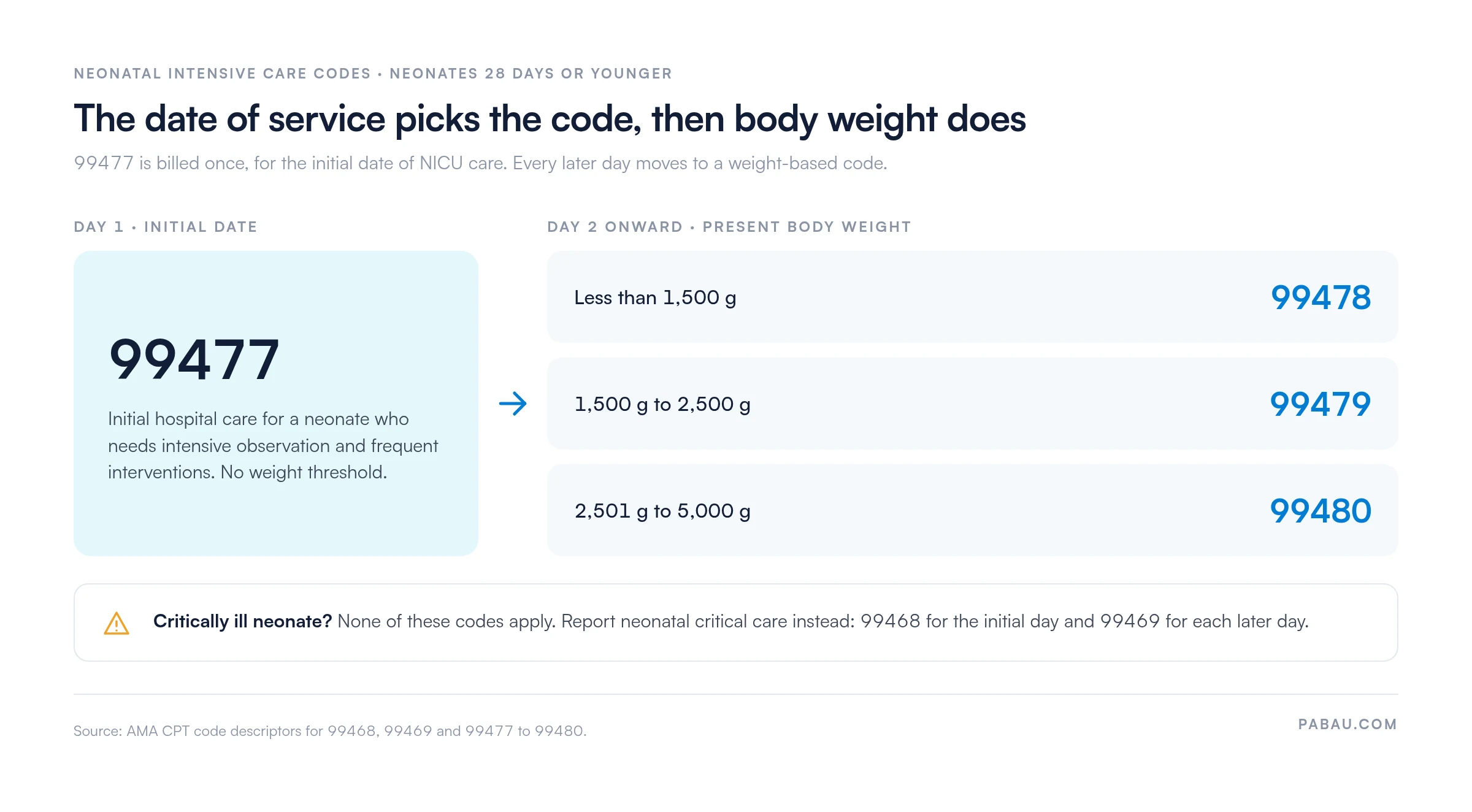
CPT Code 99477 applies only on day 1. From day 2 onward, the physician bills a continuing intensive care code (99478, 99479, or 99480) chosen by present body weight, not age. This weight-based cascade is where many NICU billing errors originate.
Body weight is documented at the start of each calendar day. If the neonate’s weight crosses a threshold between days, the code changes accordingly. Re-billing 99477 on day 2 without updating the weight is an audit-triggering pattern. The chart below maps each day and weight band to its code, with the critical care exception.
CPT 99291 and CPT Code 99477 are mutually exclusive on the same date for the same provider and patient. NCCI edits prohibit billing both codes together, and payers deny the lower-value code when both appear on the same claim.
The key distinction is how each code is structured. CPT 99291 is time-based critical care, with a minimum of 30 minutes and CPT 99292 as the add-on for each additional 30 minutes. CPT Code 99477 is age- and site-based neonatal intensive care on the initial day, with no time requirement.
Use 99477 for a NICU neonate aged 28 days or younger who is not critically ill on day 1. A critically ill neonate on the initial day is reported with 99468, the neonatal critical care code, instead. 99291 and 99292 cover time-based critical care in settings such as the emergency department.
The 2026 Medicare Physician Fee Schedule (MPFS) values for CPT Code 99477 are published annually by the Centers for Medicare and Medicaid Services (CMS). Rates are updated each calendar year and adjusted by geographic practice cost indices (GPCI). Always verify the current rate using the CMS Physician Fee Schedule lookup tool before billing.
The table below shows the national RVUs from the October 2026 release of the CMS fee schedule. Locality-adjusted payments will vary. Use the FastRVU 2026 RVU lookup tool to calculate your specific geographic adjustment.
Medicaid rates vary substantially by state. Some state Medicaid programs reimburse NICU codes at the Medicare equivalent. Others apply a state-specific conversion factor that may be significantly lower. Always verify with your state Medicaid fee schedule before projecting revenue.
Before billing CPT Code 99477, run a quick three-point check. Confirm the neonate is 28 days or younger and the date of service is the initial NICU day. Then confirm the attending physician’s supervision note is in the chart. Payers audit these three items first on NICU claims.
Documentation failures are the leading driver of CPT Code 99477 denials. The American Academy of Pediatrics (AAP) and CMS both specify what must appear in the medical record to support a claim. Missing even one element gives a payer grounds to deny medical necessity.
Per AMA CPT guidelines and AAPC coding standards, a complete 99477 chart note must include all of the following.
CPT Code 99477 requires Place of Service code 21 (inpatient hospital). NICU care is by definition an inpatient service. Most payers deny a claim submitted with any other POS code, such as POS 22 for outpatient hospital.
CMS lists the global period indicator for 99477 as XXX, so no global surgical package applies to this per-day E/M code. Each day of NICU care is billed independently, and every date of service needs its own supporting documentation.
For superbill documentation, include the POS, the ICD-10-CM diagnosis codes supporting NICU-level care, and the physician’s NPI.
NICU claims face a predictable set of denial patterns, and catching them before submission is cheaper than working remittances afterward. For practices building denial management workflows, NICU codes are a priority because of their claim value and documentation load. Each remark code a payer returns is decoded in our guide to medical billing denial codes.
Medicare traditionally covers CPT Code 99477 without a prior authorization requirement for a standard NICU admission. Medicare Advantage plans are a different matter. Many MA organizations set their own authorization requirements for NICU stays beyond a set number of days. Check the plan’s rules early in the stay.
Medicaid coverage and prior authorization requirements vary by state. Some state Medicaid programs require notification within 24 hours of NICU admission. Others require prior authorization for transfers between facilities. Managed Medicaid plans, which are commercial entities administering Medicaid benefits, add another layer of payer-specific rules.
Commercial payers vary too. Some apply a bundled payment arrangement for NICU episodes of care that pays differently from traditional fee-for-service. Under bundled payment, CPT Code 99477 may be included in the facility’s global payment rather than paid separately to the physician. Confirm whether the physician’s professional services are carved out before billing in a bundled payment environment.
Check credentialing before the claim goes out. If the billing neonatologist is not enrolled with a commercial payer for neonatal intensive care, the claim denies with CO-B7. That code means the provider was not certified or eligible on the date of service, however strong the documentation is. Fixing enrollment before submission is faster than appealing afterward.
A day-1 NICU claim depends on details that live in different places. The age in days sits in the admission note, the weight in the nursing chart, and the code on the claim form. When billing staff re-key those details, a 99477 can land on day 2 or beside a 99291 unnoticed.
Pabau, a practice management platform with built-in claims management software, keeps the clinical note and the claim in one patient record. Claims go out electronically through the Claim.MD clearinghouse, with eligibility checks and built-in CPT and ICD-10 catalogues that catch code-pairing errors before submission.
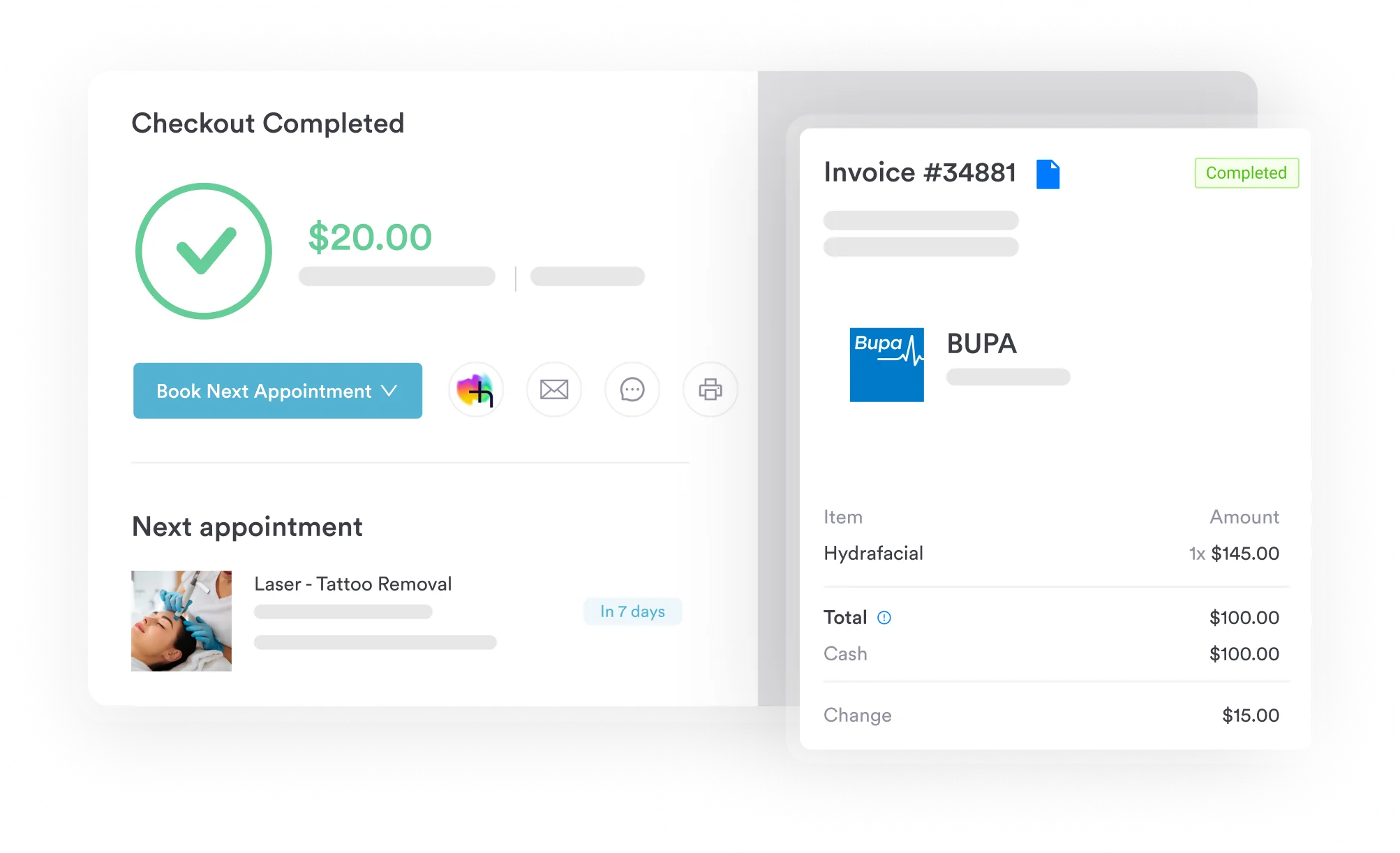
A clean claim on the first submission skips the appeal cycle described in the denial table above. Rejections and remittances come back against the same patient record, so a denied 99477 surfaces the day it happens.

Pabau connects directly to Claim.MD for electronic claim submission, real-time eligibility verification, and denial tracking. See how practices billing neonatal intensive care codes keep their clean claim rate high.

Treat 99477 as a one-day code with a hard handoff. Bill it for the initial NICU date only, then switch to 99478, 99479, or 99480 by present weight from day 2. If the neonate is critically ill, 99468 replaces it altogether.
The NICU claims that fail are rarely the hardest clinical cases. They are the long stays where day 1 gets billed twice, a weight change is missed, or the code is paired with 99291. A daily check of age in days, date of service, and weight prevents most of those denials.
Book a demo to see how Pabau keeps NICU documentation and claim submission in one workflow. Each day of the stay is then coded straight from the chart.

Billing a critically ill neonate after day 1? CPT code 99469 covers subsequent-day neonatal critical care and how it differs from the intensive care codes.
Need a clearinghouse integration for NICU claims? Claim.MD clearinghouse overview explains how Pabau’s US clearinghouse partner handles electronic claim submission and eligibility checks for physician billing.
Looking to understand the broader claim lifecycle? 837 file format guide covers how professional claims are structured and transmitted electronically from practice to payer.
CPT code 99477 covers the first day of NICU intensive care for a neonate aged 28 days or younger who is not critically ill. The neonate requires intensive observation, frequent interventions, and other intensive care services. The code bundles respiratory management, nutrition, medication oversight, vital sign monitoring, and parental counseling into one daily charge. The same provider cannot bill those bundled services separately on that date.
CPT 99477 covers the initial day of NICU intensive care for a neonate 28 days or younger, with no weight threshold. CPT 99478 covers continuing intensive care from day 2 onward for a neonate weighing less than 1,500 grams. The difference is timing. 99477 is billed once per NICU admission, on day 1, while 99478 is billed from day 2 for the lowest-weight neonates. If you bill 99477 on day 2, payers will deny it.
The exact 2026 rate varies by location and is updated annually in the CMS Physician Fee Schedule. Use the CMS MPFS lookup tool or the FastRVU calculator to find the locality-adjusted rate for your MAC jurisdiction. The 2026 work RVU for 99477 is 7.00, with 8.84 total RVUs nationally. Payment then depends on the conversion factor and the geographic practice cost indices (GPCI) for your location.
No. CPT 99477 and CPT 99291 are NCCI edit pairs and are mutually exclusive on the same date for the same provider and patient. Submitting both codes on the same claim will result in automatic denial of the lower-value code. Use 99477 for a NICU neonate aged 28 days or younger who is not critically ill on the initial day. A critically ill neonate on that day is reported with 99468 instead.
POS 21 (inpatient hospital) is required for CPT code 99477. NICU care is an inpatient service by definition, and most payers deny a claim submitted with any other place of service code. The code cannot be billed from the emergency department, an observation unit, or a step-down unit.
The attending physician who personally supervises NICU care on the initial date of service bills CPT code 99477. Nurse practitioners and physician assistants may bill under their own NPI, typically at 85% of the physician rate under Medicare. Eligibility depends on carrier policy and state scope-of-practice law. Some payers restrict NICU-level codes to physicians, so verify eligibility before submitting under a non-physician provider.



