CPT Code 99465: Newborn resuscitation in the delivery room
CPT Code 99465: Definition and clinical description CPT Code 99465 is the AMA pr...

Last Updated: Nov 2, 2026
99461 is the CPT code for initial evaluation and management, per day, of a normal newborn seen in other than hospital or birthing center.
It is the non-hospital counterpart to 99460, which covers the same first-day care in a hospital or birthing center. 99461 applies when a normal newborn is first seen outside those settings, for example after a home birth. AAP coding guidance also allows it for an initial office visit when no clinician from your practice saw the baby at birth.
Let Pabau's smart automation suggest the right codes, reduce claim denials, and keep your practice compliant—effortlessly.
Automate repetitive tasks and focus on what matters most—your patients.
Reduce coding errors and ensure compliance with the latest regulations.
Clean claims, fewer denials, and faster reimbursements.
Powerful insights and reporting to help your practice thrive.
HIPAA compliant SOC 2 certified GDPR-compliant Trusted by 4,000+ clinics worldwide

CPT code 99461 covers initial care of a normal newborn seen outside a hospital or birthing center, such as after a home birth.
AAP guidance also allows 99461 at a first office visit if no clinician from your practice saw the baby at birth. Confirm your payer’s policy.
Documentation must reflect an initial encounter: birth history, full physical exam, MDM, and parent counseling.
Traditional Medicare Part B does not cover 99461 because newborns are not Medicare beneficiaries. Medicaid programs and commercial payers generally cover it, but check your state manual.
CPT code 99461 is an Evaluation and Management (E&M) code for the initial care of a normal newborn seen outside a hospital or birthing center. The American Medical Association, which publishes and maintains the CPT code set, defines the eligible setting as anywhere other than a hospital or birthing center.
The code sits in the newborn care subsection, 99460-99465, alongside the hospital and delivery-room codes in our CPT code library.
99461 is the non-hospital counterpart to 99460, which covers the same first-day care in a hospital or birthing center. It fits a normal newborn first seen outside those settings, such as after a home birth.
AAP coding guidance also allows 99461 for a first office visit when no clinician from your practice saw the baby at birth. That same-group point is AAP guidance and payer policy rather than CPT wording, so confirm it with your payer.
The official CPT descriptor reads: Initial care, per day, for evaluation and management of normal newborn infant seen in other than hospital or birthing center.
Key elements of the descriptor to understand:
The 99461 visit encompasses more than a physical exam. The American Academy of Pediatrics (AAP) outlines the components that should be addressed at the initial outpatient newborn visit.
Each of these elements supports the 99461 claim. A visit that documents only weight and a jaundice check, without MDM and parent counseling, typically will not withstand payer audit.
For 99461, the chart must show that this is an initial newborn encounter rather than a subsequent one. Payers look for the elements below.
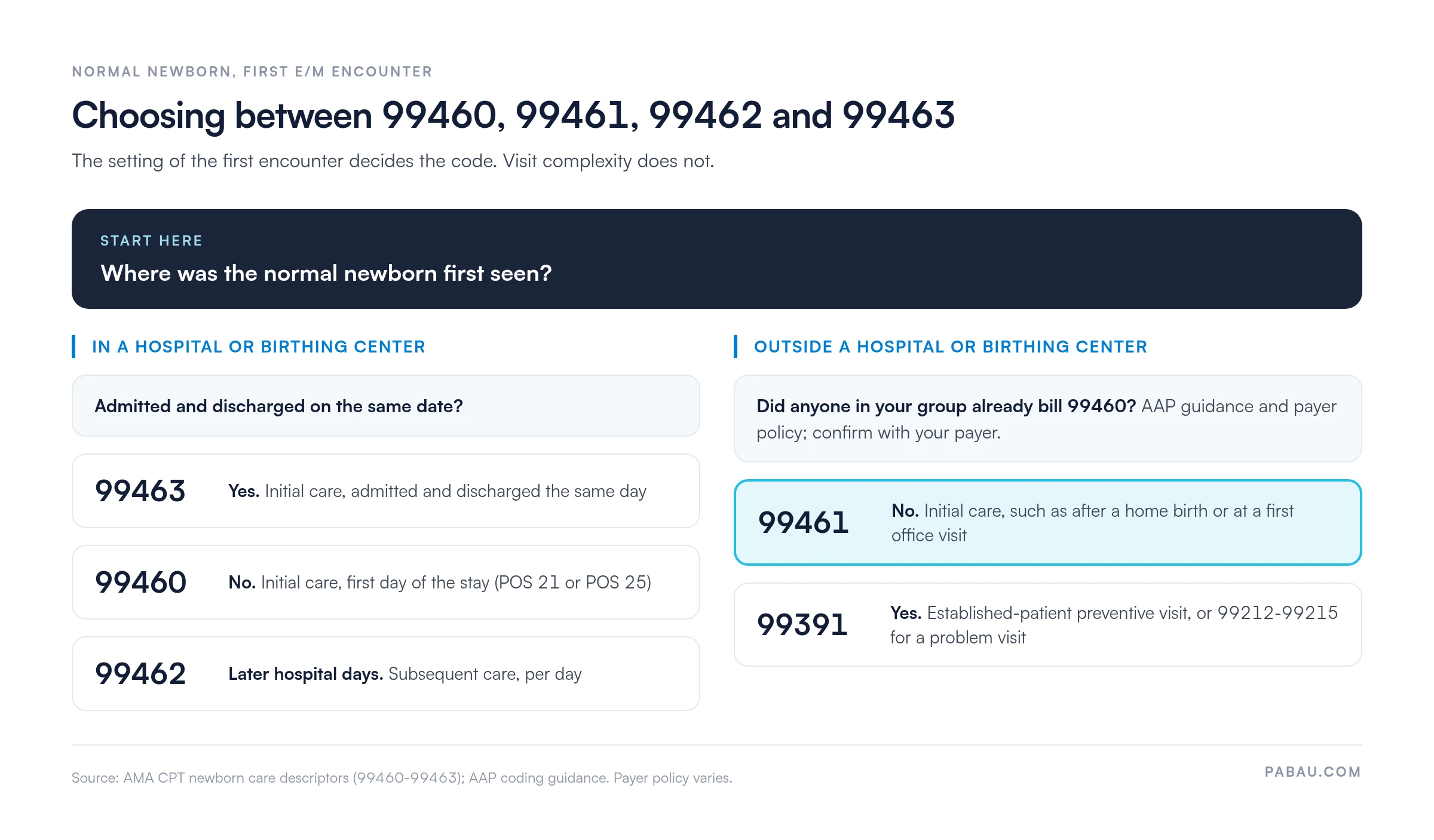
The place where the newborn is first seen decides between 99460 and 99461. Visit complexity plays no part.
The same-group rule comes from AAP coding guidance and payer policy, not from the CPT descriptor. Under that guidance, a group that billed 99460 in the hospital does not report 99461 at the first office visit. Payers that apply it usually match claims by Tax Identification Number (TIN) or group NPI, so confirm the policy with each payer.
Each of these three codes fits a different setting or point in the newborn’s care. The table sets them side by side.
A practical rule: if the infant is still in the hospital, the code is never 99461. Outside the hospital, 99461 fits the first newborn E/M visit when no one in your group has billed initial newborn care. The decision chart below follows that choice from the first question.
Two codes sometimes confused with 99461 are 99464 and 99465, though their billing contexts are entirely different.
Neither 99464 nor 99465 counts as initial newborn care, so neither triggers the same-group guidance on 99461. Both are procedural codes rather than newborn E&M codes. Confirm payer policy before combining them on one claim with any newborn E&M code.
Before billing CPT code 99461 for a first office visit, check the hospital record. Look for a 99460 claim from anyone in your Tax Identification Number (TIN) group. If one exists and your payer follows AAP same-group guidance, expect a denial. Note in the chart that this visit is the infant’s first E&M contact with your group.
Traditional Medicare Part B does not cover CPT code 99461. Newborns are not Medicare beneficiaries, and Part B eligibility requires individual enrollment.
Coverage comes from two main sources:
For RVU-based benchmarking, the CMS Physician Fee Schedule lookup tool provides the national non-facility work RVU and practice expense RVU for 99461. You can also use the FastRVU 2026 RVU lookup for location-adjusted reimbursement estimates. Your payment depends on your geographic adjustment factor and payer contract rates. Treat the published CMS non-facility amount as a benchmark.
Refer to medical billing compliance guidance when establishing internal verification steps for Medicaid claims, especially in states with managed care carve-outs for newborn services.
Denials on 99461 follow predictable patterns, and each one is cheaper to prevent than to appeal. A sound denial management workflow starts with pre-submission checks.
A clean claim for 99461 needs the right place of service and a check against your payer’s same-group policy. The chart also has to show every encounter component before the claim leaves the practice.
Most 99461 claims are submitted without modifiers. When a modifier is needed, the most common ones are listed below.
Never append a modifier to improve reimbursement prospects without supporting documentation. Modifier misuse on newborn E&M codes is a documented audit target for both Medicaid and commercial payers.
Pediatric and family practices billing CPT code 99461 need the claim, the payer’s response and any denial in one place. Pabau, the practice management platform we build, offers claims software for pediatricians that covers claim submission, eligibility checks and remittance tracking. Your billing team works one queue instead of several payer portals.
For US payers, Pabau connects to the Claim.MD clearinghouse, which sends CMS-1500 claims to thousands of insurers. Staff can check coverage and benefits in real time before the visit.
Electronic remittance advice comes back into Pabau, and denied claims are flagged for rework. Your team can then correct the chart or the place of service and resubmit a denied 99461 claim sooner.

Get newborn visits paid with less chasing. Pabau submits claims through Claim.MD, checks eligibility in real time and flags denied claims for rework.

Before you code a normal newborn’s first visit, answer two questions. Where was the baby first seen, and has anyone in your group already billed 99460? A home birth, or an office visit with no earlier contact from your practice, points to 99461.
The second question is where payers differ. Confirm each major payer’s same-group policy once, and record the answer where your coders can see it. That small step protects every 99461 claim you send to that payer.
Book a demo to see how Pabau submits newborn claims, checks eligibility and tracks denials from one billing queue.

Want to understand how claims get paid end to end? Revenue cycle management overview walks through the full billing lifecycle from encounter to payment posting.
Dealing with recurring claim rejections? Denial codes in medical billing explains common CARC codes and how to resolve each category.
Submitting pediatric claims electronically? Claim.MD clearinghouse guide covers how the clearinghouse handles claims before they reach payers.
Billing later days of a newborn hospital stay? CPT code 99462 explains subsequent hospital care for a normal newborn.
Coding the next well-child visit? CPT code 99391 covers the established-patient preventive visit for infants under one year.
CPT code 99461 is the Evaluation and Management code for initial care of a normal newborn seen outside a hospital or birthing center. It covers settings such as a home birth. AAP guidance also allows it for a first office visit when your practice did not see the baby at birth.
Bill 99461 when the newborn’s first E&M encounter happens outside a hospital or birthing center, such as after a home birth. AAP guidance also allows it at a first office visit when your group did not bill 99460. Payer policy on that same-group point varies, so confirm it with your payer.
CPT 99461 covers initial care of a normal newborn seen outside a hospital or birthing center. 99463 covers initial hospital care for a newborn admitted and discharged on the same calendar day. 99461 is a non-hospital code, while 99463 is an inpatient same-day code.
CPT code 99461 covers a newborn’s initial E&M exam in an office when no clinician from your practice saw the baby at birth. That reflects AAP guidance and payer policy, so confirm it with your payer. Later well-child visits use established-patient preventive codes such as 99391, or 99212-99215 for a problem visit.