CPT code 57460: Colposcopy with loop electrode biopsy
CPT code 57460: Official descriptor and procedure category CPT code 57460 report...

Last Updated: Oct 19, 2026
An inpatient billing cheat sheet is a quick reference for the codes and claim rules a hospital team uses on every admission. It covers hospital E&M and consult codes, ICD-10-CM sequencing, UB-04 locators, revenue codes, modifiers and denial codes.
The core of it fits in two lines. Initial care is coded 99221 to 99223, daily rounds 99231 to 99233, and discharge 99238 or 99239. Medicare doesn’t pay inpatient consult codes, and the hospital’s UB-04 carries the facility side of the stay.
Hospitalists, inpatient coders and facility billing teams use it to stop switching between the CPT codebook, CMS manuals and the UB-04 specifications mid-shift. The sections below explain each rule and where it differs from outpatient billing.
A printable reference with initial, subsequent and discharge hospital care codes, Medicare consult rules and ICD-10-CM sequencing. It also covers the key UB-04 locators, common revenue codes, modifiers and denial reason codes.
Download template
Inpatient billing uses initial (99221 to 99223) and subsequent (99231 to 99233) hospital care codes, not outpatient visit codes.
Medicare does not pay inpatient consult codes 99251 to 99255, so consult coding must follow payer rules.
Time thresholds changed with the 2023 AMA E&M revisions, and older charts still circulate.
On the UB-04, the admission date goes in FL 12, the principal diagnosis in FL 67 and the principal procedure in FL 74.
Initial hospital care codes 99221 to 99223 cover the first inpatient encounter with a patient. The level depends on medical decision making (MDM) or total time on the date of service. Subsequent hospital care codes 99231 to 99233 cover daily rounding visits after that first encounter.
If you plan to code by time, document the total time you spent on the date of service. The AMA counts only the clinician’s own activities toward it. Note whether the visit included a face-to-face encounter, since that changes what the note must show.
Inpatient consultation codes 99251 to 99255 are not paid by Medicare, so a Medicare admission should be coded with the initial hospital care codes instead. Commercial payers may still accept consult codes, so check the contract before submitting.
For each consult, record the requesting physician, the reason for the consult and the opinion given. Those three details are what most payers check when they review a consult claim.
Under the two-midnight rule, Medicare generally treats an inpatient admission as appropriate when the physician expects hospital care to span two or more midnights. Shorter stays may still qualify on a case-by-case basis. The CMS Internet-Only Manual (IOM) Pub. 100-02, Chapter 1, Section 10 sets out the policy.
Check the current year’s IPPS final rule before you rely on any DRG weight. Figures change annually, so do not use a previous year’s table for a current discharge.
For inpatient facility coding, the principal diagnosis is the condition established after study to be chiefly responsible for the admission. That definition comes from the Uniform Hospital Discharge Data Set (UHDDS). Secondary diagnoses that were present on admission and affect care should be captured with their POA indicator.
Sequencing for inpatient claims follows the ICD-10-CM Official Guidelines Section II. Outpatient rules for uncertain diagnoses do not apply to inpatient discharges, so confirm the status of each diagnosis at discharge.
Audit the principal diagnosis on every discharge summary before final coding. Compare it with the admission reason and the treatment delivered, and query the physician when the documentation does not clearly support the sequencing.
Inpatient facility claims are submitted on the UB-04 form, and each field locator (FL) carries a specific data element. Five locators come up on almost every claim. They are FL 4 (type of bill), FL 12 (admission date), FL 44 (HCPCS and rates), FL 67 (principal diagnosis) and FL 74 (principal procedure).
Revenue codes describe the department or service on each line, such as room and board, pharmacy, laboratory, radiology and operating room. Match each revenue code to the charge it supports so the claim lines reconcile with the UB-04 totals.
Modifiers adjust a CPT code without changing its description, and several appear regularly on inpatient physician claims. Use them only when the documentation supports the circumstance.
Denials on inpatient claims usually trace back to a missing authorization, a diagnosis that doesn’t support the procedure, or incomplete documentation. Claim adjustment reason codes (CARC) and remittance advice remark codes (RARC) state the reason, and the corrective action depends on the code. Our list of the top 20 CARC codes covers each fix in more detail.
Read the CARC and the RARC together before you correct the claim. The remark code often names the missing item, which saves a second denial for the same reason.
Hospitalists code each encounter from admission to discharge, so the cheat sheet works best as a daily checklist. The flow below shows which code family applies on each day of a stay, and where the facility claim takes over.
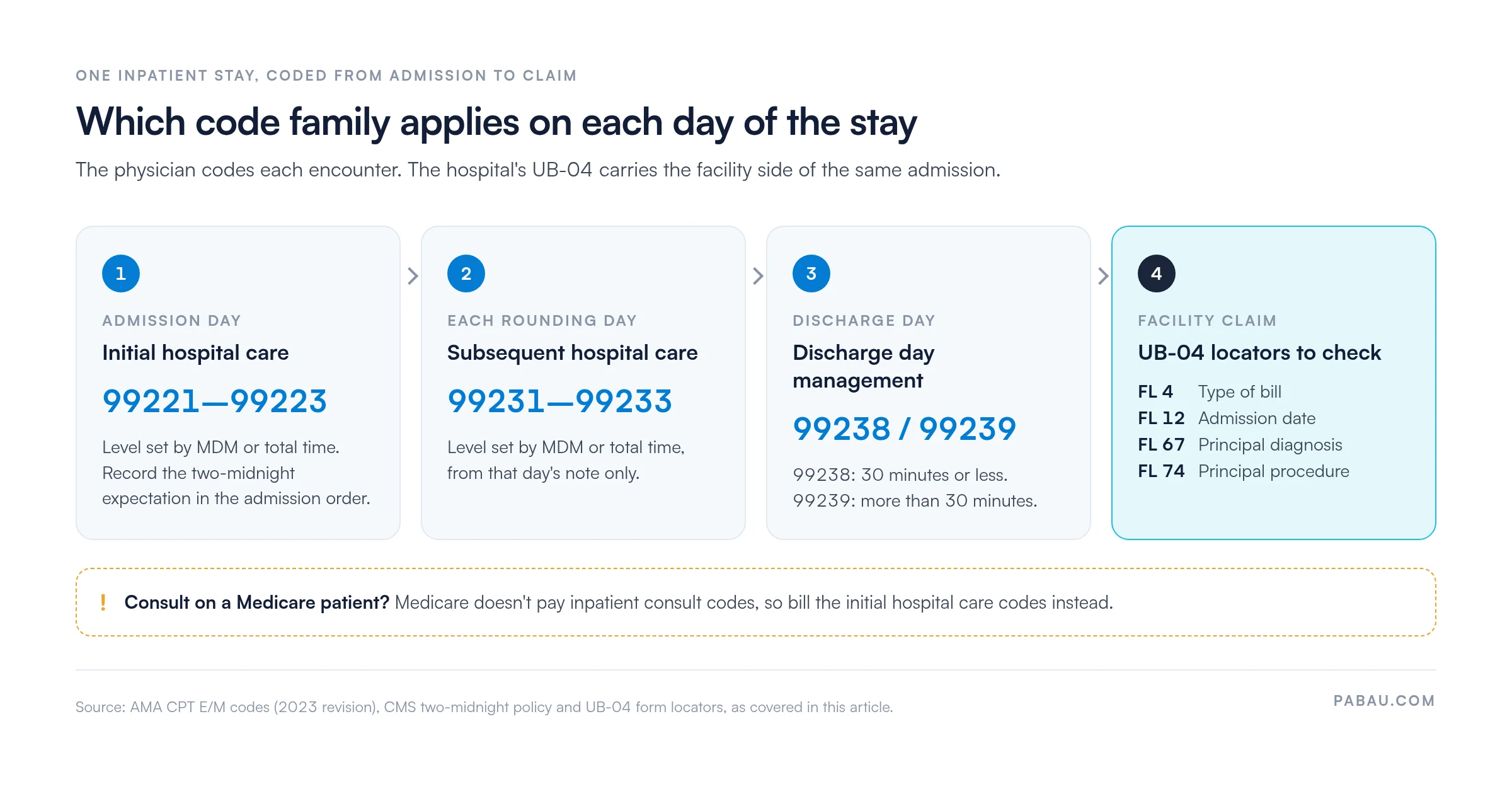
Work through the same five steps for every patient on your list.
The most frequent error is applying an outpatient visit code to an inpatient encounter. A cheat sheet only helps if the coder checks the setting first and then selects the matching code family. For office and outpatient visits, use our medical coding cheat sheet instead.
Another common mistake is using a time threshold from an older chart. Confirm the current AMA CPT guidance before you code by time, because the 2023 revisions changed the minimum time for several levels.
Date every cheat sheet you print or share. Replace it when the AMA or CMS publishes a revision, and keep the previous version on file for audit purposes.
On many billing teams, the cheat sheet lives in a binder, claims go out from one system and denials land in a spreadsheet. Each handoff is another chance to key a code twice or lose a denial reason.
Pabau, the all-in-one practice management system we build, raises, submits, tracks and reconciles insurance claims from the patient record. Its medical billing software stores insurance details once and carries prior authorization codes with the appointment. Claim validation flags errors before a claim bounces back, and claims go out through your clearinghouse.
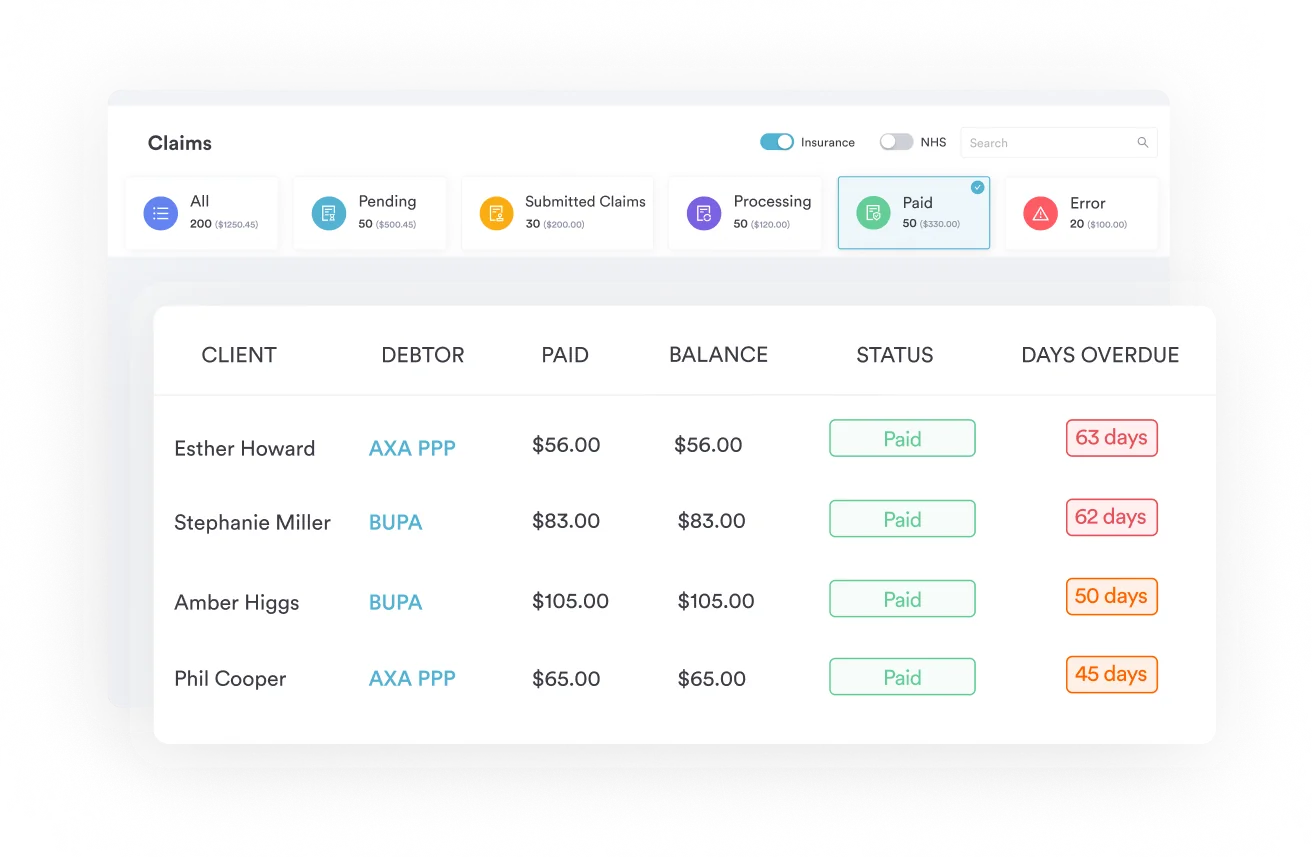
Denial reasons then sit against the original claim, so the team spots a repeat pattern and fixes its cause instead of resubmitting. Pabau suits physician groups and consultants who bill their own professional services. A hospital’s UB-04 facility claim still runs through the hospital’s own billing system.

See how Pabau raises, submits and tracks insurance claims from the patient record, so each denial reason sits next to the claim it belongs to.

Use the cheat sheet as a check at each encounter rather than a document you read once. Confirm the setting, then the code family, then the time rule, because the most frequent error starts with the wrong family.
The trade-off is upkeep. CPT and CMS publish revisions every year, so a sheet you never replace slowly becomes a source of denials.
If denials still come back to a spreadsheet nobody owns, the reference alone won’t stop them repeating. Book a demo to see how Pabau ties each denial reason to its original claim.

Need the professional claim form too? CMS-1500 form walks through the form physicians use to bill their own services.
Seeing the same denial twice? Denial management in healthcare covers the process for finding and preventing repeat denials.
Admissions stalling on authorization? Medical prior authorization form gives you a template for requesting payer approval up front.
Coding a high-complexity admission? CPT code 99223 explains the documentation behind the highest initial care level.
Need to track claims in one place? Claims management software shows how billing teams monitor submissions and denials.
An inpatient billing cheat sheet is a quick-reference guide to the codes and rules used on hospital admissions. It covers E&M codes, consult codes, ICD-10-CM sequencing, UB-04 locators, revenue codes, modifiers and denial codes.
No, Medicare does not pay inpatient consultation codes 99251 to 99255. Commercial payers may accept them, so check the contract first.
Observation is an outpatient service, while inpatient status follows an admission order and the two-midnight expectation. The status affects billing codes and patient cost-sharing.