CPT code 99461: Initial newborn care guide
What CPT code 99461 means and when it applies CPT code 99461 is an Evaluation an...

Last Updated: Nov 2, 2026
99465 is the CPT code for delivery room resuscitation of a newborn with positive pressure ventilation and/or chest compressions. It applies when the newborn has acute inadequate ventilation and/or cardiac output immediately after birth.
CPT 99464 covers attendance at delivery and initial stabilization when no resuscitation is needed. When resuscitation occurs, 99465 is reported instead of 99464, not alongside it.
Let Pabau's smart automation suggest the right codes, reduce claim denials, and keep your practice compliant—effortlessly.
Automate repetitive tasks and focus on what matters most—your patients.
Reduce coding errors and ensure compliance with the latest regulations.
Clean claims, fewer denials, and faster reimbursements.
Powerful insights and reporting to help your practice thrive.
HIPAA compliant SOC 2 certified GDPR-compliant Trusted by 4,000+ clinics worldwide

CPT Code 99465 covers delivery room resuscitation with positive pressure ventilation and/or chest compressions, not routine newborn assessment.
The same provider does not report 99464 and 99465 together. When attendance turns into resuscitation, 99465 is reported alone.
Endotracheal intubation (31500), umbilical venous catheter placement and medications are reported separately, and only when essential to the resuscitation.
Same-date billing with 99468 depends on current NCCI edits and payer policy, so check the CMS PTP table before submitting both.
Pabau, the practice management platform we build, checks eligibility in real time and tracks each 99465 claim through its Claim.MD integration.
CPT Code 99465 is the AMA procedure code for resuscitation of a newborn in the delivery room immediately after birth. A physician or other qualified health care professional reports it after performing the resuscitation. The AMA’s CPT code set gives the official descriptor. Delivery/birthing room resuscitation, provision of positive pressure ventilation and/or chest compressions in the presence of acute inadequate ventilation and/or cardiac output.
The code requires three elements: the delivery or birthing room setting, acute inadequate ventilation or cardiac output, and positive pressure ventilation and/or chest compressions. Passive observation of a vigorous newborn, routine bulb suctioning, and brief supplemental oxygen alone do not qualify.
CPT Code 99465 covers two interventions: positive pressure ventilation (PPV) and chest compressions. The Neonatal Resuscitation Program (NRP), developed by the American Academy of Pediatrics (AAP) and the American Heart Association, sets the clinical thresholds for each.
The interventions that support CPT Code 99465 are:
Other procedures performed during the same event sit outside the 99465 descriptor. Endotracheal intubation (CPT 31500), umbilical venous catheter (UVC) placement and medications are reported separately, and only when they were essential to the resuscitation.
PPV and chest compressions both go beyond the initial stabilization steps of warming, drying, stimulation, suctioning of secretions and supplemental oxygen. A chart documenting only those steps does not support 99465.
CPT Code 99464 covers attendance at delivery and initial stabilization of the newborn. The delivering physician or other qualified health care professional must request the attendance. CPT Code 99465 covers resuscitation with PPV and/or chest compressions. The two describe different services, so a provider reports one or the other.
When a provider attends at the delivering physician’s request and the newborn then needs resuscitation, the claim carries 99465 alone. AAP coding guidance published in AAP News says the two codes are not reported together by the same provider. Payer policies such as Highmark’s fold the attendance into 99465.
The note should still record the attendance request, because it shows why the provider was present when resuscitation began. The diagram below maps the decision from the request to the claim.
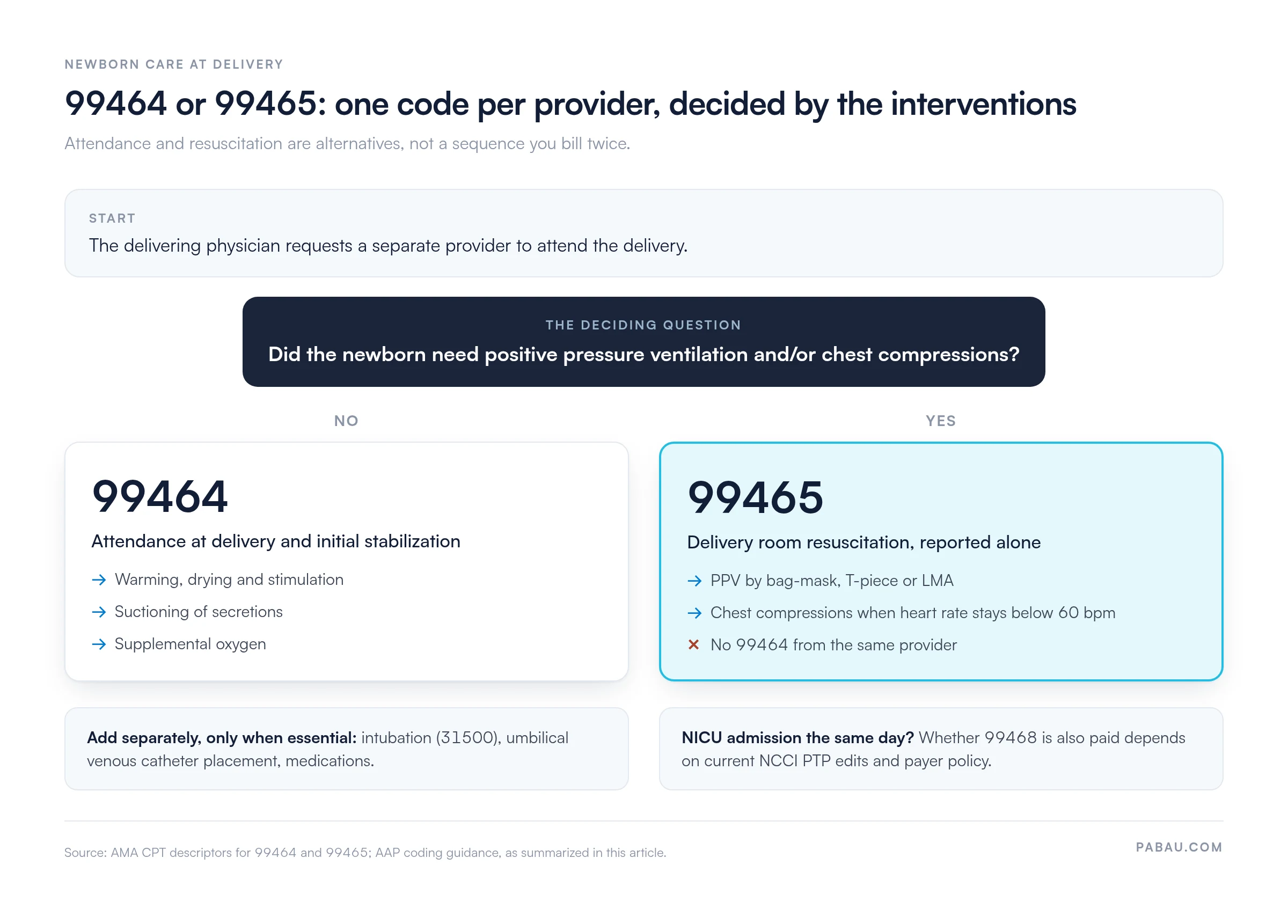
CPT Code 99465 is a single delivery-room event. CPT codes 99468 (initial day of inpatient neonatal critical care) and 99469 (subsequent day) cover ongoing critical care after NICU admission. Whether 99465 and 99468 are both paid for the same date depends on the NCCI procedure-to-procedure (PTP) edits in force and on payer policy.
A neonate resuscitated in the delivery room and admitted to the NICU on the same day raises the most common coding question here. Treat it as an edit-specific check rather than a general bundling rule.
Look the pair up in the CMS NCCI PTP edit tables and read the payer’s own policy before billing both codes for that date. The confirmed mutually exclusive pair in this family is 99468 with 99469.
CPT Code 99465 is one code in the 99460-99480 neonatal and pediatric care series. Each code addresses a specific care scenario, so the descriptor and the documentation decide which one applies.
Payer auditors and Medicare Administrative Contractors (MACs) look for specific chart elements when reviewing CPT Code 99465 claims. A claim missing any of these elements is exposed to retroactive payment recovery.
A resuscitation attestation template embedded in the delivery note, pre-populated with these fields, is the most practical way to capture every element. Structured superbill documentation that captures these data points at the time of care cuts down the retrospective chart reconstruction that triggers compliance reviews.
Build a resuscitation attestation section directly into your delivery note template. Include fields for time of birth, time PPV started and the interventions used, where checkboxes work well. Add heart rate at the 1- and 5-minute marks and the provider name with credentials. A provider who completes all fields at delivery takes roughly 90 seconds – far less than a retrospective addendum that may not hold up under audit.
Every CPT Code 99465 claim requires a supporting ICD-10-CM diagnosis code that establishes medical necessity. The Z38 liveborn infant series anchors the encounter; a secondary code naming the specific condition that required resuscitation should always accompany it. The table below lists the most commonly paired codes. Confirm specificity against the current ICD-10-CM tabular list before submitting.
Always code to the highest level of specificity the chart supports. If the chart documents severe birth asphyxia, use P21.0 rather than an unspecified code. Payers that require medical necessity crosswalks will look for alignment between the intervention documented and the diagnosis code submitted.
Medicare reimburses CPT Code 99465 under the Medicare Physician Fee Schedule (MPFS). Because this service almost always occurs in a hospital setting, the facility rate applies – the non-facility rate is rarely relevant for this code.
Medicaid reimbursement varies by state; some state programs reimburse at rates below Medicare while others exceed it. Contact the relevant state Medicaid program for current figures before projecting revenue.
Key reimbursement considerations:
CPT Code 99465 denials cluster around incomplete documentation and coding rule violations. The table below lists the most frequent denial reasons and the resolution for each. It draws on denial management best practices and published denial codes in medical billing.
Neonatal resuscitation billing requires tighter documentation discipline than most E/M codes because the service is high-intensity, time-pressured, and almost always reviewed on appeal when denied.
Check your MAC’s local coverage determination (LCD) for neonatal resuscitation annually. Some MACs have issued documentation guidance for 99465 that goes beyond the general CPT instructions. It can cover provider attestation language and the minimum clinical threshold for billing versus observation codes. A five-minute annual review of the LCD prevents multi-claim retroactive denials.
Without a connected billing system, a 99465 claim gets assembled after the fact. Staff confirm coverage by phone, key the claim into a separate clearinghouse portal, and chase its status by hand.
Pabau, the practice management platform we build, includes claims software for practices that bill US payers. Its Claim.MD integration submits claims to thousands of US payers and tracks each claim’s status through to the electronic remittance advice (ERA).
It also runs real-time eligibility checks before the date of service. For scheduled inductions and planned cesareans, coverage problems surface before the delivery rather than after a denial. Your team sees each submitted claim’s status in one place, so a rejected 99465 claim gets corrected and resubmitted quickly.

Pabau checks eligibility in real time, submits claims to thousands of US payers through Claim.MD, and tracks each one through to the ERA. Your team follows every neonatal claim from submission to payment.

Treat 99464 and 99465 as alternatives, not a sequence. Once the provider starts positive pressure ventilation or chest compressions, the claim is 99465, and intubation or line placement goes on its own line.
The same-date question with 99468 has no blanket answer, so build the habit of checking the current NCCI edit and the payer’s policy before submission. A delivery note written at the time of care, with the indication, timestamps and each intervention, is what holds up on review.
Pabau tracks each 99465 claim from the eligibility check to the remittance, so your team sees a problem while it can still be fixed. Book a demo to see how it fits a neonatal billing workflow.

Need to understand how clearinghouses process neonatal claims? Medical claims clearinghouse guide covers how claims are validated, scrubbed, and routed to payers before payment.
Want to reduce claim rejections before they happen? Electronic remittance advice (ERA) explained details how to read ERAs and use denial reason codes to prevent repeat rejections.
Working through a credentialing issue that’s blocking 99465 payments? How to get credentialed with insurance companies walks through the enrollment process by specialty and payer type.
CPT Code 99465 is the AMA procedure code for delivery room resuscitation of a newborn with positive pressure ventilation and/or chest compressions. It applies when the neonate shows acute inadequate ventilation or cardiac output immediately after birth. Endotracheal intubation is reported separately. It is a standalone Category I code in the newborn care services series.
No. The same provider does not report 99464 and 99465 together. When a provider attends a delivery and the newborn then needs resuscitation, report 99465 alone. 99464 is for attendance and initial stabilization when no resuscitation was needed.
CPT Code 99465 covers a single delivery-room resuscitation immediately after birth. CPT Code 99468 covers the first day of inpatient neonatal critical care in the NICU. Whether both are paid for the same date depends on the current NCCI procedure-to-procedure edits and the payer’s policy, so check both before submitting.
Coverage varies by state. Most state Medicaid programs cover CPT Code 99465 for qualified providers, but their rates differ from Medicare. Managed care organizations within Medicaid also use their own contracted rates. Contact the specific state Medicaid program or the managed care plan for current coverage and rate information before billing.