HCPCS Code L0472: Hyperextension TLSO billing guide
HCPCS code L0472: Official descriptor and device definition HCPCS code L0472 des...

Last Updated: Nov 5, 2026
90678 is the CPT code for respiratory syncytial virus vaccine, preF, subunit, bivalent, for intramuscular use. It maps to one product only: ABRYSVO (Pfizer), CVX 305.
ABRYSVO is approved for pregnant patients at 32 to 36 weeks gestation, adults 60 and older, and adults 18 to 59 at increased risk. AREXVY bills under 90679 and mRESVIA under 90683. Infant RSV antibodies have their own codes, 90380 or 90381 for nirsevimab and 90382 for clesrovimab.
Let Pabau's smart automation suggest the right codes, reduce claim denials, and keep your practice compliant—effortlessly.
Automate repetitive tasks and focus on what matters most—your patients.
Reduce coding errors and ensure compliance with the latest regulations.
Clean claims, fewer denials, and faster reimbursements.
Powerful insights and reporting to help your practice thrive.
HIPAA compliant SOC 2 certified GDPR-compliant Trusted by 4,000+ clinics worldwide

CPT code 90678 covers one RSV vaccine only: ABRYSVO (Pfizer), the bivalent RSVpreF vaccine, CVX 305.
AREXVY bills under 90679 and mRESVIA under 90683. Infant RSV antibodies have their own codes, 90380 or 90381 for nirsevimab and 90382 for clesrovimab.
ABRYSVO is the only RSV vaccine approved in pregnancy, given as one dose at 32 to 36 weeks gestation.
Medicare covers adult RSV vaccines under Part D, so the claim goes to the patient’s Part D plan with no cost-sharing.
On commercial and Medicaid claims, pair 90678 with administration code 90471 and diagnosis code Z23.
CPT code 90678 is the billing code for ABRYSVO, Pfizer’s bivalent RSV prefusion F (RSVpreF) vaccine, given as a single intramuscular dose. It covers no other RSV product. The table below lists the fields coders need at a glance.
The bivalent RSVpreF formulation is what separates 90678 from the other RSV codes in the American Medical Association’s CPT code set. GSK’s AREXVY is an adjuvanted monovalent vaccine with its own code, 90679. Moderna’s mRESVIA, an mRNA vaccine, bills under 90683.
CPT code 90678 covers ABRYSVO only. It is the one RSV vaccine with three FDA-approved uses: maternal immunization, older adults, and younger adults at increased risk. Vaccine tracking in Pabau, the practice management platform we build, records the product and lot number at the point of care. The claim then carries the fields payers check.
The FDA label sets who can receive ABRYSVO. ACIP recommendations then decide which uses payers treat as routine preventive care.
AREXVY and mRESVIA are not approved in pregnancy, so a maternal RSV dose is always ABRYSVO and always 90678. CDC does not recommend another maternal dose in a later pregnancy after a prior vaccinated pregnancy. If the patient is not vaccinated in the current pregnancy, the infant should receive an RSV monoclonal antibody such as nirsevimab.
Five code families cover RSV prevention, and the product in the vial decides which one applies. Each code maps to one product, so reading the label settles the coding decision.
A practice that stocks AREXVY bills 90679, never 90678. The same goes for mRESVIA, which bills under 90683. Both infant antibodies, nirsevimab and clesrovimab, go on the infant’s claim with administration code 96380 or 96381 instead of 90471.
The codes on either side of 90678 are not RSV codes at all. CPT 90677 is the 20-valent pneumococcal conjugate vaccine (PCV20), and 90680 is the oral rotavirus vaccine RotaTeq. Confirm new product codes in the AAPC Codify CPT lookup or the current AMA code book before you load them into a fee schedule.
CPT code 90678 does not stand alone on a commercial or Medicaid claim. It needs a vaccine administration code and the immunization diagnosis code, and missing either one triggers a technical denial. That pairing is a basic step in revenue cycle management for immunization services.
Report 90471 or 90472 on its own service line, next to the 90678 product line.
ICD-10 code Z23 is the standard diagnosis for CPT code 90678. As the encounter-for-immunization code, it marks the visit as preventive, which payers need before they waive cost-sharing. On a maternal claim, many payers also expect the Z3A code for weeks of gestation, such as Z3A.34.
List 90678 and 90471 on separate service lines, even when the RSV vaccine is the only shot given. Some billing systems merge them into one line, and the payer then rejects the administration charge. Check that your software outputs two lines before you submit.
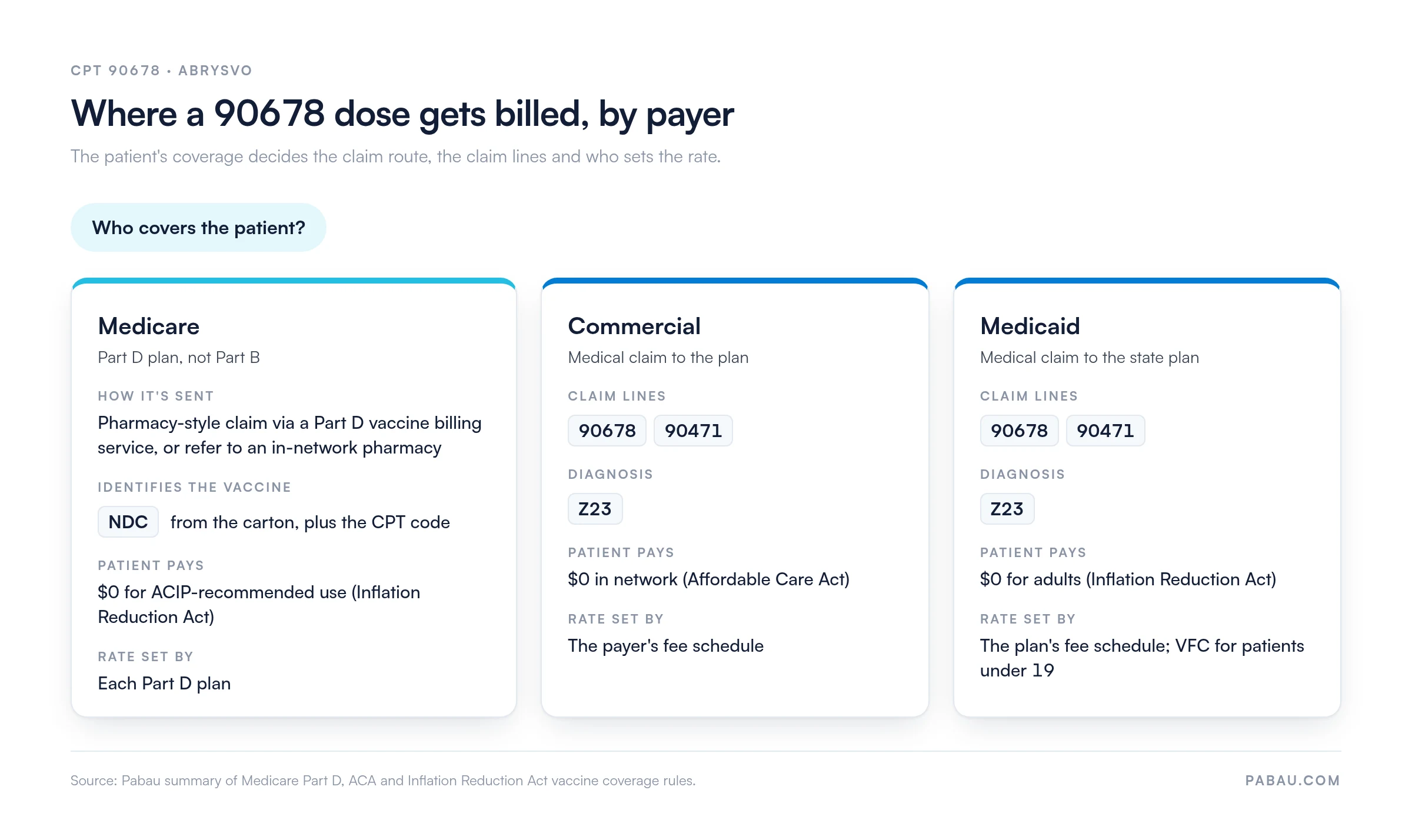
Who pays for 90678 depends on the patient’s coverage. Medicare, Medicaid and commercial plans each follow a different route, and the chart below shows what each one needs on the claim.
Practices using claims management software can route claims by payer and track allowed amounts against payments. Pabau’s US clearinghouse partner, Claim.MD, adds eligibility checks before the visit and electronic remittance advice afterward.
Medicare covers adult RSV vaccines under Part D, the prescription drug benefit, not Part B. Bill the dose to the patient’s Part D plan.
The Physician Fee Schedule does not set Medicare’s payment for 90678. Each Part D plan sets its own rate for the vaccine and its administration, so check the plan’s terms before the visit.
Under the Affordable Care Act, commercial plans cover ACIP-recommended vaccines without cost-sharing when given in network. The Inflation Reduction Act gives Medicaid adults the same zero cost-sharing for ACIP-recommended vaccines. Contracted rates for 90678 and 90471 still vary, so confirm each payer’s fee schedule before you set your RSV pricing.
The Vaccines for Children (VFC) program covers patients under 19. It touches 90678 only when an eligible pregnant patient is under 19, so check the current VFC resolution for that case.
Complete documentation prevents most denials for CPT code 90678. Medical billing documentation for vaccine claims needs specific immunization record fields on top of the clinical note. Keeping the vaccine encounter records HIPAA-compliant also protects the practice during audits.
Most denials for CPT code 90678 fall into five categories, and each has a specific fix. A structured denial management workflow catches them before resubmission becomes necessary. Sending a clean claim submission the first time prevents most of them.
When a claim is denied, pull the remittance advice and identify the CARC (Claim Adjustment Reason Code) before resubmitting. The CARC pinpoints the denial category, and our guide to medical billing denial codes lists the fix for each. Resubmitting without reading it repeats the same error.
Run an eligibility check before every RSV vaccine appointment. A check through your clearinghouse shows which plan pays, including the Part D plan for a Medicare patient. Pair it with a registry lookup to catch a dose given at another site before you vaccinate.
Most 90678 denials start at the point of care, when the vial given and the code billed don’t match. In a paper or spreadsheet workflow, staff retype the product and lot number into billing, and errors slip through.
In Pabau, the product, lot number and expiry date are recorded in the patient record when the vaccine is given. The claim is built from that record with its companion codes and sent through a clearinghouse. You get fewer product-code denials and less rework after the remittance comes back.

Pabau records vaccine lot numbers at the point of care and builds immunization claims from the patient record, so 90678 claims go out complete. See how it works.

Billing 90678 correctly starts with one check: the vial says ABRYSVO. Every other RSV vaccine has its own code, and both infant antibodies belong on the infant’s claim.
After that, the claim route matters more than the code. Medicare patients go to their Part D plan, while commercial and Medicaid claims need 90471 and Z23. Record gestational age or the risk condition, and the claim carries what payers ask for.
Pabau’s claims management software captures lot numbers, pairs companion codes and submits through a clearinghouse. Book a demo to see how Pabau gets your vaccine claims right on the first submission.

Need to understand clearinghouse claim submission for vaccines? Medical claims clearinghouse guide covers how clearinghouses validate, route, and track claims before they reach the payer.
Seeing remittance denials you can’t decode? Electronic remittance advice (ERA) explained breaks down how to read 835 remittance files and act on CARC denial codes.
Want to understand the 837P claim file your software generates? The 837 EDI transaction guide explains the data elements, segments, and submission requirements for professional claims.
CPT code 90678 covers ABRYSVO, Pfizer’s bivalent RSV prefusion F vaccine, given as one intramuscular dose. It is approved for pregnant patients at 32 to 36 weeks gestation, adults 60 and older, and adults 18 to 59 at increased risk.
No. AREXVY, GSK’s adjuvanted RSV vaccine, bills under CPT 90679 (CVX 303). CPT 90678 is for ABRYSVO only, and AREXVY is not approved for use in pregnancy.
mRESVIA, Moderna’s mRNA RSV vaccine, bills under CPT 90683 (CVX 326). Nirsevimab (Beyfortus) is a monoclonal antibody for infants, not a vaccine. It bills under 90380 for the 0.5 mL dose or 90381 for the 1 mL dose. Merck’s infant antibody clesrovimab (Enflonsia) bills under 90382.
Medicare covers RSV vaccines under Part D, so the claim goes to the patient’s Part D plan. Under the Inflation Reduction Act, enrollees pay nothing for ACIP-recommended adult vaccines, RSV vaccines included.
ACIP recommends one RSV vaccine dose for all adults 75 and older, and for adults 50 to 74 at increased risk of severe RSV. It also recommends ABRYSVO for pregnant patients at 32 to 36 weeks, usually from September through January.
CPT 90471 is the companion administration code for the first injected vaccine on the date of service. If the patient gets another vaccine at the same visit, add CPT 90472 for each additional one. List 90678 and 90471 on separate service lines of the same claim.
ICD-10 code Z23 (Encounter for immunization) is the standard diagnosis for CPT code 90678 and should be listed first. Submitting 90678 without Z23, or with an unrelated diagnosis, typically results in a technical denial.
CPT 90677 is the 20-valent pneumococcal conjugate vaccine (PCV20), not an RSV vaccine. CPT 90678 is the RSV vaccine ABRYSVO. The two codes sit next to each other in the vaccine range, which is why they get confused.
ACIP recommends a single RSV vaccine dose for eligible adults, and revaccination is not currently recommended. CDC does not recommend another maternal dose in a later pregnancy after a prior vaccinated pregnancy. If the patient is not vaccinated in the current pregnancy, the infant should receive an RSV monoclonal antibody such as nirsevimab. Check the state registry before vaccinating to avoid a denied repeat claim.