ICD-10 Code D25.9: Leiomyoma of uterus, unspecified
ICD-10 Code D25.9: Definition and quick reference ICD-10 Code D25.9 is the billa...

Last Updated: Nov 24, 2026
Billable Code Specific Code
B02.9 is the billable ICD-10-CM code for zoster without complications. It covers herpes zoster (shingles) when the note records the dermatomal rash and no nervous system, eye, meningeal, disseminated or other complication.
The code sits in category B02, Zoster [herpes zoster], within the B00-B09 block of viral infections with skin and mucous membrane lesions. Assignment turns on what the encounter note documents. Once postherpetic pain, eye involvement or spread is recorded, a more specific B02 code replaces B02.9.
Let Pabau's smart automation suggest the right codes, reduce claim denials, and keep your practice compliant—effortlessly.
Automate repetitive tasks and focus on what matters most—your patients.
Reduce coding errors and ensure compliance with the latest regulations.
Clean claims, fewer denials, and faster reimbursements.
Powerful insights and reporting to help your practice thrive.
HIPAA compliant SOC 2 certified GDPR-compliant Trusted by 4,000+ clinics worldwide

B02.9 is the billable ICD-10-CM code for zoster (shingles) when the encounter note documents no complication.
Using B02.9 once the note records a complication, such as postherpetic neuralgia, eye involvement or encephalitis, is a coding error that invites denial.
Record the rash onset and resolution dates, because pain that outlasts the rash moves the encounter to the B02.2x block.
The ICD-9-CM predecessor 053.9 (herpes zoster without mention of complication) maps approximately to B02.9 in the CMS GEM files.
Pabau’s claims management software submits electronic claims through Claim.MD and tracks remittances for each B02.9 claim.
ICD-10 code B02.9 is the billable ICD-10-CM code for zoster without complications. It covers shingles when the note documents no nerve, eye, meningeal or disseminated involvement. CMS’s FY 2027 ICD-10-CM code files list B02.9 as a valid code with no further subdivision. Check it against the CDC/NCHS ICD-10-CM web tool for the encounter’s fiscal year before submission.
B02.9 applies when the clinical note documents herpes zoster reactivation and records no organ involvement or neurological complication. The varicella-zoster virus (VZV) causes the initial chickenpox infection and then lies dormant in the dorsal root ganglia. Reactivation produces the classic unilateral dermatomal rash, typically on the trunk, face or extremities. Prodromal burning or shooting pain comes with it.
The following presentations fall within B02.9’s scope, as long as no complication is documented:
The deciding phrase in the encounter note is “no documented complications.” If the note is silent on complications, payers may still expect explicit confirmation during an audit. Document the dermatomal distribution, the clinical or laboratory confirmation of VZV, and a statement that no organ or nerve involvement is present.
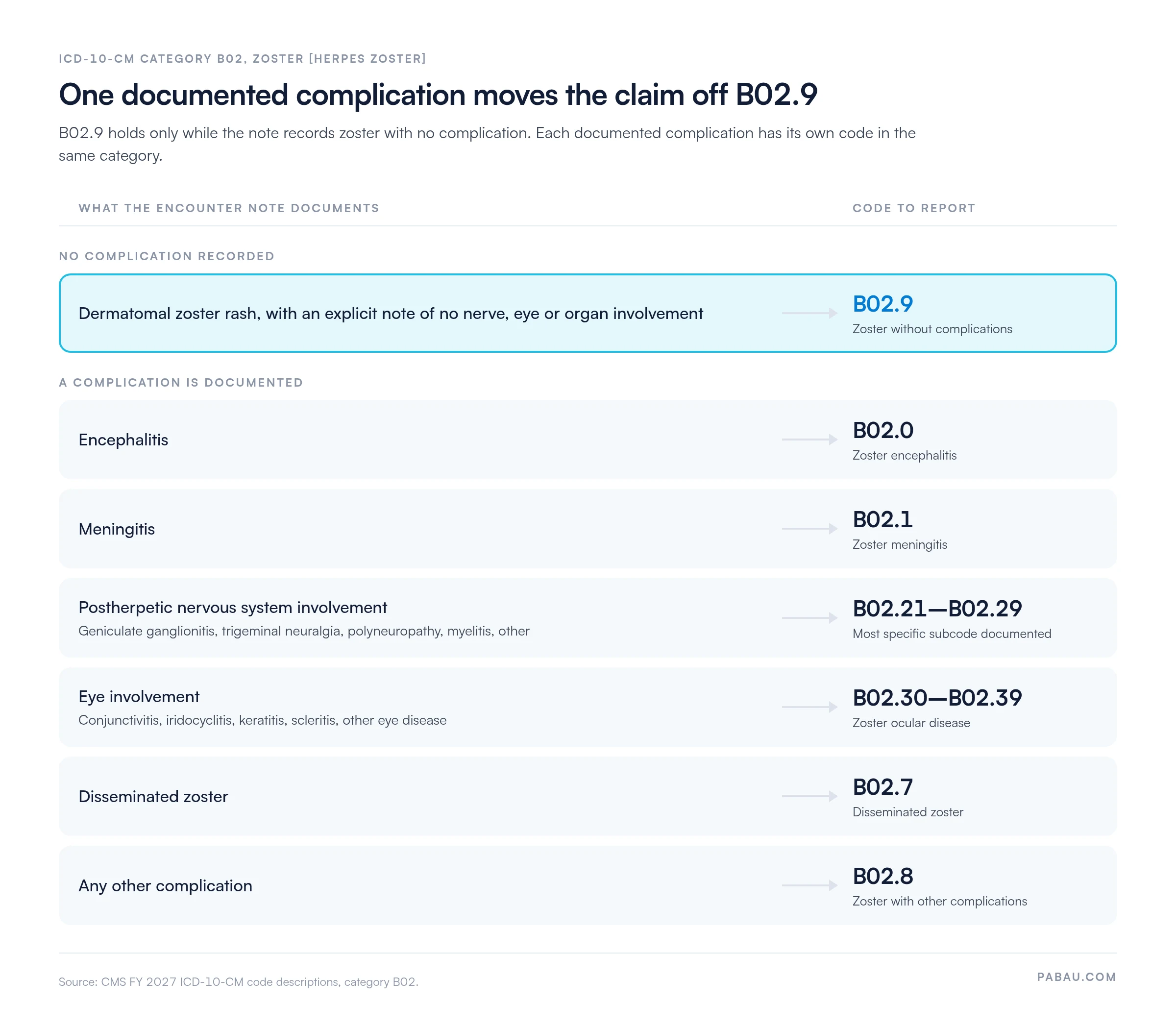
The most common coding error with herpes zoster is keeping B02.9 after a complication appears in the encounter record. Each complication has its own code within category B02. Reporting B02.9 for any of the presentations below leaves an inaccurate diagnosis on the claim, which payers and auditors can reject.
The map below condenses category B02 into the question a coder asks at each encounter: what does the note document?
Postherpetic neuralgia is pain that persists or develops after the herpes zoster rash has resolved. The clinical benchmark cited in IDSA guidance is pain lasting beyond 90 days after rash onset, though payer policies vary on the exact threshold. During the active rash, pain is part of the uncomplicated zoster picture and B02.9 is appropriate. Once the rash heals and pain continues, recode the encounter to B02.29, or to B02.21-B02.24 where the type of nerve involvement is documented.
The documentation trigger is the rash resolution date. If the note says “rash resolved, pain ongoing,” continuing to use B02.9 is a coding error. Treat the 90-day benchmark as a clinical guide. Payer rules differ, so check the applicable LCD before appealing a denial on this basis.
Herpes zoster ophthalmicus requires a code from the B02.3x block whenever ocular involvement is documented. The decision point is whether the ophthalmic branch of the trigeminal nerve is affected. A rash that only sits near the eye does not settle that question. Periorbital zoster with no eye involvement can remain B02.9.
Any documentation of conjunctivitis, keratitis, uveitis or Hutchinson’s sign (rash at the tip of the nose) should prompt an ophthalmology referral. It also moves the code to the B02.3x block rather than B02.9.
Flag encounters with facial or periorbital zoster for a same-day ophthalmology review. State in the note whether ocular involvement is present or absent. That single sentence decides between B02.9 and a B02.3x code, and leaving it out is an audit liability.
An encounter note that contains only “shingles” and a CPT code will not survive a payer audit. The note needs four elements to support B02.9 on a clean claim submission.
B02.9 does not carry a universal reimbursement guarantee. CMS processes herpes zoster claims under general E/M adjudication rules, while commercial payers and Medicare Advantage plans apply their own medical-necessity criteria. Confirm the CMS ICD-10-CM coding guidelines before appealing any denial.
Key reimbursement considerations for B02.9 claims:
Pabau, a practice management platform, includes claims management software that submits electronic claims through Claim.MD and tracks remittances. It covers US payers connected through Claim.MD and runs eligibility checks before submission. Checking eligibility when the visit is booked surfaces coverage requirements before the encounter rather than after a denial.
B02.9 is the diagnosis code paired with procedure codes on the same claim, and the pairing must reflect the medical necessity documented in the note. The codes below are commonly used for office and telehealth visits for uncomplicated zoster.
When antiviral management is the main purpose of a telehealth or phone encounter, document the medical decision-making complexity in the note. Underdocumented E/M levels are a frequent audit finding on B02.9 claims. A stable follow-up often supports 99213, but only when the documented complexity matches.
A flu shot given at the same visit sits on its own claim line, linked to Z23. Pointing the vaccine lines at B02.9 misstates why the service was given.
Herpes zoster claims with B02.9 follow predictable denial patterns. Each denial reason below maps to a specific corrective action and an appeals approach for denial management workflows.
Legacy systems, audit queries and retrospective billing analysis still map between ICD-9-CM and ICD-10-CM herpes zoster codes. The CMS General Equivalence Mapping files give the approximate crosswalk below. CMS published the last GEM update for FY 2018.
GEM mappings are approximate. When recoding historical records for an audit response, do not assume the ICD-9 to ICD-10-CM conversion is one-to-one. Review the original encounter note and select the most specific ICD-10-CM code its documented findings support.
The B02.9 denials above start in the chart: a complication recorded but the uncomplicated code submitted, or an E/M level the note cannot support. The coder fixes those in the documentation. Once the code is right, the work moves to getting the claim paid and spotting a denial early.
Pabau’s claims management software submits electronic claims through Claim.MD and tracks remittances. It runs eligibility checks before the visit and sends secondary claims from the same patient record.
For practices that run their own medical billing workflows, that keeps the visit, the claim and the payment on one record. When a B02.9 claim comes back denied, the remittance shows the reason code. The biller can check the note, correct the code and resubmit without chasing the payer for an explanation.

Pabau’s claims management submits electronic claims through Claim.MD, runs eligibility checks and tracks remittances. Your team can follow each B02.9 claim from submission to payment.

ICD-10 code B02.9 is easy to define and easy to misapply. It holds only while the note confirms that no complication is present. Once postherpetic pain, eye findings or spread are on record, the claim needs the matching B02 code instead.
Build the check into the visit itself. Record the rash onset and resolution dates, and state the absence of complications in words. That habit settles the code before the claim is built, which is cheaper than any appeal.
Book a demo to see how Pabau submits claims through Claim.MD, checks eligibility and tracks remittances for your billing team.

Need to understand how clearinghouse integration reduces claim rejections? Claim.MD clearinghouse overview explains how electronic claim validation works end-to-end.
Seeing a pattern of unresolved denials across your herpes zoster claims? Medical billing compliance guide covers audit readiness and documentation standards that prevent repeat denials.
Coding a viral rash before the cause is confirmed? ICD-10 code B09 covers unspecified viral infections with skin and mucous membrane lesions, in the same B00-B09 block as zoster.
ICD-10 code B02.9 is the billable ICD-10-CM diagnosis code for zoster without complications. It covers herpes zoster (shingles) when no organ, neurological, or ophthalmic complication is documented. It is a leaf-level code within the B02 category and requires no additional character to be valid for submission.
Yes, B02.9 is billable. It is a fully specified leaf-level code with no further subdivision in the ICD-10-CM tabular list, confirmed by the CDC/NCHS and CMS ICD-10-CM tabular list. It can be submitted on a CMS-1500 or 837P claim as a primary or secondary diagnosis code.
B02.9 covers herpes zoster with no documented complications; B02.29 covers postherpetic nervous system involvement that is unspecified or does not fit B02.21-B02.24. The practical distinction is timing and documentation. Acute-phase zoster pain with an active rash is B02.9. Pain or neurological symptoms that persist after the rash resolves move the encounter to the B02.2x block.
The most common pairings are outpatient E&M codes 99202-99205 (new patient) and 99212-99215 (established patient). 99213 is the most frequent follow-up level for stable uncomplicated zoster. The E&M level must be supported by documented medical decision-making complexity consistent with the billed code.