ICD-10 code S61.201A: Open wound of left index finger without nail damage
ICD-10 code S61.201A covers a left index finger wound of unstated type ICD-10 co...

Last Updated: Oct 16, 2026
Billable Code Specific Code
Z23 is the billable ICD-10-CM code for encounter for immunization.
Let Pabau's smart automation suggest the right codes, reduce claim denials, and keep your practice compliant—effortlessly.
Automate repetitive tasks and focus on what matters most—your patients.
Reduce coding errors and ensure compliance with the latest regulations.
Clean claims, fewer denials, and faster reimbursements.
Powerful insights and reporting to help your practice thrive.
HIPAA compliant SOC 2 certified GDPR-compliant Trusted by 4,000+ clinics worldwide

ICD-10 Code Z23 (Encounter for immunization) is a valid, billable ICD-10-CM diagnosis code for FY2026, effective October 1, 2025 through September 30, 2026.
Z23 is used for preventive immunization encounters only. It is not appropriate for sick visits or disease treatment, even when a vaccine is incidentally administered.
CPT 90460/90461 require documented face-to-face physician counseling. Without that note in the chart, use CPT 90471/90472 instead or risk a claim denial.
Medicare pays flu, pneumococcal, and hepatitis B administration under G0008, G0009, and G0010, not CPT 90471.
Practice management software like Pabau keeps the vaccine record, the administration code, and Z23 on one encounter, then submits the claim through Claim.MD.
ICD-10 Code Z23 is a billable ICD-10-CM diagnosis code for an encounter whose primary purpose is vaccination. It covers preventive immunization visits only, so a sick visit with an incidental flu shot needs a different first-listed code.
Z23 sits in the Z20-Z29 block of ICD-10-CM Chapter 21, Factors influencing health status and contact with health services. It covers standard preventive immunization encounters: flu shots, COVID-19 vaccines, pediatric well-child series, travel vaccines, and pneumococcal vaccines. The code is valid for all HIPAA-covered transactions from October 1, 2025 through September 30, 2026.
Use Z23 when the reason for the visit is vaccination. Per ICD-10-CM Official Coding Guidelines Section I.C.21, Z23 is the first-listed diagnosis for an immunization-only encounter.
These are the visit types it covers, as long as vaccination is the primary purpose of the encounter:
When Z23 does not apply: On a sick visit with an opportunistic flu shot, the illness is the primary diagnosis. Z23 may be listed as an additional code, but it cannot be first-listed. Z23 is also never used for allergy immunotherapy, or when the encounter is primarily for a post-vaccination reaction.
Z23 is the diagnosis code. The four CPT administration codes below tell the payer how the vaccine was delivered and whether counseling occurred. Getting the CPT selection wrong is the most common reason for immunization claim denials, according to AAFP billing guidance.
Each administration code pairs with Z23 on the claim. You also need a separate vaccine product code (90658 for flu, 90714 for Td, etc.) to identify the specific antigen administered. Submitting only the administration code and Z23 without the product code is a common denial trigger. Our CPT code reference lists the full administration and product code families if you need to look one up.
90460 is the most frequently misapplied code in immunization billing. It requires a face-to-face encounter with a physician or qualified healthcare professional who provides counseling about the vaccine being administered. That counseling must be documented in the encounter note. A generic “vaccine given” entry does not satisfy the requirement, per AAPC coding guidance.
Practical guidance for pediatric practices billing 90460 with Z23:
The ICD-10-CM Official Guidelines for Coding and Reporting (Section I.C.21) are clear on sequencing. Z23 is the first-listed code when the sole reason for the encounter is immunization. If a chronic condition is also addressed or monitored during the visit, that condition may be listed as an additional code. Z23 stays first only if vaccination is the primary purpose.
Documentation has to support that sequencing. Every Z23 encounter should carry these elements in the chart note before the 837P claim goes out:
Structured digital forms capture these fields more reliably than free-text notes, which cuts transcription errors and keeps the record audit-ready. Practices still documenting on paper can start from an encounter form template that already carries diagnosis code, procedure code, and charge fields. Refer to the CMS ICD-10 codes page for the current official guidelines file, updated each October.
Flag Z23 encounters in your practice management system as a distinct visit type. This makes it easier to audit for missing lot numbers and VIS documentation before claims go out. Those two items account for most preventable denials on immunization claims.
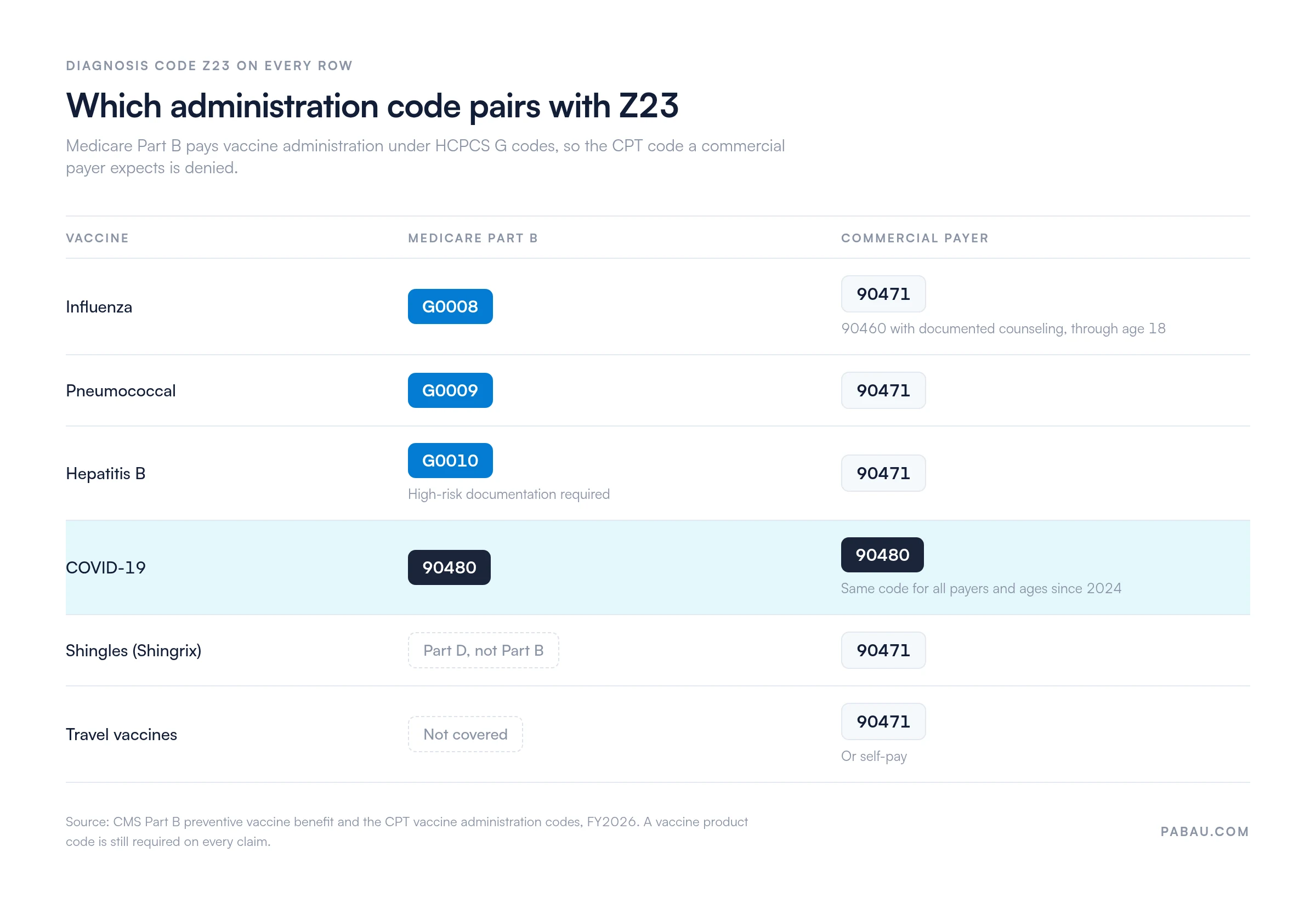
Medicare Part B covers several vaccine types under the preventive care benefit, and Z23 is the diagnosis code for all of them. The administration code is where Medicare parts company with commercial payers. Part B requires HCPCS G codes for flu, pneumococcal, and hepatitis B, and it denies CPT 90471.
Medicare does not reimburse CPT 90460 or 90471 for adult immunization. Use G0008 for influenza, G0009 for pneumococcal, and G0010 for hepatitis B administration. COVID-19 administration uses CPT 90480, which replaced the product-specific codes in 2024 and applies to every payer and age group. Medicaid rules vary by state, so check your state fee schedule for allowed administration codes and rates before you submit.
Those G codes do not cover shingles. Shingrix carries its own product code, 90750, and Medicare routes the vaccine and its administration to the patient’s Part D plan.
The grid below puts the two payer paths side by side, so you can see which administration code applies before the claim goes out.
Coders working in preventive care frequently need to cross-reference Z23 against adjacent codes in the Z00-Z29 range. The table below covers the codes most commonly confused with or paired alongside Z23, sourced from the CDC/NCHS ICD-10-CM web tool.
Solid organ transplant recipients take immunosuppressants such as the oral tacrolimus billed under HCPCS code J7507. Live vaccines like MMR and varicella are contraindicated for them, so the deferral is coded Z28.03 instead of Z23.
Claim denials on immunization encounters cluster around the same handful of errors. Fixing them before submission is faster than working a denial queue.
A form that prompts for lot number, VIS date, and administration site catches most of these errors at the point of care. That is cheaper than reworking a denial three weeks later.

Z23 billing errors usually start in the chart rather than the code set. The coder picks the right code, but the note has no lot number, or the counseling entry is missing. Practice management software like Pabau makes those fields part of the encounter itself, so the note cannot be filed half-finished.
When a clinician opens an immunization encounter in Pabau, the record prompts for the vaccine name, lot number, and expiration date. It also asks for the administration site, the VIS edition date, and the clinician’s credentials.
Pabau’s medical claims management then pulls what is already on that record into a pre-filled claim. Submission runs through Claim.MD, with real-time eligibility checks and claim status tracking, so nobody retypes the encounter into a separate billing tool.
Payments come back the same way. Electronic remittance advice posts back against the claim, so a partial payment on a vaccine line shows up without opening the payer portal. The audit trail on each encounter is what you hand over when a payer or a state immunization registry asks.

Pabau records the vaccine type, lot number, administration code, and Z23 on one encounter, then submits the claim through Claim.MD. See how it works.

Z23 itself is rarely the problem. What decides whether the claim pays is the administration code you pair with it. The second half is whether the chart can prove the encounter happened as billed. Get the payer split right, and the rest of the immunization workflow is routine.
If your practice still types lot numbers into a free-text note and chases rework on vaccine claims, the fix is upstream of the coder. Book a demo to see how Pabau keeps the immunization record and the claim on one encounter.

Want to understand how immunization claims reach the payer? Claim.MD clearinghouse review explains how 837P files are validated and routed across 4,000+ US payers.
Trying to reduce rework from denied vaccine claims? Denial management in healthcare covers the most effective pre-submission and post-denial strategies for preventive care practices.
Need the encounter summary in one document? What is a superbill sets out the fields a payer or patient expects when a vaccine claim is billed outside your usual channel.
Want the wider revenue cycle picture? What is revenue cycle management covers payer coverage logic, eligibility verification, and clean-claim criteria across government and commercial payers.
ICD-10 Code Z23 documents an encounter for immunization. That means a visit whose primary purpose is administering a vaccine or series of vaccines. It applies to flu shots, COVID-19 vaccines, pneumococcal vaccines, pediatric immunization series, and travel vaccines. It does not apply to encounters where the primary reason is illness treatment, even if a vaccine is administered during that visit.
Yes. Z23 is a valid billable ICD-10-CM diagnosis code for FY2026, effective October 1, 2025 through September 30, 2026. It can be submitted on all HIPAA-covered electronic transactions and is accepted by Medicare, Medicaid, and commercial payers for qualifying immunization encounters.
Yes. Influenza encounters are one of the most common uses for Z23. For commercial payers, pair it with CPT 90471, or 90460 when a physician documents counseling. For Medicare Part B, use HCPCS G0008 instead. Either way, add the flu product code, such as 90658 or 90674, for the formulation you administered.
Yes, Z23 is the diagnosis code for COVID-19 vaccine encounters. Administration is reported with CPT 90480, which replaced the product-specific administration codes in 2024 and applies to all payers and ages. Medicare coverage rules changed after the Public Health Emergency ended, so verify current CMS guidance before billing. Commercial payers still take Z23 as first-listed with the administration and product codes on the same claim.