CPT Code 25210: Excision of a single carpal bone
CPT Code 25210: Official descriptor and quick-reference data CPT Code 25210 is a...

Last Updated: Nov 26, 2026
87807 is the CPT code for infectious agent antigen detection by immunoassay with direct optical observation; respiratory syncytial virus (RSV).
It covers rapid, point-of-care RSV antigen tests whose result is read by eye rather than by an instrument or a nucleic acid method. Practices append modifier QW when the kit is CLIA-waived, and Medicare pays the code under the Clinical Laboratory Fee Schedule.
Let Pabau's smart automation suggest the right codes, reduce claim denials, and keep your practice compliant—effortlessly.
Automate repetitive tasks and focus on what matters most—your patients.
Reduce coding errors and ensure compliance with the latest regulations.
Clean claims, fewer denials, and faster reimbursements.
Powerful insights and reporting to help your practice thrive.
HIPAA compliant SOC 2 certified GDPR-compliant Trusted by 4,000+ clinics worldwide

CPT code 87807 covers rapid RSV antigen detection by immunoassay with direct optical observation, a point-of-care method distinct from nucleic acid and PCR-based RSV tests.
Medicare requires the QW modifier whenever 87807 is performed with a CLIA-waived kit at a point-of-care site. Omitting it is the most commonly reported cause of denial.
When a multiplex respiratory panel such as CPT 87637 is billed for the same encounter, NCCI bundling edits bar 87807 from being reported separately.
Medicare pays 87807 under the Clinical Laboratory Fee Schedule, which sets one national rate rather than facility and non-facility rates.
Practices using Pabau can run Claim.MD eligibility checks before testing and submit electronic US claims from the patient record.
CPT code 87807 reports a rapid RSV antigen test whose result is read by eye. Its official descriptor is Infectious agent antigen detection by immunoassay with direct optical observation; respiratory syncytial virus (RSV). That descriptor belongs to the CPT code set maintained by the AMA’s CPT Editorial Panel. The phrase before the semicolon names the method, and the phrase after it names the organism.
The code sits in the Microbiology subsection (87003-87999) of the Pathology and Laboratory section, inside the infectious agent antigen detection range (87260-87899). It is a Category I code, payable when the record supports medical necessity and carries a covered diagnosis.
CPT code 87807 covers the detection of RSV antigen in a patient specimen with a rapid immunoassay that the clinician or technician reads visually. The defining element is “direct optical observation.” Staff read the result from a reaction indicator on the device, such as a colored line, dot or zone, instead of using an instrument analyzer.
These are lateral-flow or similar rapid test formats commonly used in physician offices, urgent care centers, and pediatric practices during RSV season. Test kits must be FDA-cleared and, for CLIA-waived billing, must appear on the FDA’s list of CLIA-waived tests for RSV antigen detection.
CPT code 87807 covers only the direct optical observation method. Using it for a different detection technology results in incorrect coding and potential audit exposure.
Picking a neighboring code by mistake is an easy error on RSV claims, because the descriptors differ by a single word. The correct code depends on the detection method, the organism, and whether a panel or a standalone test was performed.
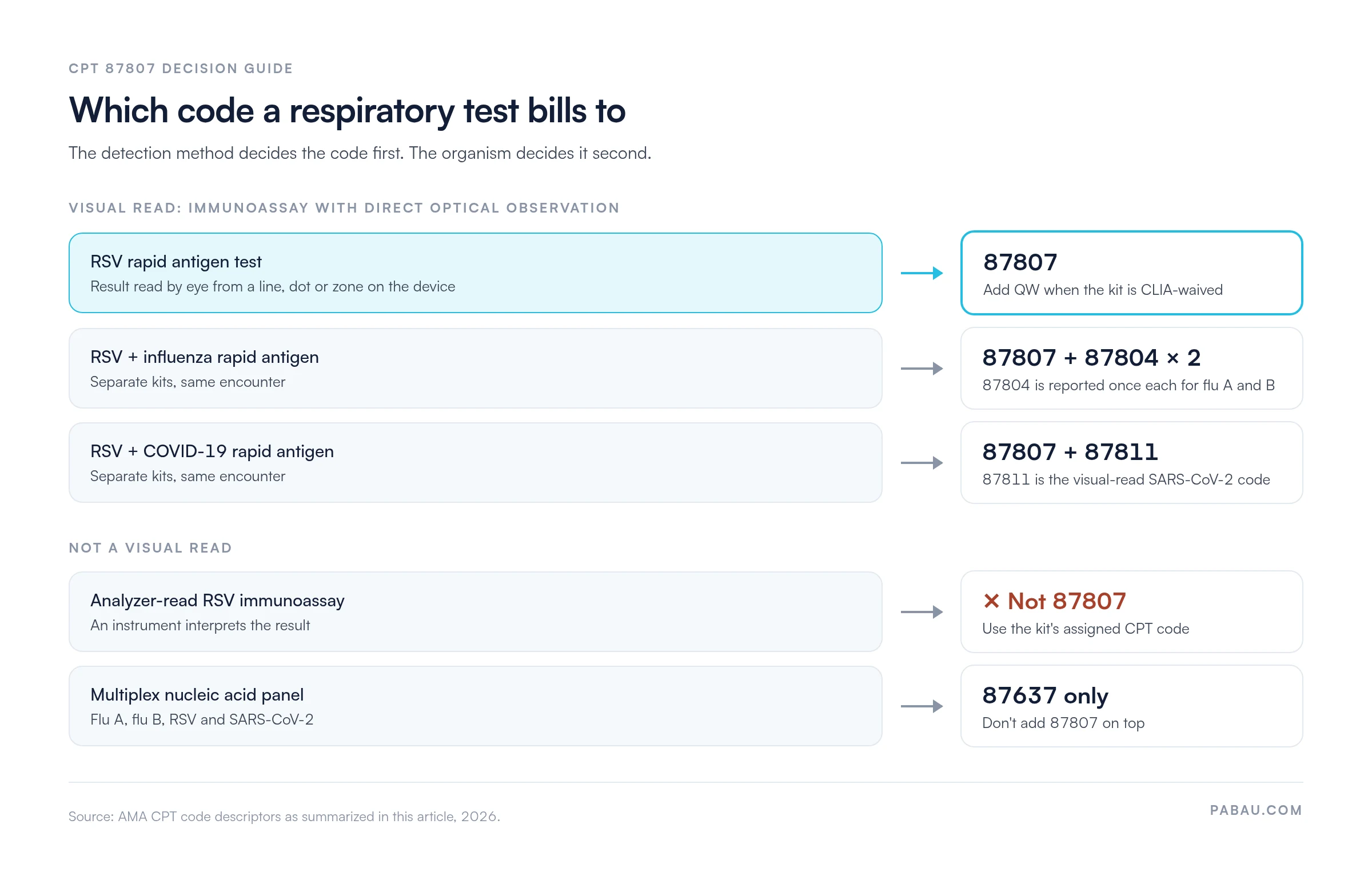
Key rule: A kit read by eye is an immunoassay with direct optical observation. That means 87807 for RSV, 87804 for each influenza type, 87811 for SARS-CoV-2 and 87880 for a Group A strep test. A PCR or nucleic acid amplification method takes the test out of this code family, however the result is displayed. The guide below maps the common same-day combinations to their codes.
Linking CPT code 87807 to a covered diagnosis is required for every claim. A missing or non-covered diagnosis code is one of the leading denial causes for this code. Payers use the linked ICD-10 code to confirm medical necessity before they pay.
Always verify covered diagnoses against the active Local Coverage Determination (LCD) for RSV antigen testing from your Medicare Administrative Contractor (MAC). Coverage criteria differ by jurisdiction, and payers update them between fiscal years. Palmetto GBA, Novitas, and CGS each maintain RSV-specific LCD policies that list accepted and excluded diagnosis codes.
Three modifiers apply to CPT code 87807. Each has a specific trigger condition, and using the wrong modifier (or omitting a required one) can cause denials that the practice must then reprocess.
Set a billing rule in your practice management system that appends QW to 87807 whenever the site’s CLIA certificate is a Certificate of Waiver. Catching it at order entry stops the most common denial before the claim leaves the practice.
Medicare pays CPT code 87807 under the Clinical Laboratory Fee Schedule (CLFS), not the Physician Fee Schedule. The CLFS sets one national payment amount per lab code. That rate does not change by locality or place of service the way a Physician Fee Schedule rate does. CMS publishes the 2026 amounts in its annual CLFS files.
Accurate documentation is what turns a correct code selection into a payable claim. For CPT code 87807, the medical record must demonstrate medical necessity at the time the test was ordered, not after results are known. Practices focused on submitting a clean claim build documentation checklists into the order workflow rather than chasing records post-encounter.
Reference the active LCD from your MAC for RSV antigen testing to confirm any additional documentation requirements specific to your jurisdiction. Palmetto GBA, Novitas, and CGS each publish RSV antigen testing LCDs that specify which diagnoses, patient populations, and clinical settings are covered under their policies.
Most denials on CPT code 87807 fall into a small number of predictable categories. Building denial management workflows around these patterns eliminates the majority of rework. Coders who want a full reference on denial codes can match CARC/RARC reason codes to each denial type below.
During respiratory season, a provider often orders an RSV rapid test and an influenza rapid test at the same encounter. The codes follow the tests performed. Separate rapid kits bill separately, while a multiplex panel such as 87637 replaces them.
Understanding the role of a medical claims clearinghouse in routing multi-code claims helps practices catch NCCI conflicts before submission. Clearinghouses typically apply NCCI edits during pre-submission scrubbing, returning an error on bundled combinations before the claim reaches the payer.
A valid CLIA certificate is a billing prerequisite for 87807. Medicare and most commercial payers will not pay for the test at a point-of-care site without the right certificate. For practices performing CLIA-waived RSV tests, these requirements apply before billing begins.
Three workflow-level interventions eliminate most of the preventable denials on CPT code 87807. Each targets a specific point in the order-to-payment cycle where errors typically enter.
Automated modifier assignment: Have your billing system append QW whenever the ordered code is 87807 and the performing site holds a Certificate of Waiver. Typing modifiers by hand at checkout invites errors just when respiratory season pushes volumes highest.
Eligibility verification before the test is run: Run insurance eligibility verification for the patient’s plan before the RSV test is performed. This surfaces coverage restrictions, prior authorization requirements, and benefit limits that would otherwise produce a denial after the fact.
Standardized ICD-10 order sets: Build a standing order template for RSV rapid antigen testing with the common covered diagnoses as a pick list. J21.0, J20.5, B97.4 and Z20.828 belong on it. The ordering provider then picks the code at the point of order, so the billing team never has to guess a diagnosis after the visit.
Before respiratory season, run a CLIA certificate audit across all testing sites. Confirm the certificate type, expiration date, and that each site’s current CLIA-waived test kit list is accurate. An expired certificate discovered mid-season means every 87807-QW claim from that site is unbillable until it is renewed.
Pabau, a practice management platform with built-in insurance billing, connects US practices to the Claim.MD clearinghouse. Front-desk staff can run an eligibility check on the patient’s plan before the RSV test. Coverage limits and authorization rules then surface while the patient is still in the room.
Once the test is done, the practice submits the claim electronically as a CMS-1500/837P from the same patient record. Pabau’s claims management software also receives electronic remittances through Claim.MD, so a denied 87807 line shows up without chasing paper.
The QW modifier, the CLIA certificate and the diagnosis pairing still depend on your billing rules and documentation. Pabau takes the retyping out of the step between the eligibility check, the encounter and the claim.

Pabau lets US practices run Claim.MD eligibility checks and submit electronic claims from the patient record. Coverage limits on 87807 show up before the test.

CPT code 87807 pays reliably when three checks happen before the claim leaves the practice. Confirm the kit is a visual read on the CLIA-waived list, attach QW, and link a diagnosis your MAC’s LCD covers.
The pressure point is respiratory season. Combined testing is when 87804, 87811 and 87637 pull claims off course, so settle your same-day combinations in the order set before volumes rise.
Book a demo to see how Pabau runs eligibility checks and electronic claims for in-office RSV testing.

Need a clearinghouse for rapid antigen claims? Claim.MD clearinghouse overview explains how Pabau practices check eligibility and send US claims through Claim.MD.
Billing an influenza test at the same visit? CPT code 87804 covers the visual-read influenza antigen code and how to report it per type.
Running a rapid strep test too? CPT code 87880 covers the matching Group A Streptococcus antigen code.
Want the bigger picture behind lab claim denials? Revenue cycle management fundamentals walks through the cycle from eligibility check to payment.
Want a broader view of the billing submission process? 837 electronic claim file guide walks through how 87807 and other lab codes travel from practice to payer in the 837P format.
CPT code 87807 covers RSV antigen detection by immunoassay with direct optical observation. It is a rapid, point-of-care test whose result is read by eye from the test device, not by an instrument analyzer. PCR and other nucleic acid RSV tests use separate codes in the 87631-87637 range.
Yes. Medicare requires the QW modifier whenever 87807 is performed with an FDA-cleared, CLIA-waived RSV antigen kit at a point-of-care site. Submit the claim as 87807-QW. Claims for waived tests without QW are commonly denied. The modifier is not needed when a reference laboratory performs the test under a higher CLIA certificate.
The strongest pairings are J21.0 (acute bronchiolitis due to RSV) and J20.5 (acute bronchitis due to RSV). B97.4 (RSV as the cause of diseases classified elsewhere) and Z20.828 (exposure to other viral communicable diseases) also support the test. Some payers accept symptom codes such as J06.9, R05.9 and R50.9 before RSV is confirmed. Always check them against your MAC’s active LCD for RSV antigen testing.
Medicare pays CPT 87807 under the Clinical Laboratory Fee Schedule (CLFS), which sets one national payment amount for the code. There is no facility or non-facility split and no locality adjustment. Look up the 2026 amount in the CMS CLFS files, which CMS updates each year.
Yes, in many cases, when separate rapid antigen kits test for RSV (87807) and influenza (87804). Report 87804 once per influenza type, so a kit that reads flu A and flu B bills it twice. Check the current NCCI edit between the two codes first, because edits change quarterly. If an edit applies, modifier 59 may be needed to mark them as distinct services. If a multiplex nucleic acid panel (87637) was run instead, 87807 cannot be billed separately.
The most commonly reported denials are a missing QW modifier on a CLIA-waived point-of-care test and a missing or non-covered ICD-10 code. NCCI bundling also denies 87807 when 87637 is billed for the same encounter. Payer policies that require prior authorization, and a repeat same-day test billed without modifier 91, round out the list. Fixing these at order entry prevents most of the rework.