

CPT Code 30801: Superficial turbinate ablation billing guide
CPT Code 30801: Official descriptor and procedure overview The American Medical ...

Last Updated: Nov 27, 2026
90378 is the CPT code for respiratory syncytial virus, monoclonal antibody, recombinant, for intramuscular use, 50 mg, each. It reports the palivizumab (Synagis) drug product only, billed in 50 mg units.
Palivizumab is dosed at 15 mg/kg, so a 5 kg infant's 75 mg dose is billed as two units. The injection goes on its own line as CPT 96372. Nirsevimab (Beyfortus) has its own codes, 90380 and 90381, introduced in 2023. The manufacturer discontinued Synagis at the end of 2025.
Let Pabau's smart automation suggest the right codes, reduce claim denials, and keep your practice compliant—effortlessly.
Automate repetitive tasks and focus on what matters most—your patients.
Reduce coding errors and ensure compliance with the latest regulations.
Clean claims, fewer denials, and faster reimbursements.
Powerful insights and reporting to help your practice thrive.
HIPAA compliant SOC 2 certified GDPR-compliant Trusted by 4,000+ clinics worldwide

CPT code 90378 covers the palivizumab (Synagis) drug product for RSV prophylaxis, billed per 50 mg unit.
Units are weight-based. Divide the 15 mg/kg dose by 50 and round up to the next whole unit.
Bill the injection with CPT 96372 on the same claim, never with vaccine administration codes 90460, 90461, 90471 or 90472.
The manufacturer discontinued Synagis at the end of 2025, so nirsevimab (90380/90381) and clesrovimab (90382) are now the RSV antibody options.
Pabau’s claims management software tracks prior authorizations and checks claims for missing or invalid details before submission.
CPT code 90378 is the billing code for respiratory syncytial virus monoclonal antibody, recombinant, for intramuscular use, 50 mg, each. It covers palivizumab, sold under the brand name Synagis. Health First Colorado’s Synagis bulletin requires 90378 for doses given in an office or outpatient setting, reimbursed in 50 mg units. Palivizumab supplies ready-made antibodies against RSV, so payers treat it as passive immunization. That classification is why its administration code differs from a vaccine’s.
The code sits in CPT’s immune globulins, serum or recombinant products subsection (90281-90399) and covers the drug product only. The injection is a separate line item, reported with 96372. The table below summarizes the billing facts coders need before submitting a claim.
CPT code 90378 covers the palivizumab drug product only. The injection, other RSV antibodies and patients outside the high-risk criteria all fall outside it.
Palivizumab is dosed at 15 mg/kg of body weight per injection. CPT code 90378 is defined as “50 mg, each,” so billing teams convert the total dose into 50 mg units. Any part of a unit rounds up to the next whole unit. Under-billing loses revenue, and over-billing creates compliance exposure.
Formula: Total mg dose (weight in kg x 15) divided by 50, rounded up to the next whole number. A new unit starts roughly every 3.3 kg of body weight, as the bands below show.
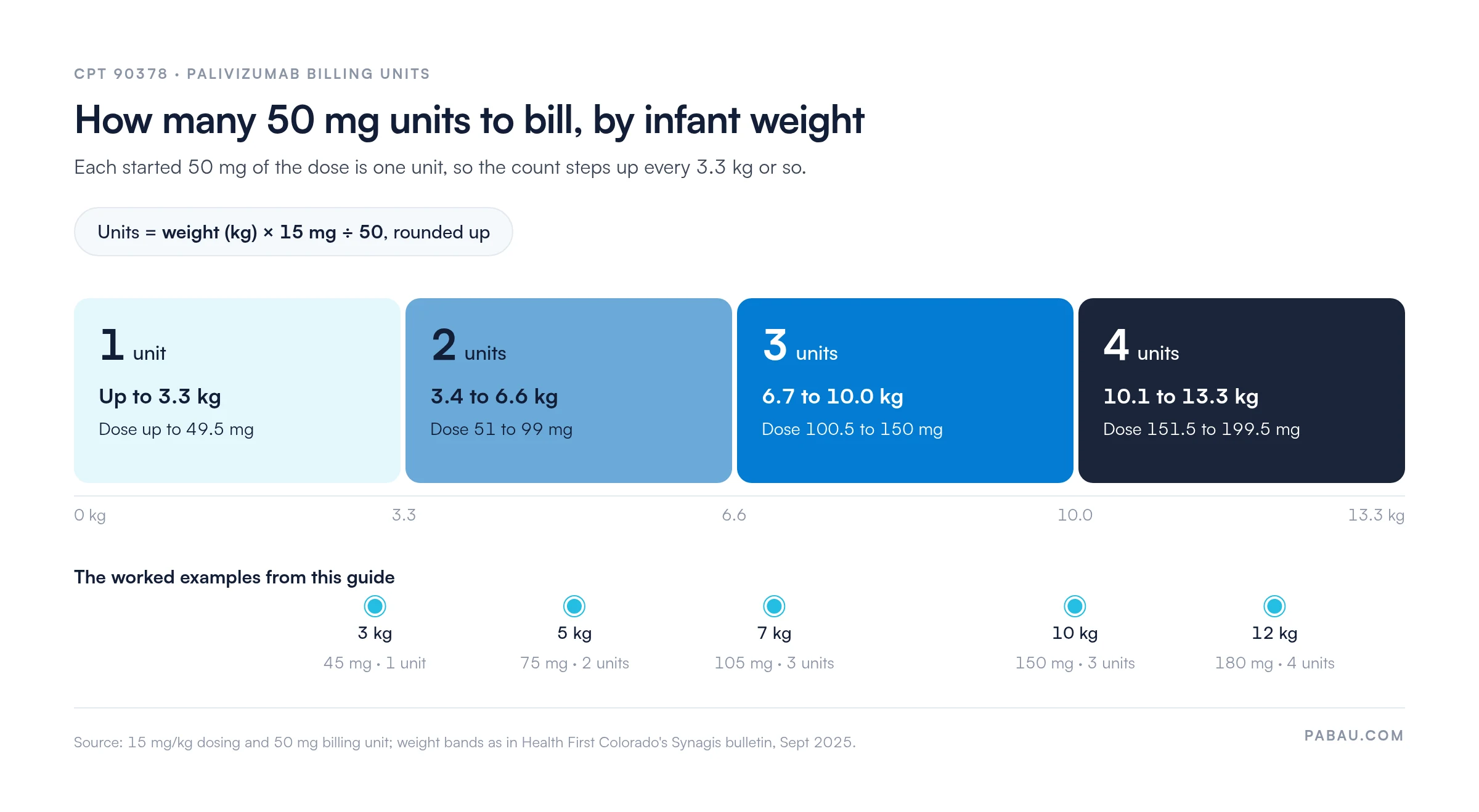
Document the patient’s weight in the chart on the date of service. Payers audit this calculation, and a unit count that doesn’t match the documented weight is a denial waiting to happen.
Record the patient’s weight in kilograms on the same encounter note as the injection. When a payer requests records for 90378, auditors first cross-check whether the billed unit count is mathematically consistent with the documented weight. A weight in pounds with no kg conversion documented is a common audit flag.
CPT code 90378 is a drug-only code, so the injection goes on its own line of the same claim. Palivizumab is a monoclonal antibody, not a vaccine or toxoid. Report the intramuscular injection with CPT 96372, the code for a therapeutic, prophylactic or diagnostic injection.
The AAP’s RSV immunization coding guidance says not to report 90460-90461 or 90471-90472 for RSV immunization, because those codes cover vaccines and toxoids only. Counseling does not change the code choice for palivizumab either. Whether the physician counsels the caregiver or a nurse gives the shot, the injection is still 96372.
Payer rules on 96372 vary, mostly around same-day visits. CareSource Indiana’s Synagis billing notice allows 96372, but does not pay it separately when the injection falls on the same day as an E/M visit. Where a payer does pay both, AAPC’s Pediatric Coding Alert advises appending modifier 25 to the E/M code. Check each payer’s policy before the first claim of the season goes out.
CPT 90380 covers nirsevimab (Beyfortus), not palivizumab. These are two distinct monoclonal antibodies targeting RSV, introduced in different years, with different indications and payer coverage rules. Reporting one drug’s code for the other misstates what was given, which is a compliance problem as well as a denial risk.
In August 2025, the manufacturer of Synagis announced it would discontinue the product at the end of 2025. That timeline comes from a September 2025 Health First Colorado provider bulletin. NC Medicaid’s 2025-2026 RSV guidelines also list palivizumab as discontinued as of Dec. 31, 2025.
For coders, CPT 90378 remains the code for palivizumab claims with earlier dates of service and for doses from any remaining supply. New RSV antibody doses are now nirsevimab (Beyfortus), billed with 90380 or 90381, or clesrovimab (Enflonsia), billed with 90382. Always confirm which drug was administered before selecting the CPT code.
Three modifiers can appear on CPT 90378 claims, and each depends on payer policy. Using one when it isn’t warranted creates its own denial risk.
The JW modifier in particular requires payer-by-payer verification. According to AAP guidance, some plans mandate it for wastage reporting while others do not accept it at all. Submit the JW modifier only when confirmed as appropriate for the specific payer on that claim.
Most commercial payers and state Medicaid programs require prior authorization for palivizumab. Many want it renewed for each monthly dose during the prophylaxis season. Thorough insurance eligibility verification at the start of each RSV season helps practices avoid mid-season denials.
The AAP defines the high-risk criteria payers use to evaluate prior auth requests. Most payers require documentation of at least one of the following:
Include the gestational age at birth, the qualifying diagnosis, and the patient’s current weight in every prior auth request. Payers also limit coverage to their RSV season, typically November through March, though dates vary by payer and region. Many cap the doses per season, often at five. Confirm the season dates and dose limits with each payer before the first claim, because commercial plan policies differ from state Medicaid policies.
Medicare Part B reimburses palivizumab under the buy-and-bill model, with the allowable amount based on Average Sales Price (ASP) plus a percentage markup. CMS updates ASP-based drug pricing quarterly, so any specific dollar figure cited here would be outdated before the next dose cycle. Always verify the current allowable in the CMS Physician Fee Schedule lookup or the quarterly ASP drug pricing file before submitting a claim.
For Medicaid, coverage and reimbursement rates vary significantly by state. Some states reimburse at ASP plus a fixed percentage. Others use a fee schedule or carve palivizumab out to a managed care organization. Submitting CPT 90378 claims through a clearinghouse that validates payer-specific rules reduces the lag between service and payment. Practices using Pabau’s claims management software can send 90378 claims through Claim.MD, a clearinghouse that reaches thousands of US payers. Each claim is scrubbed for missing or invalid details before transmission.
Palivizumab claims attract a consistent set of denials. Most are preventable with upfront verification. Structured denial management workflows catch these before they become aged accounts receivable. The table below maps the most common denial triggers to their root causes and fixes.
Practices using automated claims management software can run pre-submission checks that catch missing diagnosis codes and invalid details before the claim leaves the practice. A clean claim submission on the first pass matters most for high-cost drugs like palivizumab. A denial and resubmission cycle can hold up payment for weeks.
Payers that audit 90378 claims look for specific elements in the medical record. If any of these are missing, an appeal is unlikely to succeed even when the clinical care was appropriate. Strong medical billing compliance starts in the chart, before anyone opens the claim form. A superbill template that lists these fields helps staff capture them at the point of care.
Incomplete diagnosis coding is a common denial reason for CPT code 90378. Claims need a prophylactic encounter Z-code as the primary diagnosis, plus at least one secondary code that shows medical necessity. To look up related diagnosis codes, search Pabau’s ICD-10-CM code directory.
Use the most specific code available. Most payers expect Z29.11 as the primary diagnosis on every encounter, and a 90378 claim without it often denies automatically. Always check that each secondary code is valid in the current fiscal year’s ICD-10-CM edition, using the CDC/NCHS ICD-10-CM web tool. Codes can be revised, deleted, or added each October 1.
Cross-reference your secondary diagnosis code against the payer’s Local Coverage Determination (LCD) for RSV prophylaxis. Some Medicare Administrative Contractors publish a specific list of ICD-10 codes that support 90378 coverage. If your secondary code is not on that list, the claim may deny even when the clinical situation clearly qualifies.
During RSV season, pediatric practices often track authorizations on a spreadsheet. Someone logs each infant’s auth number, dose dates and weight, then rebuilds that detail on every monthly claim.
Pabau keeps that detail on the patient’s case instead. The auth code, its dates and the approved sessions sit on the case, with a warning when one is missing. Stock carries its batch number and expiry date, and the lot is recorded against the patient and the appointment.
US claims go out through Claim.MD, which reaches thousands of US payers. You get eligibility checks before the visit and claim validation that flags missing or invalid details. That leaves your team less paperwork to rebuild for payers at the busiest point of the season.

Pabau tracks each prior authorization’s code, dates and sessions on the patient’s case, with a warning when one is missing. Claims go out checked for missing or invalid details.

CPT 90378 now serves a shrinking set of claims. The manufacturer discontinued Synagis at the end of 2025, so most 90378 claims still to file carry earlier dates of service.
Before each of those claims goes out, confirm the weight-based unit count, the prior authorization number, and Z29.11 paired with a qualifying diagnosis. Then retire any billing template that pairs palivizumab with 90460 or 90471. Nirsevimab and clesrovimab use their own drug codes plus 96380 or 96381, so a stale template carries errors into next season.
Book a demo to see how Pabau keeps prior authorizations and claim checks on one record through RSV season.

Need a framework for reducing claim rejections across all drug codes? Denial management in healthcare covers the end-to-end process for tracking, categorizing, and preventing recurring denials.
Want to understand how the clearinghouse fits into your billing workflow? Medical claims clearinghouse guide explains how clearinghouses validate claims before payer transmission.
Looking for guidance on the 837P electronic claim format for drug submissions? 837 file overview breaks down the transaction set structure used for professional claims including immunization products.
Billing a vaccine on the same visit? CPT code 90471 covers immunization administration for vaccines and toxoids, the code family palivizumab does not use.
CPT code 90378 covers palivizumab (Synagis), the recombinant monoclonal antibody for RSV prophylaxis given by intramuscular injection, billed per 50 mg unit. The code covers the drug product only. Bill the injection separately with CPT 96372, not with the vaccine administration codes 90460, 90461, 90471 or 90472.
Multiply the patient’s weight in kilograms by 15 to get the total mg dose. Divide that by 50 and round up to the nearest whole number. A 7 kg infant receives 105 mg, which rounds up to 3 units of 90378.
CPT 90378 covers palivizumab (Synagis), used for high-risk infants since 1998. CPT 90380 covers nirsevimab (Beyfortus), FDA-approved in 2023 for broader RSV prevention in infants and toddlers, including healthy term infants. CPT 90378 is billed per 50 mg unit, while nirsevimab is billed per dose with 90380 (0.5 mL) or 90381 (1 mL). They are different drugs and are not interchangeable.
Yes, most commercial payers and Medicaid programs require prior authorization for each dose of palivizumab. They expect documentation of a qualifying high-risk criterion such as prematurity, congenital heart disease, or chronic lung disease. Prior auth requirements vary by payer and can differ for each monthly dose during the RSV season.
The JW modifier is appended to 90378 when palivizumab is drawn from a single-use vial and a portion is discarded. It is not universally required. Some payers mandate JW for wastage reporting while others do not accept it, so verify with the specific payer first. Document the vial size, amount administered, and amount wasted in the chart.
Pair 90378 with CPT 96372, the code for a therapeutic, prophylactic or diagnostic intramuscular injection. Palivizumab is a monoclonal antibody, not a vaccine, so the immunization administration codes 90460, 90461, 90471 and 90472 do not apply. Codes 96380 and 96381 belong to nirsevimab and clesrovimab. Some payers do not pay 96372 separately on the same day as an E/M visit, so check payer policy first.
Yes, for palivizumab claims with earlier dates of service and for doses given from remaining supply. The manufacturer discontinued Synagis at the end of 2025. New RSV antibody doses are billed as nirsevimab (90380 or 90381) or clesrovimab (90382).




