

CPT Code 98981: RTM Treatment Management Billing Guide
CPT code 98981: Definition and official descriptor CPT code 98981 is an add-on c...

Last Updated: Nov 9, 2026
M7330 is the CCSD code for closure of fistula of urethra (including cystoscopy). It covers surgical closure of an abnormal tract between the urethra and the skin or a neighbouring structure. The cystoscopy is done in the same operative episode.
That cystoscopy is bundled into the code, so it is never billed on a separate line. Bupa, AXA Health, Aviva and Vitality Health expect prior authorisation before the operation.
Let Pabau's smart automation suggest the right codes, reduce claim denials, and keep your practice compliant—effortlessly.
Automate repetitive tasks and focus on what matters most—your patients.
Reduce coding errors and ensure compliance with the latest regulations.
Clean claims, fewer denials, and faster reimbursements.
Powerful insights and reporting to help your practice thrive.
HIPAA compliant SOC 2 certified GDPR-compliant Trusted by 4,000+ clinics worldwide

CCSD Code M7330 covers closure of a fistula of the urethra, including cystoscopy. The cystoscopy is bundled into the code and is never billed on a separate line.
N36.0 (urethral fistula) is the usual principal ICD-10 diagnosis. Hypospadias and post-procedural codes are its most common companions.
Bupa, AXA Health, Aviva and Vitality Health typically require prior authorisation before M7330 is performed, and a claim without it risks full denial.
Pabau sends UK insurance claims through Healthcode and to Bupa, and tracks each prior authorisation on the patient’s case.
CCSD Code M7330 describes closure of a fistula of the urethra, including cystoscopy. The code covers the whole operation, from cystoscopic assessment to formal closure of the abnormal tract, in a single operative episode.
It sits in chapter 12 of the schedule, Urinary system and male reproductive organs, and Bupa lists it at complexity Intermediate 2. Like every code in the CCSD code library, it is used for UK private insurance billing, not the NHS tariff.
A consultant urologist performs the procedure, typically under general anaesthetic. Cystoscopy is integral to the operation. It confirms the fistula site, assesses the urethra above and below it, and guides the closure technique.Because the M7330 descriptor names cystoscopy explicitly, it cannot be billed as a standalone code on the same claim.
A urethral fistula is an abnormal tract connecting the urethra to the skin surface or to an adjacent structure. In private urology practice the most common types are urethrocutaneous (opening onto the perineal or penile skin), urethrorectal and urethrovaginal.
A urethral fistula closed with cystoscopy in the same episode is coded M7330. Repair of a urethrorectal fistula has its own code, M7340, so check where the tract ends in the operative note first.
Hypospadias repair is the leading cause in the UK private paediatric and adult urology caseload. Other causes include traumatic instrumentation, catheter-related injury, pelvic radiation and cancer surgery. Insurers judge medical necessity partly on the documented cause, so record it clearly before seeking prior authorisation.
Technique varies by fistula type and location. A urethrocutaneous fistula is usually closed in layers, with healthy tissue interposed between them.
Cystoscopy comes first, to rule out a stricture or a second fistula that would change the operative plan. The British Association of Urological Surgeons (BAUS) operative standards are the clinical reference for the procedure.
Knowing what M7330 bundles is the surest way to prevent claim denials. The table below shows what the code covers and what cannot sit beside it on the same claim. It also flags what may be billed separately when genuinely distinct.
The anaesthetist bills separately, on their own claim, using the relevant CCSD anaesthetic codes. For a repeat procedure, check current insurer policy before submission. Some payers reduce the fee for a repeat operation on the same anatomical site within a set period.
Coders often confuse M7330 with neighbouring urology codes. The table below shows the codes most often met alongside or instead of M7330, with the detail that separates each one.
Urethroplasty (M7360 or M7361) is the most common mis-selection. Use M7330 when the operative purpose is closure of a fistula tract. Use M7360 or M7361 when the procedure is formal urethral reconstruction for stricture disease, even if a fistula turns up along the way.
Where cystoscopy shows a stricture that needs only endoscopic incision, internal urethrotomy is coded M7940. The chart below maps each primary aim to its code.
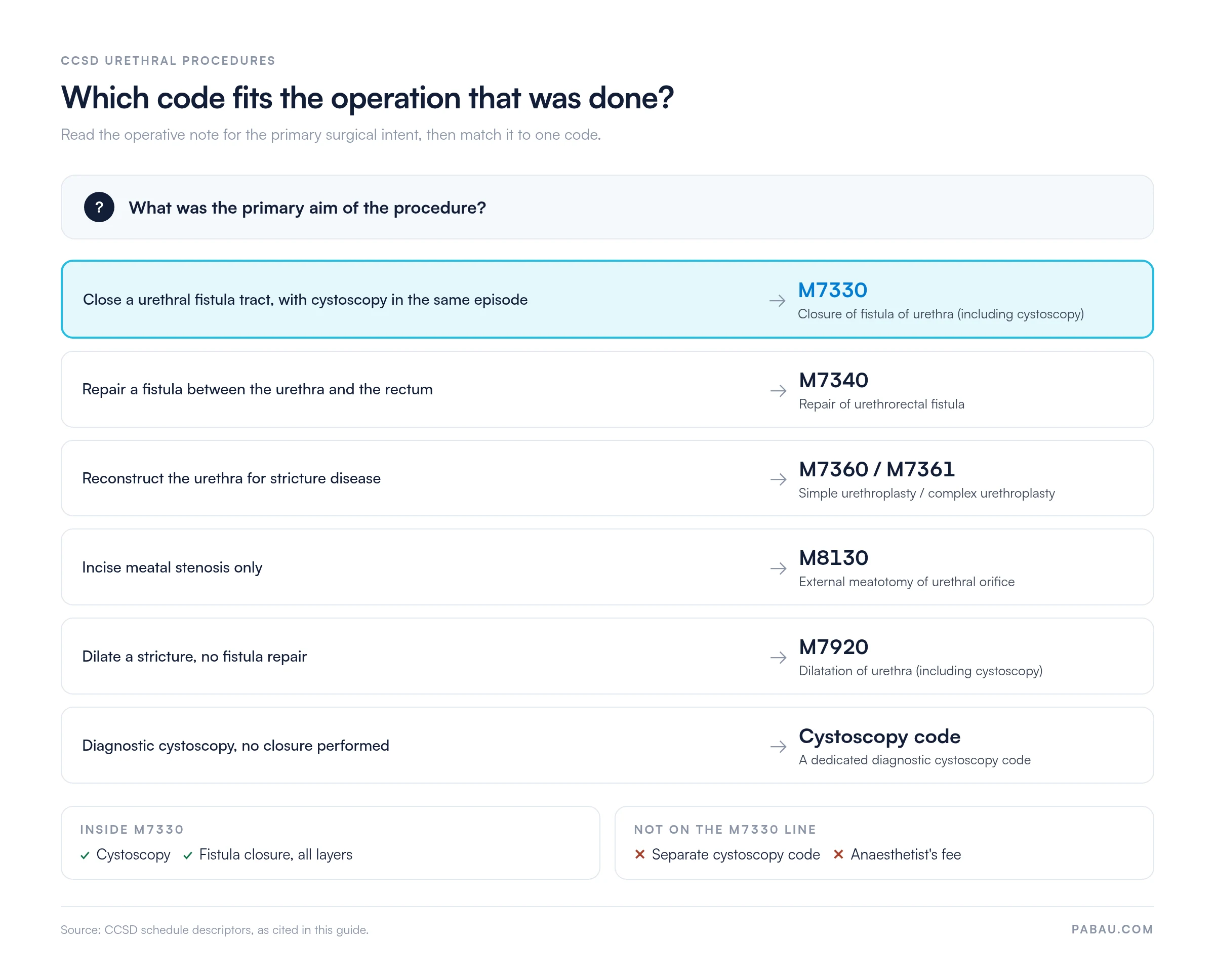
Before selecting M7330, check the operative note for the primary surgical intent. If the note states ‘urethral fistula closure’ as the primary aim and cystoscopy is documented as part of the same episode, M7330 is correct. If the primary aim is stricture repair or urethral reconstruction, consider M7360 or M7361 instead.
Every M7330 claim to a UK private medical insurer needs an ICD-10 diagnosis code. Pick the most specific code that matches the confirmed diagnosis. The table below lists the codes most often paired with M7330 in UK private urology practice.
N36.0 is the standard principal diagnosis for most M7330 claims. When the fistula follows hypospadias repair, use the most specific Q54 subcode as the primary diagnosis. Add N36.0 as a secondary code where the insurer’s claim form allows. Payer-specific rules can apply, so confirm diagnosis code requirements with each insurer.
Thin operative documentation is the leading cause of M7330 claim denial. Complete the operative note on the day of surgery, and make sure it contains each element below.
The referral letter should also state the clinical indication and confirm that surgical closure is medically necessary. Insurers reviewing medical necessity look for evidence that simpler options were considered before they authorise surgery.
All four principal UK private medical insurers require prior authorisation before M7330 is performed. Proceeding without it typically leads to full claim denial, with no guarantee that an appeal succeeds.
The table below summarises each insurer’s general position. Rules change, so verify the requirement with the insurer and the patient’s policy every time.
For Bupa CCSD code guidance including recognised code lists and fee schedule access, Bupa’s provider portal at codes.bupa.co.uk is the definitive reference.
AXA Health procedure codes and fee chapters sit in the AXA Health provider portal. Both are updated periodically, so always use the current edition.
Each insurer sets its own fee for CCSD Code M7330, and the consultant’s recognised fee agreement with that insurer decides what is paid. Bupa lists M7330 at complexity Intermediate 2 (INTER 2), with a schedule fee of £286.
The table below shows where to check each insurer’s current fee. Actual payment depends on contracted rates, any agreed uplifts and the patient’s policy.
Consultants checking Bupa procedure codes should compare the Bupa fee for M7330 with their own recognised fee agreement. Insurer portals publish standard schedule rates, and individual consultant contracts may differ.
Healthcode’s billing platform also shows the applicable fee when the claim is submitted, which gives a second check.
M7330 claims fail for a small number of recurring reasons. Identifying which denial type applies to a rejected claim determines whether re-submission or formal appeal is the correct response.
When appealing a denied M7330 claim, include the operative note, the referral letter, the prior authorisation reference and a covering letter from the consultant. That letter explains the clinical rationale.
Appeals that cite BAUS operative standards and peer-reviewed literature on urethral fistula repair tend to carry more weight than administrative arguments alone.
Most M7330 denials have one of three causes. A cystoscopy code sits on the same claim, the authorisation reference is missing, or the diagnosis doesn’t match the note. Pabau, the practice management platform we build, keeps the operative note, the CCSD code and the insurer claim on one patient record.
From that record, UK practices submit insurance claims through Healthcode and to Bupa with Pabau’s claims management software. Nobody re-keys the code into a separate portal.
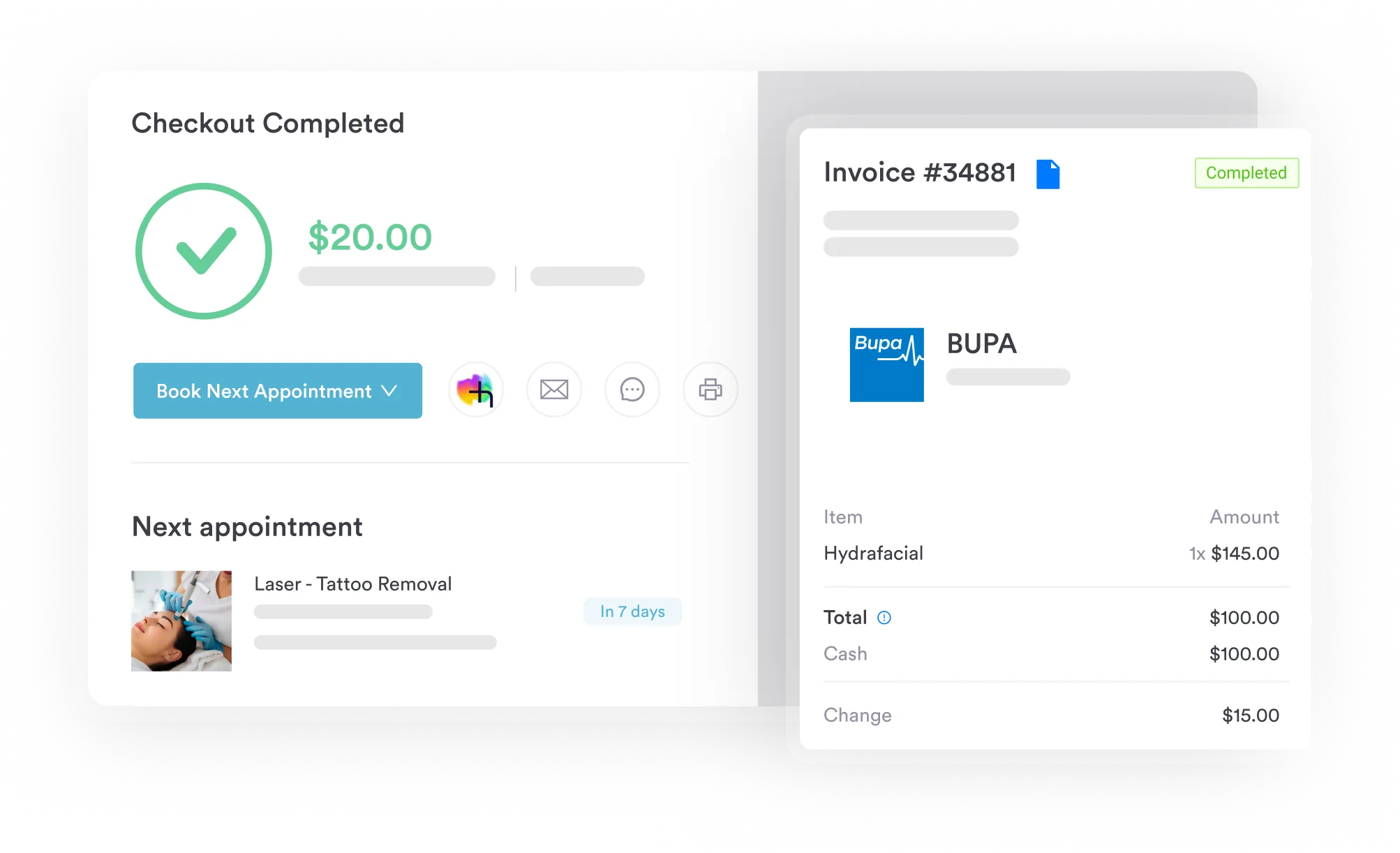
Prior authorisation is tracked on the patient’s case in Pabau. The authorisation code, its dates and the authorised sessions are recorded there, and Pabau warns the team when a code is missing. A surgery booked without a confirmed authorisation is caught before the claim goes out, not after the insurer rejects it.
Run a monthly audit of M7330 claims submitted in the previous 90 days. Look for a standalone cystoscopy code alongside M7330, and for claims sent without an authorisation reference. Then check that the ICD-10 code on the referral letter matches the claim form. These three checks resolve the majority of recurring M7330 denial patterns.

Pabau submits UK insurance claims through Healthcode and to Bupa, and tracks each prior authorisation on the patient’s case. See how private urology practices keep CCSD claims clean from operative note to payment.

M7330 rewards precision more than volume. A clean claim needs the code, the diagnosis and a pre-surgery authorisation reference to agree with each other.
Once the operative note names fistula closure as the primary aim and records the cystoscopy, the code is settled. Keep the cystoscopy off the claim line and the most common denial never happens.
The cost of getting it wrong sits in rework. A five-minute check of the note, the ICD-10 pairing and the authorisation costs far less than an appeal. Book a demo to see how Pabau carries CCSD claims from the operative note to Healthcode submission.

Coding a different urethral procedure in a child? CCSD code M7280 covers resection of posterior urethral valves, another urethra code from the same chapter.
Removing a lesion at the urethral opening instead? CCSD code M5580 covers excision of a urethral caruncle, a much smaller urethral procedure.
Was the cystoscopy the only procedure performed? CCSD code M4510 covers a standalone flexible cystoscopy, which M7330 already includes when the fistula is closed.
Treating the bladder by open surgery? CCSD code M4110 covers open excision of a bladder lesion, a lower urinary tract code you may meet on the same lists.
CCSD Code M7330 covers closure of a fistula of the urethra including cystoscopy, performed as a single operative episode in UK private healthcare. The cystoscopy component is explicitly bundled within the code and cannot be billed separately on the same claim.
No. Cystoscopy is explicitly included within the M7330 descriptor. Submitting a separate cystoscopy code alongside M7330 on the same claim is the most common cause of M7330 claim denial and must be avoided.
N36.0 (urethral fistula) is the principal diagnosis code for most M7330 claims. Where the aetiology is post-hypospadias, use the most specific Q54 subcode as primary with N36.0 as secondary. Traumatic aetiologies use S37.3. Post-procedural complications use N99.1 or N99.8, depending on the finding.
Yes. Both Bupa and AXA Health require prior authorisation before M7330 is performed. Aviva and Vitality Health also require pre-approval for inpatient surgical procedures. Claims submitted without a valid authorisation reference are typically denied in full, and an appeal on procedural grounds alone has little to stand on.
M7330 is for closure of a urethral fistula tract. M7360 and M7361 cover simple and complex urethroplasty, which is formal reconstruction of the urethra, typically for stricture disease. The key distinction is surgical intent. Use M7330 when the primary aim is fistula closure with cystoscopic assessment, and M7360 or M7361 when the procedure reconstructs the urethra beyond fistula closure.
The most common M7330 denial reasons are unbundled cystoscopy codes, missing prior authorisation references and thin medical necessity documentation. To correct a denial, remove any separately billed cystoscopy code and attach the operative note and referral letter. Confirm the prior authorisation reference, then use the insurer’s appeal or query process instead of submitting a new claim.




