CPT code 59618: Cesarean after attempted VBAC billing guide
CPT code 59618 bills a cesarean after a VBAC attempt CPT code 59618 is the globa...

Last Updated: Nov 4, 2026
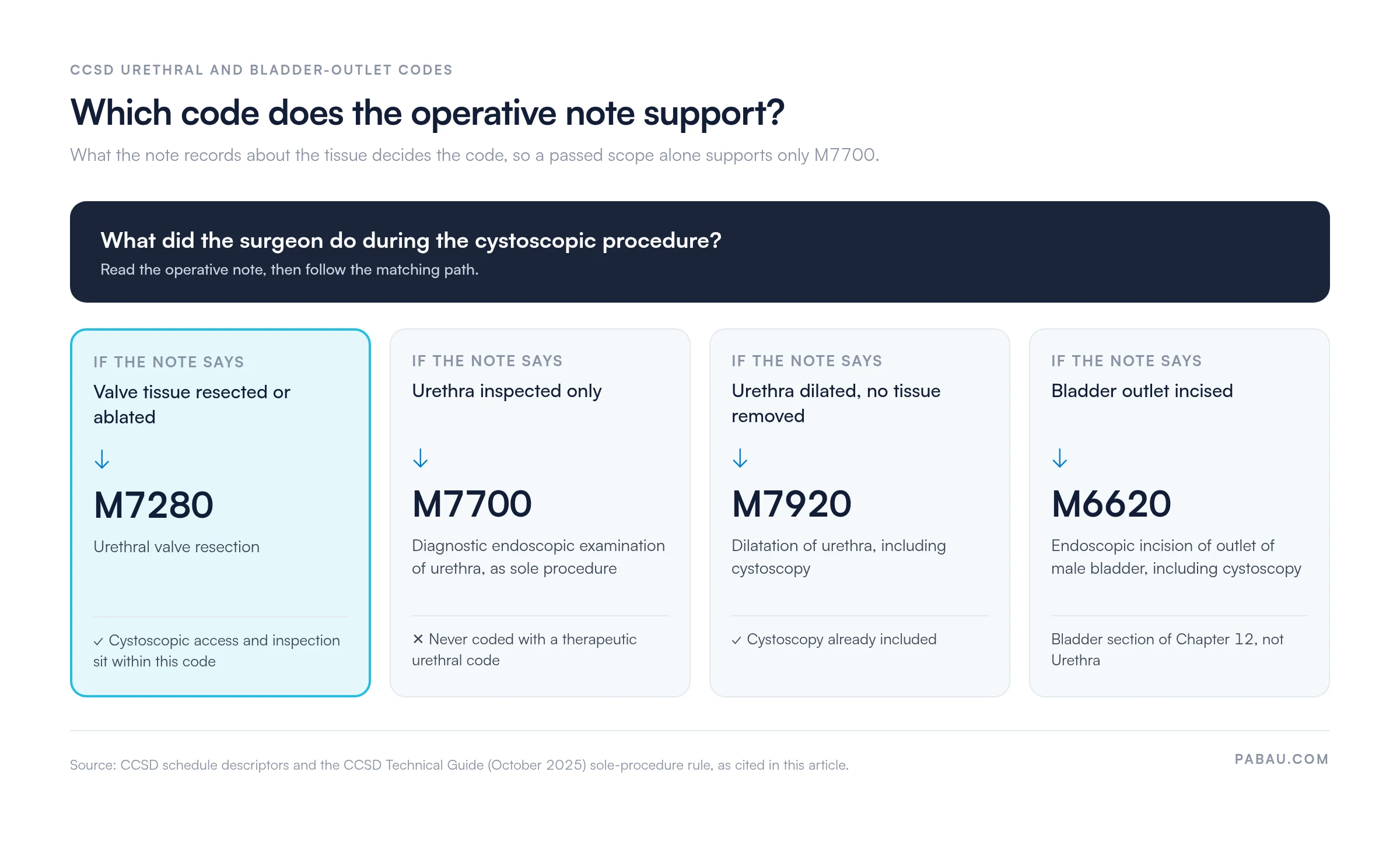
M7280 is the CCSD code for urethral valve resection, the endoscopic removal of valve tissue that obstructs the urethra. UK private medical insurers use it when the surgeon resects or ablates the valve leaflets during cystoscopy.
The cystoscopic access and inspection fall within M7280. Inspection alone is coded M7700, dilatation alone M7920, and incision of the male bladder outlet M6620. Most cases are boys with congenital posterior urethral valves, coded Q64.2.
Let Pabau's smart automation suggest the right codes, reduce claim denials, and keep your practice compliant—effortlessly.
Automate repetitive tasks and focus on what matters most—your patients.
Reduce coding errors and ensure compliance with the latest regulations.
Clean claims, fewer denials, and faster reimbursements.
Powerful insights and reporting to help your practice thrive.
HIPAA compliant SOC 2 certified GDPR-compliant Trusted by 4,000+ clinics worldwide

CCSD Code M7280 covers endoscopic urethral valve resection, with the cystoscopic access and inspection included in the code.
A note that records inspection only supports M7700, a sole-procedure code that cannot be billed with M7280.
Q64.2 (congenital posterior urethral valves) is the primary ICD-10 code paired with M7280 for paediatric cases.
A missing pre-authorisation reference is a common reason UK private medical insurers reject an M7280 claim.
Pabau’s claims management software keeps the CCSD code, operative note and authorisation number on one patient record before the claim goes to Healthcode.
CCSD Code M7280 is the Clinical Coding and Schedule Development Group’s procedure code for urethral valve resection. The procedure is the endoscopic removal of abnormal mucosal folds or valve tissue that obstruct the urethra.
The code sits in Chapter 12 of the CCSD schedule, Urinary system and male reproductive organs. UK private insurers use it when a surgeon resects urethral valve tissue during a cystoscopic procedure. It does not apply to simple cystoscopy, urethral dilatation, or incision of the bladder outlet performed without valve resection.
Urethral valve resection is the cystoscopic removal of obstructive valve tissue from the urethra. It is most often performed to treat posterior urethral valves (PUV) in male patients.
The surgeon passes a cystoscope through the urethra and visualises the valve leaflets causing the obstruction. The leaflets are then incised or destroyed with diathermy, a cold knife or laser energy. The procedure relieves lower urinary tract obstruction and protects the upper urinary tract from ongoing pressure damage.
The standard steps in a cystoscopic urethral valve resection are as follows:
Endoscopic resection is the standard approach to posterior urethral valves, and open urethral surgery is rarely used for them. M7280 applies to the cystoscopic approach whichever energy source the surgeon uses: diathermy, laser or cold knife.
Posterior urethral valves are the most common cause of severe obstructive uropathy in male infants, and paediatric urologists perform the majority of M7280 procedures. The code is not age-restricted, though. Adults with acquired valve-like obstructions or residual valve tissue after childhood repair may also be treated under M7280.
The procedure is performed by a consultant urologist, or a paediatric urologist for neonatal and infant cases, in a CQC-regulated private hospital or day-case unit.
Knowing what M7280 already includes prevents both under-coding and unbundling errors. The cystoscopic access and the inspection during valve resection sit within M7280. Diagnostic urethroscopy has its own code, M7700, which CCSD lists “as sole procedure”. Under the CCSD Technical Guide, a sole-procedure code is never coded in addition to another procedure.
Bundling rules vary by insurer contract. Always verify with the specific insurer’s schedule of benefits before billing a concomitant procedure alongside M7280.
Three neighbouring codes are often confused with M7280 in urology billing. The deciding question is whether valve tissue was resected. Inspection alone, dilatation alone and incision of the bladder outlet each have their own entry among the CCSD codes.
The operative note decides between these four codes, so read it first and follow the path that matches what the surgeon recorded.
UK private healthcare billing pairs CCSD procedure codes with ICD-10 diagnosis codes, using the NHS Classifications Browser as the reference standard. A diagnosis that does not support urethral obstruction is a common reason for an M7280 claim to be queried. The table below lists the most commonly used ICD-10 codes submitted alongside this procedure.
Verify all ICD-10 pairings against the current NHS ICD-10 tabular list before submission. Specific insurer contracts may require additional specificity in the diagnosis code beyond what is shown here.
A claim for CCSD Code M7280 is only defensible when the operative note confirms that resection occurred, not simply that a cystoscope was passed.
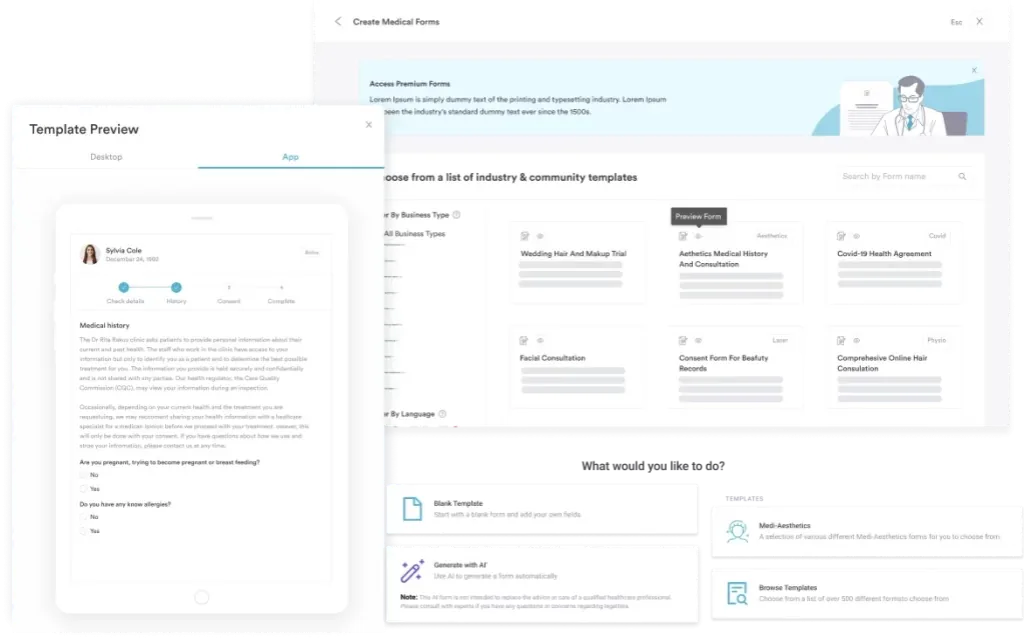
Insurers audit urology procedure claims. A note that says “cystoscopy performed, valves visualised” without documenting resection leads to a downgrade or denial. A structured digital operative-note form captures the required fields the same way for every urethral procedure.
The operative note must contain all of the following:
Major UK PMI insurers generally require pre-authorisation for inpatient and day-case surgery, so check each insurer’s rules for M7280. Submit the authorisation request before the procedure date. Our guide to Bupa CCSD procedure codes explains how Bupa’s recognised code schedule works.
Insurer policies on pre-authorisation requirements change. Always verify directly with the insurer’s provider portal before submitting a claim.
The CCSD schedule defines each code and its narrative, but it does not set a fee. Each insurer sets its own benefit for M7280, and the surgeon’s recognition agreement with that insurer decides the rate paid. The Vitality Health fee finder allows recognised providers to look up current agreed rates by CCSD code.
Contracted rates change, so confirm the current rate on the insurer’s provider portal or in your recognition agreement.
Denials for CCSD Code M7280 follow the same themes as other surgical urology codes. Incomplete operative notes, missing pre-authorisation and ICD-10 mismatches come up most often. A pre-submission check for the authorisation number and the resection wording catches these before the claim reaches the insurer.
Yes, M7280 can be billed with other CCSD codes when distinct procedures are performed in the same session. The operative note must document each one separately, and no CCSD unacceptable-combination rule may block the pairing. The key test is whether each additional procedure required distinct effort and would have been a separately planned procedure in its own right.
The workflow for each M7280 episode runs in six steps:
Before submitting an M7280 claim, run a three-point check. Confirm the operative note explicitly mentions resection, not inspection only. Confirm the pre-authorisation reference number is recorded. Confirm the ICD-10 code is Q64.2 or an appropriate acquired-obstruction code.

Pabau keeps the CCSD code, operative note and authorisation number on one patient record. Claims go to Healthcode without re-keying, so fewer come back for missing details.

For M7280, the operative note carries the claim. A note that records resection, technique and valve position holds up at audit. A note that records only a passed scope supports M7700, not M7280.
Make the authorisation number and the resection wording required fields before any urethral claim leaves the practice. That one change protects the claim at the two points where insurers question M7280.
Book a demo to see how Pabau keeps CCSD codes, operative notes and authorisation numbers together for urology claims sent to Healthcode.

Need a guide to Bupa’s CCSD procedure codes? Bupa CCSD codes covers the full schedule of Bupa-recognised procedure codes and how to submit claims correctly.
Looking up another CCSD code? CCSD codes lists the procedure codes UK private insurers recognise, chapter by chapter.
Coding another urethral procedure? CCSD code M5580 covers excision of a urethral caruncle and how to bill it.
Want to streamline private practice billing? Claims management software shows how Pabau handles CCSD coding, pre-auth tracking, and Healthcode submission in one workflow.
CCSD Code M7280 covers urethral valve resection, the cystoscopic removal of obstructive valve tissue from the urethra. It includes the cystoscopic approach, intraoperative inspection, and the resection or ablation of valve tissue in the same session. It does not include the anaesthetic fee, the hospital facility fee, or a separate concomitant procedure such as a bladder biopsy.
Q64.2 (congenital posterior urethral valves) is the primary ICD-10 code used alongside M7280 for paediatric cases. Adult patients with acquired obstruction are typically coded with N35.0 (post-traumatic urethral stricture) or N35.9 (urethral stricture, unspecified). Always verify the correct code against the current NHS ICD-10 tabular list and the specific insurer’s requirements.
No. The anaesthetic fee is billed separately by the anaesthetist under the applicable CCSD anaesthetic code. M7280 covers the surgical work only. The hospital facility and nursing care fees are also billed separately by the treating hospital.
There is no single published rate for M7280: the fee is determined by each insurer’s contracted schedule with the individual surgeon. Recognised providers can look up current agreed rates via insurer provider portals such as the Bupa code search tool or the Vitality Health fee finder. Self-pay rates are set by the surgeon independently.